
The glossy pitch about telemedicine start‑ups is incomplete. What physicians are actually walking into is a tech company that happens to touch patients, not a clinical practice that happens to use tech.
If you do not understand that distinction before you sign, you are the product. Not the professional.
Let me walk you through what really happens inside these companies—the things recruiters and “clinical directors” do not spell out when they tell you it’s “flexible,” “innovative,” and “future of medicine.”
1. You’re Not Joining a Practice. You’re Joining a Product.
The first lie by omission: they talk like a group practice, but they run like a software start‑up.
A telemedicine start‑up has three real priorities, in this order:
- Growth metrics (visits, users, retention, acquisition cost).
- Regulatory survival.
- Actual medical care.
You’ll hear the reverse. But watch where decisions land.
Product and growth teams sit at the center. Physicians are a cost line and a regulatory shield. At multiple companies (think the big DTC names in hair loss, weight loss, and ED you see on Instagram), the internal conversation is literally: “What’s the minimum clinical friction we can have and still be compliant?”
They won’t say it in orientation. You’ll feel it three weeks in.
You’ll see:
- Changes to visit length or async review volume dictated by a product manager who has never seen a septic patient but is very confident about “conversion funnels.”
- New “required templates” that just happen to shave 2 minutes off each chart so they can promise investors a 20% throughput bump.
- Pressure to default‑approve certain medications or plans because “our conversion on that flow is much better.”
You’re told you’re “helping design the future of care.” In reality, you’re a constraint they’re constantly trying to optimize around.

| Step | Description |
|---|---|
| Step 1 | Investor Pressure |
| Step 2 | Executive Team |
| Step 3 | Product and Growth |
| Step 4 | Platform Changes |
| Step 5 | Clinical Workflows |
| Step 6 | Physician Experience |
| Step 7 | Patient Care |
Notice where patients actually show up in that chain. Last.
Does that mean all telemedicine start‑ups are evil? No. But it means if you walk in expecting it to feel like a group practice with Zoom, you’ll be blindsided.
2. “Flexible” Usually Means “You Own the Risk and the Chaos”
The marketing line is irresistible: “Work from home! Set your own hours! See patients on your terms!”
Here’s the fine print nobody explains clearly:
You’re typically 1099, not W‑2
Translation: you’re not an employee, you’re a vendor. That means:
- No malpractice coverage sometimes, or the cheapest possible occurrence policies if they do offer it.
- No health insurance, PTO, or retirement match.
- You pay your own self‑employment tax.
- You can be dropped with essentially no notice if metrics dip or the business model pivots.
I’ve watched physicians build 20–25 hr/week telemed income streams, get used to the money, then lose 70% of their volume after one executive meeting decided to switch states or change clinical offerings.
No severance. No warning. Just “we’re pausing operations in your state” or “we’ve decided to partner with a different medical group.”
“Choose your hours” has an asterisk
The true rule is: you can choose any hours you like…as long as they align with:
- Peak patient demand,
- State coverage requirements,
- Whatever the ops team promised the board last quarter.
You’ll see “minimum 15 hours/week recommended” magically become “we expect 20–25 hours” during busy seasons. You’ll get Slack messages about “uncovered shifts” and “patient backlogs” that sound very optional until you see your visit assignments and bonuses quietly throttled if you do not play.
And if it’s async care (forms, messaging, e‑visits), you’ll find demand spikes at weird times: Sunday evenings, late nights, post‑holiday surges. Flexibility often means you absorb the unpredictability so the company can promise “instant access” to patients.
You carry the medicolegal risk anyway
The legal structure is always some version of: tech company + separate physician group.
The company tells investors: “We’re just the platform; clinical decisions are independent.”
The physician group tells you: “Protocols are standardized; you’re just following guidelines.”
In a courtroom, you stand alone.
I’ve sat in risk review calls where leadership literally said, “We want to empower physicians to use their discretion” right after telling the product team, “Our default buttons need to push toward prescription, not deferral.”
You’re given “clinical autonomy” as a legal shield for them, not as a gift to you.
3. The Metrics Watching You (That You’re Never Really Told About)
Traditional practice measures productivity. Telemedicine measures everything.
Your entire workday is instrumented: click counts, time on page, prescribing rate, follow‑up ticket rate, average message response time.
Here are the real dials being turned behind the scenes:
| Metric | What They Call It |
|---|---|
| Time per encounter | Efficiency |
| Script rate per visit | Conversion |
| Return visit percentage | Retention |
| Denial/deferral rate | Friction |
| Patient chat response lag | Engagement |
You’ll get a glossy “provider dashboard” with a handful of numbers. What you usually don’t see is how those numbers tie to performance tiers, priority for shift allocation, or who gets quietly off‑boarded.
I’ve heard this sentence almost word for word at a growth meeting:
“Dr. X spends 9 minutes on async cases; Dr. Y spends 3. Dr. Y’s CSAT is the same and conversion is higher. Why are we giving Dr. X any new patients?”
No one asks whether Dr. X is the only one actually reading the med list properly.
Once you’re inside, watch for:
- Sudden “coaching” emails about documenting more succinctly or “aligning with standard workflow.”
- Benchmark PDFs showing your “peer average time per case” suspiciously lower than what a real, careful review would take.
- Nudges to use more macros, more auto‑responses, more pre‑checked options.
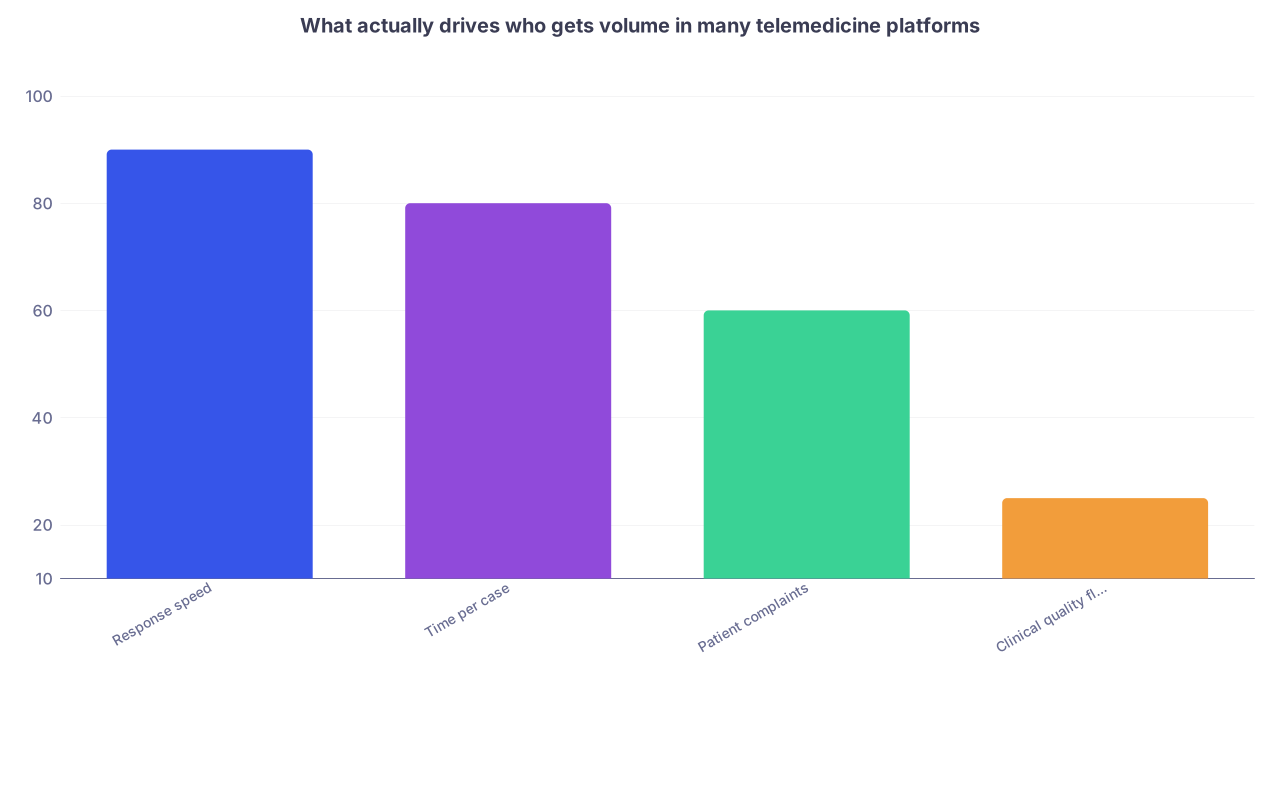
| Category | Value |
|---|---|
| Response speed | 90 |
| Time per case | 80 |
| Patient complaints | 60 |
| Clinical quality flags | 25 |
The quiet part: “clinical quality flags” are often the least weighted until something blows up publicly.
4. Protocols Are Written for Scale, Not for Edge Cases
In residency, you’re trained for nuance. At a start‑up, nuance breaks A/B tests and throughput.
Most telemedicine platforms run on protocolized flows:
- Symptom‑driven questionnaires
- Inclusion/exclusion criteria
- “Safe” default treatment pathways
The business model depends on 80–90% of cases fitting into a clean flow that a midlevel or even non‑clinical staff could shepherd with minimal physician touch.
So protocols get designed for volume and legal defensibility, not clinical elegance.
You’ll see:
- Overly conservative rules that force you to “refer to PCP” or “ED” for things you know you could safely handle with a 5‑minute phone call and follow up.
- Or the opposite: flows that push you to treat borderline cases via telehealth because requiring in‑person confirmation would tank “completion rate.”
And here’s the rub: if you go off‑script to do what’s actually right for the patient, you’ll often break the system.
Maybe:
- There’s no field in the template to actually document what you’re doing.
- The pharmacy integration doesn’t support the specific regimen you know is better.
- Customer support starts complaining because your “exceptional handling” of a case doesn’t align with the scripts they’re trained on.
I’ve seen physicians get flagged for “workflow deviation” when the deviation was literally saving a patient from a dangerous medication combo the form never caught.
The lesson from leadership was not “let’s improve our safety net.”
It was “let’s retrain physicians to stick to the flow so the data is clean.”
5. The Money: What You’re Really Getting Paid For
Telemedicine pay structures look attractive because they’re framed against your worst days in clinic.
“$120 an hour just to sit at home and click through cases? No nights on call? Where do I sign?”
Look at what you’re actually being compensated for:
- Per‑consult flat fees (e.g., $15–$40 per async case; $40–$80 per video visit).
- Hourly guarantees…that vanish quietly once volume is “stable.”
- RVU‑like hybrids—more complex but same underlying pressure: speed, volume, compliance with platform norms.
The manipulation is subtle: they benchmark your income against your current effective hourly rate in a broken system. You feel like a winner at first.
Then:
- Volume gets throttled if demand drops or new markets don’t launch on time.
- They add uncompensated “clerical” work: extra messaging, follow‑ups, “quick clarifications” with support.
- They sneak in expectations for Zoom meetings, QA reviews, mandatory “trainings” for new features—often unpaid.
Suddenly your “$120/hr” is more like $60–$70 when you account for unpaid overhead and downtime. And that’s before you pay your own benefits and taxes.
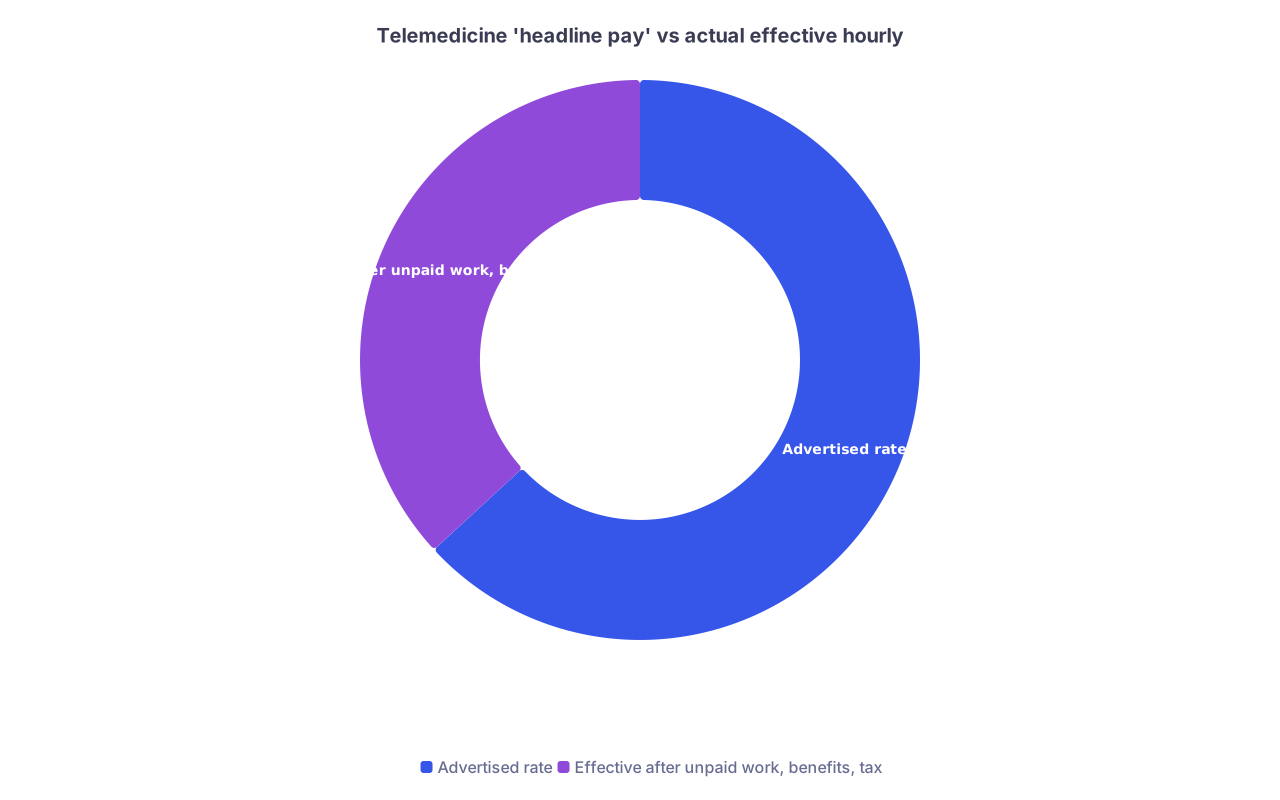
| Category | Value |
|---|---|
| Advertised rate | 120 |
| Effective after unpaid work, benefits, tax | 70 |
The seasoned physicians who survive in this space do one of three things:
- Use telemed as supplemental income, not core.
- Negotiate brutally—contract, rates, minimums, and guaranteed hours.
- Move up the ladder into clinical leadership or non‑clinical roles where they’re closer to the money and decision‑making.
If you’re coming out of residency thinking this will be your stable full‑time anchor, understand you’re tying your financial life to a company whose entire culture is “fail fast, pivot faster.”
They are not married to the current service line. You are.
6. Culture Shock: You’re a Clinician in a Tech Bro Aquarium
The cultural whiplash is real.
In hospitals, hierarchy and training matter. In start‑ups, the pecking order is based on who controls the roadmap and the capital.
That’s usually:
- Product managers
- Founders
- Growth/marketing
- Data science
Where do physicians sit? Somewhere between “needed for compliance” and “annoying blockers.”
You will sit in meetings where:
- Someone with a BA in economics explains how your “risk‑averse mindset is slowing innovation.”
- A 27‑year‑old PM insists that a new clinical shortcut is fine because “we tested this copy and the drop‑off is minimal.”
- Leadership calls patients “users” so often you stop hearing “patients” at all.
There are good people inside these companies, to be clear. Smart, mission‑driven, trying to do the right thing. But the gravity is always toward growth.
And clinical voices only really carry weight if:
- You’re one of the earliest physicians and personally close with the founders.
- You own a meaningful chunk of equity.
- You control something they cannot easily replace (e.g., you’re the only boarded sub‑specialist in a regulatory‑sensitive domain).
If you’re just one more license in one more state, you’re replaceable. And they know it.

7. Clinical Reality: You’ll See Extremes, Not Continuity
Another thing most physicians don’t appreciate until they’re in it: telemedicine start‑ups don’t give you a panel. They give you fragments.
You’ll repeatedly see:
- Hyper‑motivated, health‑literate patients who picked your platform after doing hours of research.
- Or the complete opposite—people who clicked an Instagram ad at 1 a.m. and just want “the pill I saw on TikTok.”
You rarely get:
- Longitudinal follow‑up you control.
- Full chart access beyond whatever they scraped from a “link your records” integration.
- Clear ownership. You’re always stepping into a slice of someone’s care, then handing them back to the void.
For some physicians, this is liberating. You handle discreet problems, communicate clearly, document defensively, and move on.
For others, it’s deeply unsatisfying. You’ll feel like you’re:
- Handing out band‑aids.
- Cleaning the mess other doctors or the system created with no way to fix the root issue.
- Constantly saying, “You really need an in‑person evaluation” to people who clearly won’t get one.
And if the company’s model is direct‑to‑consumer meds (weight loss, mental health, hormone therapy, etc.), expect a constant low‑level battle over boundaries:
- Pressure (explicit or implied) to say yes more than no.
- Patients primed by marketing to expect a specific prescription as the product, with you as a speed bump.
I’ve seen physicians downranked in internal notes because of “high deferral rate vs cohort” when those deferrals were absolutely appropriate.
Someone in growth doesn’t see that nuance. They see: “Dr. Y = lower revenue per user.”
8. What a Savvy Physician Does Before Signing On
Telemedicine can absolutely be part of a smart, sustainable career. But you have to approach it like you’re evaluating a venture, not just picking up shifts.
Here’s how the physicians who don’t get burned handle it.
They interrogate the model:
Ask explicitly:
- “What percentage of your revenue comes from prescriptions vs visits vs subscriptions?”
- “What happens to physician volume if a particular product line gets hit with new regulation?”
- “How many full‑time clinical staff have been here >2 years?”
If they dodge those questions or give fluff answers, that’s your sign.
They study the contract like it’s a hostile M&A document:
Watch for:
- Termination clauses: can they drop you with 30 days’ notice? 7 days? Same‑day?
- Uncompensated obligations: mandatory trainings, meetings, QA reviews.
- Non‑compete language: especially in telehealth niches (weight loss, online primary care, mental health). I’ve seen ridiculous multi‑state, multi‑year non‑competes quietly tucked into “independent contractor” agreements.
They clarify malpractice and liability in writing:
- Who is the named insured?
- Are you personally named?
- Does coverage extend to board complaints?
- What if the company changes insurers? Are you notified?
They ask about metrics and dashboards:
- “What provider metrics do you track?”
- “Which ones influence shift allocation or continued engagement?”
- “Can I see my data regularly?”
If they flinch at that, they’re not planning to treat you like a partner.
They treat this as one leg of a diversified income stool:
The clinicians who sleep at night:
- Cap telemed at a certain percentage of income (say 20–40%).
- Keep at least one in‑person anchor (hospital, group, locums) while the start‑up proves it can survive more than one funding cycle.
- Stay mentally ready for the plug to be pulled with 30 days’ notice. Because it happens. Often.

9. When Telemedicine Is Actually a Good Move
There are legitimate scenarios where joining a telemedicine start‑up is smart.
You might be:
- Building geographic freedom (moving frequently, dual‑career couple, kids at home).
- Transitioning out of a toxic in‑person environment and need a softer landing.
- Chasing non‑clinical opportunities (medical director, informatics, product) and want to learn the tech game from the inside.
If that’s you, look for:
- Companies with actual clinical leadership that still practices, not just MD window dressing.
- At least one or two funding rounds already completed and a path to profitability that doesn’t rely on magical thinking.
- Reasonable visit expectations: enough time per encounter that you could defend every chart in court with a straight face.
And be honest with yourself:
- If you’re easily rattled by gray areas and legal exposure, this world will grind you down.
- If you’re energized by building, iterating, arguing with product teams, you can carve out a powerful niche here—and even shape the clinical culture from the inside.

FAQ (Exactly 4 Questions)
1. Is it realistic to make full‑time income from a telemedicine start‑up right after residency?
It’s possible, but unstable. The physicians who do it either work for the larger, more established platforms with predictable volume, or they stack multiple telemed gigs at once. Even then, volume swings, regulatory changes, and product pivots can gut your hours with almost no notice. As a new attending with loans and no savings buffer, tying 100% of your income to a single start‑up is high‑risk bordering on reckless.
2. Are telemedicine start‑ups good for building a CV or just a dead end?
They can help you pivot. If you’re interested in informatics, digital health, medical leadership in tech, or even pharma/consulting, time at a serious telehealth company can be a strong signal. But random 1099 “urgent care by app” work with no leadership or project responsibilities does not move your CV much. If you want career leverage, push for roles that involve protocol development, QA, or cross‑functional projects.
3. How worried should I be about malpractice risk in telemedicine compared to in‑person care?
The risk is different, not inherently lower. Documentation is your only shield because you often have limited exam and incomplete records. Most claims so far cluster around misdiagnosis, delayed diagnosis, or failure to refer appropriately. The real danger is being pushed into unsafe speed and high volumes. If the expected visit time does not allow you to document and think at a defensible level, that’s the malpractice risk you should fear more than any specific telehealth modality.
4. If I want to try telemedicine without getting trapped, what’s the safest way to start?
Start part‑time with a clear cap on hours and income dependence. Keep your in‑person role and treat telemed as a side stream while you learn the culture, workload, and actual pay. Insist on seeing the contract before doing any onboarding work, clarify malpractice coverage in writing, and avoid broad non‑competes. Set a calendar reminder six months in: reassess pay, stress, and how often you feel pressured to cut corners. If those metrics look bad, you exit cleanly and chalk it up as paid education, not a career failure.
If you remember nothing else:
- You are joining a product company, not a practice—so think like a contractor, not a partner.
- The metrics you never see are the ones that decide your future there.
- Use telemedicine to expand your options, not to hand your entire career to a start‑up with a 5‑year plan and a 2‑year runway.