
The most financially dangerous thing many telemedicine physicians sign is not their loan document. It’s their first telemedicine contract.
Let me be blunt: telemedicine employers bank on you not reading the fine print. Or reading it but not understanding how it plays out in real life. I’ve sat with physicians in their 30s and 40s who are locked into terrible pay structures, suffocating non‑competes, and unpredictable schedules because of clauses they thought were “standard.”
They were not standard. They were traps.
You’re post‑residency, maybe burned out from in‑person medicine, and telemedicine looks like freedom: remote work, flexible hours, less bureaucracy. That freedom disappears fast when you sign the wrong contract.
Let’s walk through 7 contract clauses in telemedicine jobs that physicians regret signing—over and over again—and how you avoid joining them.
1. “Flexible” Schedule Clauses That Are Anything But
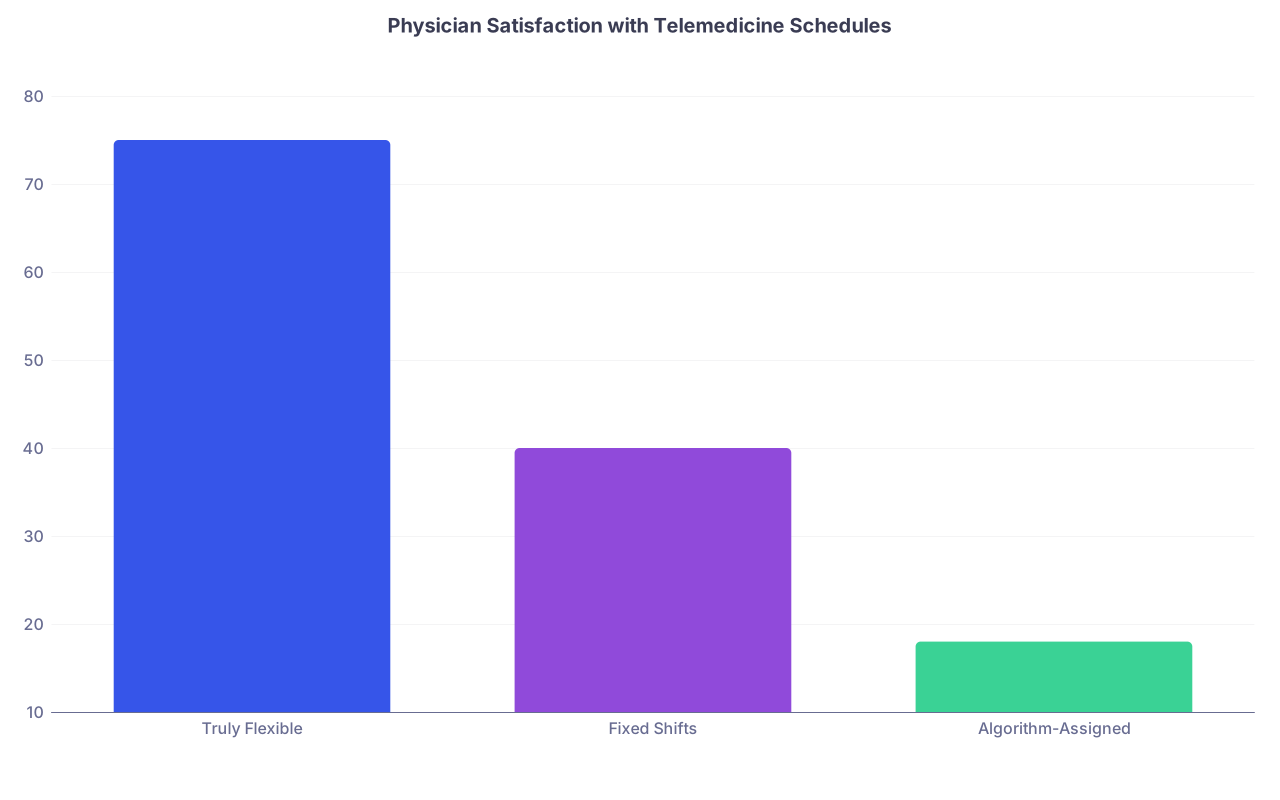
| Category | Value |
|---|---|
| Truly Flexible | 75 |
| Fixed Shifts | 40 |
| Algorithm-Assigned | 18 |
The biggest lie in telemedicine contracts? The word “flexible.”
Physicians hear “work from anywhere, whenever you want.” The contract quietly says something else:
- “Physician agrees to be available for up to X hours per week at times determined by Company.”
- “Company may modify schedules at its sole discretion based on business needs.”
- “Physician shall work a minimum of X hours per month including evenings, weekends, and holidays.”
I’ve seen people “agree” to:
- Rotating 10‑hour weekend shifts.
- Mandatory holiday coverage “as assigned.”
- Being on the hook for short‑notice coverage changes with no additional pay.
Red flags in the schedule language:
- “At Company’s discretion”
- “As reasonably requested by Company”
- No defined maximum weekly hours
- Vague “availability window” instead of actual shift times
You do not want:
- To find out in November that your contract lets them assign you Christmas Eve and New Year’s because “coverage needs.”
- Your “0.5 FTE telemed side gig” quietly morphing into 30–35 hours/week because they can assign more and you “agreed to meet patient demand.”
What to insist on instead:
Hard numbers, not vibes
- Minimum AND maximum hours per week/month.
- Clear definition of “FTE” (you’d be shocked how often this is missing).
Defined scheduling process
- How far in advance are schedules posted? (You want 2–4 weeks, not “as needed.”)
- How are shifts requested and approved?
- Are specific days/times guaranteed or just “preferred”?
Limits on last‑minute changes
- No unilateral schedule changes within X days unless mutually agreed.
- Premium pay (1.5x or similar) for last‑minute add‑on shifts if they’re allowed.
If the recruiter says, “Oh, we’re always very reasonable about schedules,” you say, “Great, then let’s make that reasonableness contract language.” Otherwise, assume you’ll get the worst version of whatever is written.
2. Productivity‑Only Pay with Algorithm Control

If you want one clause that quietly destroys income expectations, it’s this: pure productivity pay + total algorithmic control over your volume.
Where this goes wrong:
- Pay is per‑visit (e.g., $20–$35 per video visit, $10–$15 per async e‑visit).
- The company controls patient assignment by an opaque algorithm.
- Your “expected hourly rate” in the recruiting call assumes a visit every 5–8 minutes.
- Reality: your queue is empty for chunks of your shift, or you get flooded with complex, time‑consuming patients at the same rate as simple ones.
Danger phrases:
- “Compensation will be based on completed encounters only.”
- “No guarantee of patient volume.”
- “Company retains the right to modify visit assignment processes at its discretion.”
- “Rates may be adjusted to reflect market conditions.”
You know what this turns into?
- Newer physicians or “favored” states get more volume.
- Your hourly equivalent drops below urgent care pay.
- They quietly drop per‑visit pay by $3–$5 a year later and you have no recourse.
| Model | Predictability | Common Regret Risk |
|---|---|---|
| Pure per-visit | Low | Very High |
| Hourly + small bonus | High | Low |
| Base + RVU-style bonus | Medium | Medium |
| Flat per-shift stipend | High | Medium |
How to protect yourself:
Push for a base rate
Even a modest guaranteed hourly (e.g., $60–$80/hr) plus per‑visit bonuses is better than pure commission.Cap downward changes
“Per‑visit rate shall not be reduced by more than X% in any 12‑month period without mutual agreement.”Ask blunt questions in writing
- Average visits per hour per doc in your specialty over last 6 months?
- Distribution: what % of docs hit the “projected” rate?
- Any rate drops in the last 24 months?
If their “projected annual income” isn’t backed by historical data in writing, treat it as marketing, not reality.
3. Non‑Compete Clauses That Silently Kill Your Options

Telemedicine companies love aggressive non‑competes because your work is license‑based, not location‑based. I’ve seen clauses like:
- “Physician shall not provide telemedicine services for any competing entity within the United States for 12 months following termination.”
- “Non‑compete territory: any state in which Physician held a license while employed by Company.”
That’s not just “don’t steal our patients.” That’s “don’t work in your own field, even from your own living room.”
Common non‑compete mistakes:
Nationwide or multi‑state bans
You thought “it’s remote, so geography doesn’t matter.” The contract writers thought the same thing—and used it to lock down your entire telemed future.
Overbroad definitions of “competitor”
- Any entity delivering “virtual care” or “digital health services.”
- Includes totally different care models (e.g., asynchronous med‑management, behavioral health platforms, niche specialties).
Long duration (12–24 months)
Two years is absurd for most telemedicine roles, yet I see it regularly. People sign it because “everyone does.” They don’t. Smart physicians walk away.
What a reasonable telemed non‑compete looks like (if you can’t get it removed):
Narrow scope
Only platforms substantially similar in service line. E.g., if you’re doing direct‑to‑consumer urgent care, the non‑compete shouldn’t block you from working for a B2B chronic care management company.Limited geography
Restricted to:- A small number of core states where the company actually markets heavily; or
- A defined panel or specific employer contracts (for B2B telemed).
Short duration
6–12 months max. And 6 is far more defensible than 12.
And no, “Well, non‑competes aren’t enforceable in my state” is not a safe plan. Telemedicine employers draft these to apply to their home jurisdiction, not yours. You don’t want to be the test case fighting a corporate legal team from your laptop.
If they refuse to narrow an absurdly broad non‑compete? That’s your sign. They’re telling you what kind of partner they are.
4. Malpractice & Indemnification: The Hidden Time Bomb
The fastest way to ruin a telemedicine job is to misunderstand who owns the malpractice risk.
Here’s the lazy assumption: “They said they provide malpractice. So I’m covered.”
Often true. Often not enough.
Watch for these traps:
Claims‑made coverage with no tail
- Contract: “Company will provide claims‑made malpractice coverage.”
- Missing: “Company will provide tail coverage upon termination.”
Result: you leave, get sued 18 months later, and discover you’re personally buying a tail policy for multiple states. I’ve watched that tail quote hit $20k+.
High deductibles or self‑insured retention you never saw
Buried in a policy summary: “Physician responsible for first $X of any claim or settlement.” No thanks.One‑sided indemnification
You see language like:- “Physician agrees to indemnify, defend, and hold harmless Company from any claims arising out of Physician’s services.”
Missing: parallel obligation for Company if their tech, workflows, or policies cause the problem.
- “Physician agrees to indemnify, defend, and hold harmless Company from any claims arising out of Physician’s services.”
This matters in telemedicine because:
- You’re relying on their platform, records, connectivity, triage flows.
- You may be working under insane visit times or productivity pressure.
- Documentation tools may be stripped‑down or glitchy.
Non‑negotiables to protect yourself:
Malpractice with tail explicitly covered
- “Company shall provide claims‑made coverage with limits not less than X/Y and shall purchase tail coverage upon termination for any reason.”
Mutual, balanced indemnification
- You indemnify them for your gross negligence or intentional misconduct.
- They indemnify you for issues arising from platform failures, data loss, bad corporate protocols, or their own staff.
Right to review the malpractice policy summary
Ask for:- Limits
- Deductibles
- Retroactive date
- Any physician financial responsibility
If they say, “Don’t worry, everyone is covered,” and refuse specifics? Worry.
5. Quality Metrics and Performance “Standards” That Move the Goalposts
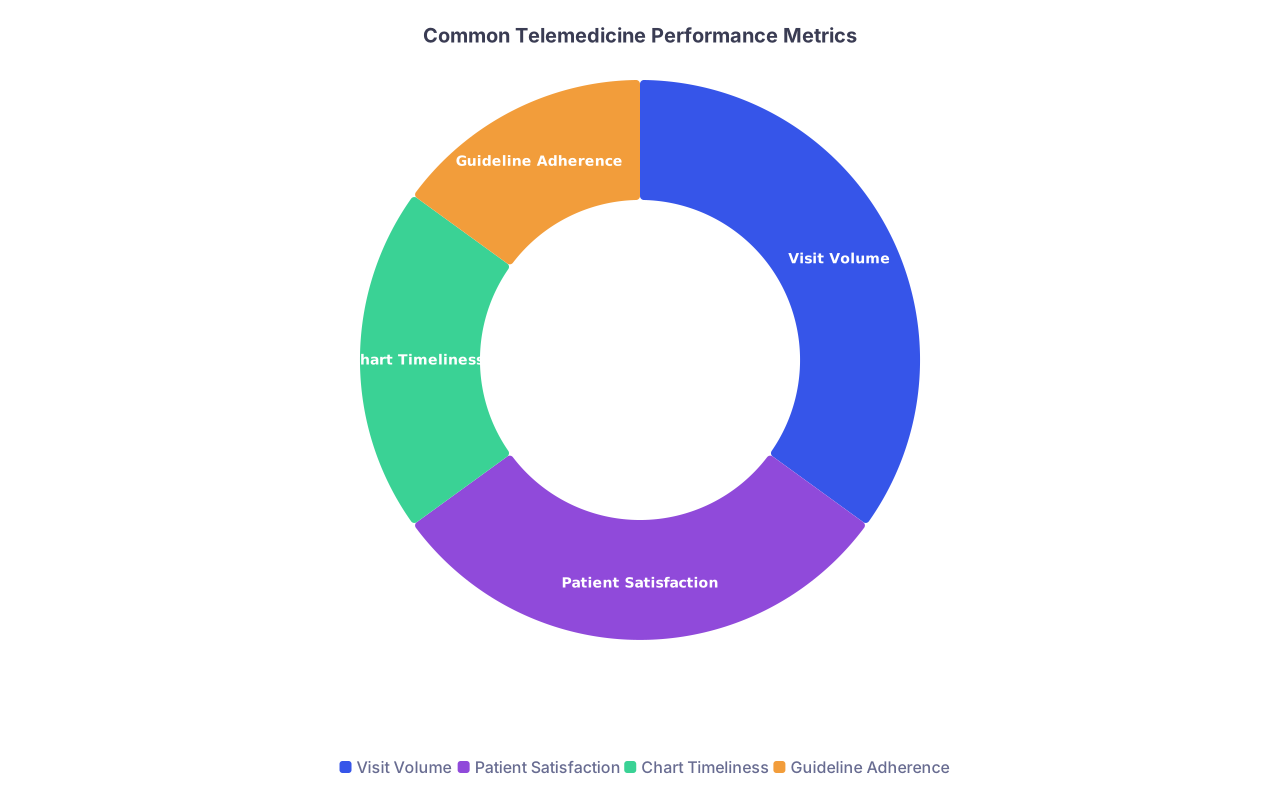
| Category | Value |
|---|---|
| Visit Volume | 35 |
| Patient Satisfaction | 30 |
| Chart Timeliness | 20 |
| Guideline Adherence | 15 |
Most telemedicine docs don’t understand how deeply quality metrics can be weaponized until they’re already on a performance plan.
Here’s the pattern I’ve seen:
- Contract: “Physician shall meet quality and productivity standards as established by Company.”
- No appendix. No definitions. Just a blank check for them to set expectations later.
- After you’re onboarded, suddenly:
- You must see X visits/hour,
- Maintain a patient NPS above Y,
- Close charts within Z minutes,
- Hit prescription/conversion targets that make you uncomfortable.
These become the excuse to:
- Cut your shifts.
- Drop your per‑visit rate.
- Terminate you “for cause,” voiding any severance, tail coverage promises, or bonuses.
Watch for:
Vague phrases: “industry standards,” “reasonable expectations,” “comparable providers.”
Performance tied to “patient satisfaction” without guardrails. Telemedicine patients skew demanding:
- Want antibiotics for viral infections.
- Get angry if you appropriately refuse controlled substances.
- Blame you for platform or wait‑time issues.
Hidden sales/retention metrics in DTC models:
- Pressure to order more tests, prescribe more meds, or schedule more follow‑ups to hit revenue targets.
How to anchor this before you sign:
Ask them to put specifics into an exhibit:
- Defined metrics and thresholds.
- How performance is measured (timeframe, sample size).
- How often metrics are reviewed and whether you get data access.
- Remediation process before termination:
- Notice of deficiency.
- Reasonable time to improve.
- Access to coaching/feedback.
If they tell you, “We don’t put those in contracts; they change too often,” your response is simple: “Then they shouldn’t be tied to termination for cause or pay reductions.”
6. IP, Data, and Moonlighting Clauses That Lock Up Your Future

Telemedicine attracts entrepreneurial physicians. Side projects. Startups. Consulting. Educational content. You can lose all of that with one lazy signature.
The dangerous language here usually shows up in three places:
Intellectual property (IP) assignment
- “Physician hereby assigns to Company all inventions, ideas, processes, and works of authorship conceived during the term of this Agreement that relate to Company’s business.” Translation: you build a small app, create protocols, or design educational content on your own time, and they own it if it “relates” to telemedicine in any way.
Overbroad confidentiality
- Reasonable: protecting their customer lists, pricing, internal processes.
- Not reasonable: blocking you from using your own clinical experience, learnings, or general telemedicine know‑how in future roles.
Moonlighting and outside activities
- “Physician shall not engage in any other clinical or consulting work without prior written consent of Company.” If this is your main full‑time job, maybe partially reasonable. For a 0.2–0.5 FTE telemed role? Overreach.
You’ll regret signing:
- Anything that claims ownership of “all ideas related to digital health” during employment.
- Blanket bans on “any telemedicine work elsewhere” without narrow definitions.
- Language that suggests your social media, blogs, or courses about telemedicine could be considered company property.
What to push for:
IP carve‑outs
- “Excluding any inventions developed entirely on Physician’s own time without use of Company resources that do not incorporate Company confidential information.”
Clarified scope
- IP assignment only for work specifically requested and paid for by the company (e.g., building their protocols).
Reasonable moonlighting rules
- Advance notice, not permission, for outside work that:
- Does not conflict with your schedule.
- Is not directly competitive as defined narrowly in a non‑compete.
- Meets a reasonable workload cap.
- Advance notice, not permission, for outside work that:
If they want to own your brain 24/7 for a part‑time rate, they’re not serious about being a sustainable partner.
7. Termination, “Cause,” and One‑Sided Exit Doors

| Step | Description |
|---|---|
| Step 1 | Start of Employment |
| Step 2 | Notice Period |
| Step 3 | Notice or Pay |
| Step 4 | Immediate End |
| Step 5 | No Severance |
| Step 6 | Potential Loss of Tail |
| Step 7 | Clean Exit |
| Step 8 | Termination? |
The last thing physicians scrutinize is often the thing that bites them hardest: how this ends.
Telemedicine jobs can sour quickly:
- Platform changes.
- Rate cuts.
- Leadership turnover.
- Increasing demands with stagnant pay.
You need a clean way out. You also need protection from being fired under sketchy “for cause” pretexts.
Patterns I see that cause real damage:
No‑cause termination that’s only one‑way
- Company can end it “for any reason or no reason” with 30 days’ notice.
- You’re stuck with 90 days’ notice and penalties for leaving earlier.
Bloated “for cause” definitions
Some contracts treat very minor issues as “for cause,” e.g.:
- Falling below certain metrics for 1–2 months.
- One unsubstantiated patient complaint.
- “Unprofessional conduct” defined however they want.
- Losing one state license (even if you still hold multiple others).
For‑cause termination clauses matter because they’re usually tied to:
- Losing tail coverage.
- Forfeiting bonuses.
- Being reported to NPDB or state boards.
No severance, even after long service
Especially in higher‑rank telemedicine roles or full‑time positions, complete lack of severance—paired with broad non‑competes—is a bad combination.
Safer structure:
Mutual no‑cause termination
- Either party may terminate without cause with X days’ written notice (60–90 is typical for full‑time; 30 okay for part‑time).
Narrow, specific “for cause” language
- Limit to:
- Loss of license or DEA (all relevant to job).
- Exclusion from Medicare/Medicaid.
- Conviction for serious crimes.
- Material breach of contract after written notice and chance to cure (except in truly egregious misconduct).
- Limit to:
Guaranteed malpractice tail regardless of exit type Do not tie tail coverage to “good behavior.” If you practice under their umbrella, they should own the long‑term risk, not you.
If the exit doors only open easily for the company, believe them: they plan to use them.
Quick Checklist Before You Sign Any Telemedicine Contract
Use this like a pre‑flight list. Don’t skip it.
| Area | Safe Enough? | Needs Review? |
|---|---|---|
| Schedule | ||
| Compensation | ||
| Non-compete | ||
| Malpractice | ||
| Metrics/Quality | ||
| IP/Moonlighting | ||
| Termination |
Ask yourself, for each of the 7 areas above:
- Is it written in clear, specific terms?
- Would I be okay with this clause if:
- Leadership changed?
- Volumes dropped?
- Pay structures shifted?
- I wanted to leave in 6 months?
If you wouldn’t advise a colleague to sign what you’re about to sign, don’t convince yourself it’s fine just because you like the recruiter.
FAQ (Read This Before You Pick Up a Pen)
1. Do I really need a lawyer for a telemedicine contract, or is that overkill?
You’ll waste more in bad terms than you’ll spend on a solid contract review. Is every $100/hr, side‑gig telemed contract worth a full legal overhaul? Maybe not. But for anything full‑time, multi‑state, or with non‑compete language, you should at least pay for a 1–2 hour review with a physician‑focused contract attorney. The big mistake is letting the “it’s just remote work” mindset trick you into treating this like a casual locums deal. It’s not.
2. The recruiter says all their contracts are “standard” and “non‑negotiable.” Should I just accept that?
No. “Standard” means “what benefits the company most that enough people have signed without pushing back.” Many telemedicine groups will tell you it’s non‑negotiable until you say, “Then I can’t sign this as written.” Suddenly, some things become negotiable. You won’t get every change you want, but you should not sign a contract where every single leverage point is on their side.
3. What’s a reasonable per‑visit rate for telemedicine?
It depends heavily on specialty, state licensing, and care type, but the mistake isn’t just the rate—it’s the lack of volume guarantees and reliance on fantasy projections. I’ve seen good urgent‑care style telemed jobs paying the equivalent of $130–$180/hr when volume is solid and scheduled. I’ve seen “$25/visit” gigs that drop below $70/hr when the queue is empty or patients are complex. Always ask for historical data, not theoretical maximums.
4. Is a non‑compete always a dealbreaker in telemedicine?
Not always. But broad, multi‑state, or nationwide non‑competes often should be. If the non‑compete prevents you from working for any other telemed company for 12 months in all the states where you’re licensed, that’s excessive. A narrowly tailored non‑solicitation (not poaching their clients) is often fine. A clause that keeps you from earning a living in your own specialty? That’s dangerous.
5. I already signed a bad telemedicine contract. Am I stuck?
Not necessarily, but do not assume you can just ignore it. Get the contract reviewed by a physician‑savvy attorney before you make any moves. Sometimes clauses are unenforceable as written, sometimes they can be negotiated on exit, and sometimes you need a careful strategy to avoid triggering non‑competes or for‑cause termination that nukes your malpractice tail. The mistake is pretending it will never matter—these things only matter when the relationship sours, and by then it’s too late to renegotiate.
Open your current (or draft) telemedicine contract right now and mark up every clause that touches those 7 areas. If you can’t explain each one in plain English—and live with the worst‑case version—you’re not ready to sign it.