
It is 9:45 p.m. You are home after a full clinic day, finishing your last telehealth follow-up of the evening. You click “End Visit,” jot a few lines in the note, and tell yourself you will “clean it up later.”
Three months pass. A patient you saw that night ends up in the ED with a bad outcome. Hospital risk management requests your telehealth note. You open the chart and feel your stomach drop.
The note is almost empty. No documentation of why you chose telehealth instead of in-person. No exam description. No clear safety net plan. It looks like you barely saw the patient at all.
That is how telehealth malpractice cases start. Not with a dramatic surgical error. With thin, lazy, copy‑pasted documentation that does not withstand scrutiny.
If you are practicing post‑residency and using telemedicine even part‑time—for urgent care platforms, follow‑ups, or hybrid clinic—this is your blind spot if you are not paying attention.
Let me walk you through the most common telehealth documentation mistakes I see—and how to avoid turning a simple virtual visit into a liability time bomb.
1. Failing to Document That It Was a Telehealth Visit (and the Basics Around It)
One of the most embarrassing chart failures in telemedicine: the record does not clearly show it was a virtual encounter at all.
You laugh. But I have reviewed charts that look like standard in-person clinic notes, with no mention of video vs audio, patient location, or consent. In a lawsuit, that looks sloppy at best and deceptive at worst.
Here is what gets people in trouble.
The common errors
Not explicitly labeling the encounter as telehealth
- No “video visit,” “telephone visit,” or “synchronous audio-video” anywhere.
- Templates that auto-populate “seen and examined in clinic” when they were not.
Missing modality and limitations
- No note of whether it was:
- Video visit
- Audio-only (phone)
- Platform failure that forced a switch to phone
- No acknowledgement of how that limits your exam or decision-making.
- No note of whether it was:
No documentation of patient location
- Plaintiff attorney gold. If the patient was physically in a different state and you were not licensed there, your defense collapses.
- Many clinicians assume the platform “tracks” this. That may be true technically—but if it is not in your note, it might as well not exist.
No explicit telehealth consent
- Some states and payers require verbal or written telehealth consent.
- Many EMRs have a one-click consent checkbox. People ignore it or let MAs handle it—then it never gets recorded.
Here is the right way to cover yourself—in 20 seconds.
At the top of every telehealth note, include a short structured line such as:
“Synchronous audio-video telehealth visit conducted via [platform]. Patient located in [state] at time of visit. Provider located in [state]. Verbal consent for telehealth obtained; risks, benefits, and limitations discussed.”
For audio-only, tighten the language:
“Audio-only (telephone) visit; no video available despite attempt. Limitations of exam and potential impact on diagnostic accuracy reviewed with patient.”
Do not rely solely on system metadata. If a regulator, payer, or opposing attorney has to dig four clicks deep into a settings log to prove what type of encounter this was, you already look careless.
2. Treating the Telehealth Exam Like a Box You Can Skip
The number one clinical documentation sin in telemedicine: no exam, or a fake one.
You have seen this: a “telehealth” note that says:
“CV: RRR, no murmurs. Lungs: CTAB. Abd: soft, NTND.”
Really? Through a laptop speaker? That is not just lazy. It is indefensible.
The dangerous patterns
Copy-forward physical exam from in-person templates
- Auto-populating normal heart, lung, and abdominal findings in a remote visit.
- Plaintiff experts shred this in deposition. It undermines everything else you say.
“Exam: limited by telehealth” and nothing else
- That line alone is not enough. You have to describe what you actually did observe or assess.
No patient-assisted or proxy exam maneuvers
- For many complaints, you can meaningfully approximate parts of the exam if you try.
- Most clinicians simply do not bother, and then cannot defend their decision not to bring the patient in.
What a defensible telehealth exam looks like
You will not have a full hands-on exam. But you must show that you reasonably tried to assess what you could.
Document three things clearly:
What you directly observed
- General appearance: distress, work of breathing, ability to speak in full sentences.
- Mental status: orientation, affect, insight.
- Skin: visible rashes, color, lesions (even if limited by camera quality).
What you guided the patient (or caregiver) to do
- “Patient palpated RLQ; reported moderate tenderness without rebound.”
- “Patient pressed over maxillary sinuses—no significant increase in pain.”
- “Parent counted child’s breaths for 30 seconds on screen; RR approx 32.”
What you could not reliably assess—and why that matters
- “Unable to auscultate lungs or heart sounds; discussed limitations and low threshold for in-person evaluation if symptoms worsen.”
- “Abdominal exam limited; cannot fully exclude appendicitis in this setting.”
Never document a normal finding you did not actually assess. If you are tempted, stop, delete it, and write what you could really see or do instead.
3. Sloppy Risk Assessment and Safety Netting (This Is Where Cases Are Lost)
In telehealth, you live and die on risk assessment and safety netting. The medium itself introduces diagnostic risk. Your documentation has to show that you took that seriously.
Most telehealth malpractice cases I have seen boil down to this pattern:
- High-risk or ambiguous symptoms
- Quick diagnosis (often viral vs “musculoskeletal” vs “anxiety”)
- Thin note
- No explicit red flag discussion
- No clear follow-up or ED return instructions
Then something catastrophic happens.
The most costly documentation errors in risk assessment
No clear “why not in-person?” reasoning
- If a reasonable clinician might have brought the patient in, you must show why you did not.
- Without that, the plaintiff’s expert simply says: “Standard of care was in-person evaluation.” You now look reckless.
Not documenting differential diagnosis at all
- Telehealth notes often jump straight from HPI to “Assessment: viral URI.”
- In a risky complaint—chest pain, SOB, abdominal pain, neuro deficits—you must show that you considered the dangerous stuff.
Missing explicit red flag counseling
- The patient will swear in court: “No one told me it could be serious.”
- Your only defense is a specific, written, time-stamped safety net plan.
How to document risk like someone who knows they can be sued
For any potentially serious complaint (and yes, this includes vague chest discomfort on video at 11 p.m.), build in three short elements:
Document your threshold for escalation
Example for chest pain:
“Telehealth only permits limited cardiac/respiratory assessment. Life-threatening ACS, PE, or aortic pathology cannot be fully excluded. Discussed this explicitly with patient. At present, pain is non-exertional, reproducible with palpation, no associated SOB, diaphoresis, syncope, or radiation. Low clinical suspicion at this time, but advised low threshold for ED evaluation.”
List at least 2–3 alternative diagnoses you considered
- “Differential includes: musculoskeletal chest wall pain (most likely), GERD, less likely ACS, PE. Red flag symptoms explained.”
Spell out emergency warning signs and exact next steps
- “Advised immediate ED evaluation or calling EMS for any: worsening chest pain, pain with exertion, SOB, syncope, new diaphoresis, or radiation to arm/jaw. Patient verbalized understanding and agreed to seek urgent care if symptoms change.”
- “If symptoms persist beyond 48–72 hours or worsen, patient will schedule in-person evaluation or urgent care for full exam and ECG.”
Do not just write “ER precautions given.” That phrase is malpractice bait. It is vague and nearly useless in court. Spell it out.
4. Copy-Paste, AI-Generated, and Template Bloat: Documentation That Looks Fake
Telehealth platforms and EMRs love templates. Many now offer AI-generated drafts. That convenience is a double-edged sword.
When something goes wrong, bloated, generic, or obviously recycled documentation looks dishonest. And dishonest-looking records are very hard to defend.
The big offenders
Massive generic telehealth boilerplate
- Half a page of stock legal language, three lines of actual clinical thinking.
- Juries and judges can smell when a note is mostly legal padding.
Copy-pasted H&P across multiple encounters
- Old problems and medications pulled forward without being updated.
- Prior telehealth assessments pasted into new visits with no changes.
AI-generated notes that do not match reality
- The platform’s “smart” summary mentions counseling you never provided.
- Or an exam section that overstates what you did on a 5-minute audio call.
Contradictions inside the same note
- HPI: “Severe abdominal pain 9/10, started 2 hours ago.”
- Plan: “Likely viral gastroenteritis, follow up PRN.”
- No explanation for why such severe acute pain was safe to manage at home via telehealth.
Here is the rule: anything that looks like it was created to bill or satisfy an auditor, not to care for a patient, hurts you in litigation.
How to use templates without them using you
- Keep templates short and obvious
- One simple telehealth preamble.
- A short exam block with prompts like “Observed:” and “Patient-assisted exam:”.
- Always edit AI/auto-generated content
- If your system drafts the note, read and prune.
- Delete anything you did not actually say or do.
- Kill contradictions
- Before signing, scan:
- Does the acuity in HPI match the plan?
- If not, either:
- Adjust the plan to reflect the risk, or
- Clarify why telehealth-only management is reasonable for now.
- Before signing, scan:
If your note looks like it could have been created for any random patient with the same chief complaint, it will not save you.
5. Ignoring Telehealth-Specific Legal and Regulatory Traps in Your Documentation
Telemedicine is not just “clinic, but on Zoom.” The regulatory mess is different, and parts of it must be documented to defend yourself.
I have seen smart physicians burned not by clinical error, but by documentation that failed to support licensing, prescribing, or standard-of-care issues in the telehealth context.
Common traps
Licensing and location
- Patient in State A, you licensed only in State B.
- No documentation of patient location, no system stopgap, and now a board complaint.
- Your defense attorney will beg for any proof you thought about this. Your note is silent.
Controlled substance prescribing
- Especially post-COVID waiver changes, the rules are constantly shifting.
- Documenting that criteria were met and that telehealth was appropriate for initiating or continuing certain medications protects you.
Failure to mention why telehealth was appropriate for this problem
- For some conditions, regulators or payers expect in-person evaluation first.
- If you deviate, you need a written rationale.
No documentation of tech failure or limitations
- Camera froze, audio cut out, poor lighting.
- You “made it work” but never documented that the exam was partially compromised.
What you should be documenting in high-risk situations
| Scenario | Critical Elements to Document |
|---|---|
| Cross-state encounter | Patient state, your license state(s), platform checks |
| New controlled substance Rx | Justification, prior records, PDMP checked, follow-up plan |
| Mental health crisis | Suicide risk assessment, safety planning, emergency resources |
| Tech limitations (poor video) | What was not assessable, attempts to fix, reasons visit continued |
| Deviation from usual standard | Why telehealth was still reasonable, plan for in-person if needed |
When you know you are on regulatory thin ice—new controlled substance, high-risk psych, complex pain, cross-border patient—slow down and give that section 3–5 extra sentences. That is your malpractice insurance.
6. Inadequate Documentation of Communication, Follow-Up, and Handoffs
Telehealth adds distance and ambiguity. Patients log off, misunderstand, and vanish. In a bad outcome, you will be judged on what you wrote, not what you think you said.
Sloppy communication documentation is another frequent failure point.
The errors that come back to haunt people
No documentation of patient understanding
- You rattled off a plan, but the note shows no confirmation that the patient actually got it.
Vague follow-up plans
- “Follow up PRN” in telehealth is often interpreted as “we do not really care what happens to you.”
No record of failed outreach or rescheduling attempts
- Patient misses scheduled follow-up video visit before deteriorating.
- No documentation from your side that you attempted to contact or reschedule.
Weak handoffs between telehealth and in-person care
- You recommend urgent in-person evaluation but:
- Do not send a message to the patient’s PCP.
- Do not document any attempt to coordinate care.
- Do not clearly mark the urgency.
- You recommend urgent in-person evaluation but:
What strong telehealth communication documentation looks like
- Document that the patient understood:
- “Patient verbalized understanding of plan and red flag symptoms; all questions answered.”
- Give specific, time-bound follow-up:
- “Patient instructed to schedule in-person visit with PCP within 3–5 days if symptoms persist; sooner (same day or ED) for any worsening as outlined.”
- Document handoffs:
- “Message sent to PCP summarizing today’s telehealth assessment and concern for possible early cellulitis; suggested in-person exam within 24–48 hours.”
- Document failures and patient choice:
- “Offered same-day in-person clinic or urgent care evaluation; patient declined, prefers home observation with clear return precautions.”
That last line is critical. If the patient refuses escalation, you are not helpless—but only if it is documented.
7. Overlooking Time, Context, and Workload—And How They Look in Court
Telehealth often happens at the edges of your day. Late evenings. Weekends. Squeezed between other obligations. Plaintiffs love that context.
I have seen plaintiff attorneys put this line on a slide:
“Provider completed 31 telehealth encounters that day. Average documented encounter time: 4 minutes.”
Then they show your flimsy note for the patient who had the bad outcome.
Your documentation has to counter the narrative that you were rushing, distracted, or treating telehealth as transactional “drive-thru medicine.”
How clinicians accidentally help the plaintiff
- Very short, bare-bones notes for complex complaints
- Telehealth does not justify minimal documentation.
- No vital context for time of day / weekend / on-call
- 2 a.m. video visit assessed exactly like a 2 p.m. clinic visit, with no acknowledgement of risk and limitations.
- No documentation of why you accepted the visit at all
- High acuity complaint + telehealth + no triage logic written down = you look reckless.
Two things that help you in hindsight
Document clinical reasoning depth, not just decisions
- One or two lines of actual thinking:
- “Patient appears nontoxic on video, reports stable symptoms x48h, no red flags, reliable for follow-up, has transportation to ED if needed.”
- That sentence alone often makes or breaks a case.
- One or two lines of actual thinking:
Document when telehealth was not appropriate and you said so
- “Advised patient that telehealth was not adequate for this problem and recommended immediate ED evaluation rather than continuing virtual assessment. Patient agreed and will go to ED now.”
- This proves you are not using telehealth indiscriminately.
Visualizing the Telehealth Risk Points Across a Visit

| Step | Description |
|---|---|
| Step 1 | Start Telehealth Visit |
| Step 2 | Confirm patient ID and location |
| Step 3 | Telehealth consent and limitations |
| Step 4 | Focused history |
| Step 5 | Telehealth-appropriate exam |
| Step 6 | Recommend in-person or ED |
| Step 7 | Telehealth management reasonable |
| Step 8 | Document escalation and handoff |
| Step 9 | Document risk assessment and differential |
| Step 10 | Explicit safety net and follow-up |
| Step 11 | Sign complete, accurate note |
| Step 12 | Red flags present |
Where most malpractice risk hides: between steps E and K. Right where documentation tends to get lazy.
A Quick Reality Check on Time: You Can Do This in Under 2 Minutes
You are probably thinking, “I do not have 10 extra minutes per telehealth note.” Fine. You do not need 10. You need 60–120 seconds of focused documentation that covers your vulnerability.
Think of it as a structured checklist you hit every time:
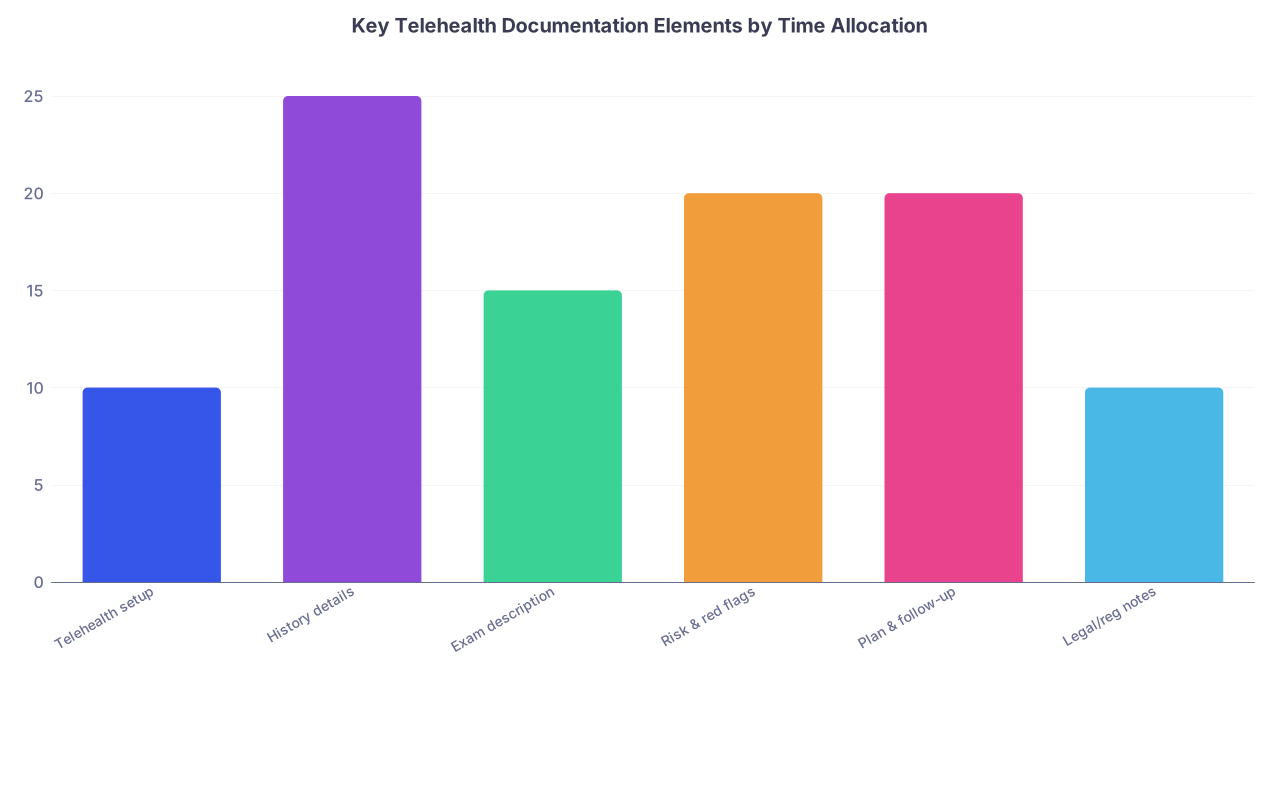
| Category | Value |
|---|---|
| Telehealth setup | 10 |
| History details | 25 |
| Exam description | 15 |
| Risk & red flags | 20 |
| Plan & follow-up | 20 |
| Legal/reg notes | 10 |
Focus your effort where judges and boards look first:
- Was it really a telehealth visit?
- Did the exam documentation make sense for that medium?
- Did you consider dangerous diagnoses?
- Did you explain red flags and follow-up in writing?
Miss those, and no fancy phrasing or AI-generated paragraphs will save you.
FAQs
1. Do I really need a different documentation style for video vs telephone visits?
Yes. Treating video and audio-only as interchangeable in your notes is a mistake. For video, you can reasonably document visual exam findings: work of breathing, visible rashes, mental status, gait (if you ask them to walk). For audio-only, you cannot. Your note should explicitly state it was a telephone visit, and clearly describe the limitations: no visual assessment, no observable respiratory effort, no skin exam. If a bad outcome occurs after an audio-only visit where you charted “appears comfortable, no increased work of breathing,” you will be torn apart on cross-examination. Make the difference obvious on paper.
2. How detailed should my differential diagnosis be in a telehealth note?
More detailed than you are probably writing now, especially for higher-risk complaints. You do not need a full board-exam style differential, but you should mention at least the serious conditions you considered and why you thought they were less likely at that time. For example: “Chest pain differential includes musculoskeletal chest wall pain (most likely), GERD, less likely ACS or PE based on absence of exertional component, SOB, syncope, risk factors.” That one sentence shows that you recognized the big threats and were not blindly anchoring on “musculoskeletal.”
3. Can templates and AI-drafted notes protect me from malpractice risk?
They can help with consistency, but they can also hurt you if you let them lie. Templates ensure you do not forget basics like consent or location. AI drafts can save time summarizing the HPI. But neither knows what you actually saw, thought, or decided in context. If you sign a note that claims you did an exam you did not perform or gave counseling you did not deliver, you have created false documentation. Courts and boards are very unforgiving of that. Use templates as prompts, not as autopilot. Edit aggressively, and delete anything inaccurate—even if it reduces your billing level.
4. What is the single most protective sentence I can add to a risky telehealth note?
When dealing with potentially serious symptoms managed via telehealth, one of the most protective sentences you can write is something like: “Discussed that telehealth limits the ability to perform a complete physical exam and fully exclude serious conditions; reviewed specific red flag symptoms requiring immediate ED evaluation, and patient verbalized understanding.” That line does three things at once: acknowledges limitations, shows risk counseling, and documents patient understanding. It will not make a negligent decision defensible, but it will often be the difference between “they never told me it could be serious” and a note that clearly proves you did.
Open your last five telehealth notes right now. Pick the riskiest complaint among them—chest pain, SOB, neuro symptoms, severe pain, mental health crisis. Ask yourself: if this case went badly and ended up in front of a jury, would my documentation show what I thought, what I could and could not do via telehealth, and what I told the patient about red flags and follow-up? If the answer is anything short of “absolutely,” rewrite that note template today.