
The biggest mistake physicians make in telemedicine is treating state licensure as an afterthought instead of a growth strategy.
If you want serious, flexible, well‑paid telemedicine work, you do not need “a license.” You need a license portfolio. Built intentionally. Sequenced. Aligned with where the jobs and reimbursement actually are.
Let’s build that.
1. Understand the Rules of the Game (Or You Will Waste Time and Money)
Before you start sending fingerprints and checks all over the country, you must understand one non‑negotiable principle:
You need a license in the state where the patient is located at the time of the encounter.
Not where you sit. Not where your employer is based. Where the patient is.
So if:
- You live in Texas
- Your telemedicine company is headquartered in New York
- Your patient is sitting in a hotel in Florida
You must hold a Florida license for that visit to be legal.
This single rule drives everything:
- Which states you should target
- Which licenses are high yield vs. vanity
- Why some jobs require a “minimum of 3–5 state licenses” even if you are remote
Now layer in three more realities:
States vary wildly in:
- Application complexity
- Cost (initial + renewal + hidden fees)
- Processing speed
- Drama (boards that nitpick vs. boards that just want clean paperwork)
The Interstate Medical Licensure Compact (IMLC) can massively speed things up if:
- Your “State of Principal License” (SPL) is a compact state
- You meet the criteria (we will cover that in a moment)
Telemedicine employers care about specific states, not just “lots of licenses.” They will often pay more or fast‑track contracts if you hold:
- Large population states
- High‑need states (low physician density, Medicaid heavy, rural)
- Regulation‑friendly states for telemedicine
Your job is not “get as many licenses as possible.”
Your job is “build a strategic set of licenses that unlocks the best work with the least friction.”
2. Start with a Clear Strategy: Which States and Why
You are post‑residency. You have limited bandwidth. So you need a ruthless filter.
Step 1: Lock In Your Home Base
You almost certainly already hold:
- Your primary state license (where you trained or where you live now)
This becomes either:
- Your workhorse license (if you only want local telemedicine), or
- Your State of Principal License candidate for the IMLC.
If your home state is not in the IMLC, that changes the playbook. We will handle that in the next section.
Step 2: Choose a Portfolio Size Target
Decide upfront: what is “enough” for your goals in the next 12–24 months?
Common benchmarks for telemedicine physicians:
- Entry level / side gig: 3–5 states
- Serious part‑time: 5–10 states
- Full‑time multi‑platform telemed: 10–20+ states
More is not always better. Every license adds:
- Renewal deadlines
- CME tracking (some states have quirks)
- Extra background questions next time you renew or apply anywhere
Do not build a 25‑state portfolio if you only plan to do 4 hours one evening a week.
Step 3: Prioritize High‑Yield States
You want a mix of:
- Population‑heavy states (lots of patients, lots of volume):
- California*, Texas, Florida, New York, Pennsylvania, Illinois, Ohio, Georgia, North Carolina, Michigan
- Telemed‑friendly states (reasonable rules, strong payer markets)
- States your current or target employer explicitly values
To keep this concrete, here is a simple priority framework:
| Tier | State Examples | Why They Matter |
|---|---|---|
| Tier 1 | TX, FL, NY, CA*, IL | Large populations, frequent employer requests |
| Tier 2 | GA, NC, OH, PA, MI | Good volume, often on “preferred” lists |
| Tier 3 | AZ, CO, VA, WA, MN | Telemed-friendly, solid demand |
*California is not in IMLC and is slower/annoying, but still very high yield for certain telemed niches.
Your exact list depends on:
- Your specialty (e.g., addiction, psychiatry, urgent care, dermatology)
- Whether you want daytime vs. nights/weekends
- Whether you want cash‑pay platforms vs. insurance‑based vs. health system‑owned telemed
Action now: List 10 states you think you want. Next to each, write why. If you cannot articulate a reason beyond “big state,” do not apply there yet.
3. Use (or Work Around) the IMLC Like a Pro
The Interstate Medical Licensure Compact is either your best friend or irrelevant. Depends where you are standing.
Step 1: Check Compact Eligibility Fast
You qualify for IMLC only if:
- You hold a full, unrestricted license in a compact member state, and
- You meet criteria about:
- Where you live, vote, or pay taxes
- Where you did most of your residency
- Board certification status
- Disciplinary / legal history (must be clean)
Go to the IMLC website and use their eligibility tool. Do not guess.
If you qualify, your home state becomes your State of Principal License (SPL).
If you do not qualify, skip down to the “Non‑Compact Playbook” section.
Step 2: Understand What the IMLC Actually Does
The IMLC does not give you a magic “national license.”
It does:
- Centralize verification (board cert, NPDB, background check)
- Generate “Letter of Qualification” (LOQ) from your SPL
- Allow you to request additional state licenses from participating states quickly
You still get separate, full state licenses. You just avoid repeating the same paperwork 20 times.
Step 3: Time and Cost Expectations
The IMLC itself charges a fee to process your LOQ, and each state you add charges its own license fee.
Realistic scenario for an IMLC‑eligible physician:
- LOQ processing: ~1–4 weeks (if your SPL lags, this can stretch)
- Additional state licenses via compact: 3 days to 4 weeks, often on the shorter end
- Cost:
- IMLC fee (a few hundred dollars)
- Each state: $150–$800+ depending on the state
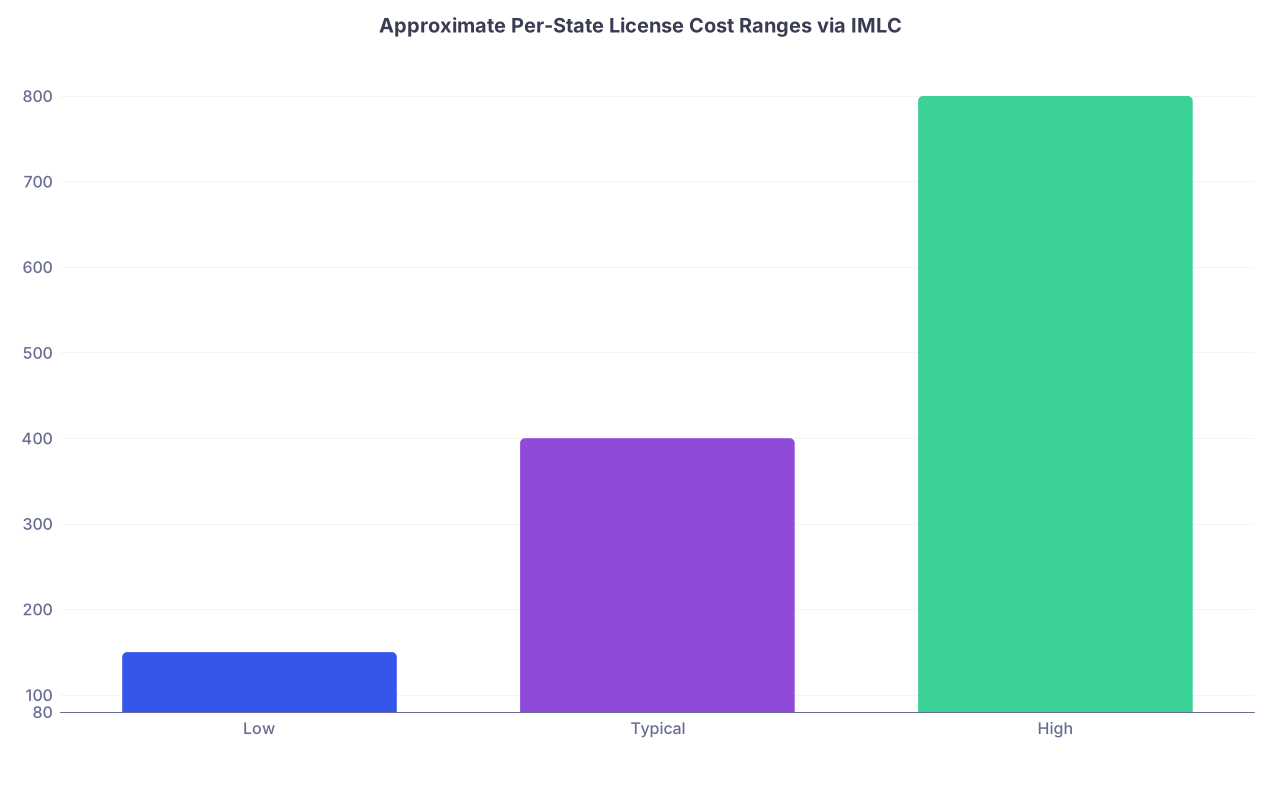
| Category | Value |
|---|---|
| Low | 150 |
| Typical | 400 |
| High | 800 |
Step 4: Compact‑First Sequencing
If you are compact‑eligible, the smartest sequencing is:
- Secure/maintain your SPL license in good standing.
- Apply for your LOQ via IMLC.
- Select 3–5 highest‑yield compact states first (that match your telemed job offers or target markets).
- Only after you see employer patterns should you expand to a second wave of 3–5 more states.
4. Non‑Compact Playbook: How to Build Your Portfolio the Harder Way (Without Going Insane)
Not in a compact state? Or specialty board issues? Or your record is not squeaky clean?
Fine. You can still build a strong multi‑state portfolio. You just need more discipline and less wishful thinking.
Step 1: Build a Master Credentials Packet
This is the single biggest time‑saver I have seen for non‑compact physicians.
Create a secure folder (encrypted cloud storage or local) with:
- Updated CV (month/year precision, no gaps)
- Copies of:
- Medical school diploma
- Residency certificate
- Board certification(s)
- USMLE/COMLEX transcripts
- Current DEA certificate
- State licenses you already hold
- Driver’s license/passport
- List of:
- All practice locations, with dates and addresses
- All hospital privileges (past + present) and dates
- All malpractice carriers + policy numbers + coverage dates
- Any malpractice claims or complaints with outcomes and dates
- Written explanations (saved as separate documents) for:
- Any gaps > 30–60 days in training/clinical work
- Any criminal history, even “dismissed” or “expunged”
- Any board actions, investigations, or restrictions
Why this matters: Most of the pain in non‑compact applications comes from re‑thinking this same data while some slow PDF portal times out every 15 minutes. You want to be in copy‑paste mode, not “hunt through old email” mode.
Step 2: Choose 2–3 “Anchor States” to Start
Pick a small starter set with these traits:
- Reasonable processing times
- High telemedicine demand
- Costs you can live with
For many, a good anchor trio might be:
- Texas
- Florida
- A Midwestern state (e.g., Ohio, Michigan) or a Southeast state (e.g., Georgia, North Carolina)
You are looking for fast wins and early revenue, not prestige.
Step 3: Use a Simple Application Tracker
Tracking on a napkin will burn you. Use a basic spreadsheet with columns:
- State
- Application type (compact / regular)
- Date started
- Date submitted
- Fees paid
- Verification items pending (USMLE, references, background check, fingerprints)
- Contact notes (name of board staff, dates of calls/emails)
- License number and expiration date once issued

| Step | Description |
|---|---|
| Step 1 | Select Target States |
| Step 2 | Build Credentials Packet |
| Step 3 | Submit Applications |
| Step 4 | Complete Verifications |
| Step 5 | Respond and Clarify |
| Step 6 | License Issued |
| Step 7 | Add to Renewal Calendar |
| Step 8 | Any Deficiencies? |
Step 4: Stagger Applications Intelligently
Do not apply to 10 non‑compact states on the same day. That is how you end up:
- Paying $8,000+ in fees before your first telemed paycheck
- Drowning in simultaneous requests for additional documents
Smarter sequence:
- Apply to 2–3 states.
- Push those to completion (including fingerprinting, verifications, etc.).
- As those are 80% done, start the next 2–3.
- Reassess after 5–6 total:
- Where are you getting actual telemed volume?
- Which employers are asking for which states?
Then either double down or pivot.
5. Align Your Licenses With Actual Telemedicine Jobs
Building licenses in a vacuum is like buying tools for a job you have not been offered yet. Backwards.
Step 1: Talk to Employers Early
You should be asking every telemedicine recruiter or medical director you talk to:
- “Which states are most valuable for your platform right now?”
- “Do you offer license reimbursement or bonuses for adding specific states?”
- “Is there a minimum number of active licenses required for hire or for full‑time volume?”
You will hear patterns:
- “We really need Texas, Florida, and Georgia right now.”
- “We prefer candidates with at least 5 active state licenses.”
- “If you get New York and California, we can double your shifts.”
Write these down. Let employer demand dictate your Phase 2 and Phase 3 states.
Step 2: Build State Bundles That Match Real Shifts
Telemed volume is often regional. I have seen platforms do this:
- Assign East Coast day shifts to physicians licensed in East + Midwest states
- Assign late night/overnight to physicians covering multiple time zones
So you might intentionally build:
- Eastern bundle: NY, NJ, PA, FL, GA, NC
- Central bundle: TX, IL, OH, MI, MO
- Western bundle: AZ, CO, WA, OR, CA
You do not need all three bundles. But you should have one that clearly covers a region well enough that a scheduler can say, “Perfect, we can plug you in.”
Step 3: Negotiate Around Licenses
If a company wants a specific state they know is a pain (California, New Jersey, Massachusetts, etc.), use that.
Things you can reasonably ask for:
- Full reimbursement of license and related fees (including fingerprints, notary, exam transcript fees)
- A bonus for each additional license you obtain for them (e.g., $500–$1,500 per state)
- Contract language that:
- Requires reimbursement within a fixed window
- Does not claw back the license if you leave (you keep the license; they just paid for it)
You are investing in your portfolio, not theirs. The license stays with you.
6. Protect Yourself From the Two Biggest Risks: Paperwork Landmines and Compliance Mistakes
Multi‑state licensing is not just tedious. Done sloppily, it is dangerous.
Risk 1: Inconsistent or Sloppy Disclosures
The boards care about consistency more than perfection.
If you:
- Answer “no” to an arrest on one application
- But “yes” with an explanation on another
You are inviting an investigation for “false statement” or “material misrepresentation.” That can trigger discipline, which then has to be reported to every other state. That’s how one bad application snowballs into a career‑long headache.
Fix this now:
- Create a master disclosure sheet for:
- Malpractice claims
- Board actions
- Criminal/disciplinary history
- Substance use treatment, if any
- Use it to answer all “Have you ever…” questions identically across states.
- When in doubt, over‑disclose with a clear, concise explanation.
Risk 2: Practicing in a State Before You Are Actually Licensed
Telemed platforms occasionally get sloppy with geolocation. Or patients travel.
Your responsibility:
- Know exactly which states you are licensed in, and effective dates
- Confirm with your employer how their system geofences or filters patients
Set hard rules for yourself:
- Never:
- “See just one patient” in a state pending license
- Trust that an HR email saying “you should be good to go” is enough
- Always:
- Verify your license is listed as issued and active on the state board website before seeing a single patient in that state
7. Maintain and Grow Your Portfolio Without Letting It Take Over Your Life
Once you have 5+ licenses, the hardest part is not getting more. It is keeping up with what you already have.
Step 1: Build a Renewal System
Set up a simple but ruthless system:
- Calendar reminders:
- 120 days before expiration
- 60 days before
- 30 days before
- A single document or spreadsheet with:
- License numbers
- Issue and expiration dates
- Renewal requirements (CME specifics, controlled substance registrations, etc.)
You want renewals to feel like paying a bill, not a crisis.
Step 2: Decide When to Let a License Lapse
You do not need to renew every license forever.
Use these criteria to cut:
- No telemed volume from that state in 12–18 months
- Employer partners do not list it among high‑demand states
- Renewal fees or CME requirements are painful compared with actual revenue
When you let one lapse:
- Document the reasoning
- Save final renewal notices and any relevant communication
- Update all credential profiles (e.g., CAQH, internal HR portals) to avoid mismatch
Step 3: Add New States in Targeted Bursts
Once you are stable with your first wave of licenses and you know where the work is:
- Add 2–3 new states at a time, tied to:
- New employer needs
- New telemed contract you are signing
- Strategic goal (e.g., building a West Coast presence to add evening shifts)
Avoid the “I am bored, I will apply to three random states” approach. That is how portfolios become bloated and expensive.
FAQ (Exactly 3 Questions)
1. How many state licenses do I actually need to be competitive for telemedicine jobs?
For most post‑residency physicians starting telemedicine, 3–5 well‑chosen licenses are enough to get solid side‑gig work. If you want serious part‑time telemed (e.g., 10–20 hours/week), aim for 5–10. Full‑time, multi‑platform telemed physicians often carry 10–20+ licenses, but that only makes sense once you have confirmed demand and established stable contracts. Focus on which states, not just the raw count.
2. Is joining the Interstate Medical Licensure Compact always the best move?
If you are eligible and your State of Principal License is in the compact, using the IMLC is usually the fastest route to a multi‑state portfolio. However, it is not automatically “best” if you do not actually need that many licenses. The compact charges its own fees on top of state fees. For someone who only plans to add one or two extra states, a regular application path may be simpler and cheaper. The sweet spot for IMLC is when you want 5+ compact‑member state licenses over the next 1–2 years.
3. Will telemedicine employers pay for my additional state licenses?
Many will, especially for high‑priority states like TX, FL, NY, or CA, or when they are pushing you toward a full‑time equivalent role. The most common arrangements are direct reimbursement of fees or per‑license bonuses when a new license is obtained and used for their patients. Always ask explicitly during contract discussions which states they value most, what they will reimburse (license fee only vs. also fingerprints, exam transcripts, etc.), and whether there are any clawback provisions if you leave the company. Use their needs to shape your next licensing wave.
Open your current license list right now and write down three more states that are (a) high yield for telemedicine and (b) realistically obtainable in the next six months. Then pick one of them and start the application this week—do not build a “someday” portfolio in your head while everyone else is already getting paid for those states.