The way most clinicians run “remote dermatology” today is clinically unsafe, legally shaky, and leaves money on the table.
Let me walk you through how to do it properly: from getting usable photos, to building a triage pipeline that actually works, to follow‑up algorithms you can hand to staff without losing sleep.
1. Remote Dermatology Isn’t One Thing – It’s Three Different Workflows
If you treat “telederm” as a single product, you will design a bad system. In reality you are dealing with three distinct workflows that each need their own rules:
- Asynchronous store‑and‑forward
- Synchronous video visits
- Hybrid pathways with in‑person backup
You build your operational and clinical algorithms around these, not around whatever your EMR happens to support.
| Modality | Use Case Focus | Key Strength | Key Weakness |
|---|---|---|---|
| Store-and-forward | Rash, acne, lesions | Highest efficiency | No real-time history |
| Live video | Complex rashes, hair | Interactive exam | Image quality, time cost |
| Hybrid (tele + F2F) | New + chronic disease | Safety + scalability | Needs clear protocols |
If you are post‑residency, building a telederm‑heavy practice or joining a digital health group, your job is to:
- Define what belongs in each bucket
- Set explicit photo standards
- Create triage and follow‑up algorithms that are simple enough for staff, rigid enough for medicolegal safety, and flexible enough for real life.
2. Optimizing Photos: The Part Everyone Hand‑Waves And Then Regrets
Bad photos are the single biggest reason telederm fails. Not reimbursement. Not platform. Photos.
I have seen entire clinical days blown because 40–50% of store‑and‑forward consults had images that were too blurry, too zoomed, too dark, or simply the wrong body part.
You fix this with three things:
- A strict minimum image set per complaint
- A patient‑facing capture protocol written in normal language
- A hard triage rule: “No diagnosis from bad photos. Period.”
2.1. The Minimum Image Set – Don’t Wing It
Every remote dermatology program should have written standards, by complaint type. For example:
For a single lesion (e.g., “new mole on arm”):
- 1 regional context image (entire forearm showing elbow/wrist for scale)
- 1 mid‑range (hand‑width field around the lesion)
- 2–3 close‑ups (with and without flash if possible)
- 1 with a ruler or coin for scale
For a generalized rash (e.g., “itchy rash on body”):
- 2 overall body distribution images (front and back, underwear on)
- 2–4 regional images (e.g., both arms, both legs, trunk)
- 2–3 close‑ups of “typical” lesions
For face acne/rosacea:
- 3 standardized angles: full face front, left oblique, right oblique
- Optional: macro close‑up of cheeks / forehead if scarring or texture is relevant
You write these into your intake forms and into your staff scripts. Patients should never be told “send a few photos.” That is how you end up guessing.
2.2. Patient Instructions That Actually Work
The average patient will not read a wall of text. You need a short, specific template you can reuse for most cases.
Here is a practical example you can adapt:
- “Take photos in daylight near a window. Avoid yellow bathroom lighting.”
- “Hold the camera 30–50 cm away for close‑ups. If it looks blurry, step back slightly.”
- “Clean the lens first (shirt or tissue).”
- “Turn off filters, portrait mode, and beauty mode.”
- “Include: 1 photo showing where it is on your body, and 2–3 close photos of the spot.”
- “If possible, place a coin or ruler next to it for size.”
Send this automatically via your patient portal or SMS link the moment a telederm consult is booked or requested. Do not assume the platform’s generic instructions are adequate.
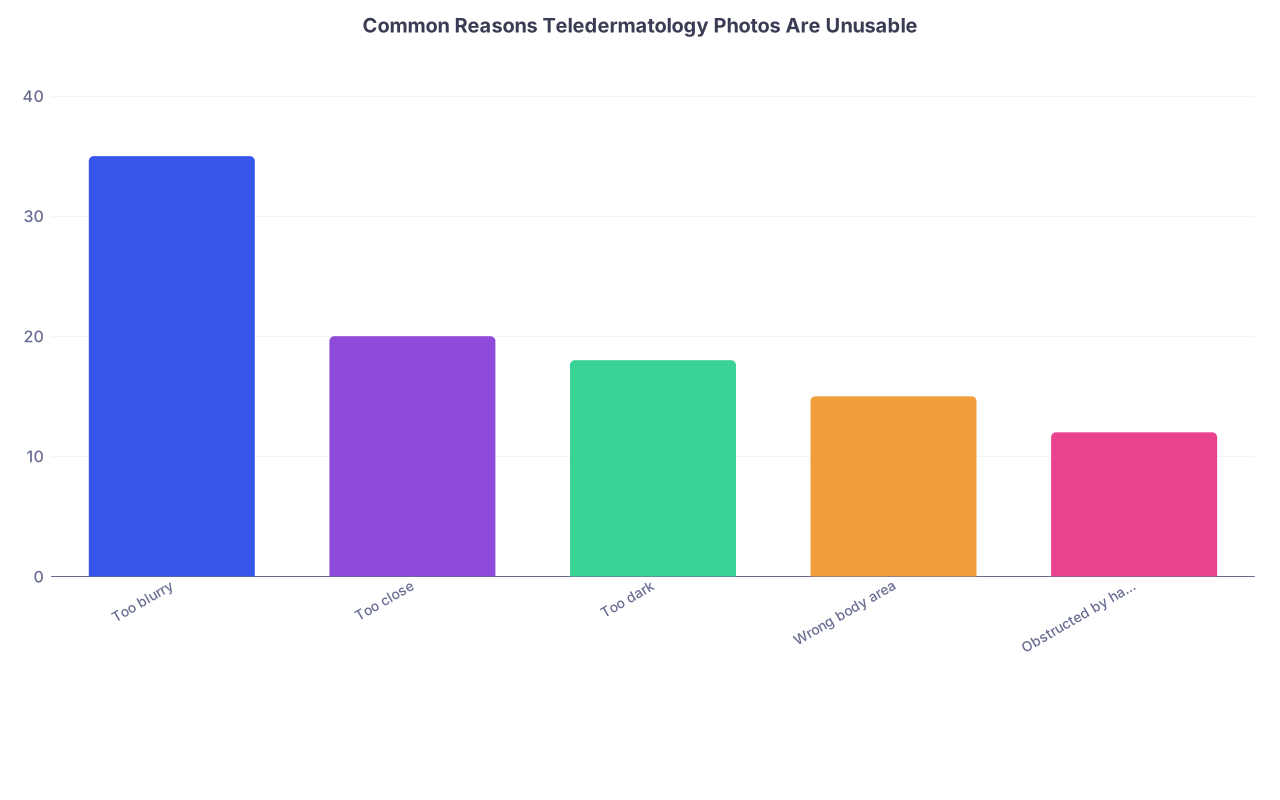
| Category | Value |
|---|---|
| Too blurry | 35 |
| Too close | 20 |
| Too dark | 18 |
| Wrong body area | 15 |
| Obstructed by hair/makeup | 12 |
2.3. Technical Requirements You Should Enforce
You do not need to be a photographer, but you do need a baseline:
- Resolution: Aim for at least 8–10 megapixels (most modern phones meet this). The important part is to prevent aggressive compression by the app.
- File type: JPEG is standard; avoid HEIC unless your platform converts it.
- Minimum dimensions: 1024px on the shortest side is decent; anything below ~600px tends to be useless for subtle morphology.
- Maximum count: Usually 6–10 per region is enough. More images ≠ more clarity; they just slow you down.
On the backend, push your vendor to stop compressing images to tiny thumbnails. If you join an existing telehealth company that does this, that’s a red flag.
2.4. Safety Rule: No Diagnosis From Garbage Photos
You must have a documented workflow:
- If photos do not meet criteria and lesion is potentially malignant → auto‑escalate to in‑person within a defined time frame (e.g., ≤ 2 weeks, faster if “ugly duckling,” rapidly changing, bleeding).
- If photos are inadequate but complaint is low risk (e.g., mild acne, seb derm) → request repeat images or convert to video.
Staff should be empowered to send a standard “photo quality insufficient” message without you manually intervening every time.
3. Building a Real Triage Algorithm (Not Just “Use Your Judgment”)
Remote dermatology becomes dangerous when everything is left to “clinician discretion.” That sounds nice until you get 70 teleconsults in your queue and everyone shortcuts differently.
You need a structured pathway. Here is the core logic that actually works in practice.
3.1. Start At The Top: Is This Even Appropriate For Remote Care?
Your first triage node should be: “Is this inherently in‑person?”
Immediate in‑person / urgent evaluation only (no remote management as primary):
- Suspected necrotizing infection
- Systemic symptoms with severe rash (toxic epidermal necrolysis, DRESS, SJS, erythroderma)
- New purpura with systemic signs (e.g., fever, hypotension)
- Rapidly expanding erythema with pain and systemic symptoms
- Postoperative wound complications with systemic signs
High‑priority in‑person (can use tele as screening but not definitive):
- Any lesion where you (or the platform) suspect melanoma, SCC, or amelanotic lesion that cannot be safely deferred
- Rapidly growing nodules, bleeding lesions, nail matrix lesions
- Hair loss where scarring alopecia is considered and trichoscopy needed
These categories should be coded into your intake with “red flag” questions that trigger auto‑routing.

| Step | Description |
|---|---|
| Step 1 | Patient submits photos and questionnaire |
| Step 2 | Urgent in person within 24-48h |
| Step 3 | Lesion algorithm |
| Step 4 | Rash algorithm |
| Step 5 | Chronic disease algorithm |
| Step 6 | Tele OK or in person based on risk |
| Step 7 | Red flag symptoms |
| Step 8 | Lesion vs widespread rash vs chronic disease |
3.2. Lesion‑Focused Algorithm (The Money Maker And The Malpractice Trap)
For isolated lesions, your triage needs to answer 3 questions quickly:
- Is malignancy reasonably excluded by history + photos?
- If not, what is the fastest safe path to biopsy?
- If yes, can this be definitively managed remotely?
General approach:
- Clearly benign lesions on good photos (classic seborrheic keratosis, cherry angioma, dermatofibroma, skin tags) → store‑and‑forward response, reassurance, optional in‑person if patient prefers cosmetic removal.
- Ambiguous pigmented or vascular lesions, or anything where you find yourself zooming in repeatedly wondering “is that structure real?” → in‑person dermoscopy / biopsy. Do not let tele become an excuse for “probably benign, let us watch.”
- Non‑melanoma skin cancer suspicions (pearly papules with telangiectasia, scaly non‑healing plaques in sun‑exposed sites) → schedule in‑person biopsy or in‑person evaluation with clear SLA (service level agreement) timeline.
If you are working for a telehealth startup that pressures you to “give an opinion anyway” on borderline lesions, that is the time to walk.
3.3. Rash and Inflammatory Disease Triage
Rashes are where remote dermatology can shine, if set up correctly, because most diagnoses are clinical plus pattern recognition.
You want your triage to decide:
- Can we safely trial therapy remotely?
- Do we need labs, biopsy, or phototesting?
- Is there risk of systemic involvement or drug reaction?
Examples of high‑yield remote candidates:
- Atopic dermatitis flares in known patients
- Mild–moderate psoriasis without systemic therapy initiation
- Urticaria without anaphylaxis features
- Tinea corporis, tinea pedis
- Pityriasis rosea
- Seborrheic dermatitis
- Miliaria, irritant/contact in obvious exposures
More cautious / often hybrid:
- New onset severe psoriasis with extensive BSA → lab workup, in‑person baseline prior to systemic therapy
- Suspected cutaneous vasculitis → cannot rely on photos alone
- Blistering diseases (BP, pemphigus) → need biopsy and labs
- Drug eruptions beyond mild morbilliform without systemic findings
Write this out as a decision tree you and your colleagues agree on. Otherwise your “hybrid” care becomes random.
4. Follow‑Up Algorithms: Where You Gain Or Lose Control Of Outcomes
Most telederm failures are not at the first visit. They are at follow‑up. People leave it vague: “follow up PRN” or “schedule in 4–6 months,” and nobody owns the timeline.
You need disease‑specific follow‑up algorithms that your staff can run almost on autopilot.
4.1. Chronic Disease: Fixed Intervals Plus Event‑Driven Follow‑Ups
Take psoriasis as a simple example:
- New moderate plaque psoriasis starting topical therapy only
- Video or photo follow‑up at 6–8 weeks
- If <50% improvement, upgrade regimen or consider in‑person systemic/biologic discussion
- On stable biologic, doing well
- Photo‑based follow‑up every 6 months plus annual in‑person for labs / TB screen / full exam
- Disease flare (patient messages portal)
- Asynchronous review within 72 hours; convert to video if unclear or severe
Same pattern for atopic dermatitis, acne, HS, vitiligo. The exact intervals vary; the structure does not.
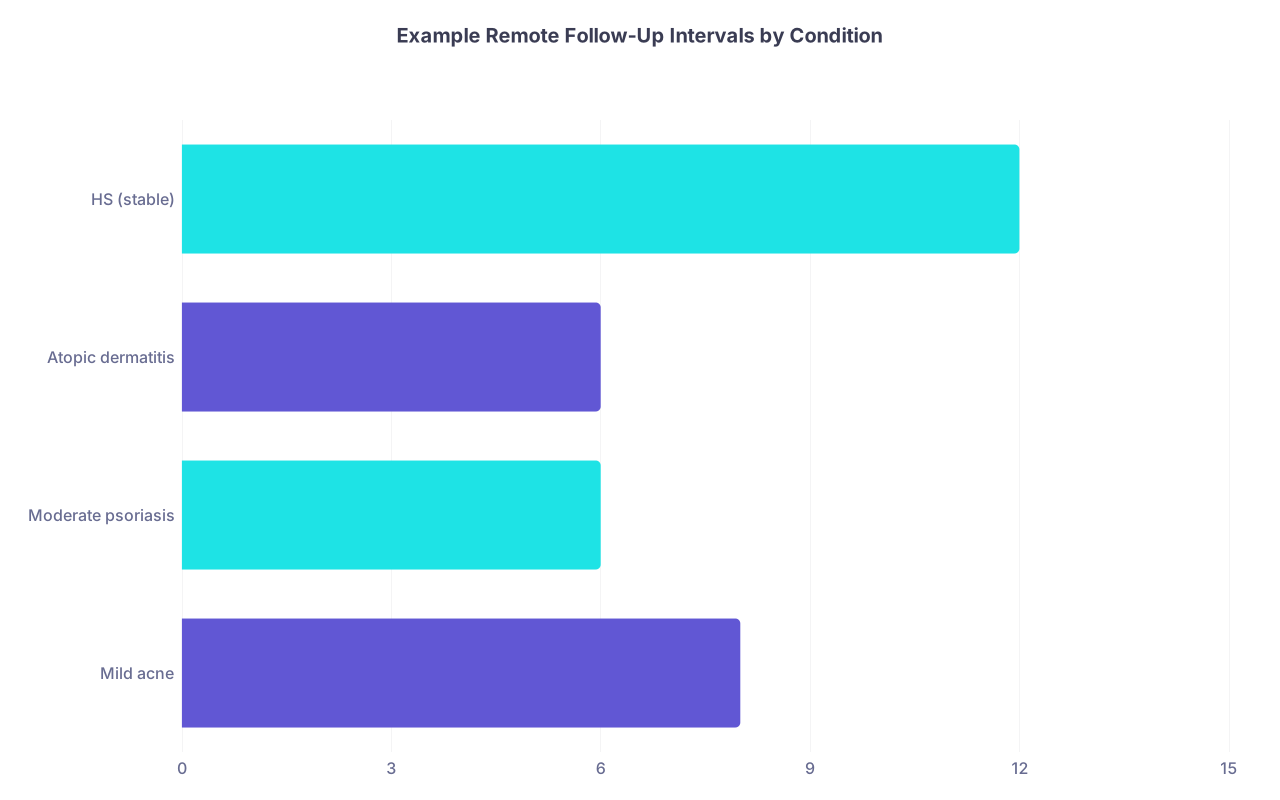
| Category | Value |
|---|---|
| Mild acne | 8 |
| Moderate psoriasis | 6 |
| Atopic dermatitis | 6 |
| HS (stable) | 12 |
(Values = routine follow‑up interval in weeks for remote visits in stable patients.)
4.2. Algorithms For Therapy Escalation (Topicals → Systemics → Biologics)
You must decide in advance what you are willing to start entirely via telemedicine.
Reasonable purely remote starts (with local lab draw, if needed):
- Topical steroids, calcineurin inhibitors, non‑steroidal topicals
- Oral antibiotics for acne, folliculitis, some HS
- Limited‑course systemic steroids for defined conditions (only if you are very clear about red flags)
- Certain non‑lab‑heavy systemic agents if labs can be arranged locally and documented
Higher‑risk or higher‑liability initiations (often hybrid):
- Methotrexate, cyclosporine, mycophenolate
- Biologics where payors demand elaborate documentation, TB/hep screening, and injection teaching
- JAK inhibitors with detailed monitoring schedules
The algorithm structure is roughly:
- If remote visit + criteria X/Y/Z met + labs A/B/C obtained within T days → OK to initiate; schedule remote follow‑up in N weeks + in‑person annual.
- If criteria not met or high‑risk comorbidities → in‑person for baseline assessment.
This is how you sleep at night when you are covering 2–3 states remotely.
4.3. Automated Follow‑Up Triggers Built Into Workflows
You should not be manually telling front desk “call this patient in 3 months.” That fails.
Instead:
- Build EMR order sets or smartphrases that automatically generate follow‑up tasks (e.g., psoriasis_tele_8wk → auto‑create task “schedule tele follow‑up in 8 weeks”).
- Use disease registries or lists (psoriasis panel, acne panel) with last visit date + last lab date; have MA run through them monthly.
- For medication refills, require a tele check if more than X months since last contact.
This is the boring operational piece no one teaches you in residency, but it is what differentiates a scalable, safe telederm practice from ad‑hoc video calls.
5. Operational Design: How To Build A Remote Derm Service That Doesn’t Burn You Out
Let’s shift from clinical to practical. If you are post‑residency, you either:
- Join a large group / system trying to expand telederm
- Join or build a private practice with mixed in‑person and remote
- Work for a telehealth company (good, bad, or ugly)
Your leverage point is in how you design the pipeline.
5.1. A Practical Telederm Day Structure
What works in the real world:
- Protected asynchronous blocks: 60–90 minute sessions dedicated to reviewing store‑and‑forward consults. No phone calls. No interruptions. This is where your per‑hour productivity is highest.
- Cluster live video: Back‑to‑back 15–20 minute slots, grouped together rather than scattered across the day. Context switching kills efficiency.
- Keep in‑person and remote distinct when possible: Half‑day remote, half‑day clinic is far cleaner than alternating every slot.
Do not let administration sprinkle tele visits randomly “where it fits.” Push back. Explain that telederm requires a different mental workflow, especially when assessing photos.
5.2. Staff Roles You Actually Need
At minimum:
- A tele‑intake MA or coordinator who screens photos for basic adequacy and completeness of forms before they reach you.
- Someone (does not have to be clinical) tasked with sending/monitoring standardized photo instruction templates and follow‑up scheduling.
- A “results + refill” protocol owner – often an RN or experienced MA – who knows exactly when to route messages to you versus respond with templated education.
If you are a one‑person show, you still build these protocols; you just run them yourself until volume justifies delegation.
5.3. Documentation Templates That Save Your Sanity
You want:
- Separate note templates for:
- New lesion tele consult
- Chronic disease tele follow‑up
- Rash / acute complaint
- Each template with:
- Section confirming “photos reviewed, quality adequate for remote assessment” or “limitations discussed”
- Explicit safety netting: “Advised patient to seek in‑person evaluation if X/Y/Z”
- Clear plan with follow‑up interval that matches your algorithm
A lot of malpractice risk in telemedicine is about documentation mismatch: tele visit treated like casual messaging rather than a full encounter.
6. Career and Market Realities: Where Remote Dermatology Is Heading
If you are looking at telemedicine as a significant part of your post‑residency career, you need a realistic view.
6.1. Where The Demand Actually Is
Right now the highest and most stable demand for dermatologists in telemedicine is:
- Large integrated health systems wanting to reduce access delays
- Insurer‑aligned telederm services for triage and utilization control
- Direct‑to‑consumer platforms centered on a few conditions: acne, hair loss, rosacea, “anti‑aging,” ED/andrology adjacencies
The truly general telederm practices that handle “anything skin‑related” remotely are rarer and require more thoughtful triage and liability control.
6.2. Reimbursement And Regulatory Constraints You Cannot Ignore
Key points:
- Store‑and‑forward coverage varies by state and by payer. You need to know whether your state Medicaid and major commercial plans pay for asynchronous telederm or consider it bundled.
- Cross‑state licensure is not optional. If you are reading photos of a patient in State B while you are sitting in State A, you need a license in State B. Full stop.
- Documentation of patient location at time of visit, consent to telemedicine, and limitations of remote exam should be baked into your note templates.
Do not rely on the telehealth company’s generic T&C to cover your clinical obligations.
7. Putting It All Together: A Concrete Example Workflow
Let me stitch this up into something you can picture using.
Scenario: You are a dermatologist in a mid‑size group that wants to add telederm to improve access.
You design:
- Intake forms with complaint‑specific question sets (lesion vs rash vs acne vs chronic follow‑up) and embedded photo instructions.
- Staff protocol:
- Verify photo count and basic quality on receipt.
- If inadequate, send standardized “photo redo” instructions.
- If red‑flag symptoms noted, route as urgent in‑person.
- Your triage algorithm:
- Benign‑appearing lesions with high‑quality photos → asynchronous report with counseling; in‑person optional.
- Ambiguous or suspicious lesions → scheduled in‑person within 2 weeks.
- Classic rashes / acne / AD / psoriasis flares → tele management using disease‑specific templates and follow‑up intervals.
- Follow‑up automation:
- Note templates that trigger recall tasks: “psoriasis_tele_6wk,” “acne_tele_8wk.”
- Monthly registry review by MA to catch no‑shows or overdue labs.
- Daily schedule:
- 1–2 blocks per week for reading store‑and‑forward consults.
- 1 half‑day per week of live tele visits for complex cases and chronic follow‑up.
- Remainder in‑person.
Over time, you adjust based on hard numbers: photo reject rate, conversion‑to‑in‑person rate, no‑show rate, and disease‑specific outcomes. That is how you iterate into a mature telederm practice instead of endlessly reacting.
FAQs
1. How many photos should I allow patients to upload for a single telederm consult?
For most platforms, a practical cap is 6–10 images per problem area. Beyond that, your cognitive load goes up and diagnostic yield does not. The key is not the raw number but enforcing that you get: at least one context shot, one mid‑range, and 2–3 close‑ups. If a patient has multiple unrelated issues (e.g., a leg ulcer plus a new facial mole), they should submit them as separate consults where possible to avoid confusion and billing problems.
2. Can I safely start biologic therapy purely via telemedicine?
In selected patients, yes, but only with a rigorous protocol. You need documented history, prior treatment failure, appropriate labs (TB, hepatitis, baseline CBC/CMP or drug‑specific panels), and a clear follow‑up plan. The actual prescription can be written after a tele visit if you are confident in the diagnosis and have objective data, but I strongly prefer at least one in‑person exam at baseline for complex psoriasis, HS, or severe atopic dermatitis before committing to years of expensive systemic therapy.
3. What is an acceptable miss rate for inadequate photos in a mature telederm service?
If more than about 15–20% of your incoming consults require repeat photos or conversion to video solely due to image quality, your front‑end process is broken. With good patient instructions and staff screening, I have seen programs drop the “unusable photo” rate to under 10%. You will never get to zero, but if 1 in 3 consults is a struggle to interpret, that is not “just how telemedicine is”; that is fixable.
4. How do I protect myself medicolegally when giving benign diagnoses remotely?
Document three things every time: that photo quality was adequate for assessment, that you explicitly discussed the limitations of remote evaluation, and that you provided clear warning signs that should trigger in‑person reassessment (change in size, color, border, bleeding, pain, rapid evolution). Avoid language like “definitely benign” in tele notes. Use “appearance is most consistent with X, no features concerning for malignancy on current images,” and back it up with a safety‑net plan and offered option for in‑person exam if the patient prefers.
Key points to carry forward:
- Remote dermatology stands or falls on photo quality and explicit triage rules; do not improvise those.
- Follow‑up algorithms must be written, disease‑specific, and tied to automated tasks, not memory.
- If a telederm setup ever pressures you to “make the best guess” on malignant‑possible lesions, you are being set up for trouble—build or join systems that respect clear in‑person thresholds.