
The hospital did not “fail to renew” your contract. They fired you with a nicer font.
You are now in the worst limbo of modern medicine: post-residency or early attending, contract non‑renewed, next job not started yet, bills still due on the first. And you’re staring at your inbox thinking, “Can I actually plug this hole with telemedicine… or is that a fantasy?”
You can. But only if you treat it like a real bridge job and not a side hustle you “sort of” set up.
Let’s walk this like you’re sitting across from me, 2 months from the end of your contract, slightly panicked, maybe a little angry, and you need a concrete plan.
Step 1: Get Real About Your Situation (Timeline, Licensing, Money)
Before you start firing off telemedicine applications, you need three numbers written down:
- When your current job income stops.
- When your next stable role might realistically start.
- How much you must clear per month to stay solvent (not “comfortable,” just solvent).
Most people in your shoes underestimate the lag.
- Credentialing at traditional jobs: 60–120 days
- Telemedicine credentialing: 7–60 days (company dependent)
- Licensure (new states): 4–12+ weeks
So if your contract ends June 30 and you “think” your new job will start August 1, you’re already lying to yourself. Hospital onboarding plus payer enrollment can easily push it to September or October.
Write this down:
- Contract end date
- Worst-case start date at next job
- Monthly “must-pay” expenses: rent/mortgage, insurance, minimum debt, core living
- Minimum monthly income target from bridge work
Now we can talk about what kind of telemedicine load you actually need.
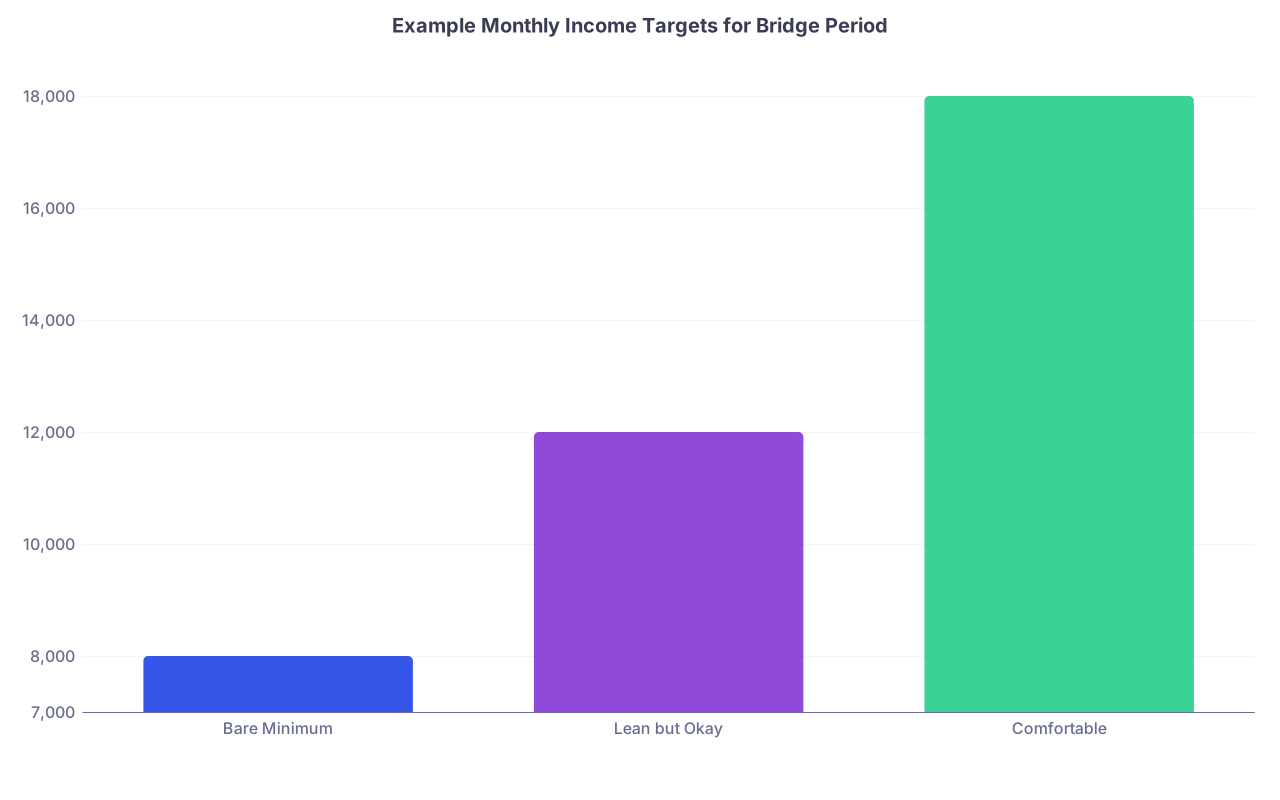
| Category | Value |
|---|---|
| Bare Minimum | 8000 |
| Lean but Okay | 12000 |
| Comfortable | 18000 |
If your “bare minimum” is $8k/month, and a given telemedicine platform pays you around $80/hour net (realistic for some primary care/urgent care setups if you’re efficient), that’s:
- $8,000 ÷ $80/hr = 100 hours/month ≈ 25 hours/week
That’s your ballpark. Not the fantasy of “I’ll just hop on for a few hours when I feel like it.”
Step 2: Sort Out the Legal and Credentialing Landmines Now
You cannot “just start seeing telemedicine patients tomorrow” in most cases. You need:
- Active medical license in the state where the patient is located
- Active DEA (if prescribing controlled substances) with appropriate address
- Malpractice coverage that explicitly covers telemedicine
If you’re exiting a non‑renewed contract, check three things today:
Licensure status and employer entanglement
- Does your current employer pay your license/DEA fees? That’s fine. License is still yours.
- Do they control your email listed with the medical board? Change that immediately.
- Any pending complaints or investigations? Telemed companies will smell that in credentialing.
Malpractice tail coverage
- Non‑renewed contracts often trigger your paranoia about lawsuits. Rightly so.
- Tail for your old job is separate from malpractice for telemedicine. Do not confuse them.
- Telemedicine companies usually provide claims-made coverage for your work with them, but you want that in writing.
Contractual restrictions
- Any non‑compete or outside work clauses?
- Many hospital contracts ban “moonlighting” without approval. That may still apply while you’re on payroll or on garden leave.
- If you’re still technically employed but non-renewed, you can get burned for signing up for outside work before your last day. I have seen this happen.
If in doubt, do a 30–45 minute consult with a healthcare attorney and let them look at:
- Your current employment contract
- Your proposed telemedicine contracts (you will get several, all slightly predatory in different ways)
The $300–$500 for that call is worth far more than blindly signing something that restricts your future practice locations or owns your patient panel in absurd ways.
Step 3: Pick the Right Telemedicine “Bucket” for Your Specialty and Risk
Not all telemedicine is created equal. Some of it is a reasonable bridge. Some of it is a lawsuit with a login screen.
Here’s the core breakdown:
| Type | Example Work | Risk Level | Setup Speed |
|---|---|---|---|
| High-volume urgent care | Coughs, UTIs, rashes | Medium | Fast |
| Asynchronous/text-based care | Refills, simple issues | Medium | Fast |
| Specialty consults | Cards, neuro, psych | Low–Med | Medium |
| Direct-to-consumer niche apps | Weight loss, ED, acne | High | Fast |
| Hospital/system telehealth | Follow-ups, consults | Low | Slow |
If you’re primary care / EM / FM / IM
You’re the default target for:
- Direct-to-consumer urgent care platforms
- Text-based consult services (simple scripts, algorithm-driven)
- Niche services: weight loss, men’s health, hair loss, etc.
As a bridge, I’d prioritize like this:
- Legit urgent care platforms with clear protocols, good documentation tools, and malpractice provided.
- Text-based/asynchronous platforms with sane visit volume expectations and control over your schedule.
- Niche direct-to-consumer only if:
- They have real medical leadership you can speak to
- They are conservative on controlled substances
- Their protocols are written down and defensible
If a platform’s pitch is “we make it frictionless for patients to get meds quickly,” my guard goes up.
If you’re a specialist
Your options are narrower but actually often more stable:
- Teleradiology
- Telepsych / telepsych consults
- Cardiology / neurology / ID consult services
- Hospital-affiliated telehealth consult pools
These take longer to onboard but pay better and are less wild-west.
If you have a procedural specialty (surgery, OB, anesthesia), your telemedicine bridge will mostly be:
- Second opinion consults
- Pre-op clearance consults (some platforms do this)
- Medical-legal review work (longer to break into, but real)
Do not expect to replace a full attending surgical income via telehealth alone. Think “offset damage,” not “replicate OR paychecks.”
Step 4: Apply Aggressively and In Parallel (You Don’t Have Time)
You are not in a “see which one feels best” season. You’re in a “cast a wide net, then filter hard” season.
Concrete process:
Make a simple one-page CV emphasizing:
- Board status
- Licensure (list states)
- Telemedicine or virtual care experience (even if just “managed video visits during COVID at XYZ clinic”)
- Languages spoken, if relevant
- Any QI/efficiency projects that sound like “I can handle volume without cutting corners”
Identify 5–10 telemedicine companies that:
- Cover your license states
- Are not all in the same risky niche
- Offer different revenue models (per consult vs hourly vs RVU-ish)
Apply to all of them within 48–72 hours.
You’re not promising 40 hours a week to each. You’re getting through their onboarding gauntlet so you can choose once credentialed.
Typical onboarding pieces:
- Application + CV
- License, DEA, board certification verification
- Background check
- Training on platform and protocols
- Test cases or onboarding calls
Realistic timeline: anywhere from 1–8 weeks. That’s why we apply in parallel.
Step 5: Understand How You’ll Actually Get Paid (So You Don’t Get Screwed)
The fastest way to hate telemedicine is to misunderstand the pay structure and end up making $35/hour doing what you thought would be $120/hour.
Common models:
-
- Example: $25–$40 per simple urgent care visit, no follow-up needed
- Good if you’re fast and the EMR isn’t a nightmare
- Bad if they dump complex multi-complaint visits into a 5-minute slot
Per-hour guaranteed rate (with volume expectations)
- Example: $90–$140/hour for blocked shifts
- Best for bridge stability: you can plan your month
- Watch for: abusive minimum volume or penalty if you don’t hit quotas
RVU-style / percentage of billed charges
- Example: 60–70% of collections
- Can pay well but harder to predict in the short-term
- Risk shift is on you: if they suck at billing or collections, you eat it
Let’s anchor this with hours vs money. Say one platform offers:
- $30/visit, average 4 visits/hour → $120/hour gross
- You work 20 hours/week → 80 hours/month → 320 visits → $9,600/month
Another offers:
- $100/hour flat, 15 hours/week → 60 hours/month → $6,000/month
You might combine both. For a bridge, most smart physicians stack:
- 1 platform with reliable hourly shifts
- 1 platform with “log on when you want” per-visit pay
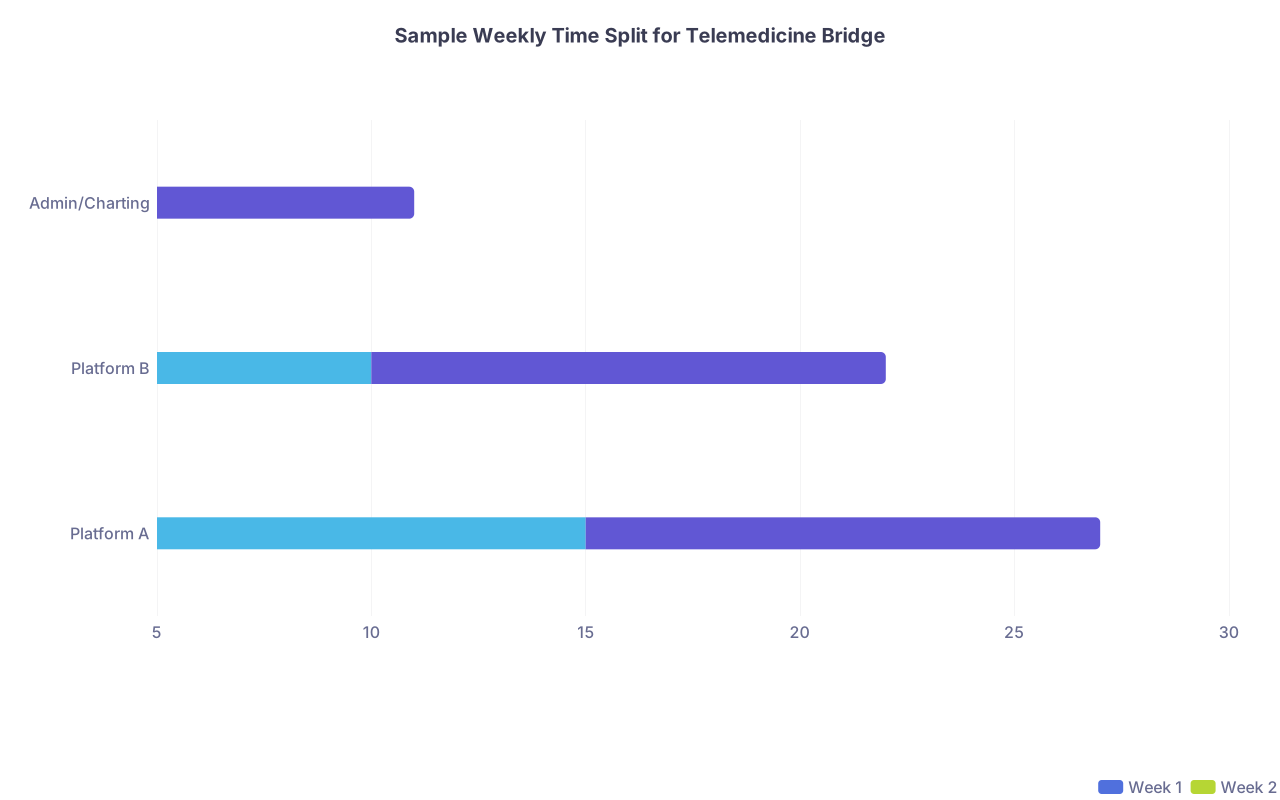
| Category | Week 1 | Week 2 |
|---|---|---|
| Platform A | 15 | 12 |
| Platform B | 10 | 12 |
| Admin/Charting | 5 | 6 |
And yes, the admin/charting block is real. You will chart after you log off the video platform. Factor that in.
Step 6: Design a Schedule That Won’t Fry You (Or Get You Sued)
You’re likely doing three things simultaneously:
- Ending your current job (with all the emotional garbage that entails)
- Interviewing or onboarding for your next “real” job
- Starting telemedicine shifts to cover income
So you cannot just think in hours. You have to think in cognitive load.
Some specific guardrails:
- Don’t stack >6 straight hours of high-volume tele-urgent care if you’re not used to it. Your decision fatigue will show in your charts.
- Leave at least 1 hour buffer before/after major interviews or meetings. You do not want to be fielding a chest pain case 15 minutes before meeting the CMO.
- Consider early mornings, evenings, and weekends when telemedicine volume is high but your daytime is free for job search or onboarding.
A realistic sample bridge schedule:
- Mon–Thu:
- 8–12: job search, credentialing paperwork, future employer calls
- 1–4: blocked telemedicine shifts (hourly platform)
- Fri:
- Flexible: interviews, travel, admin
- Sat–Sun:
- 2–4 hour telemedicine blocks on one or both days (per-visit platform)
That’s enough to hit 20–25 hours of telemed a week without annihilating yourself.
Step 7: Protect Your License and Sanity While Doing Volume
Here’s where a lot of desperate physicians screw up: they trade clinical judgment for speed because they’re chasing income.
Do not do that. A non‑renewed contract is annoying. A board action is career-altering.
Specific safety rails for telemedicine bridge work:
Know when to say “this needs in-person evaluation.”
- Chest pain, neuro deficits, significant SOB, abdominal catastrophes – you know the list.
- Telemedicine chart must show your thought process and explicit ED/clinic instructions.
Refuse impossible visit structures.
- If a platform expects full acute visits in 3 minutes, or 30+ texts per hour continuously, walk. You can’t defend that in court.
- Volume is not your only lever. Your license is the floor.
Document like someone will read it angry later.
- Clear chief complaint
- What you can’t examine over video and that limitation
- Your safety netting: what to watch for, where to go, when to go
Be extra conservative with controlled substances and off-label use.
- Direct-to-consumer ADHD, benzos, and weight-loss mills are getting scrutiny. This will only intensify.
- If their protocol feels like “hand out stimulants and GLP-1s for customer satisfaction,” leave.
You want this bridge period to be boring from a legal standpoint. Income, yes. Lawsuits, no.
Step 8: Handle the Optics on CVs and Future Employers
You’re worried about the story: “My contract wasn’t renewed, then I did telemedicine for 6 months. Do I look like damaged goods?”
No. Unless you handle it poorly.
Here’s how to frame it:
On your CV:
- [Dates]: Telemedicine Physician – [Platform or “Multiple Platforms”], Remote
- Bullet examples:
- “Provided urgent-care level virtual care to 20–25 patients/day across [X] states.”
- “Implemented evidence-based triage and safety-netting workflows in a high-volume telehealth environment.”
- “Maintained patient satisfaction ratings of [X]% while prioritizing clinical safety and appropriate escalation.”
In conversation:
- “My previous employer opted not to renew my contract due to [X – volume expectations, shift redistribution, service-line restructuring]. During the transition, I’ve been doing telemedicine to maintain my clinical skills and income while I look for a better long-term fit.”
Deliver that line calmly and move on. Do not overshare drama. Physicians get cut from systems all the time for non-clinical reasons. Most smart CMOs know this.
Step 9: Use This Period to Future-Proof Yourself, Not Just Survive
You’re in a bad spot, yes. But this is also the moment you can intentionally build something more durable:
- Get licensed in 1–2 additional strategic states (big telehealth markets: e.g., FL, TX, CA if feasible).
- Build relationships with at least one hospital-based telehealth program (often more stable, better pay, and those people talk to other systems).
- Learn to handle high-volume, protocol-driven care without losing your standards. That skill translates to urgent care, ED, primary care settings.
And keep your options open. I’ve seen more than one physician turn “temporary telemedicine bridge” into:
- 0.6 FTE long-term telemedicine + 0.4 FTE in-person
- Fully remote multi-platform career once they moved to a lower cost-of-living area
- A portfolio practice with consulting, teaching, and a small virtual panel
You might not want that. But knowing you could do that changes the power dynamic in every future negotiation.
Step 10: Red Flags That Mean “Walk Away” (Even If You Need Money)
There are some telemedicine setups I would not touch even in a financial crunch. You probably should not either.
Major red flags:
- Mandatory minimum visit volume per hour that’s clinically absurd
- Pressure (explicit or implicit) to prescribe controlled substances to keep “customer satisfaction” high
- No clear medical director or clinical governance structure you can talk to
- You’re asked to practice outside your training or comfort zone with no support
- No malpractice coverage provided, or they try to shift all risk to you as a 1099 with laughable pay
- Contract with broad non-compete on all telemedicine or all virtual care in multiple states
If you read a contract and your first reaction is, “Huh, that seems aggressive, but I really do need the money” – pause.
Short-term cash isn’t worth long-term damage to your record.
A Simple, Brutally Practical 30-Day Action Plan
Let’s make this painfully concrete. Over the next 30 days:
Today–Tomorrow:
- Pull out your employment contract. Identify the last paid day and any moonlighting restrictions.
- List your licenses, DEA status, and calculate your true bare-minimum monthly income need.
Next 3–5 days:
- Build or update your 1-page CV.
- Identify 5–10 telemedicine companies across at least 2 different “types” (urgent care + asynchronous + maybe a niche).
- Submit applications to all of them.
Next 1–2 weeks:
- Respond instantly to credentialing emails. Sitting on “please upload your license” for 4 days costs you money.
- Schedule at least one short consult with a healthcare attorney to vet your worst-looking contract.
Weeks 3–4:
- Complete platform trainings, dry runs, and test visits.
- Start with 10–15 hours/week and ramp toward your needed income target.
- Track your actual earnings and time per visit so you can dump low-yield platforms quickly.
By the 6–8 week mark, you want:
- At least one primary telemedicine platform that reliably pays your minimum
- One backup/on-demand platform you can ramp up if your next job start date slides
- A clean record, sane schedule, and enough mental bandwidth left to interview well
Open your calendar and your calculator right now. Put your contract end date, worst-case next job start date, and your minimum monthly income number onto one piece of paper. That’s the problem you’re solving. Then, in the next 48 hours, submit at least 5 telemedicine applications. Not “research them.” Submit them. The bridge only exists if you start building it before you reach the edge.