Telemedicine is not a retirement hobby. It is a serious practice model, and the people who do best in it are often in their 30s and 40s—not collecting Social Security between video visits.
The stereotype is persistent: telemedicine equals semi-retired FM docs in Florida doing a few urgent care visits between golf rounds. I hear this from residents, new grads, and even attendings: “I’ll do telehealth when I’m older and tired of clinic.”
That mindset is outdated. And it is costing some of you real career options.
Let’s walk through what the data and real-world hiring patterns actually show about who thrives in telemedicine post-residency, who struggles, and how to tell which camp you’re likely in.
The Myth: Telemedicine Is a Soft Landing for Burned-Out, Near-Retirement Docs
This myth comes from three half-truths that have been stretched beyond recognition:
- Early telemedicine companies often marketed to older docs who wanted “flexible work from home.”
- Pre-2020, a decent chunk of tele-urgent-care work was picked up by older PCPs supplementing income.
- Students and residents mostly saw telehealth framed as a side gig, not a core career path.
Then COVID hit, everything went remote, and assumptions froze in place.
Here’s what changed that most people haven’t updated in their mental model:
- Large health systems moved entire service lines online.
- Major payers began reimbursing telemedicine at parity (or close to it) in many states.
- Startups built entire virtual-first practices: primary care, psychiatry, endocrinology, obesity medicine, women’s health, men’s health, dermatology, addiction medicine, etc.
Telemedicine is no longer a quirky add-on. For some specialties, it is the practice.
And the clinicians thriving there are not just “retired plus Zoom.”
They’re:
- Early- and mid-career physicians who want control over schedule and geography
- Subspecialists who realized 80% of their follow-ups don’t need an exam table
- Psychiatrists and therapists whose whole pipeline went digital
- Hospitalists and intensivists doing virtual consults and eICU work
Let’s be blunt: a lot of older physicians struggle with telemedicine platforms, documentation requirements, rapid chat workflows, and multi-state licensure. Some do great, of course. But the idea that “telemedicine is for retirees” is lazy and wrong.
What the Data and Hiring Patterns Actually Show
Most telehealth companies don’t publish detailed workforce demographics, but we do have decent signals: surveys, job postings, compensation reports, and who you see on these teams.
Three patterns show up repeatedly:
Telemedicine usage by age is not skewed to the old.
Surveys from AMA and various specialty groups show that clinicians in their 30s and 40s are just as likely to use telehealth as those 55+. In many systems, the most consistent users are mid-career attendings who’ve integrated virtual visits into their existing panels.Virtual-first companies disproportionately hire earlier-career clinicians.
Why? They:- Adapt quickly to new workflows and EMRs
- Are comfortable with tech, chat-based care, and asynchronous models
- Are more willing to juggle multi-state licenses and telehealth-specific compliance
- Are often looking for non-traditional schedules (childcare, second jobs, startups)
Subspecialty telemedicine teams are heavily mid-career.
Think:- eICU teams staffed by intensivists in their 30s–50s
- Tele-epilepsy or tele-stroke covering multiple hospitals overnight
- Virtual endocrinology managing diabetes, thyroid, obesity, PCOS nationally
You see seasoned experts, yes. But many of them are primetime in their careers—not winding down.
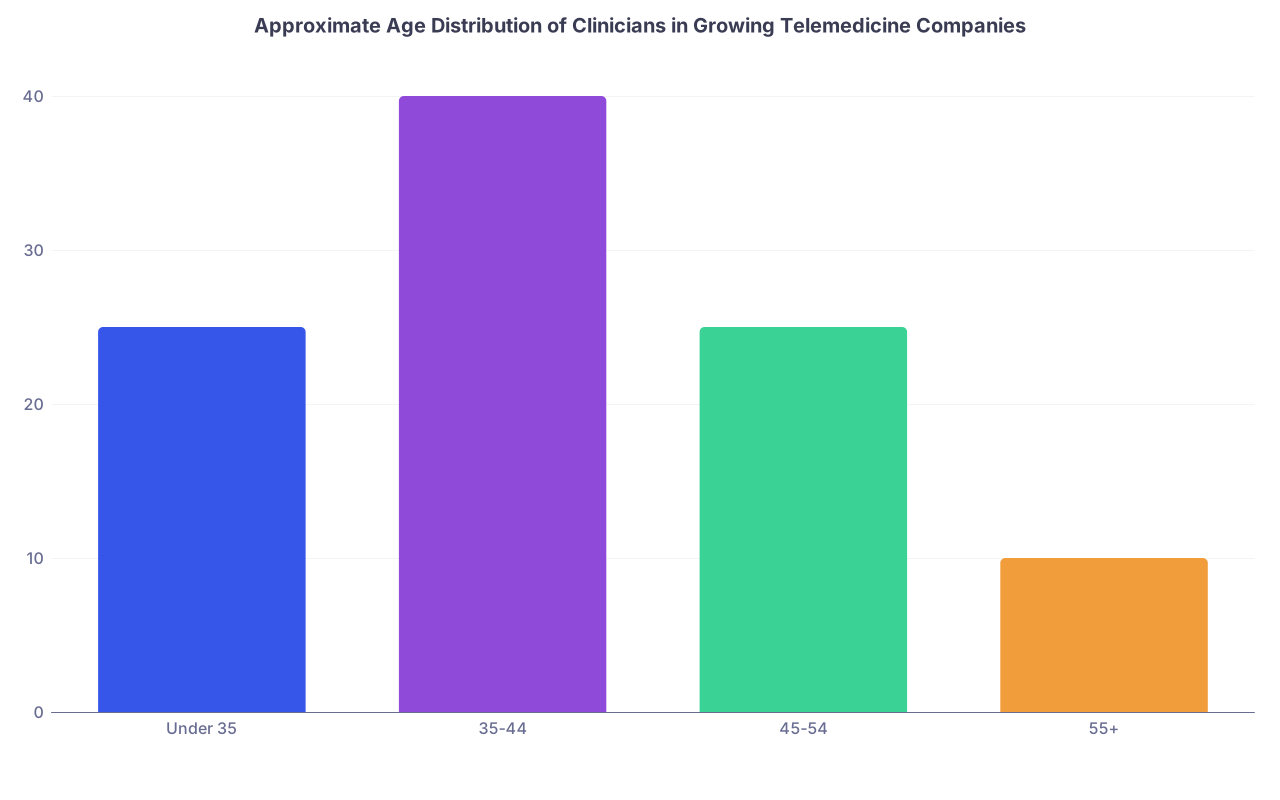
To make this less abstract, here’s the mix I repeatedly see when telemedicine companies show internal data or when I talk to hiring managers:
| Category | Value |
|---|---|
| Under 35 | 25 |
| 35-44 | 40 |
| 45-54 | 25 |
| 55+ | 10 |
Not perfect, not universal, but you get the idea: this is not a gray-only workforce.
Who Actually Thrives in Telemedicine (Post-Residency)
The people who do best in telemedicine share traits that have nothing to do with age and everything to do with how they think and practice.
1. Clinicians Who Can Synthesize Fast and Communicate Clearly
Telemedicine punishes ramblers and over-testers. It rewards:
- Fast pattern recognition
- Clear explanations without physical props
- Ability to set boundaries and safety nets without defensive over-ordering
You have to be comfortable saying things like:
- “Here’s what I can safely do by video today, and here’s what I cannot.”
- “We’re going to handle X now, but if Y happens, you must go in-person or to the ER.”
That requires clinical judgment and confidence. Which is why brand-new grads with shaky decision-making can feel exposed in pure virtual urgent care. But someone 2–5 years out who’s done enough real-world triage? Prime candidate.
2. Specialists Whose Follow-Up Is Mostly Cognitive
If your value is primarily your brain, not your hands, telemedicine probably fits you well.
Obvious winners:
- Psychiatry
- Psychology / therapy
- Endocrinology
- Rheumatology
- Sleep medicine
- Addiction medicine
- Dermatology (especially follow-up and chronic disease management)
- Allergy & immunology
- Neurology for many visit types
Less obvious but growing:
- Cardiology (virtual follow-up, risk factor management, chronic HF)
- GI (IBD management, functional GI, follow-up)
- Oncology survivorship care
These people thrive because 70–90% of what they already do in brick-and-mortar is counseling, medication management, and interpretation of data that can be sent electronically (labs, imaging, wearables).
The retirees do not own this space. The clinically sharp mid-career doc who’s sick of 45 minutes commuting each way does.
3. People Who Actually Like Structure and Metrics
Here’s the part almost no one tells residents: a lot of telemedicine companies are metric-heavy. Think:
- Visit counts per shift
- Average handling time
- Response time to messages
- Patient satisfaction scores displayed on your dashboard
- Protocol adherence
If that sounds suffocating, you might hate it.
But if you’re the kind of person who:
- Already tracks your own productivity in clinic
- Likes seeing your “numbers” improve
- Doesn’t mind targeted protocols for acne, UTI, ADHD, depression, etc.
You can do extremely well. Compensation often ties directly to volume or productivity. And the people who accept and use the metrics—not fight them—tend to earn more and report fewer surprises.
4. Early- and Mid-Career Docs Who Value Flexibility More Than Prestige
A quiet truth: some of the happiest telemedicine docs deliberately traded “shiny” for control.
Common profiles:
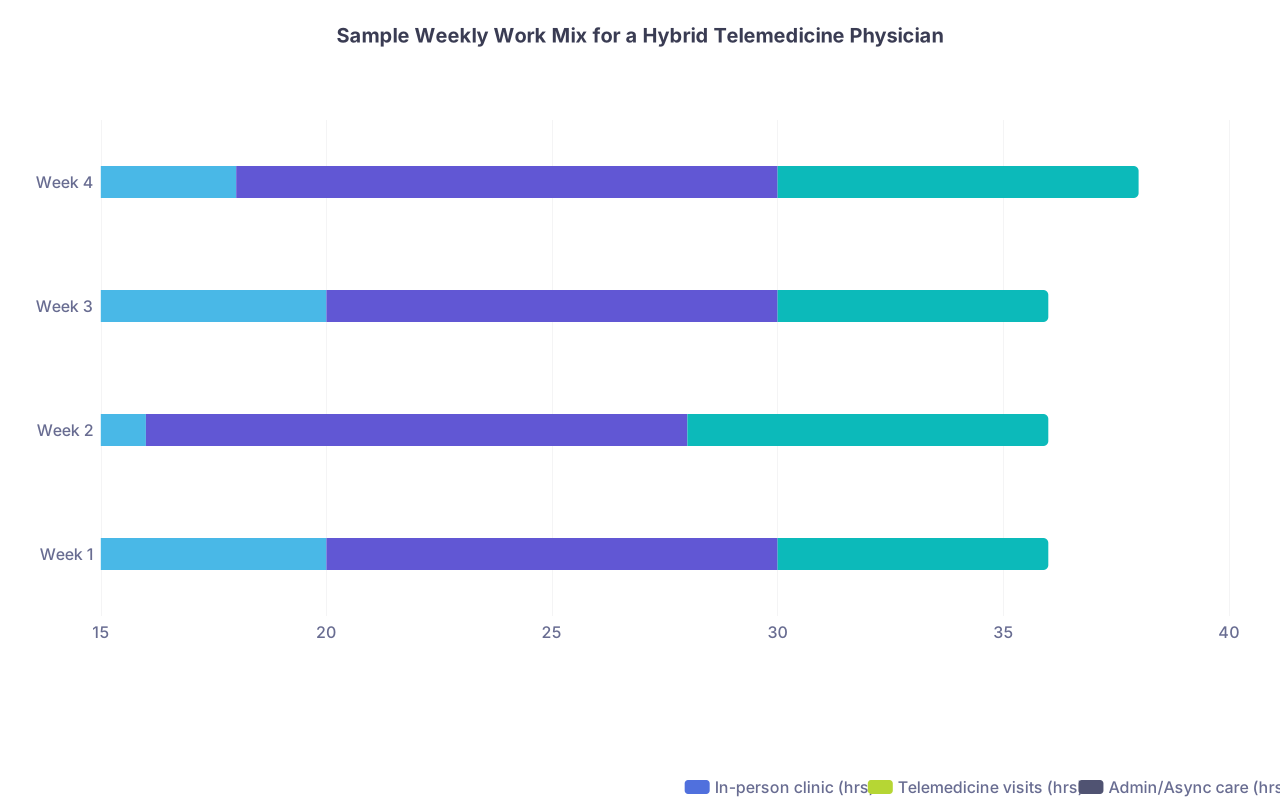
- A 34-year-old IM physician in a mid-sized city doing hybrid: 0.6 FTE in-person, 0.4 FTE remote evenings for a national primary care or weight-loss company.
- A 40-year-old psychiatrist with kids, working school hours from home, reasonably paid, zero commute.
- A hospitalist who moved to a cheaper state, picked up eICU and tele-hospitalist roles, and stopped fighting for parking at 6:45 am.
Do these jobs impress your med school classmates who all wanted academic titles? Maybe not.
Do they let you live where you want, with a schedule you control, while still practicing real medicine? Often yes.
Who Struggles (Even If They Think Telehealth Will Be “Easy”)
Let’s flip it. It’s not that some people can’t do telemedicine; it’s that they’re miserable when they do.
1. Procedure-Heavy Specialists Who Hate Cognitive-Only Work
If you went into medicine for procedures and that’s what gives you energy—endoscopy, caths, OR, scopes—pure telemedicine is going to feel like slow suffocation. There are a few procedural tele-roles (e.g., remote proctoring of cath labs, tele-ICU guiding lines & vents), but they’re the minority.
If your joy is “hands on,” telemedicine better stay a side gig, not your core job.
2. People Who Rely on Physical Exam as a Crutch for Uncertain Thinking
Painful but true: some clinicians use physical exam as a way to delay making decisions. They feel safer ordering one more test, one more imaging study, one more in-person check.
In telemedicine you lose that crutch. You still use exam skills—visual, directed maneuvers, pattern recognition—but you absolutely have less to lean on. If your internal monologue is always, “I’ll just bring them back in a week,” you’re going to feel exposed.
The clinicians who do well virtually are those who already practice with tight, high-yield history-taking and focused exams in person.
3. Docs Who Expect Telemedicine to Cure Burnout Without Changing Anything Else
You know this person:
- Burned out from 20-minute visits, EMR overload, insane inbox
- Thinks: “If I just work from home, all that goes away”
- Joins high-volume tele-urgent-care platform
- Discovers: still EMR, still inbox, still metrics, still difficult patients—now with less physical variety and more screen time
Telemedicine can fix your commute and sometimes your schedule. It does not magically fix your relationship with work, your boundary issues, or a dysfunctional company culture.
If you don’t change how you practice or what you tolerate, you can burn out from home just as effectively as in person.
Where Telemedicine Careers Are Actually Strong Right Now
Let’s get concrete. Where are people actually building serious telemedicine careers post-residency?
Strong / Growing Areas
- Psychiatry & therapy: Huge demand, high tele-acceptance, relatively good pay, patients like it.
- Virtual primary care + chronic disease: Especially tech-enabled outfits handling HTN, DM2, obesity, lipid disorders, PCOS, etc.
- Tele-dermatology: Store-and-forward plus live video, particularly for acne, psoriasis, atopic derm follow-up.
- Women’s and men’s health verticals: Contraception, menopause, fertility counseling, ED, low T, hair loss—love it or hate it, it’s lucrative and growing.
- Tele-ICU, tele-hospitalist, tele-stroke: Systems-level roles with real responsibility, great for experienced hospitalists and intensivists.
Meh / Still Maturing
General tele-urgent-care as your only job:
- Oversaturated in some markets
- Race-to-the-bottom pay in certain platforms
- A good component of a portfolio career, not always a stable full-time path.
Surgery and procedural-heavy specialties:
- Limited to consults, follow-up, second opinions.
- Useful, but rarely replaces your main gig unless you pivot almost entirely to consultative practice.
Here’s a quick comparison so you stop thinking “telehealth” as one monolith:
| Specialty Type | Telemedicine Fit | Common Model |
|---|---|---|
| Psychiatry / Therapy | Excellent | Fully virtual |
| Endocrine / Rheum / Neuro | Strong | Hybrid / virtual-first |
| Primary Care | Strong | Hybrid or virtual-first |
| Derm / Allergy | Strong | Hybrid / virtual-first |
| Hospitalist / ICU | Moderate-Strong | System tele-roles |
| Surgery / Procedural | Limited | Consult-only / follow-up |
How Telemedicine Actually Changes Your Day-to-Day
Let me kill another fantasy: telemedicine is not you sitting in pajamas casually clicking through two visits an hour.
Here’s what actually changes:
You need a real setup.
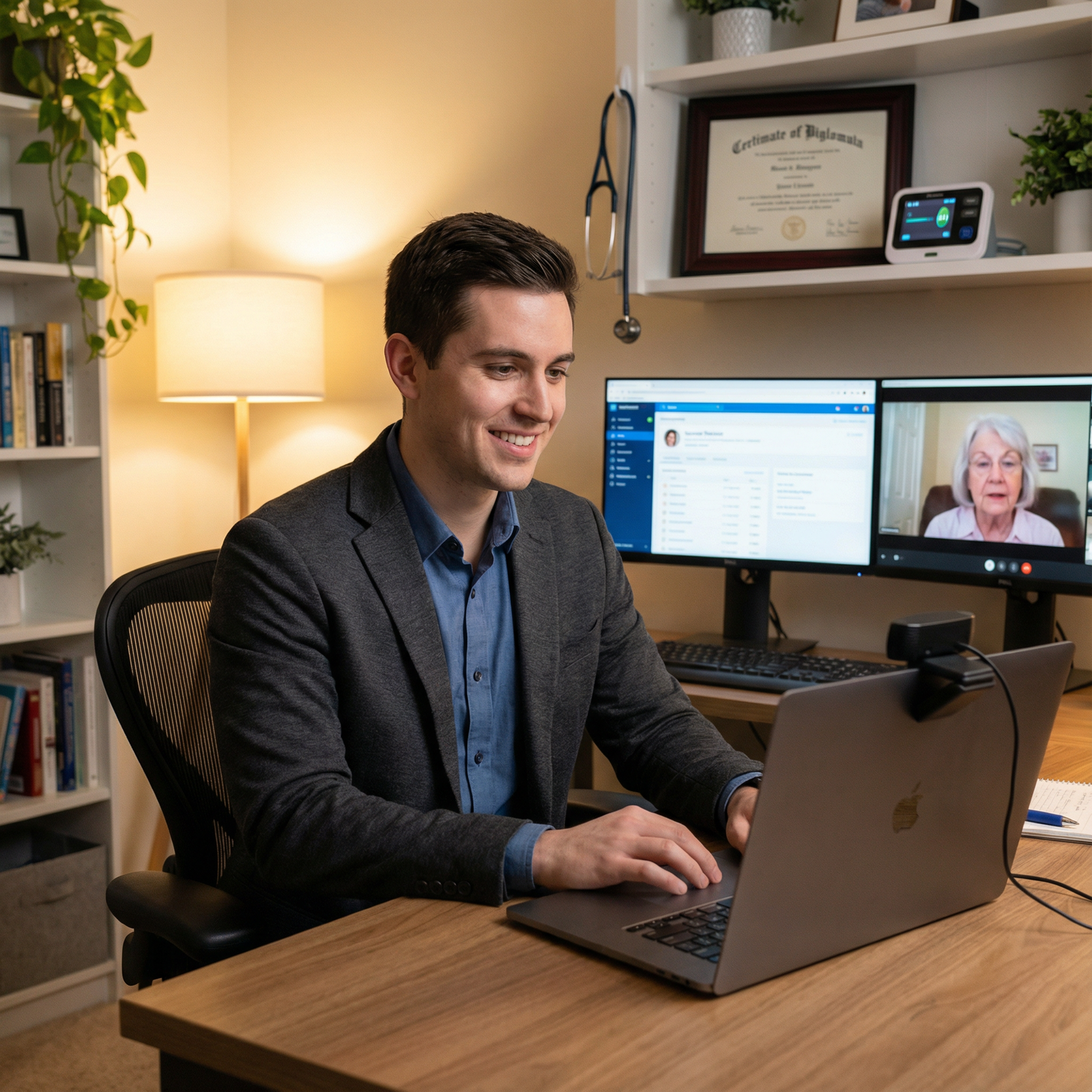
Good lighting, decent camera, fast internet, a quiet space, dual monitors. If you look and sound like a 2008 Skype call from your kitchen table, patients and employers notice.You live and die by protocols.
Especially in startup or urgent-care-style telehealth, protocols are tight: when to escalate, when to deny certain prescriptions, when to require in-person follow-up. People who fight every protocol lose these jobs fast.You may gain geographic freedom—but lose geographic identity.
Good: live anywhere, see patients in multiple states, pick up shifts on your schedule.
Bad: your “panel” can feel anonymous, relationships thinner, less longitudinal continuity depending on the platform.Compensation is often volume-based.
Strong clinicians who can do high-quality, efficient visits can earn quite well. But if you’re slow, overly chatty, or constantly escalating to in-person for safety, your effective hourly rate drops quickly.

| Step | Description |
|---|---|
| Step 1 | Patient logs in |
| Step 2 | Pre-visit intake |
| Step 3 | Clinician reviews chart |
| Step 4 | Video or chat visit |
| Step 5 | Treatment plan and Rx |
| Step 6 | Refer to in-person or ER |
| Step 7 | Document and close |
| Step 8 | Safe to treat virtually |
If reading that flow gives you hives, telemedicine might not be your forever home. If it looks clean and efficient, you’re probably wired for it.
How to Tell if You Are a Good Fit (Post-Residency)
Ask yourself a few hard questions:
When you’re in clinic, do you already think: “Most of this could have been done by video if I had the labs and history”?
If yes, good sign.Do you secretly enjoy EMR tinkering, templates, shortcuts, and optimizing workflow?
Odds are you’ll do fine in telehealth. You’re living in the EMR either way.Are you comfortable making clear decisions with partial data and setting firm safety boundaries?
If you freeze without a physical exam, that’s a problem. If you already practice with tight decision-making, you’ll transition well.Do you value flexibility—even at the cost of prestige or some in-person camaraderie?
Telemedicine can be socially isolating. For some, that’s a feature, not a bug. Know which you are.
| Category | In-person clinic (hrs) | Telemedicine visits (hrs) | Admin/Async care (hrs) |
|---|---|---|---|
| Week 1 | 20 | 10 | 6 |
| Week 2 | 16 | 12 | 8 |
| Week 3 | 20 | 10 | 6 |
| Week 4 | 18 | 12 | 8 |
Hybrid models like that are where a lot of post-residency docs are quietly landing, even if they never brag about it on LinkedIn.
The Bottom Line: Who Actually Thrives
Strip away the myths and marketing, and it boils down to this:
- Telemedicine is not a holding pen for retired physicians. It’s a fast-growing sector where early- and mid-career clinicians, especially in cognitive and chronic-care specialties, are doing very well.
- The people who thrive aren’t defined by age—they’re defined by how they think: fast synthesizers, comfortable with tech and metrics, willing to trade a bit of prestige and in-person buzz for autonomy, flexibility, and focus.
- If you’re post-residency and you like clean workflows, cognitive problem-solving, and schedule control more than white-coat theatrics, telemedicine isn’t your backup plan for age 65. It might be the smartest move you make in your 30s.