Telemedicine does not automatically explode your malpractice risk. The data so far suggest something more uncomfortable: the risk is mostly different, and most clinicians are miscalibrated about where the real landmines are.
I keep hearing the same lazy takes in hospital hallways and recruiter calls:
- “Telehealth is dangerous; you’ll get sued more.”
- “It’s safer because you see less sick patients.”
- “Malpractice carriers hate telemedicine.”
All three are wrong, or at least badly incomplete.
If you’re finishing residency or reshaping your post‑residency job mix, you do not need vibes. You need numbers, lawsuits, and policy language. Let’s talk about what is actually happening.
What the Evidence Actually Shows (So Far)
Short version: There is no massive malpractice tsunami from telemedicine. If anything, formal claims are still relatively rare. But that does not mean you’re safe.
Several key data points:
- A 2022 analysis of the Candello (CRICO) database—tens of thousands of med mal cases—found telemedicine accounted for significantly less than 1% of all claims over ~7 years. Most of those were in tele-stroke and tele-psych.
- A 2019 review in Journal of Telemedicine and Telecare looking at telemedicine malpractice litigation in the US found a small but growing number of cases; the majority centered on diagnostic error and triage failures, not technical glitches.
- Large carriers (e.g., The Doctors Company, ProAssurance) have publicly stated they have not yet seen a disproportionate rise in claims tied to telehealth compared with in‑person care, adjusting for volume.
So is telemedicine “safer”?
Not exactly. Here’s the catch: telehealth visit volumes exploded from 2019 to 2022. Claims lag by years. Many cases from that surge are only now getting into the litigation pipeline. So we are driving partially through the fog.
Still, the early pattern is pretty clear: the overall risk per encounter doesn’t appear wildly higher. What changes is where and how you get burned.
Myths About Telemedicine Malpractice Risk
Let’s kill a few persistent myths.
Myth 1: “Telemedicine is a malpractice magnet.”
No. At least not yet, and probably not in the way you think.
Classically, med mal clusters in:
- High-acuity encounters
- High-uncertainty specialties (EM, IM, peds, OB, surgery)
- Situations with bad outcomes + poor documentation
Telemedicine doesn’t magically change those dynamics. A low-acuity refills visit via video is not more dangerous than the same refills visit in an exam room.
What telemedicine does do is:
- Strip away parts of the physical exam
- Introduce licensing and jurisdiction complexity
- Create permanent audio/video/documentation artifacts plaintiffs can replay in court
So the “magnet” isn’t telehealth itself. It’s poorly selected encounter types combined with sloppy process and cross‑state chaos.
Myth 2: “Telemedicine is safer because patients are healthier.”
This is a half‑truth recruiters love.
Yes, a chunk of telehealth business is low‑acuity: rashes, URIs, med questions, mental health follow‑up. Those are generally lower‑risk, just like in person.
But I’ve watched systems quietly push high‑acuity complaints into virtual front‑doors:
- Chest pain scheduled into a 20‑minute video “same-day slot”
- Shortness of breath triaged through a nurse call → tele-urgent visit
- New severe headache in a 10‑minute urgent video clinic at 7 pm
The malpractice risk comes from mismatch: high‑risk complaints in a low‑bandwidth environment with weak triage rules. Not from the presence or absence of a physical building.
Myth 3: “If the platform is compliant, I’m covered.”
This is my favorite fantasy.
Your platform being HIPAA-compliant and your employer saying “we got you” does not automatically mean:
- Proper malpractice coverage in all states you’re seeing patients
- Policy coverage for asynchronous care (e-visits, store-and-forward)
- Coverage for cross-border encounters where the patient is sitting in a different jurisdiction than expected
I have reviewed contracts where physicians were assured “full coverage”—but the underlying policy specifically excluded telemedicine outside the physician’s primary state. Nobody read the fine print until after a near-miss.
You have to verify this yourself.
Where Telemedicine Actually Changes Risk
Let’s look at how the risk profile shifts, not just whether it’s “more” or “less.”
1. Jurisdiction: Where You Can Be Sued
In telemedicine, the patient’s location usually controls the jurisdiction. Not yours. Not the corporate office. The patient’s couch.
That means:
- You can be haled into court in states you have never physically entered.
- Different states have different caps, pre‑litigation panels, and procedural traps.
- A plaintiff attorney will pick the friendliest venue they can justify.
For multi‑state telehealth work, your exposure becomes a messy overlay of every state you touch.
| Factor | Low-Risk Scenario | Higher-Risk Scenario |
|---|---|---|
| Number of states seen | 1–2 | 10+ |
| Patient location rules | Strictly enforced | Loosely enforced / unchecked |
| Licensure status | Fully licensed | Using waivers / gray areas |
| Policy wording | Explicit telehealth cover | Ambiguous, no telehealth language |
| Employer compliance | Centralized, audited | Fragmented, rely on clinician memory |
If you’re joining a telemedicine-heavy role post-residency, you must ask: “In how many states will I be seeing patients? And is my malpractice policy valid in each?”
2. Standard of Care: Same, But Harder to Meet
Legally, the standard of care in telemedicine is generally the same as in‑person care: what a reasonably prudent clinician would do under similar circumstances.
There is no “telemedicine discount” on basic competency. Courts have not been sympathetic to “well, it was video so I skipped the neuro exam.”
So what happens? The gap between what you need to do and what you can do widens.
Classic examples:
- Neuro complaints without a decent neuro exam documented.
- Abdominal pain without vitals, no in‑person follow up, no safety net.
- Chest pain waved off as “probably reflux” because the patient looks comfortable on camera.
You either:
- Over-order tests and referrals to compensate, or
- Under-evaluate and hope nothing blows up.
From a malpractice perspective, #2 is how you get sued. The cases I’ve seen fall into two categories:
- Failure to escalate: “You should have sent me to the ER or ordered an ultrasound.”
- Failure to examine adequately: “You never even asked me to stand up or check for leg swelling.”
The standard isn’t lower because you’re remote. You just have fewer tools. Which means you must be much clearer about thresholds for escalation and follow-up.
What the Claim Patterns Actually Look Like
We don’t have 20 years of mature data. But the early telemedicine malpractice cases cluster around a few themes.
Diagnostic Error and Triage Failure
Unsurprisingly, the big category is exactly the same as in-person: missed or delayed diagnosis.
Common scenarios:
- Missed stroke or TIA in a tele-urgent visit (slurred speech brushed off as “you sound tired”)
- Missed meningitis, sepsis, or appendicitis in a child seen for “fever on video”
- Pulmonary embolism presenting as mild shortness of breath
These cases often turn on two things:
- Lack of targeted exam that was realistically possible via video;
- No documented safety net: no clear instructions, no “go to ER if X”, no time‑bound follow-up.
I’ve read tele-visit notes that are literally: “Video visit. Assessment: likely viral. Plan: supportive care.” That’s malpractice bait.
Communication and Documentation Errors
You know that one downside of telemedicine everyone ignores? Everything is recorded. If not by you, sometimes by the patient.
Even without official recording, telemedicine platforms often log:
- Exact timestamps of when you joined and left
- Whether you reviewed pre-visit questionnaires or messages
- What patient consents they clicked through
Plaintiff attorneys love this. They can reconstruct the visit’s timing, find inconsistencies, and show that you were rushed or inattentive.
And when your documentation is as thin as many tele‑urgent notes, it looks bad:
- “No exam possible” (while the video clearly shows you could have asked the patient to stand, speak, move)
- “No red flags” (with no list of what was checked)
- Zero mention of video limitations or the need for in‑person follow up
The defense position becomes much weaker.
Technical and Access Issues
These are rarer but emerging:
- Patient claims harm from delayed care because the tele-visit dropped and they never got a callback.
- Incorrect medication due to miscommunication in a choppy audio visit.
- Privacy breaches due to poorly secured home setups.
These are less often the core of a malpractice suit, but they add spice to a narrative that you and your employer were sloppy.
Specialty-Specific Reality Check
Risk changes across specialties, and the clichés are wrong here too.
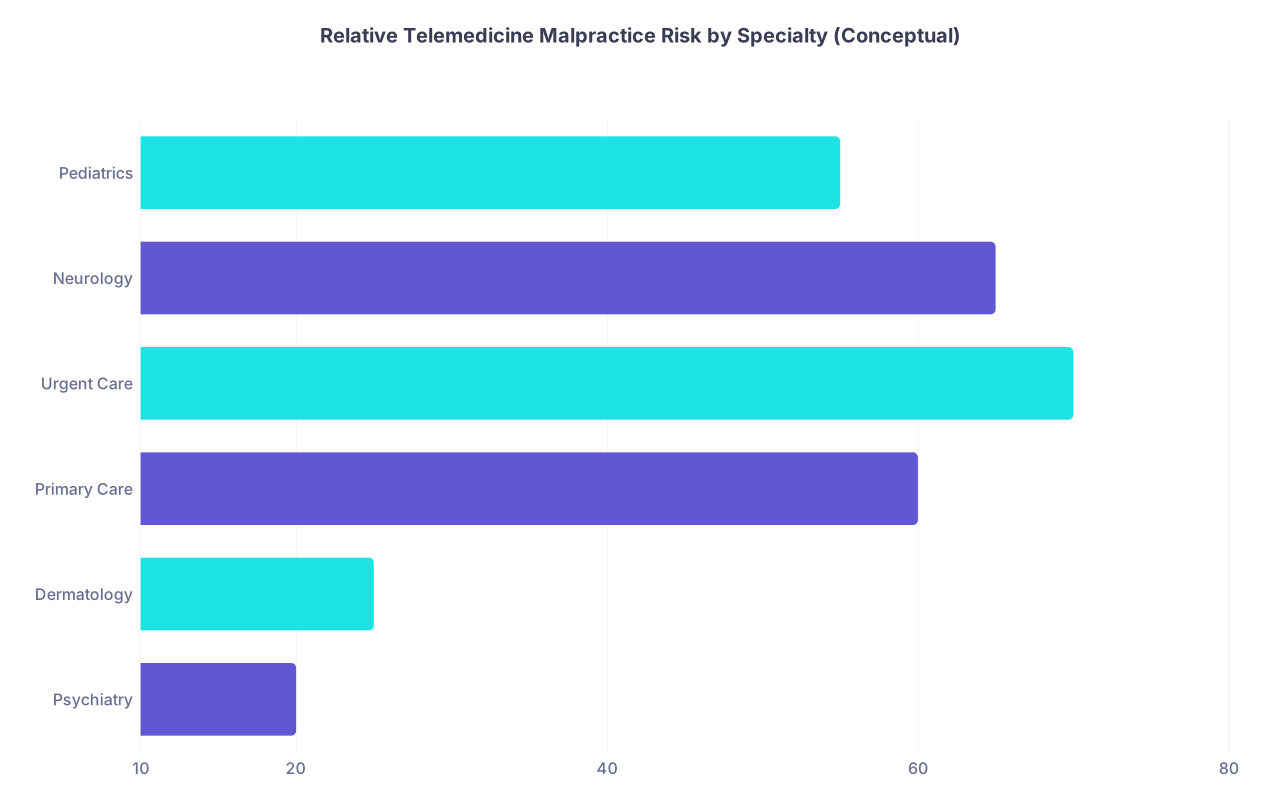
| Category | Value |
|---|---|
| Psychiatry | 20 |
| Dermatology | 25 |
| Primary Care | 60 |
| Urgent Care | 70 |
| Neurology | 65 |
| Pediatrics | 55 |
This isn’t hard numbers; think of it as a reasonable mental model, mapping onto what we’re seeing in early cases and insurer commentary.
- Psychiatry: Generally lower liability for physical harm, but don’t get cocky. Suicide/violence risk assessment in tele-psych is under intense scrutiny. If you skip risk assessments because it’s “just follow‑up,” you’re exposed.
- Dermatology: Store-and-forward and video derm can be relatively safe if you have clear image quality requirements and pathways for “uncertain” lesions to get biopsied in person. The disaster cases are melanoma missed because someone read a grainy smartphone selfie and never escalated.
- Primary care / tele‑urgent: This is the hot zone. Broad differential, mixed acuity, triage on the fly. The malpractice risk feels similar to high-throughput urgent care—but with fewer tools and weaker vitals data.
- Neurology (telestroke, tele-neuro): Huge stakes, but the infrastructure is often tighter. Protocolized consults, clear escalation, hospital support. The cases that go badly are often system failures: imaging delays, miscommunication with on-site teams, or misunderstanding of eligibility criteria.
- Pediatrics: Parents over- or under‑report symptoms, kids are harder to examine, and the threshold for badness is lower. If your tele‑peds triage is weak, malpractice risk spikes.
So is telemedicine “higher risk” than in-person? For urgent care‑style telehealth, I’d say: risk per high-acuity encounter may be higher if systems are not well built, because physical exam and immediate testing are crippled. For lower‑acuity, longitudinal follow‑up, risk may be similar or lower—if you handle escalation well.
Practical Reality for Your Post-Residency Career
The theoretical stuff is nice, but here’s what you actually have to decide:
- How much of your work will be telemedicine?
- Under what structure? Employed by a health system? 1099 for a national telehealth company? Hybrid private practice?
- How much malpractice risk are you willing to take relative to compensation and lifestyle?
What You Actually Need to Ask About Malpractice
When you’re looking at a telemedicine-heavy job, ask (out loud, in writing):
- In which states will I be seeing patients?
- Am I individually licensed in each, or are you relying on compacts / waivers?
- Does the malpractice policy explicitly cover telemedicine in all of those states?
- Are there any exclusions for asynchronous care, text‑based care, or call coverage?
- Claims‑made or occurrence? Who pays for tail if I leave?
If the recruiter gets vague here, that is a red flag.
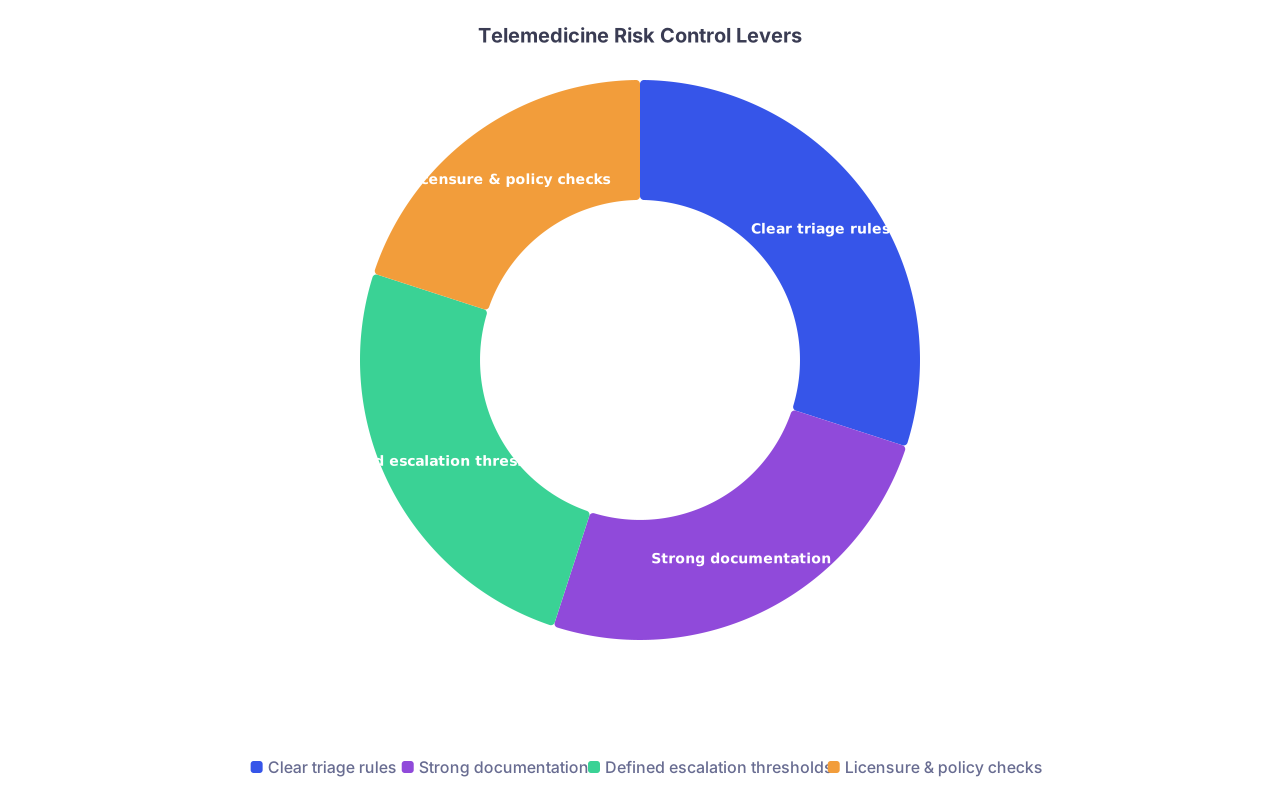
| Category | Value |
|---|---|
| Clear triage rules | 30 |
| Strong documentation | 25 |
| Defined escalation thresholds | 25 |
| Licensure & policy checks | 20 |
These levers matter more to your malpractice risk than whether the job is advertised as “telemedicine” or “in‑person.”
Where Clinicians Get Burned Most
From what I’ve seen, the worst missteps are mundane:
- Signing a 1099 tele-urgent contract assuming “they handle malpractice,” but the policy only covers one state while you see patients in ten.
- Doing tele-visits from vacation without checking patient location, accidentally treating someone in a state where you’re not licensed.
- Letting volume creep up—25 or 30 short tele-visits a day—until you’re basically doing drive-by medicine with no time to document or safety-net.
Telemedicine isn’t uniquely evil here. It just makes it much easier to stretch beyond your legal, cognitive, and time limits without feeling it in the moment.
So: Higher, Lower, or Just Different?
If you forced me to pin it down, here’s the honest answer:
- Overall malpractice claim rate per encounter for telemedicine so far appears similar or slightly lower than traditional care, largely because a big chunk of telehealth is low-acuity and relatively safe.
- For high-acuity complaints handled via tele-urgent without strong triage and escalation pathways, risk is likely higher than comparable in‑person visits. The environment is working against you.
- The pattern of risk is definitely different: jurisdiction and licensing complexity, documentation under the microscope, and standard‑of‑care expectations colliding with reduced physical exam.
So telemedicine is not a simple “more dangerous” or “safer” choice. It’s a different game with different failure modes. If you treat it like a Zoom version of your clinic, you will eventually get burned.
If you treat it like a distinct clinical setting with its own rules—clear triage, structured documentation, aggressive escalation thresholds, verified coverage—you can absolutely build a career around it without sleep‑destroying malpractice anxiety.
Key Takeaways
- Current data do not show a massive malpractice spike from telemedicine overall; the risk is shifted, not universally higher.
- The most dangerous zone is high‑acuity tele-urgent care without strong triage and escalation; that’s where missed-diagnosis suits live.
- Your real protection comes from explicit multi‑state coverage, disciplined tele‑specific processes, and ruthless honesty about what cannot safely be managed through a screen.