
Telehealth is not easy money. It is usually just invisible work paid at a discount.
If you’re post‑residency and eyeing telemedicine as the chill, high‑RVU hack that lets you see patients in slippers and print money between Peloton rides, you’re buying into a myth that recruiters, not data, created.
Let’s tear it down.
How The “Easy Money” Telehealth Myth Got Built
I’ve lost count of how many times I’ve heard some version of this from new attendings:
“I’ll do three clinic days and make up the rest with telehealth. Quick visits, no physical exam, from home. Easy extra 50–100K.”
This sales pitch comes from three places:
Recruiter marketing
“$120/hr from home!” sounds amazing when you’ve been making resident wages. They won’t highlight that you’re booked at 4–6 visits per hour with minimal admin support and uncompensated wrap‑around work.Cherry‑picked anecdotes
You hear about the one urgent care doc who crushed COVID tele‑urgent in 2020 at $150/hr doing 7–8 visits an hour in a massive surge. You don’t hear what their volume or pay looked like in 2023.The EHR illusion
On paper, telehealth visits look clean: closed notes, neat CPT codes, tidy dashboards. What you don’t see on those dashboards is the 10 minutes of unpaid work glued to each “15‑minute” visit.
Let me be blunt: telehealth can be a good part of a portfolio career. It’s rarely a passive income stream. It’s almost never easy money once you normalize for intensity, risk, and the hidden hours.
What Productivity Data Actually Shows
Strip away the hype and look at the numbers. Here’s what shakes out across large systems, national claims data, and internal productivity reports I’ve seen in the wild.
Visit length and volume: the 4–6 per hour treadmill
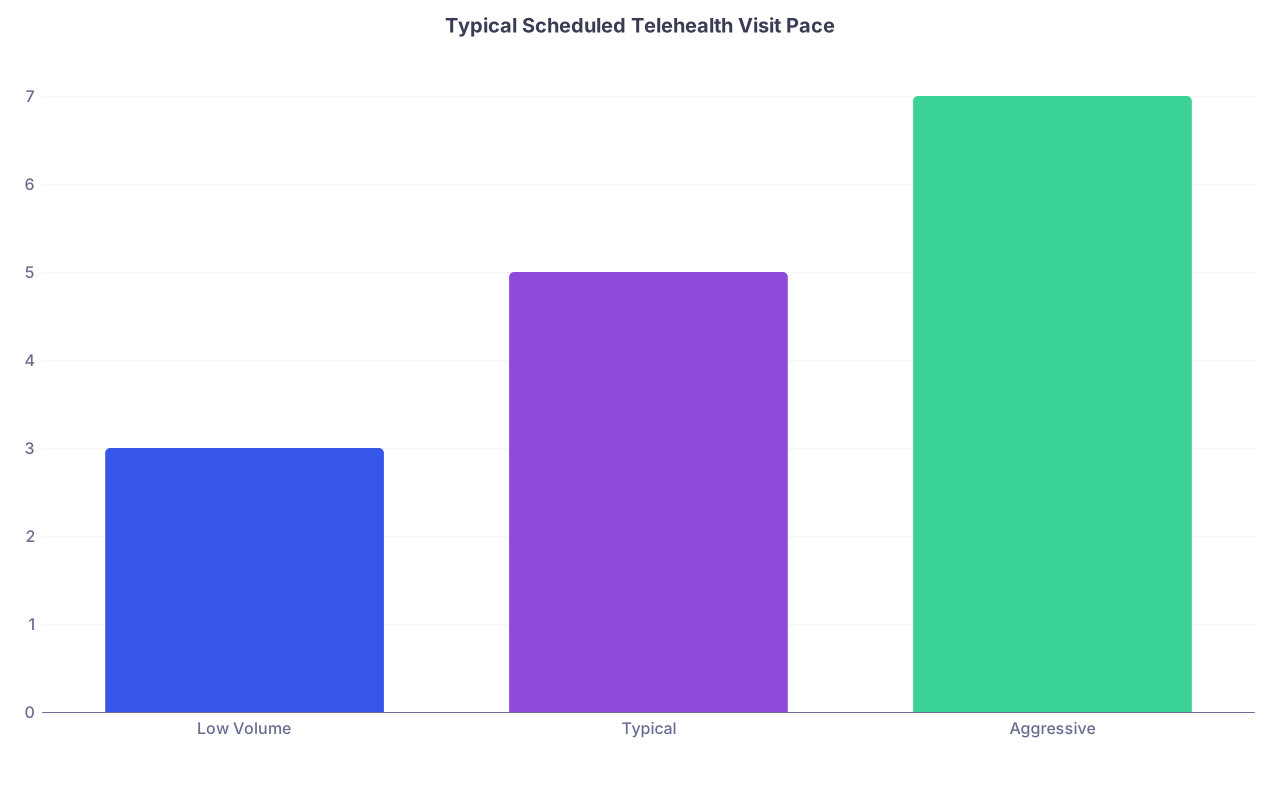
Most telehealth employer models, especially in primary care and urgent care, expect you to sit in the 4–6 visits per hour range.
Not “maximum capacity.” Baseline.
| Category | Value |
|---|---|
| Low Volume | 3 |
| Typical | 5 |
| Aggressive | 7 |
Three visits an hour is considered slow. Five is the sweet spot. Seven is what they quietly hope you’ll drift toward once you “get efficient.”
Now compare this with a sane in‑person primary care clinic template: 18–22 patients in a full day, so 2–3 per hour, with a nurse, MA, and front‑desk support absorbing a chunk of the chaos.
In telehealth, you are the MA, the nurse, and often the front desk.
You are:
- Verifying meds and allergies.
- Reconciling problem lists.
- Triaging complaints that are not appropriate for video.
- Explaining why you will not prescribe antibiotics or narcotics to a stranger with zero records.
- Documenting at a defensible level because plaintiff attorneys do not accept “it was just video” as a defense.
All while your schedule engine or queue expects 4–6 discrete, billable “units” per hour.
Time per visit vs. paid time
Here’s the part nobody selling you “easy money” wants to spell out. The clock they pay you for is not the same as the clock you live in.
For a typical telehealth primary care or urgent care visit, this is what I consistently see when physicians actually time themselves:
- 2–3 minutes: pre‑visit review, meds, chart hunting
- 10–12 minutes: video visit itself
- 4–5 minutes: documentation, orders, messages, routing
You are at 16–20 minutes of real time for what the system logs as a 10–15 minute visit.
If you’re “booked” at 4 visits per hour, the math works. Barely. At 5–6 per hour, the deficit is obvious: you either work off the clock or cut corners.
The “easy money” crowd almost never calculates effective hourly pay including this unpaid wrap‑around work.
Let’s actually do it.
Say you’re “paid” $120/hr for teleurgent care at 5 visits per hour.
- On paper: $24 per visit, 5 visits/hr, $120/hr.
- In reality: 20 minutes total per visit (including pre/post). That’s 100 minutes of work for 60 minutes of pay.
Your effective rate: $72/hr.
Still better than resident pay, sure. But not “wow, I hacked medicine” money. And that assumes your volume is stable and there’s no dead time between visits (there always is).
RVUs, Pay Models, and The Illusion of High Productivity
Telehealth economics sound great until you look under the RVU hood.
The RVU compression problem
Most standard telehealth visits map to the same E/M codes you already know: 99212–99214 equivalents or time‑based coding for established patients. Urgent/virtual‑only companies often anchor at what amounts to a 99213.
That means:
- RVUs per visit are modest.
- There’s not a magic “telehealth code” paying you more for less work.
Where things go sideways is productivity expectations.
In‑person, in a reasonable clinic:
- 2–3 visits/hour
- Support staff
- Some time blocked for admin
Telehealth:
- 4–6 visits/hour
- Little/no support staff
- Admin work buried between or after encounters
The RVU per visit doesn’t go up just because you moved to video. Only the number of visits you’re expected to crank out does.
So organizations pat themselves on the back for “improved productivity” because RVUs per day jump 30–50%. They ignore the fact that RVUs per hour of actual work often drop once you count all the uncompensated tasks.
Hourly vs. per‑visit pay: pick your poison
Most telehealth roles land in one of three pay models:
| Model Type | Typical Structure |
|---|---|
| Hourly | Fixed $/hr, volume target |
| Per-Visit | Flat $ per completed visit |
| RVU-Based | $ per RVU, volume expectations |
Hourly sounds safe. The risk is ratcheted expectations: “You’re on the clock; why are you only doing 3.5 visits/hour?”
Per‑visit sounds entrepreneurial. The risk is variability and unpaid idle time, plus pressure to cut documentation to hit pace.
RVU‑based in telehealth is usually just per‑visit in disguise. Most encounters pay out a narrow RVU band; the lever is visit count, not acuity.
The myth is that any of these models magically decouple income from grind. They do not. The only way your telehealth pay shoots up is by:
- Seeing more patients per hour.
- Working more hours.
- Or both.
You’re trading commute and clinic chaos for pace and cognitive load, not for free money.
Quality Metrics, Documentation Burden, and Hidden Work
The “no exam, easy note” fantasy dies the moment your telehealth company starts to care about quality and risk.
Which they will. Because payers do.
Quality metrics follow you to video
Commercial Medicare Advantage, ACO contracts, even plain old commercial plans are not stupid. They expect telehealth to hit the same quality marks as in‑person:
- BP control.
- Diabetes measures.
- Cancer screenings.
- Medication monitoring.
If your tele‑primary‑care role is tied into any value‑based contract, you’re now in the business of:
- Closing care gaps.
- Counseling on screening.
- Chasing labs and imaging.
- Coordinating follow‑up care.
All by video. Often with no embedded care team.
That’s more clicks, more messaging, more follow‑up. Most of it doesn’t show up as a separate billable encounter. It just eats your time.
Documentation is not lighter, it’s heavier
Telehealth documentation actually needs to be more explicit, not less. Every plaintiff expert’s dream case starts with, “Doctor chose to manage this by video but did not document why an in‑person evaluation was not necessary.”
So you end up with:
- More justification of medical decision‑making.
- Explicit documentation of limitations: “No in‑person exam; advised patient of limitations and red flags.”
- Extra lines detailing triage: “Recommended ED vs office vs home care.”
Every one of those sentences takes time. None of them increase RVUs.
Message volume and asynchronous chaos
Telehealth visits generate messages like pollen in spring.
Patients treat video access as a general portal to you. That means:
- “Quick questions” that are actually new problems.
- Follow‑up messages about tech issues, pharmacy errors, and prior auth.
- Photo uploads you now have to interpret and respond to.
Some telehealth companies pay for asynchronous encounters. Most don’t pay at a rate that reflects the cognitive work.
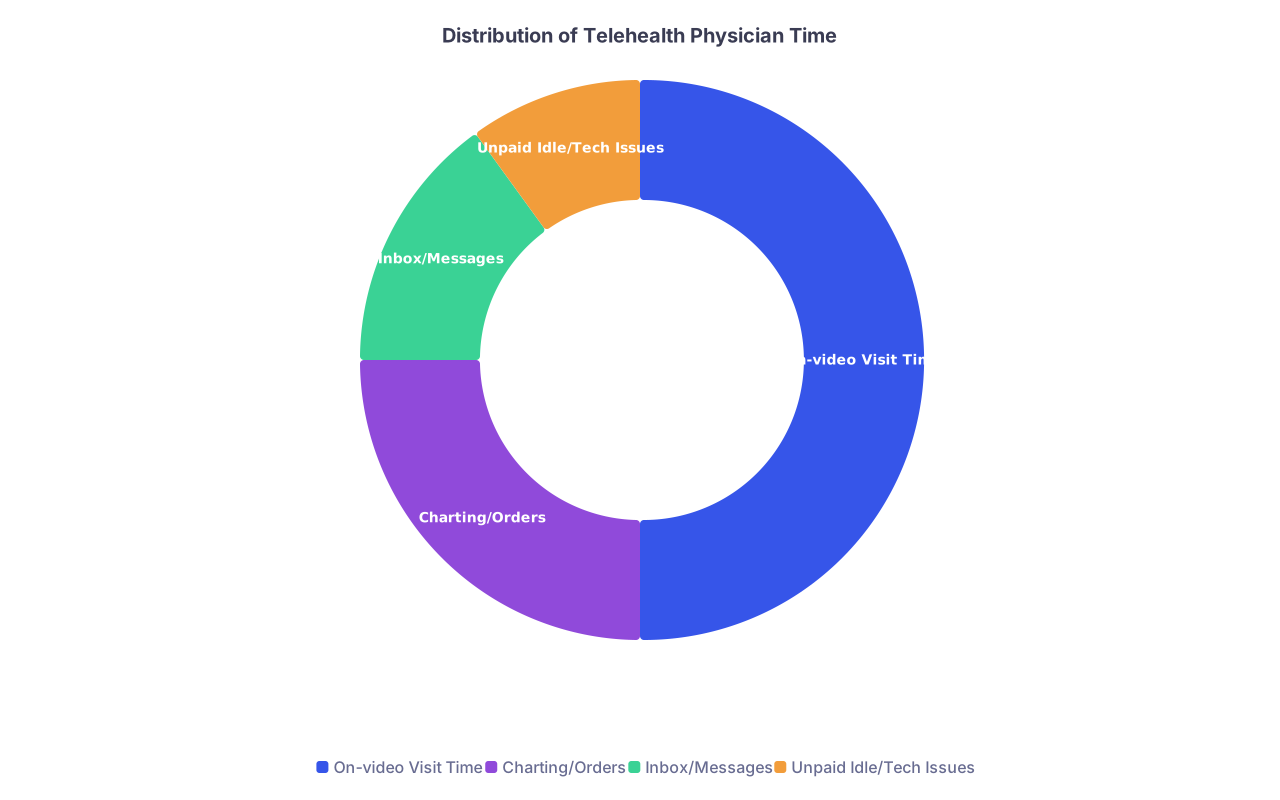
The result is what I see over and over when doctors start timing themselves:
| Category | Value |
|---|---|
| On-video Visit Time | 50 |
| Charting/Orders | 25 |
| Inbox/Messages | 15 |
| Unpaid Idle/Tech Issues | 10 |
Only about half the working time is actually on video with a patient. The rest is scattered across low‑visibility tasks.
The “easy” part is not in the data.
Burnout, Control, and The Real Tradeoffs
Let me give telehealth its due: some tradeoffs are legitimately good. Just not the ones you’re being promised.
Where telehealth does help
You gain:
- Commute‑free days and a bit of schedule flexibility.
- Fewer hallway interruptions and random in‑clinic crises.
- Less physical exhaustion; no bouncing between exam rooms.
For a new parent or someone needing geographic flexibility, that’s not trivial. Taking a half‑day of telehealth from home instead of a 14‑hour in‑person shift can be a sanity saver.
But that’s a lifestyle upside, not an economic arbitrage.
Where telehealth quietly increases strain
I see the same pattern in physician surveys and one‑on‑one conversations:
- Cognitive load goes up. Every visit is differential diagnosis with a partial dataset and limited physical exam.
- Emotional labor goes up. Patients expect instant access and instant solutions; toggling between strangers with no continuity all day is draining.
- Sense of control goes down. High‑throughput scheduling, little say over visit mix, and constant pressure to stay “green” on some internal dashboard.
And the kicker: the boundary between work and home erodes. You’re physically home but mentally still in clinic. It’s harder to shut the laptop and walk away when “just finishing a few charts” is always one click away.

| Step | Description |
|---|---|
| Step 1 | High visit targets |
| Step 2 | Less time per patient |
| Step 3 | More after hours work |
| Step 4 | Perceived lower hourly rate |
| Step 5 | Pressure to see more patients |
That loop is how “easy money from home” quietly becomes “same burnout, different chair.”
When Telehealth Actually Makes Financial Sense
Telehealth is not useless. It’s just mis-sold. There are situations where it does make solid financial and career sense – but they’re narrower than most people think.
Here’s where the data and real‑world experience line up in favor of telehealth:
As a supplement, not a core
An extra 4–8 hours/week of teleurgent or tele‑primary‑care, on your own terms, can be a decent way to add $20–40K/year if you’re clear‑eyed about the grind. The key is that you don’t rely on it as your main income.In tightly scoped niches
Tele‑derm with async image review. Sleep medicine follow‑ups. Psych follow‑ups with established patients. These can be more predictable and less admin-heavy than broad tele‑primary‑care, especially if you control the patient panel.If you own or co‑own the value stream
When you’re part of a group that actually sees the upside of value‑based contracts, telehealth can be a force multiplier: lower overhead visits, better follow‑up, fewer no‑shows. But that only matters if your comp plan shares those gains with you, not just the C‑suite.As a transition tool
Moving states, scaling back from full‑time clinical, or building a non‑clinical portfolio? Telehealth can be a flexible bridge, not a destination.
What it isn’t, for the vast majority of physicians, is a magic cheat code where you double your income by clicking “Join Meeting” in sweatpants.
The Bottom Line: Busting The “Easy Money” Story
If you strip away the glossy sales decks and recruiter scripts, the telehealth productivity story is pretty simple:
- The RVUs per visit are similar to in‑person.
- The documentation and quality expectations are at least as high.
- The visit rate expectations are often higher.
- The wrap‑around work is frequently unpaid and unmeasured.
- The net effective hourly rate is usually lower than the headline number on the contract.
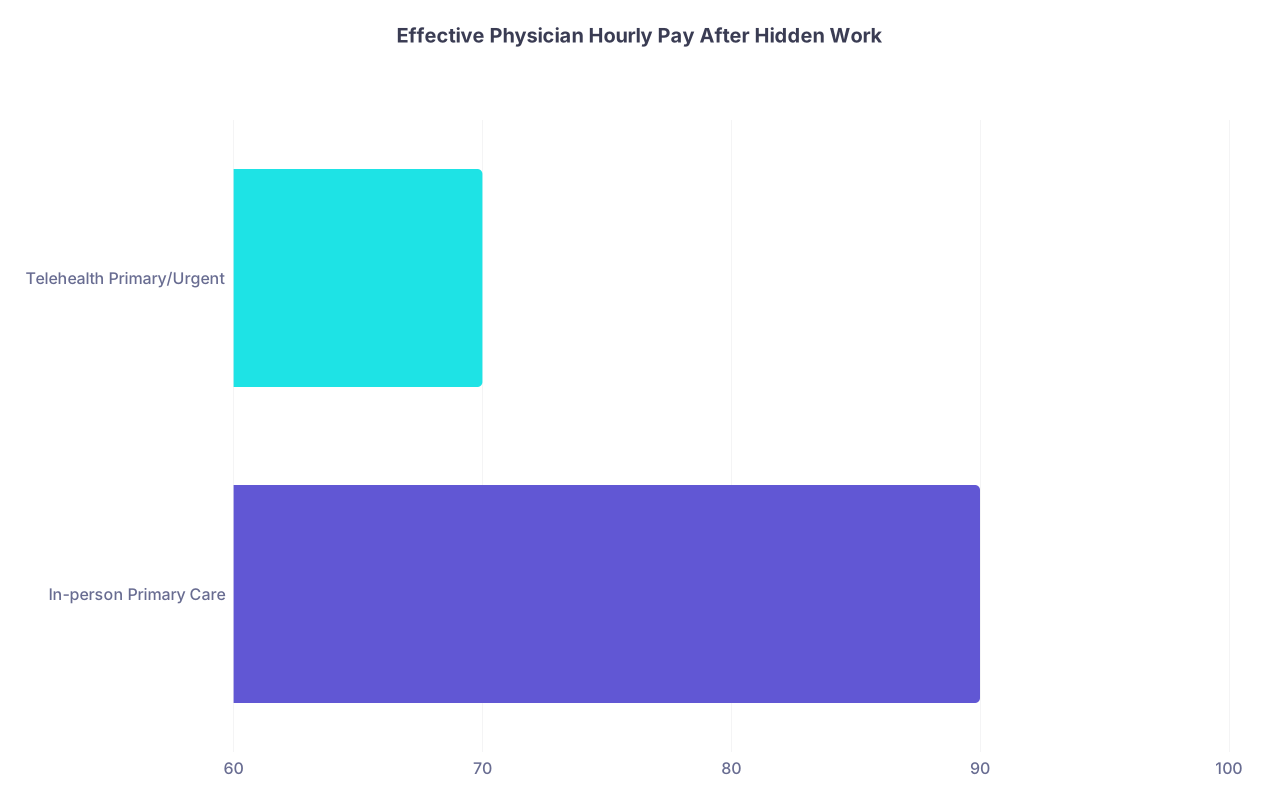
One last way to visualize it:
| Category | Value |
|---|---|
| In-person Primary Care | 90 |
| Telehealth Primary/Urgent | 70 |
Those numbers vary by geography and specialty, but the pattern – telehealth slightly lower after you account for hidden time – shows up over and over.
So if you’re post‑residency and planning your job mix, treat telehealth like any other tool:
- Run the real math on time per visit and realistic visit volume.
- Ask about documentation expectations, message volume, and quality metrics.
- Time yourself for a week and calculate your effective hourly rate, not the marketed one.
Telehealth can be useful. It can be flexible. It can be a smart slice of your income pie.
But “easy money”? The productivity data says otherwise.