The Silent Crisis: A Scenario in the Quiet Room
You know the room. You have been in a hundred variations of it. The door clicks shut behind you. The fluorescent lights hum at a frequency that seems designed to irritate the edge of your consciousness. There are maybe twelve other students in the room, but they might as well be furniture. The proctor hands you a laminated card with your login credentials. You sit down. The silence hits.
Not just quiet. Silence. The aggressive, sterile, institutional silence of a high-stakes testing center. The kind of silence that does not feel peaceful, it feels like a held breath. And the moment that silence swallows the ambient noise of the hallway, the elevator chimes, the rustle of backpacks, your internal monologue cranks up to volume eleven.
Did I study the brachial plexus lesions enough? What was that UWorld question about, no, stop, focus. Okay, question one. A 54-year-old male presents with...
You read the stem. You read it again. The words slide across your visual field like oil on water. Nothing sticks. Your heart rate is elevated. Your palms are damp. You are aware of your own pulse in your left ear. The question is sitting there in front of you, and your mind, the mind that scored a 248 on your last practice exam, has gone completely blank.
This is not a failure of preparation. This is a physiological event. Let me break this down specifically, because almost no one explains this correctly.
The quiet room is not a neutral environment. The sensory deprivation of that space strips away every external distraction, which means your brain, evolutionarily wired to scan for threat, turns its entire surveillance apparatus inward. There is no external threat in the room. No tiger. No attacker. So your amygdala, that almond-shaped sentinel sitting deep in your temporal lobe, starts treating your own thoughts as the threat. Every stray worry about your rank, your future, your competitiveness for the Match, becomes the tiger.
The body does not distinguish. Cortisol rises. The sympathetic nervous system engages. You are, neurochemically, in fight-or-flight mode, in a room where you are sitting perfectly still.
And then the blank slate phenomenon hits. You reach for the answer, the one you knew cold twelve hours ago, and the file drawer is empty. Not because the information is gone. Because the retrieval pathway is temporarily severed by the stress response. The prefrontal cortex, which handles your working memory and logical reasoning, has been told to stand down. The brainstem is running the show now, and the brainstem does not care about your UWorld percentages.
The Amygdala Hijack: Why Logic Fails in Silence
Let me break down the neurobiology here, because understanding the mechanism is the first step to interrupting it.
When you encounter a high-stakes exam stimulus, the login screen, the first question stem, the ticking timer in the corner of your screen, your amygdala processes it as a potential threat. This is not a conscious decision. The amygdala operates at a speed that bypasses conscious thought entirely. It receives sensory input from the thalamus a fraction of a second before your prefrontal cortex does. By the time your logical brain is saying, "This is just a test, I am prepared," your amygdala has already fired off the alarm.
The amygdala signals the hypothalamus, which activates the HPA axis, hypothalamus, pituitary, adrenal. The hypothalamus releases corticotropin-releasing hormone, the pituitary dumps adrenocorticotropic hormone into the bloodstream, and the adrenal cortex responds with cortisol. Meanwhile, the sympathetic nervous system, operating on an even faster timescale, floods your system with adrenaline and noradrenaline. Within seconds of sitting down at that desk, your body is marinated in stress hormones.
Here is the critical mechanism that almost no test prep company talks about: the prefrontal cortex is metabolically expensive and functionally fragile under stress. It is the most recently evolved part of the brain, the seat of executive function, working memory, and abstract reasoning. It is also the first region to go offline under a cortisol spike.
Studies have shown that even moderate acute stress, not trauma, just the stress of a timed high-stakes situation, significantly reduces prefrontal cortex activation on fMRI. The neurons there literally lose their ability to maintain sustained firing patterns. Your working memory, which is the mental scratchpad you use to hold and manipulate information while answering a question, degrades. Your ability to inhibit irrelevant thoughts, like "what if I fail", disappears. Your capacity for flexible, nuanced reasoning narrows into rigid, black-and-white thinking.
This is why standard advice fails. "Just breathe." "Stay calm." "Think positive." These directives are issued by your prefrontal cortex, which is the exact system that has been hijacked. It is like asking a hostage negotiator to resolve a situation when the hostage taker has cut their phone line.
Box breathing, while not useless, operates on the parasympathetic system, the brake pedal. But the brake pedal cannot fully override a brainstem that has already decided there is a mortal threat. The brainstem, specifically the periaqueductal gray and the locus coeruleus, are running the emergency broadcast system. Breathing helps, but it is scientifically insufficient on its own.
You need something else. You need a strategy that re-engages the prefrontal cortex directly, that forces the logical brain back online and signals to the amygdala that the threat is not real. We will get to that. But first, you need to understand why the silence itself is the problem.
The 'Silence' Trap: Sensory Deprivation and Cognitive Load
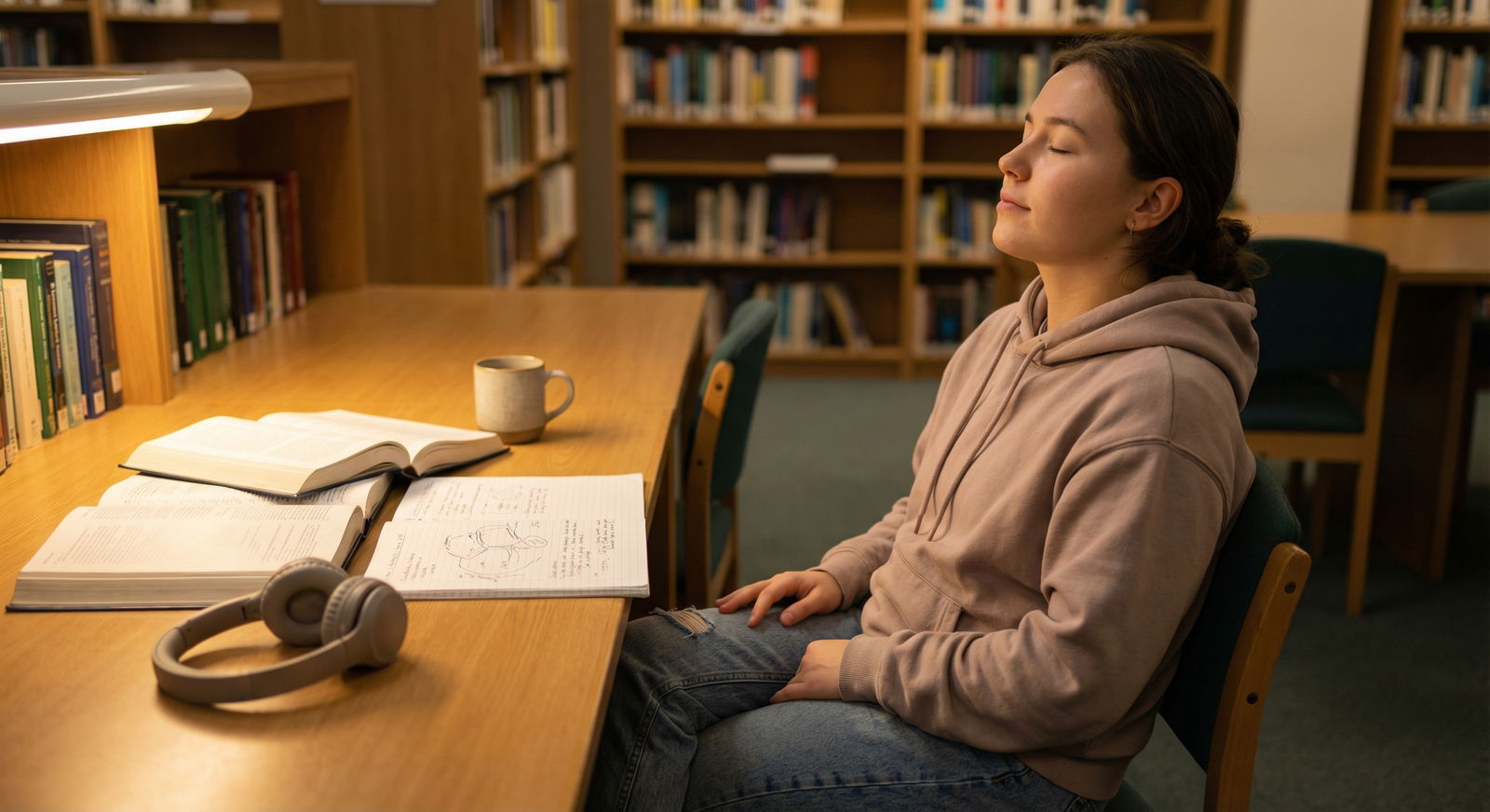
The testing center is, from a sensory standpoint, a deprivation tank. Minimal visual stimulation. No music. No conversation. The HVAC hum is the only ambient sound. Your phone is locked in a locker outside. There is no clock on the wall, the time is only visible in the corner of your screen, a silent countdown.
This is not an accident. Testing centers are designed for control, for fairness, for the elimination of cheating vectors. But they are also, unintentionally, designed to maximize internal noise.
Here is what happens in a sensory-deprived environment: the brain, starved of external input, begins to amplify its own internal signals. This is a well-documented phenomenon in sensory deprivation research. When external stimuli are minimized, the brain does not simply relax. It turns inward. Internal thoughts, worries, physical sensations, all become louder. The hum of the lights becomes a roar. The awareness of your own heartbeat becomes impossible to ignore. And the catastrophic simulations, "what if I do not match, what if I fail this shelf, what if everyone finds out I am an impostor", fill the vacuum.
This is the concept of internal noise. Cognitive scientists distinguish between external noise (distractions in the environment) and internal noise (distractions generated by the mind itself). In a normal environment, the two compete. In a quiet room, the external noise is suppressed, and the internal noise runs unopposed.
And here is the killer: internal noise consumes the same cognitive resources you need to answer the question. It is not a background process. It is a foreground process eating your mental RAM. Every cycle your brain spends monitoring your anxiety, evaluating your performance in real time, or simulating catastrophic outcomes is a cycle that is not available for retrieving the mechanism of action of vancomycin or the diagnostic criteria for SLE.
The silence is not your friend. The silence is the medium through which your anxiety amplifies itself. And if you do not have a strategy to manage that amplification, the silence will eat you alive.
Cognitive Load Theory: When Anxiety is the Variable
Let us get specific about the math, because this is where the rubber meets the road.
Cognitive Load Theory, originally developed by John Sweller in the 1980s, posits that working memory has a limited capacity. The classic estimate is 7 ± 2 items, though more recent research suggests it may be closer to 4. Either way, the pool is finite. Every element you hold in working memory takes a slot. The question stem. The patient demographics. The lab values. The answer choices. The mental model you are building to connect them all.
In a calm state, nearly all of your working memory is available for the task. You read the stem, you hold the key facts, you manipulate the mental model, you arrive at the answer. It feels effortless because your RAM is clear.
In an anxious state, your working memory is partitioned. A significant chunk, 40%, 50%, sometimes more, is consumed by what cognitive psychologists call "self-referential processing." That is the mental machinery of worrying. Monitoring your own anxiety. Evaluating whether you are panicking. Simulating the consequences of failure. Checking the clock and doing the math on how many questions per minute you need to hit. Each of these processes takes a slot.
You are not forgetting the answer. You are not stupid. Your RAM is full of panic. The information is still in long-term storage, but the retrieval pathway runs through working memory, and working memory is gridlocked.
This is why anxious students often report that they "knew the material cold" but "froze" on the exam. They are describing a working memory bottleneck. The knowledge is there, but the cognitive infrastructure to retrieve and manipulate it is occupied by a background task that will not yield.
The implication is clear: you cannot simply "try harder." Trying harder, in fact, makes it worse, because effortful self-monitoring consumes even more working memory. The solution is not more effort. The solution is to free up the RAM by offloading the anxiety process, and that requires a specific cognitive strategy.
Beyond Breathing: Tactical Countermeasures for the Quiet Room
Here is where the advice changes. Forget the generic breathing exercises. Forget the "stay positive" mantras. You need tactical, mechanistic countermeasures that directly address the prefrontal cortex shutdown and the cognitive load bottleneck. Let me give you three specific protocols.
1. Cognitive Defusion. This is a technique from Acceptance and Commitment Therapy, and it is far more effective than thought suppression. The error most students make is trying to fight the anxious thoughts. "Stop thinking about failing. Stop it. Focus." This is cognitively expensive and almost guaranteed to fail, because the act of suppressing a thought requires holding the thought in working memory to monitor for it. You are literally thinking about not thinking about it.
Cognitive defusion takes the opposite approach. You acknowledge the thought without engaging with it. "I am having the thought that I am going to fail." Not "I am going to fail." The linguistic shift creates distance. You observe the thought as a mental event, not a reality. It sounds trivial. It is not. Studies show cognitive defusion significantly reduces the physiological stress response associated with intrusive thoughts. You label the thought, you let it pass, and you redirect to the task.
2. The Anchoring Technique. This is the critical piece that breathing alone misses. You need to re-engage the prefrontal cortex directly. The fastest way to do that is through somatic grounding, deliberately directing attention to a physical sensation.
The 5-4-3-2-1 protocol is the standard: identify five things you see, four you feel, three you hear, two you smell, one you taste. In a quiet room, some of these are challenging, but that is the point. The effort of searching for sensory data forces the prefrontal cortex back online. You are directing the brain's attention outward, away from the internal noise, and into the external environment. This is the direct antidote to the sensory deprivation trap.
A faster variation: press your feet firmly into the floor. Feel the pressure. Focus on the sensation of the desk surface under your fingertips. Name three objects in the room in your head. This takes about ten seconds, and it signals to the amygdala that the environment is safe, because you are calmly observing it rather than scanning it for threats.
3. Structured Pausing. The instinct when anxiety spikes is to rush. The clock is ticking, the timer is counting down, every second spent not answering a question feels like failure. This is exactly wrong. Rushing increases the stress response, which deepens the prefrontal cortex shutdown, which makes you slower and less accurate.
Instead, when you feel the spike, stop. Not for minutes, for fifteen to twenty seconds. Close your eyes if the screen is too much. Do the physiological check: am I breathing? Is my heart rate elevated? Am I clenching my jaw? Then do the grounding sequence. Then return to the question.
Those twenty seconds cost you almost nothing in terms of time. They buy you back the cognitive capacity to answer the next ten questions correctly. The math is obvious.
Summary
The quiet room is a trap, but it is a trap you can dismantle once you understand the mechanism. The silence amplifies internal noise. The stress response shuts down the prefrontal cortex. The cognitive load bottleneck prevents retrieval of knowledge you already possess. And generic breathing advice, while not harmful, is insufficient to interrupt this cascade.
The countermeasures are specific, mechanistic, and learnable. Cognitive defusion to stop fighting the thoughts. Somatic anchoring to re-engage the logical brain. Structured pausing to trade twenty seconds of time for ten questions of clarity. These are not relaxation techniques. They are tactical protocols designed to address the actual neurobiology of test anxiety.
You are not lacking knowledge. You are lacking a system to manage the physiological hijack that steals your ability to demonstrate it. Build the system. Practice it until it is automatic. The quiet room does not get to win.