
You’re sitting on the couch, USMLE question bank open, but you’re not reading a single word. Your phone just lit up with a WhatsApp message from your mom:
“Exams coming up, right? You know we’re counting on you. Your cousin just matched derm at Mayo! We told everyone you will do even better 😊”
Your heart drops. Your chest feels tight. The thought of the exam was already making you queasy. Now it feels like your score is about to decide whether your family is proud of you or quietly disappointed for the next decade.
You’re not just anxious about the test. You’re anxious about what your parents will say. How your extended family will compare you. Whether you’ve “justified” the years of sacrifice they love to remind you about.
And it’s messing with your performance.
Let’s walk through what to do when your family pressure is amplifying your test anxiety—step by step, like you would handle an acute problem on rounds.
Step 1: Name the Actual Problem (Hint: It’s Not Just “I’m Anxious”)
You’re probably telling yourself: “I have test anxiety.” That’s true, but incomplete.
In your situation, there are usually three separate (but tangled) problems:
- Fear of the exam itself (content, timing, failing, score cutoffs).
- Fear of disappointing your family or “wasting” their sacrifices.
- Constant external reminders that raise your stress baseline: calls, comments, comparisons, questions.
You can’t fix a problem you’re not naming correctly. If you only treat this like a “self-confidence” issue or a study-technique issue, you’ll keep missing.
Here’s the real diagnosis:
You’re trying to take a high-stakes exam while carrying your family’s expectations on your back like a 50‑lb backpack.
So the plan has to include two tracks:
- How you study and manage the exam anxiety.
- How you respond to and set boundaries with your family so they stop re-triggering the anxiety every 48 hours.
We’re going to do both.
Step 2: Separate Your Story From Theirs
Right now your internal monologue probably sounds a lot like your parents.
“You have to be top of your class.”
“After everything we did for you…”
“Medicine is the only stable and respected career.”
“Imagine what people will say if you don’t do well.”
This is where things get messy: you might actually want to do well. You might even agree with some of what they say. But if you don’t separate your voice from theirs, your brain treats the exam as a referendum on your worth, your loyalty, and your gratitude—all at once.
You need a clean line. Their story vs your story.
Try this literally, on paper. Three short prompts:
“Things my family clearly expects from me about this exam:”
Write their words. Not your interpretation. Their actual phrases.“Things I actually want for myself from this exam:”
Not what sounds good on social media. Your real goals: “Pass on the first try,” “Score high enough for IM,” “Not have a panic attack in the testing center.”“Things I’m scared they’ll think of me if I don’t do well:”
This is the ugly part. Write the worst-case things your brain is whispering: “They’ll think I’m lazy,” “They’ll say I wasted their money,” “They’ll compare me to my cousin forever.”
You’re not doing this as therapy homework. You’re doing it to see the distortion.
Most of what you fear they’ll think? That’s your shame voice, not their stated words.
Does family sometimes weaponize shame? Yes, absolutely. I’ve seen parents say, “So what was the point of all this then?” after a kid missed a score target by 3 points. But usually, the actual quotes are milder than the internal catastrophe you’re spinning.
Once you see the separation, your task shifts from:
“Get a perfect score so I don’t feel like a failure”
to
“Manage my own shame and set limits around my family’s input.”
That’s a much more winnable game.
Step 3: Script Your Responses Before The Exam
If you wait until your mom calls the night before your shelf asking, “Are you ready? You studied enough, right?” you will default to either snapping or lying.
Both increase your anxiety.
You need pre-written scripts—short, repeatable responses you can rely on when your sympathetic nervous system is already in overdrive.
Let’s build three categories: update, deflect, and boundary.
1. The “Update, But Controlled” Script
Use this when you want to give some info but keep it brief.
Examples:
- “Yeah, the exam is on [date]. I’ve got a study plan and I’m sticking to it. I’ll let you know once I get my score.”
- “Studying is intense, but it’s on track. I’m focusing on what I can control day to day.”
Key features:
- No discussion of target scores.
- No detailed breakdown of your fears.
- You sound competent but not inviting interrogation.
2. The “Deflect and Move On” Script
Use this when they start poking: “How many hours are you studying?” “What’s your goal score?” “Your cousin scored a 260, right?”
Examples:
- “I’m trying not to obsess over numbers. My job is to follow my plan; the score will follow.”
- “My school’s advising me not to fixate on a specific number—everyone’s situation is different.”
- “I’ve got good guidance from my dean; I’m just doing what they recommend.”
Then: change the subject. Ask about their day, your sibling, the dog. People love to talk about themselves.
3. The “Soft Boundary” Script
Use this when their questions are directly hiking up your anxiety.
Examples:
- “Honestly, when we talk a lot about the exam, it makes me more anxious and actually hurts my studying. Can we talk about other things for now?”
- “The best way you can help right now is to trust that I’m working hard and not ask too many exam questions. After it’s over, I’ll tell you all about it.”
If your parents are reasonable at baseline, this often works. If they’re not, we move to hard boundaries later.
Write your exact version of each of these in your phone notes. Yes, literally. You’re going to copy-paste or mentally rehearse them before calls.
Step 4: Control the Volume of Family Input Around Exam Time
You can’t study effectively while your brain is bracing for the next interrogation. So you’re going to reduce the noise. Deliberately.
Here’s what this actually looks like in real life:
Two weeks before the exam, you text the key people: “Hey, just so you know, my exam is on [date]. I’m going to be a bit slower replying to messages because I’m really trying to stay focused and keep my anxiety under control. I’ll update you after.”
You move high-stress relatives (you know exactly who they are) to muted for 8 hours / 1 week / until you’re done. Muting is not betrayal. It’s basic emotional triage.
You designate one “safe” person (sibling, cousin, friend) as your family buffer if needed:
“If Mom is freaking out about not hearing from me, can you just tell her I’m studying and I’m okay?”
You’re not cutting your family off. You’re turning down the volume while you’re in a high-stakes window so your nervous system is not being constantly poked.

| Step | Description |
|---|---|
| Step 1 | Two Weeks Before Exam |
| Step 2 | Send expectation text |
| Step 3 | Minimal check-ins, low stress |
| Step 4 | Mute or limit calls |
| Step 5 | Use buffer person if needed |
| Step 6 | Exam Day |
| Step 7 | Family respects it? |
Step 5: Have a Panic-Mode Plan for Bad Interactions
You will have at least one awful interaction before a major exam. Someone will say something like:
- “Oh, you’re still studying? Didn’t you start months ago?”
- “You know we’ve spent so much money on your education… just don’t mess it up.”
- “Your cousin never seemed this stressed and she did great.”
That interaction will hijack your brain for hours unless you have a rapid response plan.
Here’s the plan:
Immediate triage phrase (to them):
“I have to get back to studying now, but we can talk later.”
Then you end the call. Not debate. Not defend. End.Physical reset (5–10 minutes):
- Stand up and move. Walk around the block. Do 20 jumping jacks. Shake out your arms.
- Sip cold water. Slow, controlled breaths—4 in, 4 hold, 6–8 out.
Cognitive reset (2–5 minutes):
Open a notes app titled “Reality Check.” Pre-write three truths about yourself and this exam:- “One exam does not define my worth or my entire future.”
- “I am allowed to have a different path and timeline than my relatives.”
- “My job is effort and process; scores are outcomes, not moral judgments.”
Read them out loud. Not in your head. Out loud.
Behavioral reset:
Do ONE easy, familiar task from your study plan. Not a new block. Something like:- Review 10 flashcards you already know.
- Redo 5 questions you got right before.
- Watch 5 minutes of a video you like.
The goal is not “maximum productivity.” The goal is: show your brain you’re back in motion.
This is the equivalent of managing a bad page on call. You don’t sit in the break room stewing for 2 hours. You stabilize, reset, and keep going.
Step 6: Decouple Your Score From Your Family’s Ego
Here’s the hard truth: some families use your accomplishments to prop up their own ego, social standing, or narrative of “we succeeded as parents.”
You cannot fix that for them. And you cannot study effectively while acting as their image-management department.
So you explicitly decouple. In your head first. Maybe later, with them.
Ask yourself:
“If this score had nothing to do with my parents—no one ever saw it except me and the program directors—what would a ‘successful outcome’ look like?”
Sometimes the answer is “pass.” Sometimes it’s “≥230.” Sometimes it’s “any score that lets me apply to these 3 specialties.”
That becomes your metric.
A concrete way to solidify this: define tiers.
| Tier | Description | Example for Step 1 |
|---|---|---|
| Floor | Minimum acceptable outcome | Pass on first attempt |
| Target | Solid, realistic goal | 225–235 |
| Stretch | High but not mandatory | 240+ |
Then you repeat to yourself (again, out loud):
“My goal is [Target]. Stretch is bonus. Floor is still success.”
You’re not lowering standards. You’re defining reality. Program directors think in ranges and thresholds. Your parents think in bragging rights and stories. Stop mixing those.
Step 7: What to Say After the Exam (Especially If It Went Badly)
A lot of your anticipatory anxiety is really: “What if I don’t do well and I have to tell them?”
So let’s pre-build that script too. Two versions: okay score and disappointing score.
If the score is fine or mixed
Example:
“Hey, I got my score. I passed and it’s within the range I needed for my plans. I’m proud of the work I put in. I know everyone always wants the highest number, but this is a good outcome for me and my goals.”
If they push for the number:
“Program directors and my school are fine with my score, and that’s what matters for my career. I don’t really want to turn it into a family comparison thing.”
Then you stop explaining. If they keep going, you move to:
“I get that you’re curious, but talking about specific numbers makes it harder for me and I’m really trying to protect my mental health. I need you to respect that.”
If the score is disappointing
This is the part that keeps people up at 3 a.m. So here’s a structure that works under stress:
- State the fact.
- State what you’re doing about it.
- State what you need from them.
Example:
“I got my score back. I didn’t hit the range I was aiming for, and I’m disappointed. My school and I already talked about next steps: [plan]. Right now what I need from you is support, not pressure. I’m already being hard enough on myself.”
If they say something shaming (“How could this happen?” “After everything we did?”):
“Comments like that make it harder for me to focus on fixing the situation. If you want to help, ask what I need going forward instead of rehashing what went wrong.”
You’re training them how to treat you. Slowly. Imperfectly. But it’s still training.
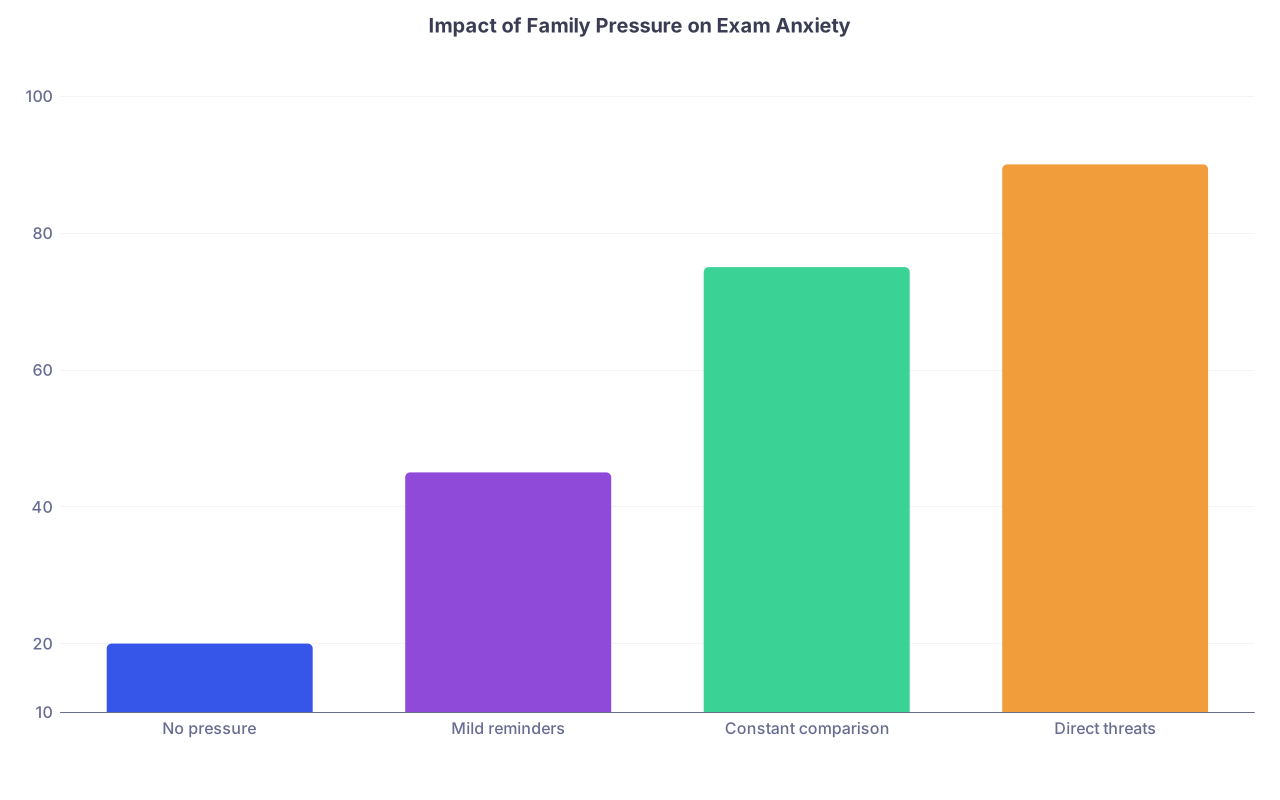
| Category | Value |
|---|---|
| No pressure | 20 |
| Mild reminders | 45 |
| Constant comparison | 75 |
| Direct threats | 90 |
Step 8: Build a Small “Anti-Family-Pressure” Support Team
You don’t need 20 people. You need 2–3 who get it.
This could be:
- A classmate from a similar cultural background whose parents also weaponize “sacrifice.”
- A resident who told you honestly that they scored lower than they wanted and still built a solid career.
- A friend outside medicine who reminds you you’re more than a walking score report.
Your ask is simple:
“Hey, my family pressure around this exam is pretty intense. Can I check in with you the week before / morning of / after I get my score just so I’m not alone with it?”
That’s it. You’re not asking them to fix your life. You’re asking them to be a counterweight.
On the actual day you get your score, contact them before you contact your parents. Even if it’s just:
“Got my score. Not what I wanted, but I’m dealing. Can I call you later after I talk to my family?”
You’re putting an emotional buffer between the event and the family narrative.
Step 9: If Your Family Pressure Is Relentless and Borderline Abusive
Some of you aren’t dealing with “subtle pressure.” You’re dealing with outright emotional blackmail:
“If you don’t get into [specialty], don’t come back home.”
“You’re the only hope for this family.”
“We told everyone you’re going to be a surgeon. Don’t embarrass us.”
When it’s at this level, polite scripts alone aren’t enough. You need structural protection.
That might look like:
Shortening calls intentionally. You keep every call to 10–15 minutes. The moment the conversation turns to exams or comparisons, you say, “I have to go now” and you hang up. Every single time. You teach them that certain lines of conversation end access.
Using text instead of calls. Text gives you time to compose answers, paste scripts, and not hear the tone that cuts into you.
Looping in a neutral professional. If your school has mental health services, use them. Not because you’re “weak,” but because you’re trying to manage an exam with chronic emotional stress at baseline. That’s like running a marathon with a weighted vest; you deserve coaching.
Considering partial information. You do not have to tell them every exam date, every result, every rotation grade. You can tell them summaries after the fact when you feel ready.
You’ll feel guilty. Fine. Guilt is not a reliable signal here. It just means you’re doing something different than the script you were handed as a kid.
You’re not betraying your family by protecting your nervous system long enough to get through med school intact.

Step 10: Integrate Family Reality Into Your Study Plan (Not the Other Way Around)
Most students try to build a “perfect” study plan and then hope their family doesn’t blow it up. That’s backwards. If your family is a known stressor, you design your plan expecting those hits.
Some examples:
You schedule “family-trigger recovery” time each week. One hour after your usual weekend call where you don’t plan heavy QBank blocks, because you know you’ll be rattled.
You front-load your hardest study in the hours when you’re least likely to be contacted. Early mornings before your family is awake in another time zone, or late evenings when they’re busy.
You set a rule: no checking family group chats during blocks. Period. Not “I’ll just glance.” During your 2-hour study interval, your phone is on Do Not Disturb or in another room.
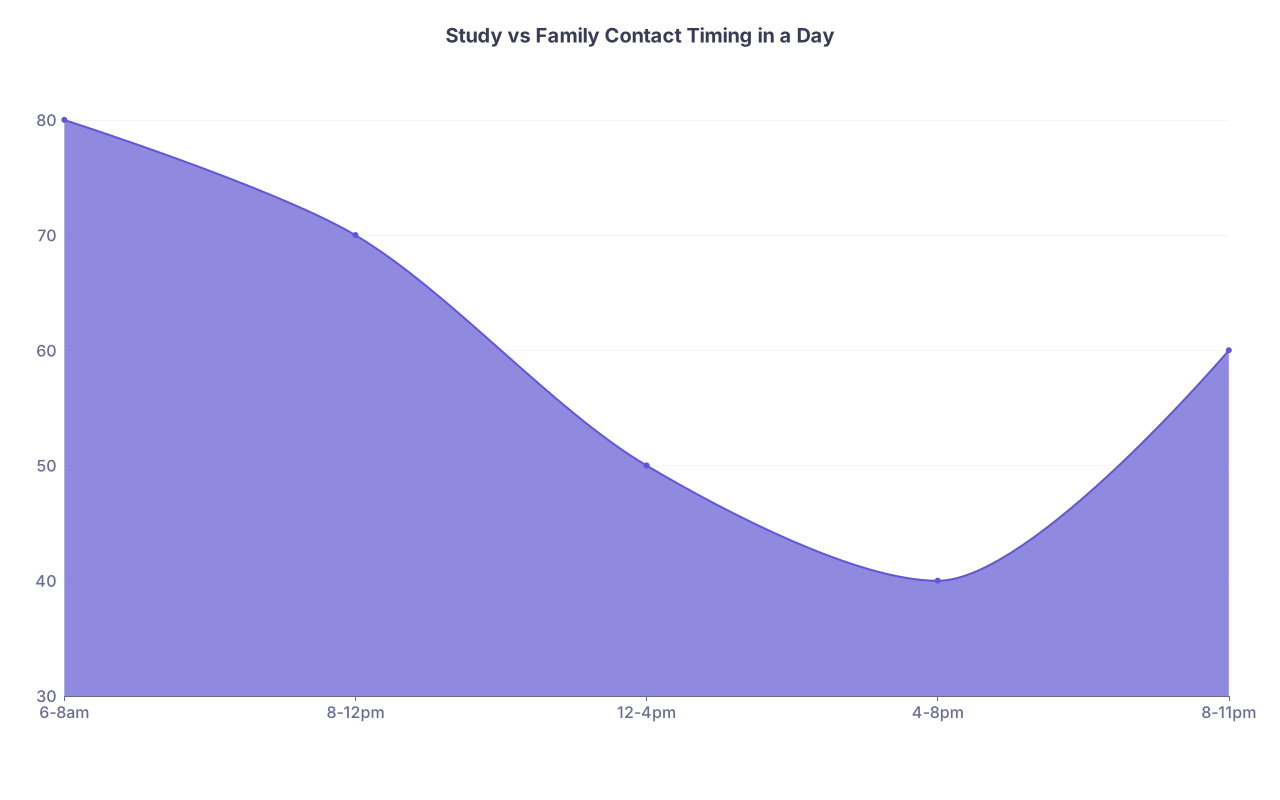
| Category | Value |
|---|---|
| 6-8am | 80 |
| 8-12pm | 70 |
| 12-4pm | 50 |
| 4-8pm | 40 |
| 8-11pm | 60 |
(Interpretation: higher values = better focus. You put your toughest work where focus is highest and family interruptions are lowest.)
You’re not aiming for a fantasy world where your family suddenly becomes serene and enlightened about mental health. You’re engineering your environment, given who they actually are.

Step 11: Prepare For the Long Game
This isn’t a one-exam issue. It’ll show up again:
- Step 2 / Level 2 / COMLEX.
- Shelf exams.
- Residency match.
- Board certification.
Your goal is not to find the magic sentence that changes your family overnight. Your goal is to build:
- A consistent way you talk about exams with them.
- A consistent way you protect your own mental space.
- A consistent way you recover when they inevitably say something unhelpful.
Over time, a few things usually happen:
- Some families adjust (a little). They learn that certain comments cause distance, and they like access more than they like control.
- You adjust. You become less reactive, because their words hit a scar, not an open wound.
- Your anxiety around exams shifts from “ice bath” to “cold shower.” Still uncomfortable, but survivable.
You’re not trying to eliminate pressure. You’re trying to keep it at a level where you can still think, still recall, still perform like the capable person you are when nobody’s watching.

You’re in a tough spot. You’re trying to grow into an independent professional while still being treated like the family project. That tension doesn’t vanish because you passed an exam.
But now you’ve got actual tools:
- Scripts for before and after the test.
- Boundaries on contact and content.
- A reset plan for when they say something that guts you.
- A way to define success that isn’t just “whatever makes my parents proudest at weddings.”
Use this exam as practice, not a final verdict. With each round, you’ll get a little better at holding your own story next to your family’s story—without letting theirs swallow yours.
And once you have that skill, you’re not just ready for the next test. You’re a lot more ready for residency, for real responsibility, and for building a life that belongs to you, not to everyone who thinks they own a piece of your success.
Those challenges are coming. But first, you’ve got this exam—and now, a much better way to face it.