
Two weeks before your shelf exam, you’re sitting in a dark call room at 2 a.m., still in sweaty scrubs. Your phone is finally quiet, your brain is fried, and your practice questions from earlier were a disaster. You know you should study. You also know if you don’t sleep, tomorrow you’ll be useless and your anxiety will spike even higher.
This is the knot a lot of medical students get stuck in: high‑stakes exams plus a brutal call schedule. You’re not anxious because you are weak. You’re anxious because the system is designed like a pressure cooker. So let’s talk about what to do in this exact situation.
Step 1: Accept the Reality You’re Actually In
You’re not a full‑time test taker. You’re a full‑time worker who happens to also have high‑stakes exams. That changes the rules.
If you try to follow study plans made for people with normal 8–5 schedules and weekends off, you will feel like you’re failing every day. That failure feeling is gasoline on your test anxiety.
So first, reset the frame:
- Your goal is adequate performance under constraints, not perfection under ideal conditions.
- Your study and anxiety strategy has to respect call, not pretend it does not exist.
- You must protect minimum cognitive function (sleep, food, hydration) before you chase high-level optimization.
If you’re on, say, Q3–Q4 call or nights, you do not have a time problem. You have an energy and predictability problem. That’s what we’re going to manage.
Step 2: Build a “Call-Safe” Study Plan (Not a Fantasy Schedule)
Your anxiety spikes partly because you create impossible plans and then watch yourself fail them. Fix that.
Design a plan that survives call
Think in minimums, not maximums. Your exam plan should have:
- A baseline you can hit even on terrible weeks.
- An upgrade version for lighter days.
On a heavy call month, your baseline might be:
- 20–30 high‑quality questions per day on non-call days.
- 10–15 questions or 20–30 minutes of light review on post‑call only if you’re not a zombie.
- 1–2 deeper review blocks (60–90 minutes) per week when you’re off.
That sounds small to high‑achiever brains. It’s not. If you do that consistently for 4–6 weeks, it adds up.
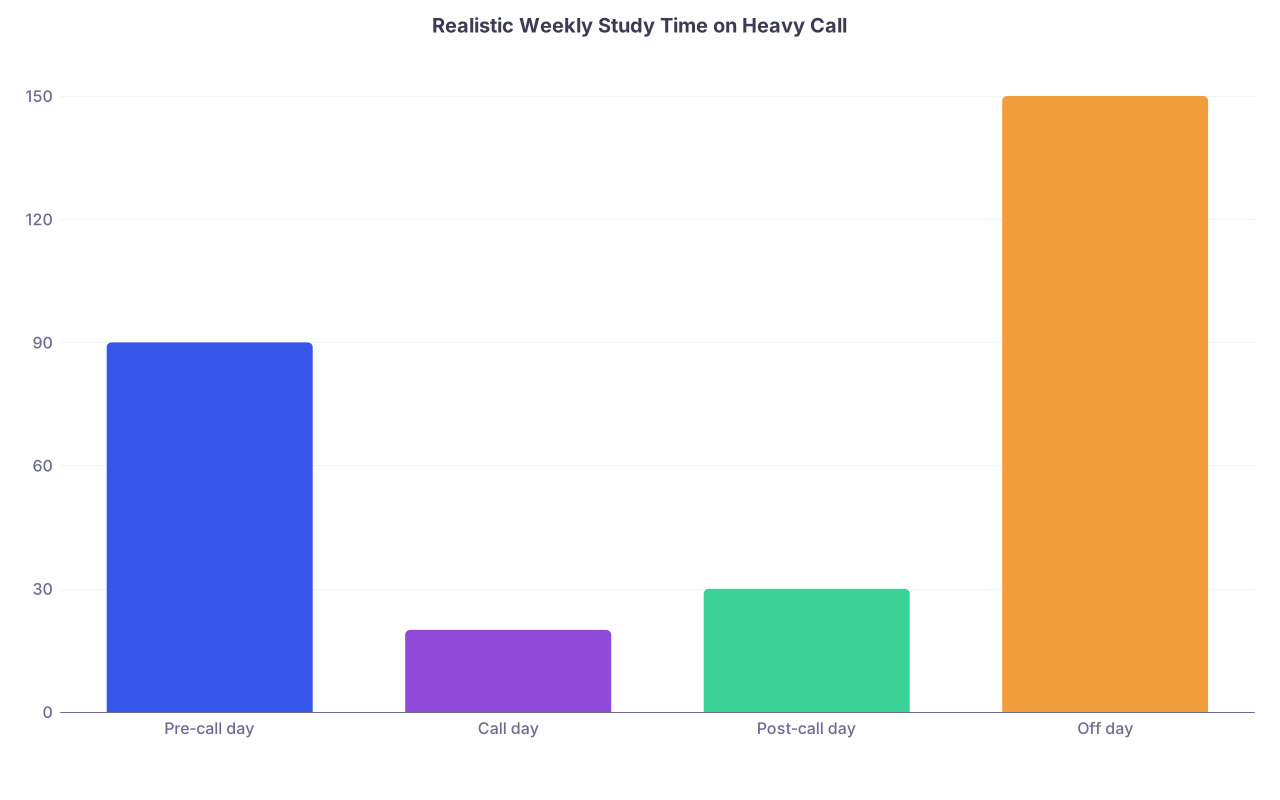
| Category | Value |
|---|---|
| Pre-call day | 90 |
| Call day | 20 |
| Post-call day | 30 |
| Off day | 150 |
Rough translation of that chart: aim for 90 minutes on pre‑call, token review on call, 20–30 minutes max post‑call (or zero if destroyed), and a bigger block on off days. That is a call‑respecting plan.
Make an “If This, Then That” schedule
Ambiguity feeds anxiety. You want rules you can execute when tired.
Example:
- If I’m pre-call and off by 6 p.m. → I do 40–50 questions + 30 minutes review.
- If I’m on call → I bring 10 easy questions or flashcards; only do them if there’s true downtime and I’m safe to concentrate. Otherwise, zero.
- If I’m post‑call and slept <3 hours → no studying. Shower, food, sleep.
- If I’m post‑call and actually napped at hospital and feel decent → 10–15 questions max, then stop.
- If I’m off day → 2 focused blocks of 60–75 minutes with a real break between. Then be done.
Write this down somewhere visible. Your anxious brain will try to renegotiate and guilt you into more when you’re exhausted. The written rules win.
Step 3: Use Micro-Studying the Right Way on Call
You’ve seen people haul UWorld and Anki into the call room and churn all night. Most of them are lying about how much they actually retain.
On heavy call, you should treat micro‑study as “bonus reps,” not the core of your learning.
What to do during actual lulls
On a lull that’s truly safe (no active patients waiting, you’re not in the middle of signouts mentally):
Open a low‑friction task:
- 5–10 flashcards of high‑yield facts (electrolyte disorders, empiric antibiotics, murmurs, etc.).
- 3–5 easy questions from a Qbank. Not brand-new brutal questions when you’re half-conscious.
- Quick read through your own notes or screenshots of “stuff I always forget.”
Set a hard cap: 10–15 minutes.
When the timer hits, you either:- Stop and rest, or
- Choose consciously to do another 10–15, but not automatically drift into a 90‑minute slog.
What you avoid on call:
- Long Qbank sessions where you’ll get crushed and feed anxiety.
- Timed blocks when a nurse can call you any second. Getting constantly interrupted trains your brain that questions = stress.
You’re not trying to “finish all of Anki” on nights. You’re trying to touch the material enough that it feels familiar and less scary later.
Step 4: Attack the Anxiety Physiology Directly
You cannot mindset-talk yourself out of anxiety if your body is locked in fight‑or‑flight. You have to work both angles.
When your heart is racing thinking about the exam while you’re on call day 23, do something physical first:
Fast reset tools you can use at work
You can do these in a supply room, empty stairwell, or call room. I’ve seen residents do some version of each during ICU months.
Physiological sigh (2 breaths, 1 long exhale)
- Inhale through your nose.
- Short second inhale on top.
- Long slow exhale through pursed lips.
- Repeat 3–5 times.
You should actually feel your shoulders drop.
Box breathing (4–4–4–4)
- Inhale 4 seconds.
- Hold 4.
- Exhale 4.
- Hold empty 4.
Do 4 cycles. That’s 1–2 minutes. You can do it walking between wards.
Grounding: 5–4–3–2–1
Quick sensory game:- 5 things you can see.
- 4 things you can feel (scrubs on skin, floor under shoes).
- 3 things you can hear.
- 2 things you can smell.
- 1 thing you can taste.
It rips your brain out of “I’m going to fail” loops and back into the real room you’re in.
If your anxiety is routinely severe (panic attacks, can’t sleep, intrusive thoughts, nausea before tests), this is not a DIY hero situation. Talk to student health or a psychiatrist. Test accommodations, short-term meds for exams, or therapy aren’t weaknesses. They’re tools.
Step 5: Build a Pre‑Exam Week That Accounts for Call
Pretending that you’ll magically have a “clean” week before the exam when you’re on an intense rotation is how people end up spiraling.
You need to know exactly what your last 7 days will look like based on your call pattern.
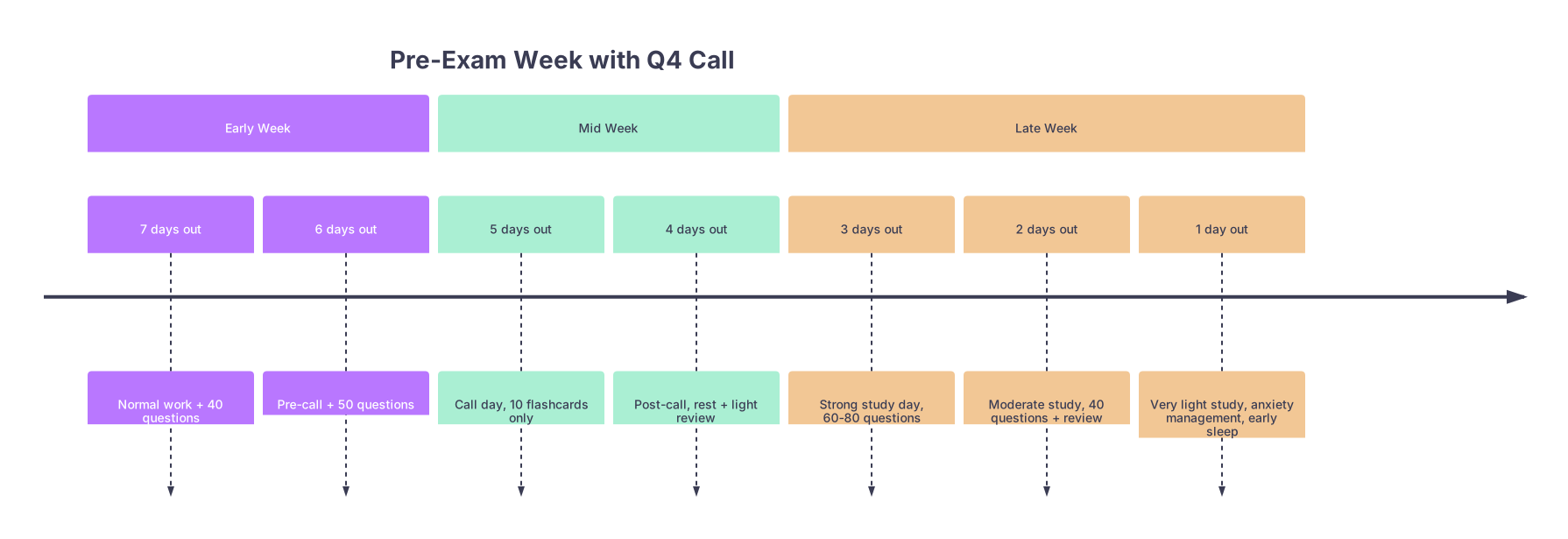
| Period | Event |
|---|---|
| Early Week - 7 days out | Normal work + 40 questions |
| Early Week - 6 days out | Pre-call + 50 questions |
| Mid Week - 5 days out | Call day, 10 flashcards only |
| Mid Week - 4 days out | Post-call, rest + light review |
| Late Week - 3 days out | Strong study day, 60-80 questions |
| Late Week - 2 days out | Moderate study, 40 questions + review |
| Late Week - 1 day out | Very light study, anxiety management, early sleep |
General rules for your last week when also on call:
5–7 days before: One big push day.
Pick the best-energy day (not call, not post‑call). Do your longest block of questions and review then. That’s your “confidence anchor” day.2–3 days before: Medium days.
Focus on:- Your weak systems (e.g., renal, heme/onc).
- Memorization lists (antibiotics, equations, diagnostic criteria).
- Reviewing your journals of missed questions or marked items.
Day before:
- NO new Qbank sets designed to “test yourself.”
- Only:
- Skim high-yield notes.
- Revisit your “always wrong” topics.
- Do a tiny set of questions only if it calms you, not if it freaks you out.
If you’re on call the day before the exam, the strategy changes:
- Prioritize sleep whenever it’s safe.
- Bring only light materials (flashcards, short notes).
- At some point in the night, mentally declare yourself done: “Whatever I know now is what I’m taking.” That mental closure matters.
Step 6: Create Clear Boundaries Between Roles
Heavy call blurs everything. You feel like you should be studying while you’re on the floor and feel guilty about patients when you’re studying. That double guilt is jet fuel for anxiety.
You need sharp mental compartments.
Make a simple rule set like this:
- “On the floor or in patient care areas: I’m 100% clinician/learner. Zero exam thoughts.”
- “In the call room with the door closed, pager quiet: I’m 100% student for the next 20 minutes.”
- “At home: I decide ahead of time: Study block vs pure rest. No half‑studying while doom‑scrolling.”
You can reinforce this with tiny rituals:
- When you sit at your study spot, plug in your laptop, set timer → that’s the signal “exam mode.”
- When you close the Qbank and physically put your materials away (not just alt‑tab) → “work is over.”
Your brain learns the association. That separation decreases the background hum of “I should be doing everything at once.”
Step 7: Fix the One Thing Everyone Ignores: Sleep on Call
Test anxiety is worse when you’re sleep‑deprived. That part is obvious. What’s not obvious is that you often have more control over tiny sleep decisions than you think.
You will not get perfect sleep. But you can go from “disaster” to “barely adequate” with a few moves.
On nights / heavy call:
Do not study during safe, guaranteed sleep windows.
If you know from 2–4 a.m. it’s usually quiet, that’s not secret study time. That’s “I lie down with an eye mask and do nothing else” time.Use simple wind‑down routines even at odd hours:
- 5 minutes of stretching in the call room.
- Very short guided relaxation (you can download one offline).
- No scrolling your phone for 45 minutes first “to decompress.” It just wakes you up more.
Protect your post‑call crash:
When you get home, your only goals:- Shower.
- Small snack if needed.
- Sleep.
Do not “quickly check email or the Qbank.” You already know how that ends.
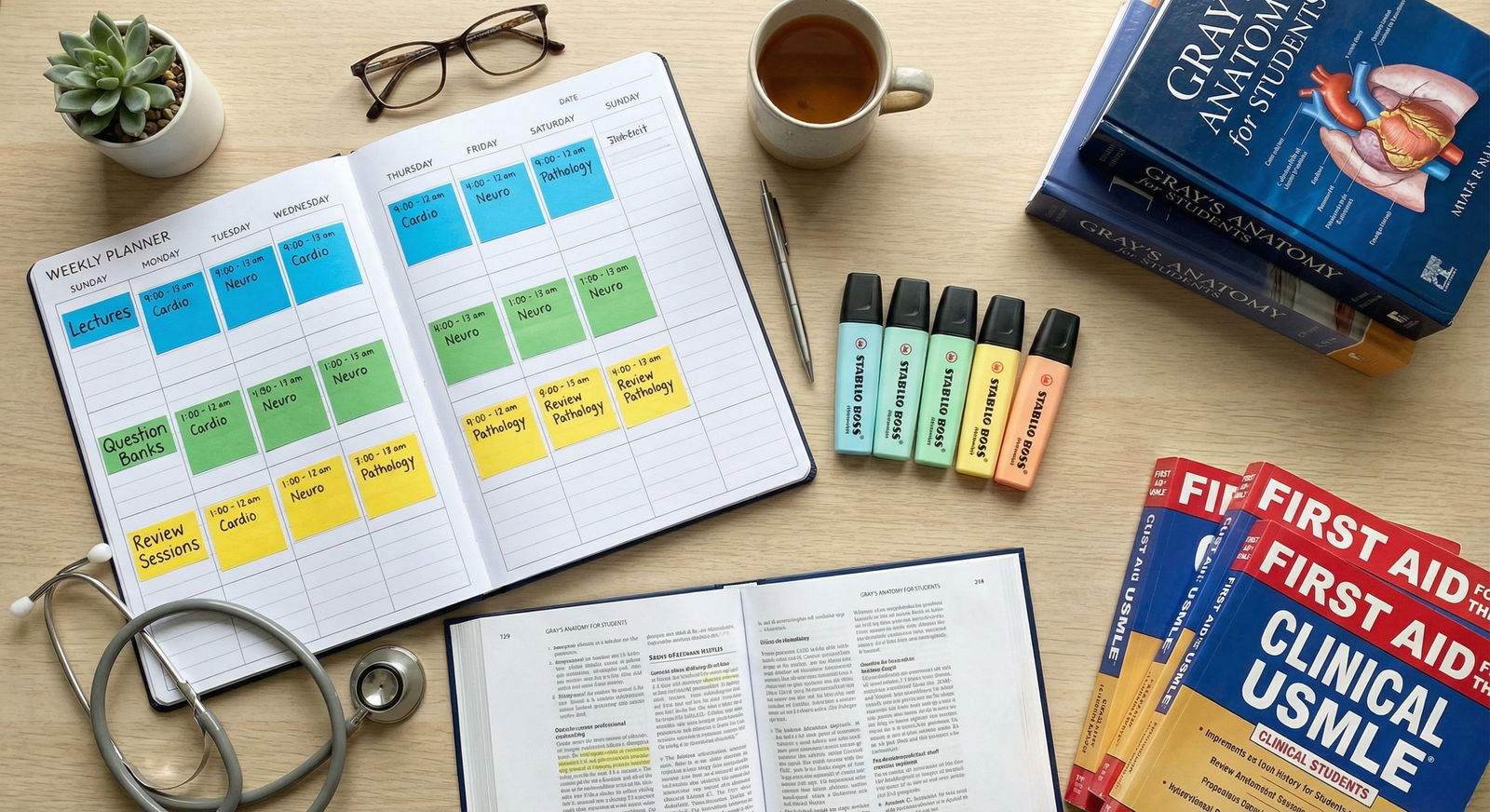
On an exam month, trading 60–90 minutes of junk studying at 2 a.m. for actual sleep will help your performance more than any extra flashcards.
Step 8: Talk to Your Team and Use Institutional Levers
A lot of students act like the schedule is sacred and they’re not allowed to say anything. That’s not always true.
Options people forget to use
- Ask your clerkship director or site director
Stuff you can reasonably ask:- If your exam is the morning after a brutal call, can your call be moved one day earlier?
- Can you get a post‑call protected afternoon in the week before the exam for dedicated study?
- If your exam is on a day you’d normally be post‑call, can the schedule be shifted?
Programs vary. Some will say no. Some will say yes and wonder why more students do not ask.
Use student health / disability services if anxiety is severe
- Testing in a smaller room.
- Extra time if clinically indicated.
- The ability to take short breaks.
This does not mean “I’m weak.” It means your brain has a known issue under pressure, and the goal is to test knowledge, not panic response.
Tell a senior you trust
Something simple:
“I’ve got my shelf/Step coming up and I’m pretty anxious about it. I’m doing my best to study around call, but if you see anything I could safely step back from the day before, I’d appreciate it.”
Sometimes they’ll shrug. Sometimes they’ll actively shield you more than you expect.
Step 9: Rewrite the Internal Narrative That’s Beating You Up
The worst part of test anxiety on heavy call is the story you tell yourself:
“I’m falling behind.”
“Everyone else is handling this.”
“If I don’t crush this exam, I’m done for this specialty.”
Most of that is garbage. And it spikes your arousal so high that your recall tanks during the actual exam.
You don’t need cheesy affirmations. You need something realistic and sharp you can actually believe.
Try replacing your mental tape with something like:
- “My prep isn’t perfect, but I’ve been learning on the wards every day. That counts.”
- “My job is to perform well enough under a bad schedule, not to be superhuman.”
- “Other people on this rotation are also tired and stressed. I’m not uniquely broken.”
- “I will see questions I do not know. My only job is to make the best guess and move on.”
Write 2–3 of these on a small card or your phone’s lock screen. Read them before call, before studying, and before the exam. Repeat until they sound less fake.
Step 10: Have a Game Plan For the Test Day Itself
Everyone talks about studying; not enough people talk about test-day tactics, which is where anxiety really wrecks you.
The night before
- Choose a hard stop time (e.g., 7–8 p.m.). After that, no more new information.
- Lay out: clothes, snacks, water bottle, ID, directions. Remove as many morning decisions as possible.
- 10 minutes of something calming: stretch, warm shower, a few pages of fiction. Not Reddit forums about score curves.
Morning of the exam
- Light breakfast you tolerate even when nervous.
- One caffeinated drink max if you’re sensitive. Don’t double your usual dose “for focus.” That’s how you shake through the first block.
During the exam
Use a two-pass rule:
First pass:
- If you know it quickly, answer and move on.
- If you’re stuck more than ~45 seconds, pick the best guess, mark it, move on. Don’t burn time spiraling.
Between blocks:
- Stand up.
- Breathe (physiological sigh x 3).
- One simple grounding statement: “Next block is new. Last block is over.”
If your mind screams “You’re failing,” respond with a scripted line:
“I’ll grade this later. Right now I’m just doing the next question.”
And pull your attention back to the stem in front of you.
Step 11: When It Goes Bad Anyway
Sometimes despite all of this, you’ll come out of an exam feeling wrecked. Combine that with a brutal call month and it’s very easy to spiral into “I chose the wrong career.”
When that happens:
Do not autopsy the exam with classmates.
Especially not immediately. That is almost always anxiety‑inducing and almost never useful.Give yourself a 48‑hour moratorium:
“For the next two days, I’m not allowed to predict my score or my future. I’m allowed to just be tired.”After 2–3 days, do a short, honest review:
- What parts of the plan actually helped?
- Where did call crush you?
- What one thing could you change next rotation? (e.g., moving Qbank to mornings, talking to the team earlier, setting firmer bedtimes.)
Then move on. You’re playing a long game across multiple exams and rotations, not a single event.
| Strategy | Time Cost per Day | Anxiety Impact | Performance Impact |
|---|---|---|---|
| 20–40 focused Qbank questions | 45–75 min | High positive | High |
| 5–10 min breathing/grounding | 5–10 min | High positive | Moderate |
| Light flashcards on call | 10–15 min | Mild positive | Mild–moderate |
| Extra 60–90 min sleep post-call | 60–90 min | High positive | High |
| Doom-scrolling exam forums | 20–60 min | Strong negative | None/negative |
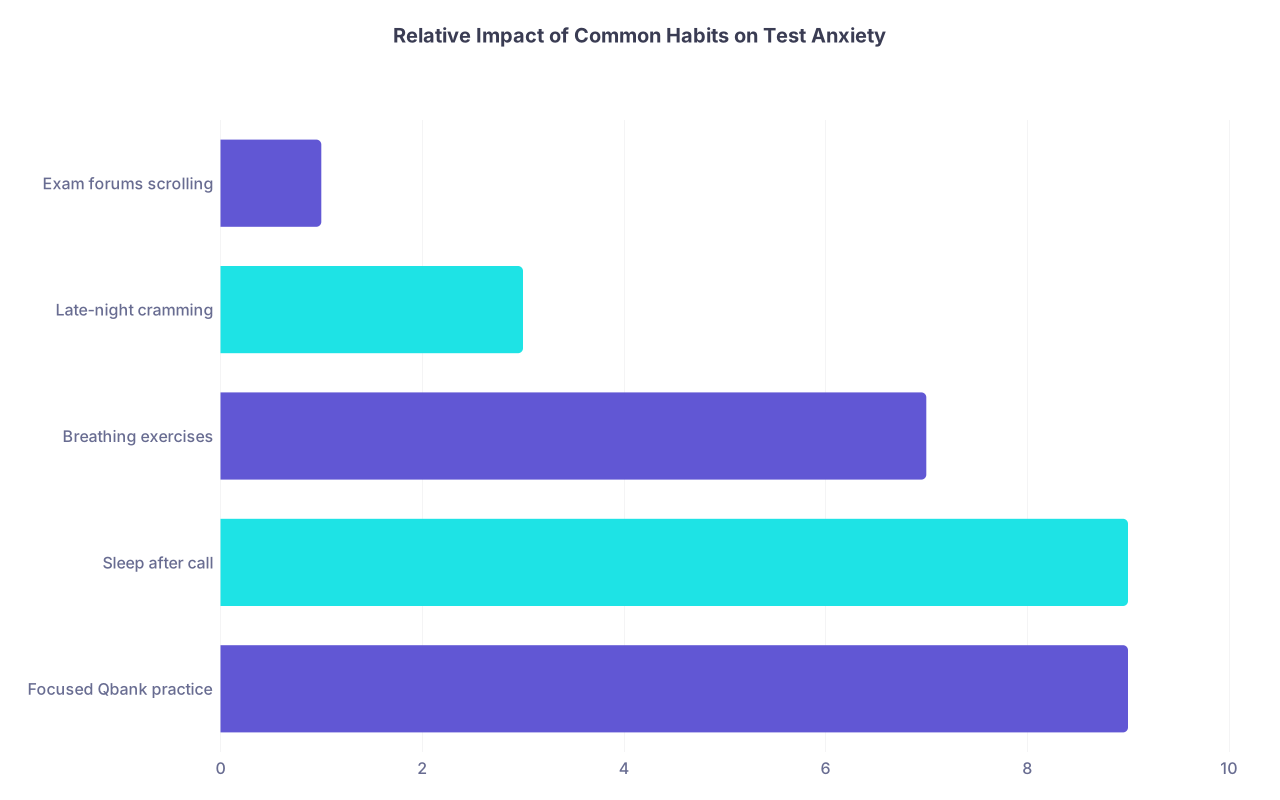
| Category | Value |
|---|---|
| Focused Qbank practice | 9 |
| Sleep after call | 9 |
| Breathing exercises | 7 |
| Late-night cramming | 3 |
| Exam forums scrolling | 1 |
FAQs
1. I’m so exhausted on post-call days that I get nothing done. Should I force myself to study?
No. If you’re truly wiped post‑call—falling asleep sitting up, rereading the same line five times—forcing study is mostly self‑punishment, not learning. On those days, your “study” is recovery. Protect your crash, get some real sleep, eat something decent, and if you wake up later and feel functional, you can add a tiny amount of light review. But the baseline expectation post‑call should be rest, not productivity.
2. Should I switch to nights off during my exam month to have more daytime to study?
It depends on your brain. Some people do fine flipping to a full nocturnal schedule for 3–4 weeks and then flipping back for the exam; many do not. The bigger question: will you be able to keep a consistent schedule for at least 10–14 days before the test, including sleep and wake times? If nights give you predictable blocks to study and you can still get 6–7 hours sleep in a row, maybe. If nights mean unpredictable naps and constant circadian chaos, they’ll probably worsen your anxiety and performance.
3. Is it ever worth delaying an exam because of call?
Sometimes, yes. If you’re in a situation where:
- You’ve had several weeks of extreme call (ICU, trauma, night float)
- Your practice scores are way below passing or your target range
- You’re experiencing significant anxiety symptoms or burnout
Then talking to your clerkship director, dean’s office, or academic support about shifting the test can be rational, not avoidance. The key is having a clear plan for how you’ll use the extra time, not just “waiting to magically feel better.”
4. How do I handle guilt about taking time for myself when other people are still working?
This guilt is baked into medical culture. You fix it by being precise: you’re not asking for spa days while others suffer; you’re trading marginal, half‑awake “productivity” for rest that lets you be safe, teachable, and useful. Patients do not benefit from a student who’s so fried they miss obvious findings because they did 40 questions at 3 a.m. Remember: resting enough to function is part of professionalism, not a violation of it.
5. My anxiety is mostly about comparing myself to classmates who seem to be doing more. How do I shut that down?
You won’t fully shut it down, but you can starve it. First, aggressively limit exam‑talk with the most competitive classmates—especially detailed question counts, resource lists, and practice score comparisons. Second, anchor your plan to your reality: your call schedule, your baseline energy, your target performance. Third, track only your own behavior: “Did I do my 30 questions today?” not “Am I doing as much as X?” Comparison is a rigged game in med school; the only way to win is not to play it too often.
Key takeaways: you’re not failing because you feel anxious on heavy call—almost everyone does. You gain ground by building a call‑proof study plan with realistic minimums, protecting sleep over fake productivity, and attacking the physiology of anxiety with simple tools you can actually use at 2 a.m. in a call room. The bar isn’t perfection. It’s showing up to the exam as the most rested, practiced version of yourself that this rotation realistically allows.