It’s Thursday night. You’ve got a renal exam tomorrow, an OSCE on Monday, and your shelf the following Friday. Your Anki reviews say “1,233 due.” Your group chat is blowing up with people asking, “Are we responsible for FENa formulas?” and “Did they say we need to know all the cytokines?”
Your heart speeds up just reading those messages. You open your notes. Nothing sticks. You read the same paragraph three times and still cannot say what you just read. Your chest is tight, you feel a little nauseated, and your brain is running one main thought on loop:
“I can’t keep this up. I’m going to blow one of these exams.”
You’re not dealing with generic test anxiety anymore. You’re dealing with cumulative test anxiety. A string of back-to-back exams where your stress from one bleeds into the next. Different beast.
Here’s how to handle this situation.
Step 1: Understand What’s Actually Making You Spiral
Your problem is not “too many exams” in the abstract. It’s a specific combo of:
- Time pressure
- Performance pressure
- Zero real recovery time between exams
- Constant comparison to classmates
And underneath all of that, usually one of these core fears:
- “If I screw this up, I’ll never match where I want.”
- “Everyone else is handling this better than I am.”
- “I can’t afford to have a bad test.”
- “My brain is breaking. I’m losing it.”
Let me be blunt: med school is built to make you feel perpetually behind and not good enough. If you wait for the system to become humane before feeling less anxious, you’ll be anxious for four solid years.
You need an approach that works inside this mess.
Step 2: Triage the Exam String Like a Clinician, Not a Panicked Student
Right now all three (or five, or seven) exams probably feel equally terrifying in your brain. They’re not. You need to sort them.
| Exam Type | Weight/Impact | Timeline | Strategy Priority |
|---|---|---|---|
| Renal Block | 15% of course grade | Tomorrow | High, focused review |
| OSCE | Pass/Fail | 3 days | Medium, targeted practice |
| Shelf | 30% of clerkship grade | 8 days | High, daily blocks |
Here’s what to do today:
- List every upcoming exam for the next 2–3 weeks.
- For each: write the date, weight (percentage, pass/fail, honors impact), and format (MCQ, OSCE, practical).
- Label each exam:
- Critical (major impact on grade/promotion/shelf)
- Important (moderate impact, can be buffered by other scores)
- Containable (low impact, truly pass/fail, or easily remediable)
If everything in your mind is “critical,” that’s your anxiety talking, not reality. I’ve seen plenty of students match into competitive specialties with a few imperfect block exams. A bad standardized exam is harder to shrug off than one random histology quiz.
Once you see the hierarchy on paper, you can stop studying like every exam deserves your soul.
Step 3: Shrink the Time Horizon (Your Brain Can’t Handle the Whole String at Once)
Back-to-back exams trigger “future overload.” Your brain is trying to “solve” exam 3 while you’re still on exam 1. No wonder it short-circuits.
You need hard rules for how far ahead you’re allowed to mentally wander.
Use this framework:
- Within 48 hours of Exam A: Exam A is 80–90% of your mental bandwidth. The rest is maintenance for later exams.
- 3–7 days out: Split your time, but with clear blocks, not chaos.
- More than 7 days out: Light prep or just simple daily maintenance (Anki, small reading).
Make it concrete:
- “Until I walk out of tomorrow’s renal exam, I’m not planning OSCE cases. I’m only doing:
- Renal review questions
- Sketchy/Pathoma/whatever your core resource is
- A 15–30 minute spaced review for shelf each day, nothing more”
Test anxiety explodes when you blur exams together. You fix that by drawing hard mental borders. Almost like patients on your list—you don’t round on everyone at once.
Step 4: Design a Short, Ruthless Daily Plan (Not a Fantasy Schedule)
Students in this situation love making 10-hour color-coded plans they cannot possibly execute. Then they “fail” the schedule, feel worse, and spiral further.
You need a plan that is:
- 100% doable on your worst day, not your best
- Specific down to the task type, not vague (“study renal” is vague, “UWorld renal blocks 40q” is specific)
- Built around energy, not wishful thinking
Here’s a realistic “string of exams” day template when you’re 3–10 days out from multiple tests:
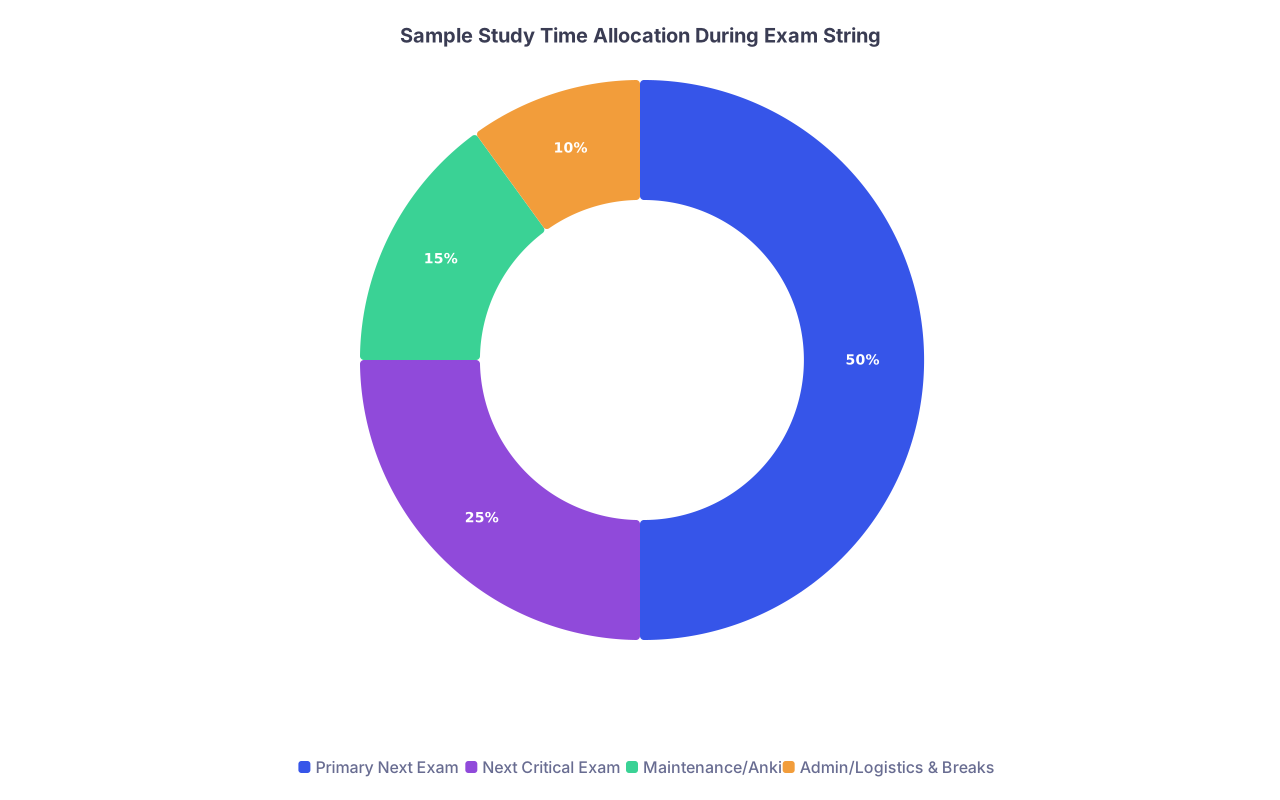
| Category | Value |
|---|---|
| Primary Next Exam | 50 |
| Next Critical Exam | 25 |
| Maintenance/Anki | 15 |
| Admin/Logistics & Breaks | 10 |
Example day (adjust times to your reality):
- 8:00–9:00: Warm-up + maintenance (Anki / spaced review / quick notes skim)
- 9:00–11:00: Deep work for the closest exam (questions + review)
- 11:15–12:30: Content consolidation (video or reading on missed topics)
- 1:30–3:30: Next critical exam block (practice questions, cases, or OSCE practice)
- 4:00–5:00: Light review or OSCE checklisting
- 7:00–8:00: Low-cognitive load review (flashcards, diagrams, image review)
The key: you’re never jumping wildly between five topics every 20 minutes. That chaos feeds anxiety. You’re batching.
Step 5: Train Your Body to Stop Hijacking Your Brain (Acute Anxiety Tools)
If your heart is pounding and your hands are sweaty while you read this, you don’t need a longer plan. You need a reset button.
Use this 5–10 minute sequence when you feel that wave of panic:
Physiologic sighs – 1–2 minutes
Double inhale through the nose (short breath + deeper breath), then slow exhale through the mouth. Repeat 8–10 times. This is not wellness fluff; it’s a studied way to dump CO₂ and calm your system fast.Grounding – 2 minutes
Name:- 5 things you can see
- 4 things you can feel
- 3 things you can hear
- 2 things you can smell
- 1 thing you can taste
Silently. Out loud if you’re alone. It yanks your brain out of catastrophic futures and back into the room.
Reset sentence – 1 minute
One simple, boring line you repeat:
“Right now, my job is just the next 10 questions.”
Not “pass the exam,” not “honors the clerkship,” just “next 10 questions.”Micro-commitment – 5–15 minutes
Commit to a single small task:- Do 5 questions
- Review 1 page of a topic
- Watch 1 short video
When you finish, then you’re allowed to reassess.
This isn’t therapy. This is field medicine for your nervous system.
Step 6: Use Exam 1 to Help Exam 2 (Instead of Letting It Haunt You)
The standard pattern I see: students take Exam 1, walk out, decide they failed, mentally beat themselves up for 24–48 hours, then try to restart for Exam 2 while exhausted and demoralized.
That’s how you tank a whole exam string off one shaky performance.
You need a strict post-exam routine that protects the next test:
Right after the exam:
- Leave the building. Physically. Don’t linger in the hallway for the postmortem.
- When people start: “What did you put for the hyperkalemia question?” you say:
“I’m not going through questions, I’ve got another exam coming up.” Then walk away. Yes, it will feel rude. Yes, do it anyway.
Next 2–4 hours:
- Eat a real meal.
- Move your body: walk, light workout, stretch.
- No studying. Zero. Your brain is mush; anything you cram here is going to be low yield.
Later that day (or next morning if you’re cooked):
- 10–15 minutes max of reflection:
- Did time management fail?
- Were there specific content gaps?
- Was anxiety the main issue (e.g., blanked early, rushed, couldn’t focus)?
Turn that into 1–2 specific adjustments for the next exam. Example:
- “I always rush the first 10 questions when I’m nervous → Next exam I’ll intentionally slow the first 5, even if I feel behind.”
- “I missed basic acid–base questions because I never drilled them → Tomorrow I’m doing 20 dedicated acid–base questions.”
Then you drop the rest. You are not allowed to replay the exam for days. That mental rehashing is anxiety feeding on itself.
Step 7: Handle Sleep Like It’s a Required Exam Component
During strings of exams, people brag about 3–4 hours of sleep like it’s a badge of honor. It’s not. It’s an easy way to turn manageable anxiety into full-blown panic.
You don’t need perfect sleep habits. You do need a floor.
During an exam string, enforce:
- Minimum sleep target: 5.5–6 hours. Non-negotiable. If you’re currently at 3–4, edge it up.
- Cutoff time: Pick a time (say 11:30 pm) where you stop learning new content. After that: only light review or nothing.
- Digital shutdown: 30–45 minutes before bed, absolutely no group chat, Reddit, or question banks. Your classmates’ panic before bed will jack up your anxiety.
If your brain races at night with “I didn’t study enough,” write a quick 3-bullet plan for tomorrow on paper, close the notebook, and say (out loud if you want): “Tomorrow-me’s problem.” Then you’re done.
You will not out-study a wrecked brain.
Step 8: Build a “Minimal Viable Performance” Mindset
Perfectionism is gasoline on test anxiety, especially during back-to-back exams. When you’re exhausted, “I must crush every exam” is how you burn out and underperform.
You need a concept I push with a lot of students: MVP—Minimum Viable Performance.
Ask for each exam:
- What’s good enough here?
- Example: Block exam you’re already passing the course in → 70–75% might be fine.
- Shelf exam that influences honors → you push harder there.
- OSCE that’s pass/fail with remediation opportunity → you aim for solid competence, not Oscar-level acting.
This isn’t about being lazy. It’s strategic conservation of energy. You’re in a marathon segment, not a 100m sprint.
Write this on a sticky note:
“What does good enough look like for THIS exam?”
Answer it in one sentence. Stick it to your laptop.
Step 9: Fix the Worst Anxiety Fuel Sources in Your Environment
There are specific behaviors that reliably spike test anxiety during exam strings. If you cut even two of these, you’ll feel a noticeable difference.
Common culprits:
- Garbage group chats – those “We’re all screwed” or “Who already finished all of UWorld?” threads. Mute them until the string is over. You can survive without knowing that someone is on their 5th pass of Sketchy.
- Doom-scrolling Reddit/Discord – especially score report threads, “I failed my exam” stories, or “How I got a 270” on Step. During your exam run, that stuff is poison.
- Studying with the wrong people – that one classmate who needs to talk through every detail of the exam and lovingly narrates how much they’ve done. Study physically away from them for now.
- Messy physical space – yes, cliché, but visual clutter makes a busy brain worse. Clear one flat surface: desk or table. Nothing magical, just visible order.
You don’t need to solve your whole life. You just need to turn down 2–3 of the loudest anxiety amplifiers.
Step 10: When Anxiety Is Severe: A Reality Check and Red Flag List
Sometimes we cross the line from “stressed med student” to “this is not safe anymore.”
You need to be honest if any of these are happening:
- You’re having frequent panic attacks (chest pain, shortness of breath, feeling like you’re going to die or lose control).
- You’re not sleeping more than 2–3 hours for several nights in a row.
- You’re having thoughts like “If I failed this, what’s the point?” or “It would be easier if I just didn’t wake up.”
- You’re using alcohol, benzos, or other meds heavily just to sleep or sit down to study.
- You’re dissociating—losing track of time, feeling unreal.
If any of that sounds like you: you do not white-knuckle your way through the rest of the exams. You loop in someone.
That can be:
- Student health / campus counseling
- A trusted attending or course director
- Your PCP or psychiatrist if you have one already
I’ve seen multiple students get short-term accommodations during brutal stretches: extra time, exam moved by a day or two, ability to take one exam remotely, etc. Schools act like everything is rigid until someone is clearly falling apart—then rules suddenly become flexible.
You’re not weak for asking. You’re being clinically appropriate.
Quick Scenario Walkthrough: How This Actually Plays Out
Let me walk through a real-feeling week.
You:
- Friday: Renal exam
- Monday: OSCE
- Friday: IM shelf
What you do:
Thursday (day before renal):
- Morning: 80% renal questions + review, 20% light shelf Anki
- Afternoon: Renal big-picture review (formulas, algorithms, key tables). Finish by 8–9 pm.
- Evening: No OSCE prep today. Sleep target 6+ hours.
Friday:
- Exam → walk out → no question postmortem.
- Post-exam: Eat, walk, maybe nap.
- Late afternoon (1–2 hours max): OSCE only. Practice 3 cases out loud with a friend or alone (timed).
- Evening: 30–45 min shelf flashcards or a short UWorld block.
Saturday:
- Morning: 2–3 OSCE hours (cases, checklists, intros, closings).
- Afternoon: 2–3 hours shelf (questions + review).
- Evening: Off or light review only.
Sunday:
- Morning: OSCE run-through (full timed “mock OSCE” if possible).
- Afternoon: Shelf questions.
- Night: Light OSCE review, early-ish bed.
Monday:
- OSCE → same post-exam protocol (no obsessing, move on).
- Afternoon: Reset, then full shelf mode from here to Friday (with 30–60 minutes each day for any course cleanup if needed).
You’re never trying to do everything at full intensity at once. You’re respecting the sequence without letting any one exam mentally poison the others.
FAQ: Test Anxiety During Back-to-Back Exams
1. What if I bomb the first exam—won’t that ruin my mindset for the rest?
It will, if you let it live rent-free in your head. You counter it with structure:
- Give yourself a 24-hour window max to feel awful, vent to someone you trust, and debrief briefly.
- Lock in 1–2 lessons learned (e.g., “I need to start questions earlier in the week”).
- Then shift to behavior, not rumination—meaning you change what you do, not endlessly replay what happened. The only thing that rebuilds confidence is stacking small wins on the next exam.
2. How do I deal with classmates who are stressing me out but I don’t want to be rude?
You set short, clean boundaries. Examples:
- “Hey, my anxiety’s been bad—I'm trying not to talk about exam details right now.”
- “I’m going to mute the group for a bit so I can focus—not ignoring you, just trying to get through this week.”
- “I can’t go over questions from the exam; I’ve got another one coming up.”
Most people will understand. And if they don’t, that’s their problem. Your primary job right now is protecting the mental bandwidth that lets you actually pass.
3. Is it worth seeing someone (counselor/psychiatrist) in the middle of a busy exam stretch?
Yes. Especially if:
- This anxiety pattern happens every exam block.
- You’re having physical symptoms (palpitations, panic attacks) or severe dread.
- You’re starting to change your behavior (avoiding studying, procrastinating to numb out).
Even one or two sessions can give you targeted strategies—and possibly medications if appropriate—that make the rest of the year less miserable. It’s like getting a consultant on a tough case; you don’t wait until the patient is coding.
Open your calendar right now and list every exam in the next 2–3 weeks. For each, write “Critical / Important / Containable” and then decide: what is “good enough” for that exam? That one exercise will calm your brain more than another hour of doom-scrolling or panicked highlighting.