The person causing half your test anxiety might be sleeping fifteen feet away from you.
If your roommate’s study style is ramping up your exam stress, you don’t need another mindfulness app. You need a strategy for the actual situation you live in. Let’s fix that.
What’s Actually Going Wrong (It’s Not Just “Personality Differences”)
There are a few classic roommate-study-disaster pairings. If you recognize yourself in one of these, good—then we can be precise about what to do.
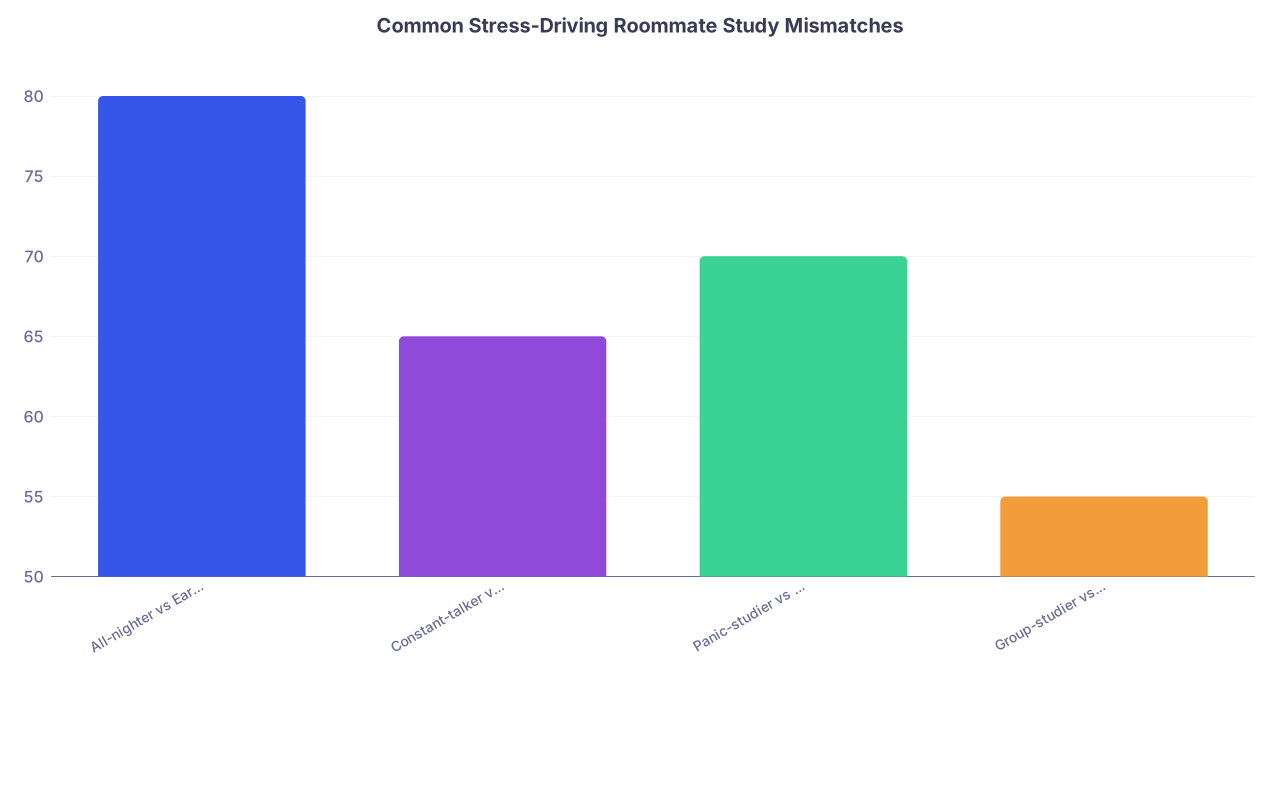
| Category | Value |
|---|---|
| All-nighter vs Early-sleeper | 80 |
| Constant-talker vs Silent-studier | 65 |
| Panic-studier vs Steady-planner | 70 |
| Group-studier vs Solo-learner | 55 |
Typical mismatches:
The All-Nighter vs The Early-Sleeper
You: trying to protect sleep before an exam.
Them: caffeinated, typing, pacing, talking about “just one more Anki deck” at 1:30 a.m.The Panic-Studier vs The Low-Key Planner
You: steady study schedule, pacing yourself.
Them: does nothing for 5 days, then spirals into “we’re all going to fail” monologues two nights before the test.The Noise Machine vs The Silent Cave-Dweller
You: need quiet to think.
Them: watches lectures on 1.75x out loud, discussions on speakerphone, group calls in the room.The Hyper-Competitive vs The “I Just Want to Pass”
You: already anxious about your scores.
Them: flexes their UWorld percentage, asks what you got on every quiz, “jokes” that you’re behind.
Here’s the core problem: your brain is trying to run your study plan while constantly reacting to their habits. That conflict is what turns normal exam stress into full-blown test anxiety.
You can’t change their personality. You can change:
- How much of their chaos reaches you
- How much you internalize their standards and pacing
- Where and when you expose your brain to them
That’s the game.
Step 1: Get Clear On Your Own Study Needs (Before You Talk To Them)
You can’t negotiate effectively if you can’t articulate what you need. “You’re stressing me out” is too vague. You need specifics.
Sit down and write, briefly, the answers to these:
What time of day do you do your best learning?
Morning? Late afternoon? Night?What absolutely wrecks your focus?
Examples: overhearing panic talk, late-night lights, phone calls, music, people asking you “what does this mean?” every 10 minutes.What do you need the night before major exams?
For many med students: strict cutoff time, low stimulation, no score talk, protected sleep.What are your non-negotiables vs flexibles?
Non-negotiable: “Lights out / headphones only after midnight during exam weeks.”
Flexible: “I can study in the library until 10 if they need the room for a group call 8–10.”
Be concrete, not philosophical. You’re creating a “terms of use” for your sanity.
Then translate that into a simple, practical “room contract” for yourself, like:
- I need: quiet and no exam talk after 10 p.m. on weeknights.
- I need: to not hear other people’s scores or practice exam results.
- I need: my own schedule, not theirs.
Having this clarity changes the entire tone of the conversation with them.
Step 2: The Conversation Script That Actually Works
You do need to talk to them. Hoping they “get the hint” is a waste of cortisol.
Pick a neutral time when neither of you is actively studying or panicking. Not 11 p.m. before a quiz. Think weekend afternoon, or after class, or during a coffee break at home.
Then use something like this:
Start with shared reality, not blame.
“Hey, exams have been rough this block and I’ve realized my stress is way higher when I’m at home. I think part of it is how our study styles collide in the room.”
Own your needs instead of attacking theirs.
Bad: “You’re stressing me out with your last-minute studying.”
Better: “I’ve learned I really need quiet and low panic the night before exams or I don’t sleep.”Make specific, doable requests.
Examples:
- “Would you be willing to use headphones after 10 p.m. on nights before big exams?”
- “Could we agree on no talking about predicted scores or UWorld percentages once we’re home at night?”
- “If you’re doing a group call, could you do it in the lounge or kitchen instead of the bedroom after 9?”
Offer something in return.
You’re not negotiating a hostage release, you’re co-living.“I’m happy to step out when you need to do group calls at X time,” or
“If you want to go over concepts together, I’m good with doing that in the afternoon at the library.”Name exam-period rules explicitly.
“Could we have slightly stricter house rules the 48 hours before big exams? Like headphones only after 9 p.m., no ‘we’re going to fail’ jokes, and no score discussions?”
This isn’t therapy. It’s logistics. Stay practical, short, and specific.
If they respond well, great. If they’re defensive, stay calm and repeat the core line:
“I’m not saying your way is wrong. I’m saying my anxiety is getting out of control and I need X, Y, Z to be able to function.”
Step 3: Set Up Physical and Time Boundaries That Don’t Rely On Their Cooperation
Even with a great roommate, you still need systems that don’t depend on their best behavior every day. Because there will be bad days.
Create a “Primary Study Zone” Outside the Room
If your main study location is also the place where your roommate spirals, your brain never gets a break.
Pick one of these as your default:
- A specific floor of the library
- A campus study room you can reserve
- A quiet coffee shop at set times
- An empty classroom after hours
Then build a routine around it: “I’m out of the apartment studying from 8–12 and 2–6 most days.” The more predictable you are, the less your roommate’s habits drive your schedule.
Use the Room for Only 2 Things During Exam Weeks
- Sleep
- Truly low-cognitive tasks (quick Anki, light review, laying out stuff for exam day)
Once you start treating your room as a semi-sacred “calm-only zone,” you stop feeding your anxiety every time you walk in.
Hard Time Boundaries
If your roommate is an all-nighter person:
- Decide your cutoff time (example: 11 p.m.).
- Past that time, you’re in full “sleep-protection mode”: earplugs, eye mask, white noise app, phone on Do Not Disturb, no screens.
- If they keep lights on, get a cheap sleep mask. If they talk, use foam earplugs + white noise.
You’re not going to out-argue their coping style at 1 a.m. You just need to defend your sleep.
Step 4: Dealing With Their Panic So It Doesn’t Become Your Panic
One of the worst triggers: roommates who constantly say things like:
- “This block is impossible. No way I’m passing.”
- “Did you see that question bank? I got 48%. I’m screwed.”
- “I studied all day and remember nothing. We’re dead.”
If your heart rate just went up reading that, you’re normal.
Here’s what to do so their spiral doesn’t become yours.
1. Decide Your Policy on “Exam Talk at Home”
You’re allowed to say: home is a no-panic zone.
Example script:
“I’ve noticed that when we talk about scores and how unprepared we are at home, my anxiety shoots through the roof and I actually study worse the next day. Could we keep detailed exam talk for campus and keep the room more low-key?”
If they still start in:
Them: “I just did 40 questions and missed 20, I’m going to fail.”
You: “I’m going to step out / put my headphones in. My brain can’t handle exam talk at home right now.”
And then actually do it. Don’t argue their feelings. Just withdraw your participation.
2. Build a Mental “Firewall”
When you hear their panic:
- Label it in your head: “That’s their coping style, not my reality.”
- Ask yourself one concrete question: “Does this change what I need to do in the next 2 hours?”
- If no: drop it.
- If yes: make a tiny adjustment (do 10 extra questions, review one weak topic) and then stop thinking about them.
Your job is not to be their therapist. Your job is to pass.
Step 5: If Your Roommate Is Hyper-Competitive Or Score-Obsessed
This one is nasty because it feeds exactly the part of your brain that’s already anxious: the comparison machine.
Classic behaviors:
- Asking what percentile you’re at. Constantly.
- Announcing their practice scores out loud.
- “Just curious, what did you get on the last exam?”
- Making you feel behind because their schedule is different.
Here’s how you handle it.
1. Hard Stop on Score Sharing
You’re allowed to opt out.
“Hey, I’ve realized I do much better when I’m not comparing scores. I’m going to stop sharing mine and I’d actually prefer not to hear other people’s numbers either.”
If they still share, treat it like background noise. Don’t react, don’t ask follow-ups. Change the subject or put in headphones. It gets boring for them fast if you don’t feed it.
2. Re-center on Your Actual Target
Most med students don’t need a 99th percentile on every exam to reach their goals. But living with a high-flyer can make you forget that.
Write this somewhere you see it:
- My actual priority: solid understanding + passing comfortably + protecting mental health.
- My current block target: ___ (e.g., “~80% average” or “pass comfortably and fix cardio next block”).
Then when they flex a 92% and you’re at 78%, you don’t go into existential crisis mode. You check one thing: “Am I on track for my own target?” If yes, you’re done.
Step 6: Concrete Tools to Reduce Room-Triggered Test Anxiety
Let’s be specific. If your roommate is stressful, build these into your exam weeks.
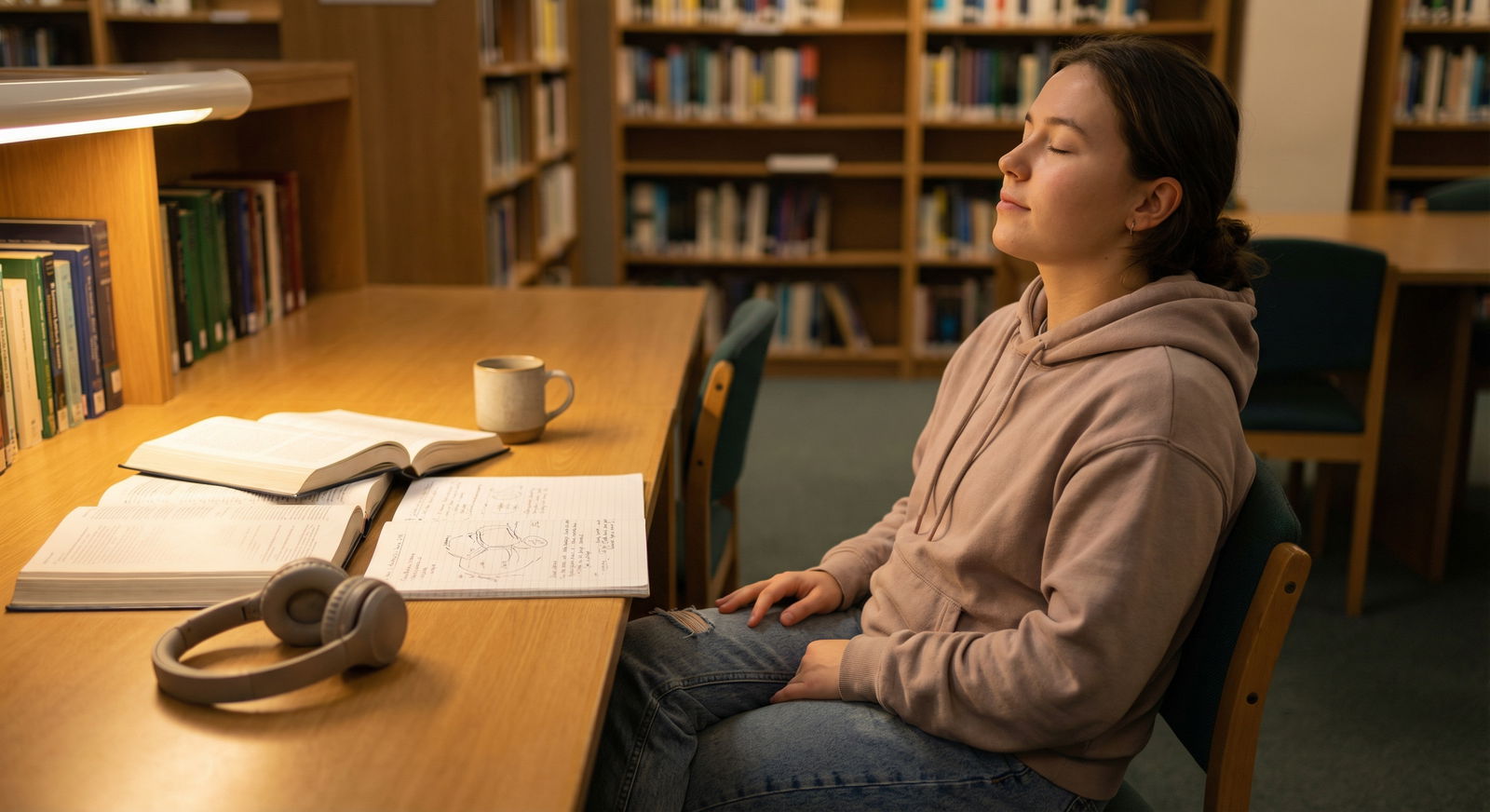
Environmental Armor
- Earplugs + White Noise: Not negotiable if you share a room. Use both.
- Headphones with a playlist you only use for studying: Trains your brain to ignore background chatter.
- Physical divider: Even a simple curtain, bookshelf, or repositioned wardrobe can create a mental and visual barrier.
A 10-Minute Reset When Room Stress Spikes
When your roommate is spiraling and you feel your chest clamp:
- Get physically out of the room: hallway, bathroom, outside for 5 minutes.
- Box breathing: in 4 seconds, hold 4, out 6–8 seconds, repeat 6–10 times.
- Ask yourself: “What is the next concrete action I can take that helps tomorrow’s me?”
Examples: do 5 questions, re-watch one short concept video, pack your bag, set out exam clothes.
Then go do just that one thing. Not everything. One.
Your goal is to interrupt the cascade from “roommate panic → catastrophic thoughts → full anxiety episode.”
Protect Sleep Like It’s Part of the Exam
Whether your roommate believes in all-nighters or not, you know the data: sleep loss trashes performance. So your protocol the night before big exams:
- Hard devices-off time at least 45–60 minutes before sleep
- No comparing how much you each studied that day
- Earplugs in, white noise on before they start their late-night routine
- If they insist on working late, you move your bedtime routine up and get horizontal earlier
You’re not being “soft.” You’re being strategic.
Step 7: When Talking Fails And You Need Backup
Sometimes you do all the adult communication and your roommate is still chaos.
That’s when you escalate. Not emotionally. Logistically.

| Step | Description |
|---|---|
| Step 1 | Identify Problem |
| Step 2 | Talk to Roommate Once |
| Step 3 | Maintain Boundaries |
| Step 4 | Document Issues |
| Step 5 | Talk to RA/Housing |
| Step 6 | Request Room Change |
| Step 7 | Adjust Personal Systems |
| Step 8 | Improved? |
| Step 9 | Still Unresolved? |
Options:
Resident Assistant / Housing / Student Affairs
If you’re in university housing, they’ve seen worse. Document repeated issues: noise after quiet hours, refusal to negotiate basic boundaries, disruptions night before exams.Request a Room Change
Not ideal mid-block, but if your living situation is a primary driver of ongoing panic attacks, you’re not being dramatic. You’re triaging.Involve Student Wellness / Counseling
Especially if your anxiety is starting to bleed into other parts of life: constant dread, physical symptoms, avoidance. They can write letters or advocate for housing accommodations if needed.
Don’t wait until you’re at the breaking point. Medical school is already hard. You don’t get extra points for suffering silently because your roommate is a hurricane.
A Quick Reality Check: You Don’t Have to Study Like Them To Succeed
One more thing you need to hear plainly:
Their style isn’t automatically better because it’s louder or more intense.
You’re going to see:
- People doing 400 questions a day before Step
- People re-reading First Aid three times in one week
- People studying until 3 a.m. daily and still complaining they’re “behind”
You are not obligated to mirror any of that.
| Style Type | Visible Behavior | What Actually Matters |
|---|---|---|
| Panic-cram | All-nighters, constant worry | Retention, not hours awake |
| Steady-planner | Daily blocks, breaks | Consistency over drama |
| Group-studier | Long discussions | Accuracy of understanding |
| Solo-learner | Quiet, solo question sets | Quality of practice and review |
What matters is:
- Are you hitting your key resources consistently?
- Are you doing active practice (questions, recall) instead of only re-reading?
- Are you adjusting based on performance, not panic?
- Are you protecting enough sleep to actually recall what you learned?
If yes, then your roommate’s chaos is just noise. Annoying, but not diagnostic of your worth or your prospects.
If You’re Close To Burning Out Already
If you’re reading this lying in bed, dreading walking back into your room, you’re not just “sensitive.” You’re likely overloaded.
Here’s the minimum viable recovery plan:
- Identify 2–3 “room boundaries” you’ll implement this week (not 10, just a few).
- Move at least 50% of your serious studying outside the room for the next block.
- Enforce an exam-eve policy: no discussions of scores or “how screwed we are” after 7–8 p.m.
- If your anxiety is spilling into sleep, appetite, or motivation, book a counseling or wellness appointment. Not later. This week.

You’re not weak for needing different conditions than your roommate. You’re smart for noticing what’s breaking you and changing it.
FAQs
1. What if my roommate says I’m overreacting or being too sensitive?
You don’t need their validation to take care of yourself. You can respond with: “Maybe it doesn’t bother you, but my anxiety’s been bad enough that it’s affecting my sleep and studying. I’m still going to do X, Y, Z to manage it.” Then follow through—use earplugs, study elsewhere, limit conversations about exams at home. Their opinion doesn’t override your lived experience.
2. How do I handle it if my roommate asks to study together but it always makes me more anxious?
You’re allowed to decline without making it a moral judgment. Try: “I’ve noticed I actually focus way better solo, so I’m going to keep mostly studying on my own. I’m happy to go over a few tough topics for 20–30 minutes sometimes, but not full study sessions.” Set a time limit if you do help them, and don’t let their style hijack your schedule.
3. Is it worth trying to move out mid-year, or should I just push through?
If the living situation is a primary driver of your anxiety—especially if it’s affecting sleep, grades, or physical health—it’s absolutely worth exploring a move, even mid-year. Talk to housing, your dean, or student wellness about options. Pushing through a toxic setup for another 6–12 months usually costs far more (in burnout and performance) than the hassle of moving once. Two key questions: “Is this fixable with boundaries?” and “If nothing changed, could I tolerate this for another block?” If the honest answer to both is no, start the process to change it.