The belief that you can “study your way out” of test anxiety is wrong. Flat-out wrong. And medical students are some of the worst offenders.
You know the script. You feel anxious about Step 2 or a shelf exam, so you respond the only way you’ve been rewarded for years: more content. Another Qbank subscription. Another AnKing deck. Another “dedicated” weekend where you cancel life to reread First Aid or re-watch Sketchy.
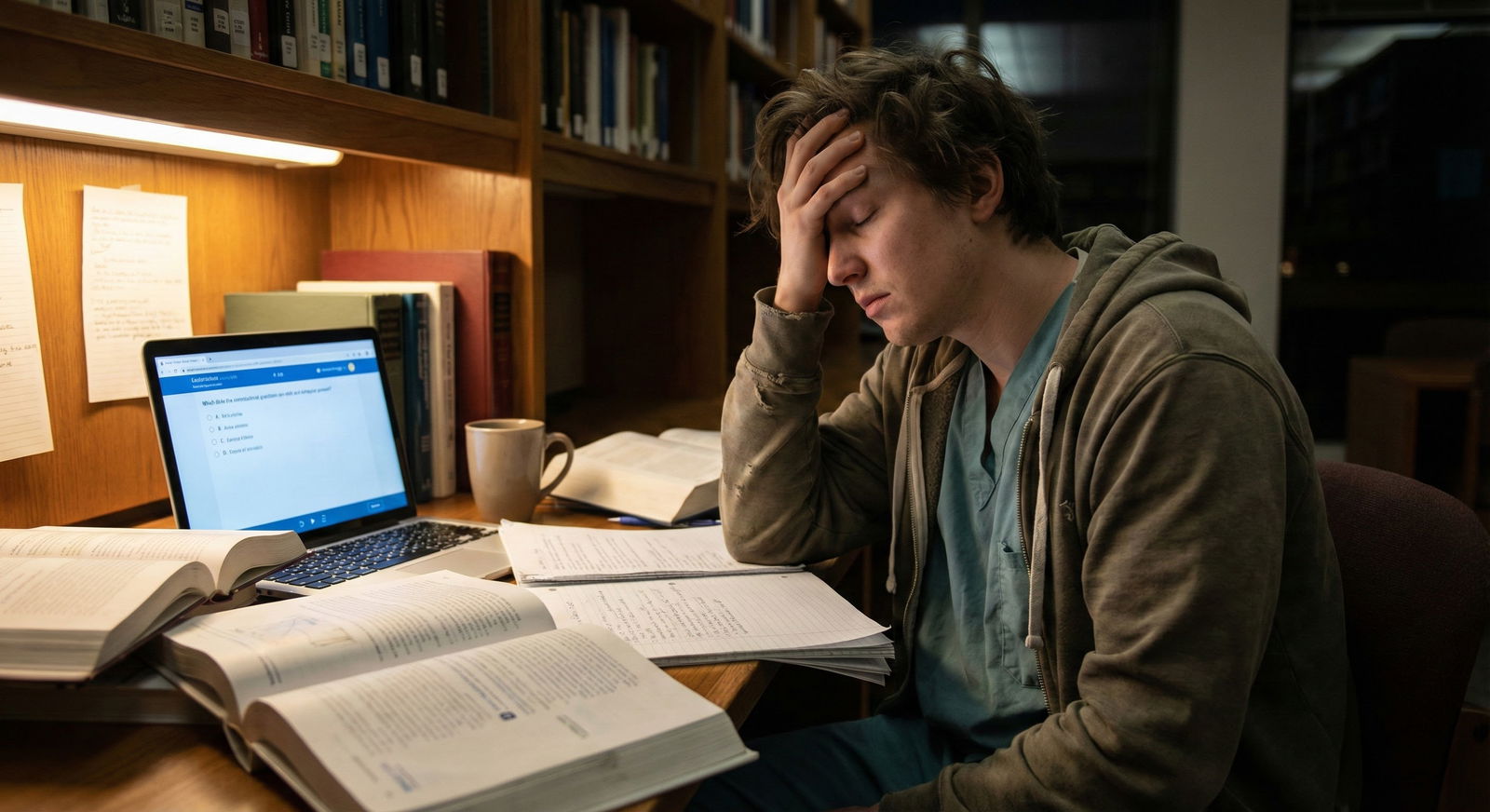
Then test day comes. Your heart rate still spikes. Your hands still shake logging into NBME. Your brain still blanks on questions you definitely reviewed. So you conclude, “I didn’t review enough content,” and the cycle repeats.
Let me be blunt: for persistent test anxiety, more content review is like pouring water on the floor when the fire is in the ceiling. It looks like effort. It does almost nothing to the actual problem.
What the Data Actually Shows About Test Anxiety
Test anxiety is not just “not knowing enough.” It’s a specific psychological pattern: cognitive (worry, catastrophic thinking), emotional (fear, dread), and physiological (tachycardia, sweating, GI upset). That triad is surprisingly well studied.
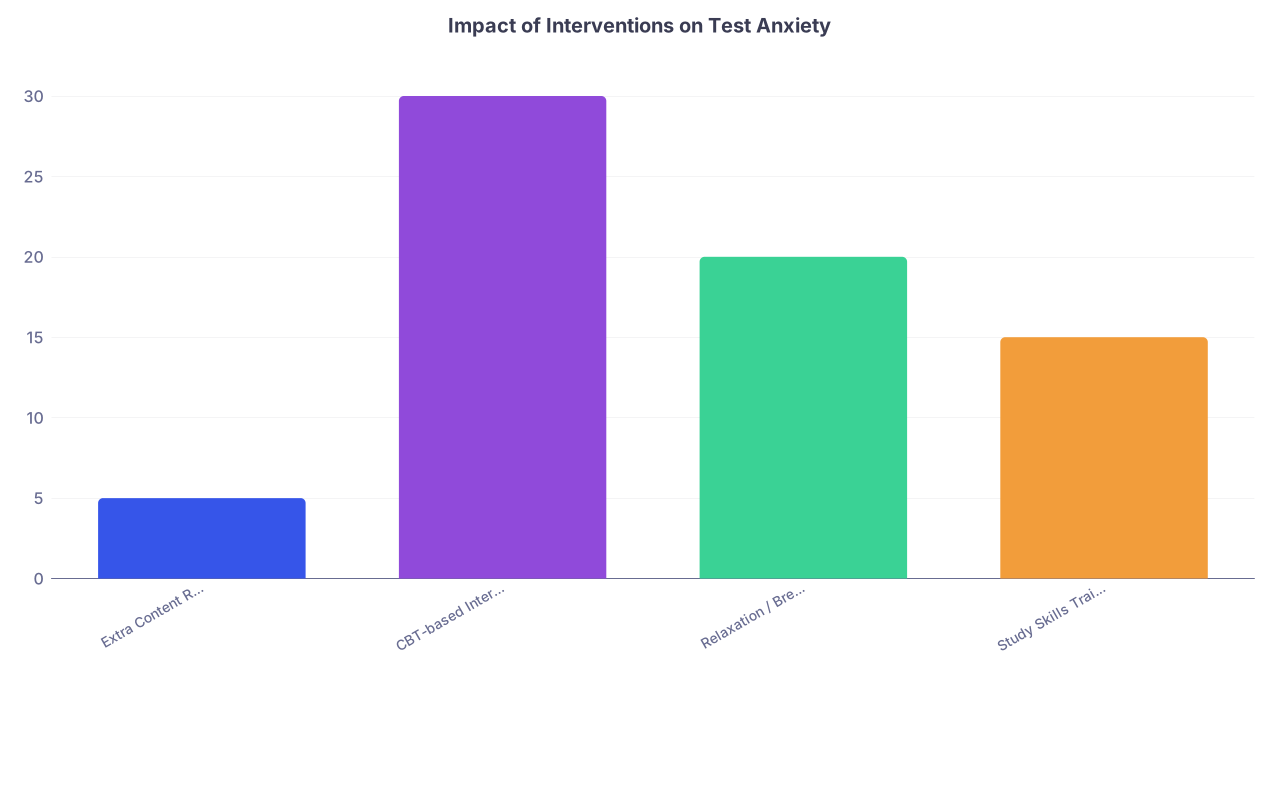
A few key findings from the literature and large student samples:
| Category | Value |
|---|---|
| Extra Content Review | 5 |
| CBT-based Interventions | 30 |
| Relaxation / Breathing | 20 |
| Study Skills Training | 15 |
That rough distribution is consistent with what multiple meta-analyses and institutional reports show:
- Cognitive-behavioral approaches (targeting thoughts and behaviors) produce moderate, reliable reductions in test anxiety.
- Relaxation and physiological regulation techniques produce small-to-moderate improvements.
- Basic study-skills training helps somewhat.
- “Just study more” barely moves the needle beyond what normal, adequate preparation already does.
What does that mean in normal language? Once you’ve hit “reasonable preparation,” extra content review gives diminishing returns academically and trivial returns on anxiety.
Yet medical students, who understand pharmacodynamics, somehow forget basic dose-response. You’re doubling the dose on the wrong drug.
The Core Myth: “I’m Anxious Because I Don’t Know Enough”
I hear this sentence constantly: “I’ll feel less anxious once I really know the material.”
Sounds logical. It’s also provably false for a big chunk of high-achieving students.
You’ve probably seen this in real life:
- The classmate scoring 250+ on NBME practice tests who’s still nauseous the week before Step.
- The student with a 3.9 GPA and honors on all shelves convinced they’re going to fail the OSCE.
- The resident, already matched, still panicking before in-training exams despite years of strong performance.
These are not people with content deficits. They’re people with distorted thinking and untrained nervous systems.
Here’s the trap: anxiety tells you, “You’re not prepared enough.” You respond by studying more. Studying more slightly lowers immediate anxiety (you’re “doing something”), but it never challenges the core belief that you are only safe when over-prepared.
Psychologically, that’s called safety behavior. You’re essentially telling your brain:
“You were right. I was in danger. We must always overprepare to survive.”
So your temporary relief actually reinforces the anxiety circuit. The bar keeps moving. What counted as “enough” last exam is now your baseline, and you need even more to feel briefly safe next time.
This is exactly how obsessive-compulsive patterns and phobias are maintained. You keep doing the ritual, the fear keeps living.
Why More Content Review Often Makes Anxiety Worse
Let’s dissect why “more content” is so seductive—and so counterproductive—for anxious med students.
1. It masks as productivity while avoiding the real problem
Anxiety is uncomfortable. Sitting with it, examining it, doing exposures, challenging thinking patterns—that’s work that feels emotionally hard.
Rewatching a Boards & Beyond video? That feels familiar. Safe. You can tell yourself, “At least I’m doing something,” while dodging the uncomfortable task of retraining your response to anxiety.
So you hide in content. It’s procrastination dressed up as discipline.
2. It feeds perfectionism and intolerance of uncertainty
Medical education selects for people who hate uncertainty. The hidden goal becomes: “I’ll feel calm once there’s no chance I’ll fail.”
In reality:
- There is always uncertainty.
- There is always stuff you will not know on the exam.
- At some point, the only question is whether you can function effectively while feeling uncertain.
The more you chase the illusion of “complete readiness,” the more intolerant of uncertainty you become. That intolerance is gasoline on the anxiety fire.
3. It drains the exact resources that protect against anxiety
Sleep, exercise, social connection, and basic downtime all reduce baseline anxiety. They also improve memory consolidation and problem solving. Not just wellness fluff—actual performance tools.
What does “more content review” usually replace?
- Sleep the week before the exam
- Any movement beyond walking to the library
- Real conversations that aren’t about test scores
- Breaks that allow consolidation instead of cognitive mush
You sacrifice your anxiety buffers to memorize another obscure glycogen storage disease. Net effect: tiny gain in content, huge loss in resilience.
4. It deepens the identity-stakes of the exam
The more time and life you sacrifice “for this exam,” the more the exam becomes a referendum on your entire self-worth.
“If I’ve studied this much and I still underperform, what does that say about me?”
That logic cranks anxiety up, not down. Because now you’re not just worried about a score; you’re defending your identity as “smart,” “competent,” “worthy of this career.”
More content review ties more of your ego to a single test. That’s a fragile system.
What Actually Reduces Test Anxiety (Without the Self-Help Fluff)
I’m not going to tell you to “just relax” or “trust your preparation.” Empty advice. You’ve heard it. It doesn’t work.
Here’s what does have evidence behind it—and what I’ve repeatedly seen work for students who were deeply stuck.
1. Target the thinking, not the chapters
Test anxiety is maintained by predictable thought patterns:
- Catastrophizing: “If I bomb this exam, I’ll never match.”
- All-or-nothing: “Either I crush this or I’m a failure.”
- Mind reading: “Everyone else is handling this fine; I’m the only one freaking out.”
- Discounting reality: “Those practice scores don’t count; I probably got lucky.”
Cognitive-behavioral techniques go after these directly. Not with “affirmations,” but with structured challenges:
- Writing down specific fears and rating belief in them (0–100%).
- Listing concrete evidence for and against those fears.
- Generating balanced alternatives: “This exam matters, but it’s one data point in a long trajectory.”
- Running behavioral experiments: “If I don’t study an extra 3 hours the night before, what actually happens?”

| Step | Description |
|---|---|
| Step 1 | Trigger: Upcoming Exam |
| Step 2 | Anxious Thoughts |
| Step 3 | Physical Symptoms |
| Step 4 | Safety Behavior: More Content Review |
| Step 5 | Short-Term Relief |
| Step 6 | Reinforced Belief: Only Safe if Overprepared |
| Step 7 | Cognitive Restructuring |
| Step 8 | Breathing / Relaxation |
| Step 9 | Exposure: Stop Overstudying |
The goal is not to be unrealistically positive. It’s to be accurate instead of catastrophically biased.
2. Train your physiology, not just your memory
People treat anxiety management like a mental game. It’s also profoundly physical.
There’s robust data that simple, practiced physiological tools can blunt the spike on test day:
- Slow, extended exhale breathing (e.g., 4-second inhale, 6–8-second exhale)
- Brief muscle tension–release cycles (clench fists/shoulders, hold 5 seconds, release)
- Visuospatial tasks (e.g., 30 seconds of “find and name 5 blue objects in the room”) to interrupt spirals
None of this is mystical. The catch: you need to practice it when you’re not panicking. If you wait until you’re in the Prometric chair to try “deep breaths” for the first time, of course it feels useless.
I’ve watched students who did 5 minutes of structured breathing before every block of UWorld for 3 weeks significantly reduce their test-day physical symptoms. Same prep, different nervous system.
3. Do exposure to not overstudying
Here’s the part most high-achievers hate.
If your safety behavior is “I must constantly review more content or I’ll fail,” one of the most powerful interventions is gradual exposure to… stopping earlier than you want.
Example progression:
- Week 1: Set a hard stop at 10 p.m. even if you feel “behind.”
- Week 2: Take one full half-day completely off each week. No “just one more Anki session.”
- Week 3: Night before quiz/exam: do no new content. Light review only.
- Week 4+: Before a major exam, deliberately schedule non-study activities 2–3 days prior (walks, dinner with a friend) and do not cancel them.
Your brain learns: “I didn’t do the extra 20%, and nothing catastrophic happened.” That lived experience undercuts the anxiety narrative way more than any self-reassurance.
Right now your behavior is screaming, “The danger is real!” Exposure flips the script.
4. Fix the type of practice, not the volume of review
This doesn’t get talked about enough. A lot of “content review” is just inefficient rote re-reading that both:
- Fails to improve performance
- Leaves you feeling ironically more insecure, because you realize how much you don’t fully own
Practice that actually stabilizes performance—and indirectly calms anxiety—usually looks like:
- Active retrieval (questions, flashcards you generate, teaching concepts out loud)
- Mixed practice (switching topics, integrating disciplines) rather than marathon single-topic sessions
- Timed blocks that simulate real exam conditions, followed by focused review of why you missed things
That last part matters. Students often weaponize question banks against themselves: every wrong answer becomes evidence of doom.
A healthier framing:
- Wrong answer = data point about your process (misread, content gap, time error, second-guessing)
- Goal of review = fix process, not accumulate shame
| Approach | Typical Student Use | Effect on Anxiety |
|---|---|---|
| Rereading notes | Night-before cramming | Little to none, often worse |
| Watching videos | Passive, at 1.5–2x speed | Minimal, false reassurance |
| Anki in huge batches | Grind through due cards only | Fatigue, limited confidence |
| Timed questions | Regular, exam-like environment | Builds tolerance + skill |
| Post-hoc review | Analyzing errors systematically | Reduces uncertainty |
You don’t need infinite content. You need high-quality reps.
5. Separate exam outcome from self-worth
This is the psychological landmine under a lot of test anxiety in med school.
If your internal equation is:
Score = Intelligence = Worthiness as a future physician
then of course your body treats every exam like a life-or-death threat. You’ve wired your identity into a 3-digit number.
You don’t fix that by memorizing more nephrotic vs nephritic details.
You fix it by actively building alternate sources of competence:
- Doing something in clinic that has nothing to do with test scores (comforting a patient, catching a near-miss, explaining a plan clearly)
- Noting specific, concrete skills you’ve developed that no exam can fully capture
- Spending time with people who know you outside of medicine and care zero about your scores
The more diversified your identity, the less a single metric can terrorize you.
When More Content Actually Does Help
Let me not swing so hard into contrarian mode that I ignore reality.
There are three situations where “more content” legitimately reduces test anxiety:
You truly have not reached basic adequacy.
If you’re scoring 40–50% on practice questions two weeks before the exam, some anxiety is appropriate. You don’t fix that with breathing exercises alone; you do need focused content and question work.You’re using content to clarify, not to chase certainty.
Targeted review of high-yield weak areas (e.g., spending 2 focused hours on endocrine pathways you consistently miss) can improve both performance and confidence. That’s different from “maybe if I watch the entire cardiology playlist again I’ll feel better.”You combine content with deliberate anxiety work.
For some students, integrating CBT-style thought work, physiological training, and exposure with ongoing studying is the sweet spot. You’re not abandoning content; you’re refusing to let “more content” be the only tool in your toolbox.
The red flag is this inner monologue: “I’ll start working on my anxiety after this exam.” That’s how people end up with the same panic cycle on Step 1, Step 2, in-training exams, boards, and even MOC decades later.
| Category | Value |
|---|---|
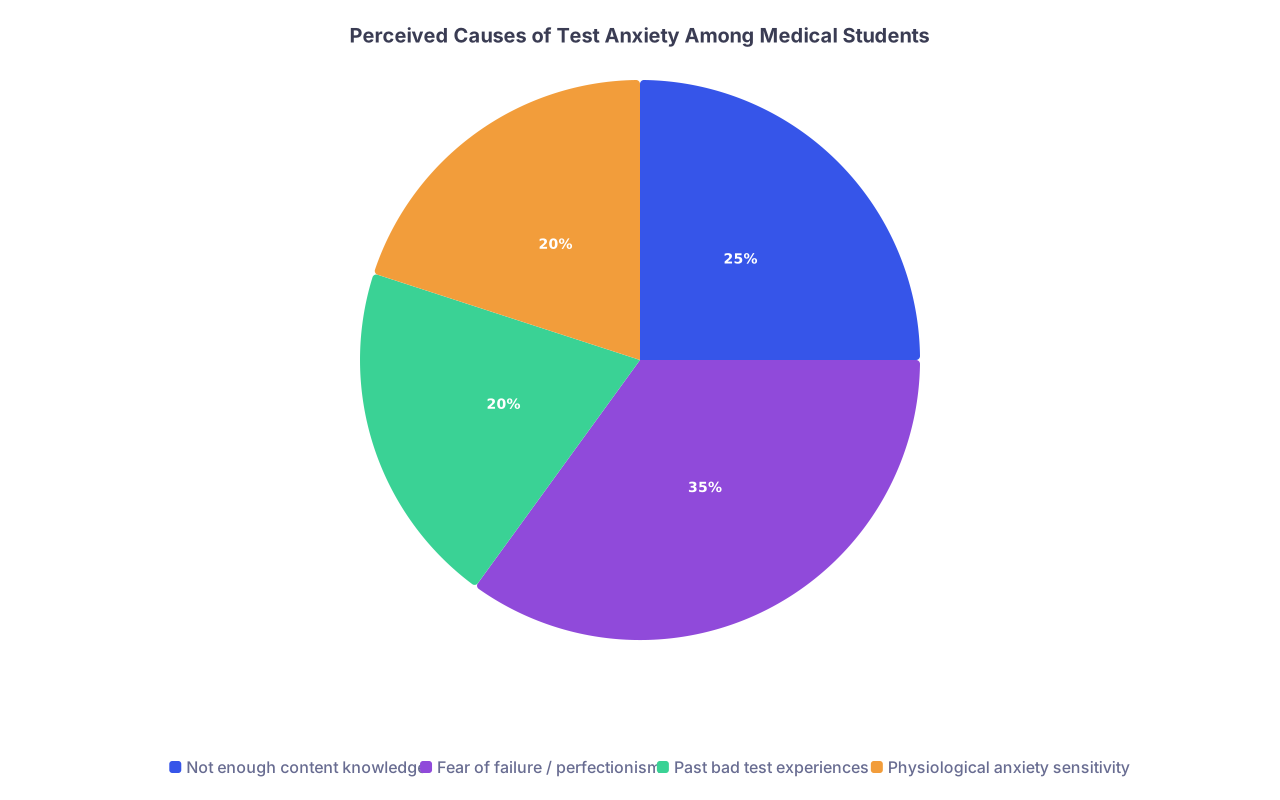
| Not enough content knowledge | 25 |
| Fear of failure / perfectionism | 35 |
| Past bad test experiences | 20 |
| Physiological anxiety sensitivity | 20 |
Students think content is the main driver. It usually is not.
How to Actually Shift Out of the Content-Anxiety Loop
If you recognize yourself in this pattern, here’s the stripped-down version of what to do before the next big exam:
- Set a clear “enough” bar for content based on practice scores, not feelings.
- Build in 5–10 minutes per day of anxiety-specific work: breathing, thought records, or both.
- Do at least one exposure per week to not overstudying (hard stop times, protected time off).
- Run 2–3 exam-like practice blocks where your explicit goal is not to feel calm, but to function while anxious.
None of this is sexy. It’s not as glamorous as 12-hour “grind” days. But it’s the stuff that actually unwires test anxiety rather than feeding it.
The Bottom Line
Two things to remember:
More content review is a terrible primary treatment for persistent test anxiety. Once you hit adequate preparation, extra review mainly reinforces your fear, wastes your resilience, and keeps you trapped in the overstudy loop.
The real leverage is in how you think, how your body responds, and how you behave around exams. CBT-style thought work, physiological training, and exposure to not overstudying have far stronger evidence—and I’ve seen them rescue plenty of anxious, overprepared med students who thought the answer was “just one more pass.”