
Last month, a clerkship director forwarded me an email from an attending: “Student X was visibly falling apart the day before the shelf. Kept saying they were going to fail. Good on the wards, but I’m concerned about resilience.”
That student had no idea that 24 hours of visible meltdown did more damage to their evaluation than a borderline shelf score ever would. And I’ve watched this exact movie play out more times than I can count.
Let me walk you through what attendings really see—and quietly write—in those moments you think are “just nerves.”
The ugly truth: attendings do notice your pre-shelf meltdown
You think everyone’s focused on patient care and the shelf is just your private hurricane. It’s not. On busy teams, everyone’s running pattern recognition constantly—on patients, and yes, on you.
When you melt down before a shelf, attendings and residents are not thinking, “Poor student, big exam, understandable.” They’re thinking:
- “What will this person be like under real pressure as an intern?”
- “Do I want to be on home call while they’re freaking out in the ED?”
- “If they fall apart over a shelf, what happens during a code?”
Here’s the harsh part: the day before the shelf is exactly when faculty are often drafting or finalizing your evaluations. Your timing could not be worse.
I’ve seen a student with strong clinical performance get knocked from “honors” to “high pass” solely because three different residents mentioned “significant test-related anxiety affecting team dynamics.” That’s the language that shows up in evals. And selection committees know exactly what it means.
What attendings actually see when you’re anxious
You feel: “I’m just nervous.”
They see a lot more. And they categorize it, even if they don’t say it out loud.
Here’s their unofficial mental checklist:
| Your Behavior | What They Infer |
|---|---|
| Repeating “I’m going to fail” | Poor emotional regulation |
| Asking everyone about score curves | External locus of control |
| Constantly checking UWorld stats | Obsessive, not strategic |
| Snapping at a nurse or peer | Risky under pressure |
| Skipping tasks to “cram” | Questionable professionalism |
1. The “I’m going to fail” loop
When you say, out loud, multiple times a day:
- “I’m going to tank this.”
- “I know I’m going to fail.”
- “I’m screwed, I’m so behind.”
What attendings hear is: this person defaults to catastrophizing. They’re not thinking, “Oh, honest vulnerability.” They’re thinking, “This is going to make sign-outs, codes, and difficult families much harder.”
One attending I know in IM put it very bluntly to me:
“If they can’t regulate their anxiety for a shelf exam, I don’t want them on nights with a GI bleed and no backup.”
Is that fair? Not always. But it’s how they think.
2. Score-obsessed behavior
The “How many questions did you do?” interrogation. The hourly Step 2 percentile screenshot. The “What did you get on your shelf?” cross-examination of interns and residents.
Faculty hear about this. Residents roll their eyes; some of them document it when it starts affecting the team.
What this signals to us:
- You’re focused on optics and numbers, not on learning.
- You’re prone to social comparison that can poison team culture.
- You might be the resident who cares more about fellowship letters than patient care.
No one comes out and tells you that at feedback time. They just click “area for improvement: professionalism / emotional maturity” on the form.
3. The sudden personality change
The student who’s been steady for five weeks suddenly becomes:
- Quiet and withdrawn.
- Snappy.
- Avoidant of tasks.
- Skipping lunch or rounds to “study.”
This is where attendings start the “future intern” projection. They imagine you as a PGY-1 in July, with sicker patients and real consequences. If your baseline changes drastically with exam stress, they assume similar or worse swings will happen when things are higher stakes.
One surgery clerkship director told me exactly how he frames it:
“I’m not evaluating who they are on an easy Tuesday. I’m watching who they become when they’re tired, scared, and behind.”
Shelf week is a sneak peek.
The three types of pre-shelf meltdowns attendings talk about
Let me pull back the curtain on how we actually talk about this behind closed doors. Because we do.
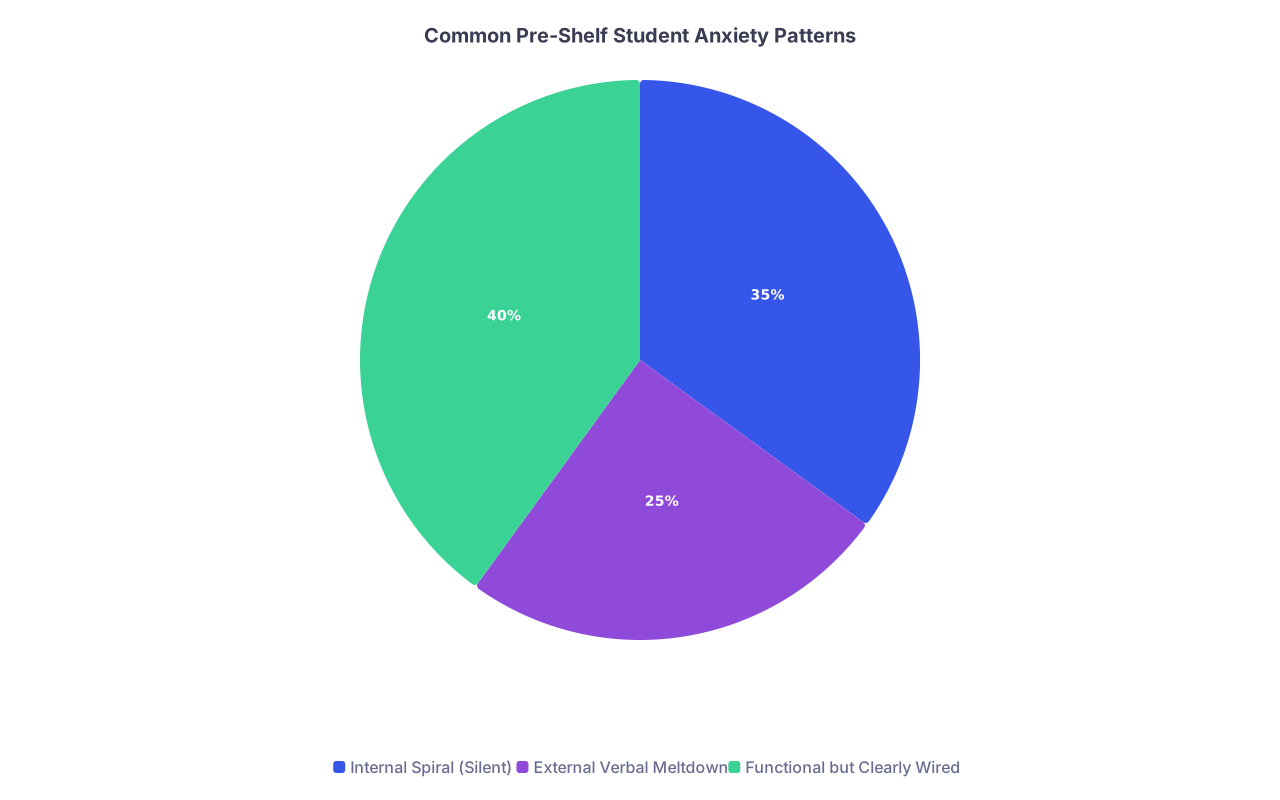
| Category | Value |
|---|---|
| Internal Spiral (Silent) | 35 |
| External Verbal Meltdown | 25 |
| Functional but Clearly Wired | 40 |
Type 1: The internal spiral (silent but obvious)
These students don’t say much, but their body language screams:
- Visibly shaking on pre-rounds.
- Forgetting very basic tasks.
- Making minor but repeated mistakes they normally wouldn’t.
- Looking teary on and off.
Residents notice. Some will protect you: “Hey, take 10 minutes, go breathe.” Others will mark it as “struggled on stressful days.”
If you stay professional and keep doing the job—just a bit more brittle—most attendings are actually forgiving. They document it mentally but don’t weaponize it. Where it gets dangerous is when anxiety starts affecting patient care: missed labs, ignored pages, incomplete notes.
Type 2: The external verbal meltdown
This is the one that burns people.
You start vocalizing your anxiety constantly. To everyone. On rounds, in front of nurses, at the workstation.
Statements like:
- “I haven’t studied at all.”
- “I’m dead, this is a disaster.”
- “I can’t do this, I’m so behind.”
- “I’m going to fail, I know it.”
Now you’re not just “anxious.” You’re reshaping how the team perceives your stability. And once someone writes, “frequently expressed inability to cope with exam stress,” good luck erasing that.
I’ve sat on promotions committees where this phrase alone triggered a half-hour discussion: “Will they be safe with a 28-hour call as an intern?” That’s the leap people make. You see “test anxiety.” They see “possible future meltdown with real patients.”
Type 3: Functional but clearly wired
This is the group that actually earns respect.
They’re obviously stressed, but:
- They show up on time.
- They finish notes.
- They’re still polite to staff.
- They ask for clear expectations for shelf week (“Is it okay if I leave by 4 pm to study?”) instead of secretly slipping away.
What do attendings say about them?
“He was clearly anxious before the shelf but did not let it affect his work.”
“She handled exam stress appropriately and remained dependable.”
That wording is gold. It tells future programs: this person gets stressed like everyone else, but they can modulate and still function.
How test anxiety really hits your evaluation (and match)
No one is putting “Student melted down before shelf” in your MSPE. They’re smarter than that. But it shows up in coded language.
You’ll see phrases like:
- “Did well when stress levels were moderate; higher-stress days revealed some challenges with emotional regulation.”
- “Needed significant reassurance around exam performance.”
- “Would benefit from further development of confidence and resilience under pressure.”
- “Anxiety sometimes impacted efficiency and team communication.”
On selection committees, people translate:
- “Needs reassurance” → high maintenance.
- “Resilience under pressure” → they struggled when things were hard.
- “Impacted efficiency” → slower, less reliable when stressed.
Programs in high-intensity fields (surgery, EM, anesthesia, critical care) weight these lines heavily. Psychiatry and pediatrics care too—but they often see this as coachable if everything else is strong.
The wildcard: letters. I’ve seen attendings write glowing letters that still contained a single line like:
“Student Z occasionally became quite distressed when discussing upcoming exams; with mentorship, I expect they will continue building resilience.”
That seems kind. Programs read: this is already a documented pattern.
What attendings wish you would do instead of melting down
Here’s the part no one teaches you: what actually plays well.
1. Name it once, not fifteen times
Saying one time to your resident:
“I’m pretty anxious about the shelf this week, just so you know—I’m managing it, but if I seem a bit on edge, that’s why.”
That’s honest, professional, and contained. You’ve:
- Acknowledged reality.
- Framed it as something you’re handling.
- Given context without asking them to fix it.
What you don’t do after that: repeat the same anxiety statement every 45 minutes.
2. Ask for structure, not sympathy
Instead of:
“I’m so behind, I’m going to fail, I don’t know what to do.”
Try:
“I’m trying to balance being useful on the team with finishing my studying. Is there a time this week where it’d be reasonable for me to leave by 4 to prep for the shelf?”
Attendings respect concrete, pragmatic requests. It signals:
- You’re planning, not panicking.
- You value both the team and the exam.
- You’re trying to solve, not just vent.
Most reasonable teams will accommodate you at least once or twice that week. The ones that don’t? They were never going to care about your meltdown anyway.
3. Use micro-regulation in real time
Your heart racing on pre-rounds? Normal. The problem is letting that show up as chaos.
Here’s what the calm students do that the rest don’t:
- Before entering the hospital, they give themselves exactly 90 seconds of slow breathing and a clear, boring script: “My job today: follow up my patients, one note at a time. Shelf is later.”
- In the bathroom between patients, instead of doom-scrolling Anki, they take 3 slow deep breaths and identify one concrete next task: “Call micro, then check vitals, then move on.”
- They limit shelf talk. One short conversation with a trusted friend. Then they shut it down.
No one sees this. They just see that you’re steady.
A simple pre-shelf week game plan that doesn’t look like a meltdown
You want something practical. Fine. Here’s what attendings like me silently approve of when we see it in action.

| Step | Description |
|---|---|
| Step 1 | 7 Days Before Shelf |
| Step 2 | Clarify Expectations with Team |
| Step 3 | Set Daily Study Hours Goal |
| Step 4 | Communicate One Specific Ask |
| Step 5 | Limit Exam Talk to 1-2 People |
| Step 6 | Use 5-Minute End-of-Day Review |
| Step 7 | Day Before Shelf: Leave on Time, Light Review |
Seven days before the shelf:
You say to your resident or attending:
“I’m taking the shelf next Friday. I’d like to keep being helpful on the team but also need some time in the evenings to review. Is there anything specific you’d like me to prioritize this week?”
You just signaled:
- You’re organized.
- You care about the rotation.
- You’re aware of your own bandwidth.
Then you quietly:
- Pick a study cutoff time (e.g., 10:30 pm). You stop at that time, even if you’re behind. Sleep is performance. People can see when you’re underslept.
- Choose 1–2 trusted friends you’ll talk shelf anxiety with. Everyone else? You keep it neutral.
Each day:
- Do your work. Ask appropriate questions. Don’t drop tasks.
- Use one five-minute block at the end of the day to write: “3 things I did well clinically” and “1 small tweak for tomorrow.” This keeps your brain from defining the whole week by “how behind I am on UWorld.”
Day before the shelf:
- You ask early in the day: “Would it be alright if I left by 3 or 4 today to study for the shelf?” Not at 2:55 when someone needs a CT consent.
- You leave, you do light review, and you go to bed at a reasonable time. No panicked all-nighter that turns you into a wreck on exam day.
What do attendings write about students like this?
“Balanced clinical responsibilities and exam preparation appropriately.”
“Remained composed during a stressful exam week and did not let anxiety interfere with patient care.”
That’s test anxiety management that helps you, not just “doesn’t hurt you.”
What to do if you already melted down
Let me be brutally honest: if you’ve already had an obvious pre-shelf meltdown on a rotation, you’re not doomed. But you cannot pretend it didn’t happen.
The smart move is small, controlled, and direct.
A day or two later, you say to your attending or senior resident:
“I realized I was visibly stressed about the shelf earlier this week, and that’s not how I want to show up on a team. I’m working on managing that better so it doesn’t impact patient care.”
Short. No long explanation. No crying apology tour. You’re showing insight and growth, which is the only antidote to a bad impression.
Then you back it up by:
- Showing up stable the rest of the rotation.
- Not rehashing the meltdown.
- Not fishing for reassurance: “Do you think I’m okay? Was I that bad?”
A single bad day is survivable. A pattern is not.
The part nobody says out loud: we’re actually on your side—until we aren’t
Most attendings remember being terrified of exams. Many still have performance anxiety; they just hide it better and have different triggers now—lawsuits, morbidity/mortality, ICU call.
We don’t dock you for being human. We dock you when your anxiety leaks into the professional space in a way that forces everyone else to manage you on top of their patients.
You’re not being asked to be a robot. You’re being asked to be:
- Predictable.
- Contained.
- Safe under moderate pressure.
Shelf week is a dress rehearsal. Act accordingly.

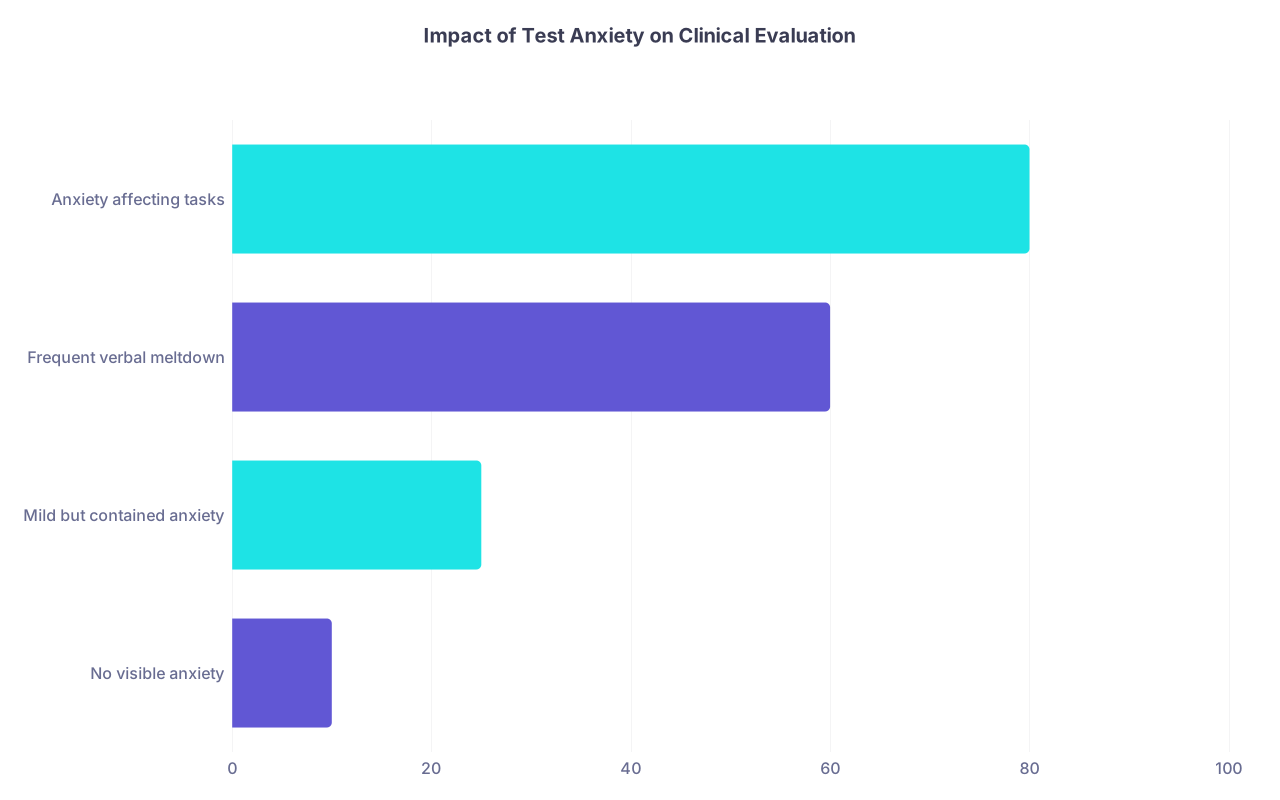
| Category | Value |
|---|---|
| No visible anxiety | 10 |
| Mild but contained anxiety | 25 |
| Frequent verbal meltdown | 60 |
| Anxiety affecting tasks | 80 |