
The biggest trigger of your test anxiety might not be the exam. It might be your group chat.
You think you are “staying in the loop.” You tell yourself everyone is stressed, so this is normal. Meanwhile, your heart rate spikes every time your phone lights up with, “OMG did you guys see question 47?” or “I just got a 260 on my last NBME!!!”
Let me be clear: unmanaged group chat behavior can quietly wreck your focus, your confidence, and your sleep. And most medical students walk right into this trap.
You are not weak for being affected by it. You are just unprotected.
This is where you stop making that mistake.
1. The Constant Comparison Trap: Score-Flexing and “Study Updates”
The fastest way to inflame test anxiety? Surround yourself with curated, selective, unfiltered performance data from dozens of other medical students. That is what group chats become during exam season.
Score-flexing (intentional or not)
You have seen this:
- “Just got a 258 on UWSA2, let’s gooo”
- “NBME 10 – 252, NBME 11 – 256, feeling okay I guess”
- “Dropped from 245 to 240 on this practice test, anyone else?”
The problem is not that people share scores. The problem is what your brain does with it.
You do not see:
- How many tests they did not post.
- How many times they guessed correctly.
- How anxious or burned out they are.
You only see a scoreboard. And you put yourself at the bottom.
Here is the mistake: staying in a chat where scores are the main language and telling yourself, “I can just ignore it.” You will not. You will read it, screenshot it, mentally rank yourself, and quietly panic.
“Study updates” that are actually covert competition
This is the more subtle version:
- “Finished UWorld for the second time, starting Anki overhaul now.”
- “Done with all the sketchy videos, just going to review FA again.”
- “I am only doing 120 questions/day now. Might bump to 160 if needed.”
You read this at 8 pm, exhausted, having done 40 questions and some review. Now you feel behind. Lazy. Inadequate.
You are not. You just consumed someone else’s schedule as if it were a moral standard.
How to avoid this trap
Do not rely on willpower. Change the environment.
-
- People frequently post raw scores.
- “What did you get?” is a common question.
- People use self-deprecation as humble bragging (“I only got a 248, I am so dumb”).
Create or join a no-score study chat with clear rules:
- No posting exact practice exam or shelf scores.
- No ranking or comparison wording (“top of the class,” “everyone else got…”).
- Focus on process, not numbers (question strategies, resources, clarification).
If you must stay in a score-heavy chat (class-wide channels, official groups):
- Keep it on mute.
- Only open it for logistics (room changes, deadlines).
- Use the search bar to skip social noise (search “schedule,” “room,” “Zoom,” etc.).
Stop testing your emotional stability against a constant feed of other people’s scores. You will lose that game even if you are doing well.
2. Panic Cascades: Post-Exam Autopsies and “Did You Get X?”
Nothing spikes anxiety like the post-exam group chat. You walk out of the test vaguely okay, then you open your phone.
And now your brain is on fire.
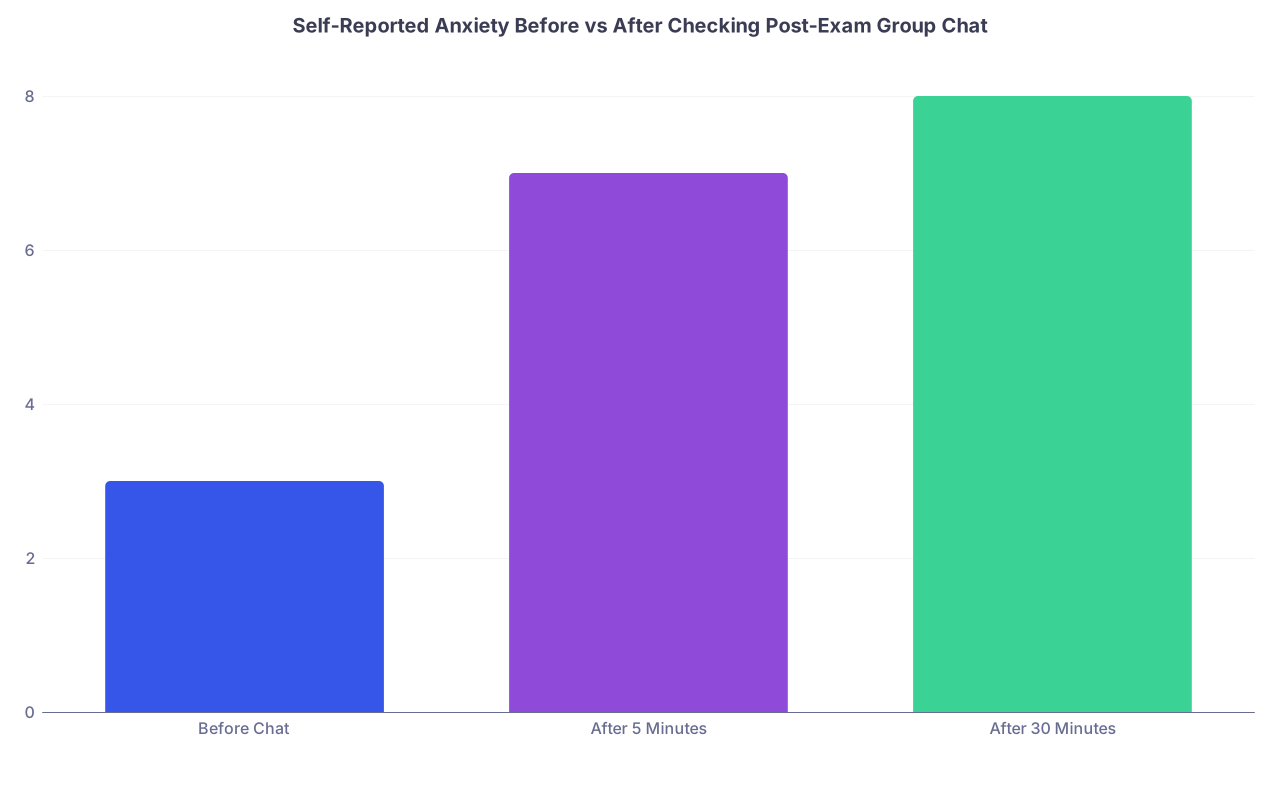
| Category | Value |
|---|---|
| Before Chat | 3 |
| After 5 Minutes | 7 |
| After 30 Minutes | 8 |
The post-exam autopsy disaster
Typical pattern:
- “What did you put for the patient with hyponatremia and confusion?”
- “Wait, you guys got C for the urea cycle question?”
- “Was the answer ARDS or cardiogenic pulmonary edema??”
Someone is always:
- 100% convinced their answer is right.
- Loud about it.
- Wrong.
But you will not know that. What you feel is: “I missed that. I am failing. Again.”
I have watched entire groups spiral into:
- Trying to reconstruct 40+ questions from memory.
- Arguing about minutiae that do not matter.
- Staying worked up for hours after the exam is submitted and gone.
None of this changes the score. It only hijacks your nervous system.
The pre-release purgatory
Then, during the wait for scores:
- “I keep thinking about that one cardio question.”
- “I definitely failed.”
- “Anyone else still obsessing over the ethics question?”
This sounds like “venting together,” but it often becomes a contest of who is most doomed. And your brain starts believing the worst narrative, especially at 1 am.
How to protect yourself
You must treat the immediate post-exam period as a danger zone.
Hard rule: No group chats for 4–6 hours after any major exam.
- Turn off notifications pre-exam.
- Do not “just check quickly” walking out of the room.
- Go eat, walk, shower, sleep. Then, maybe, open it.
Do not participate in:
- Question reconstruction.
- “What did you get for X” discussions.
- Shared Google Docs of remembered questions (yes, people do this, no, you should not join).
Prepare one or two people you trust beforehand:
- Tell them: “After the exam, I am not discussing questions. If I start, shut me down.”
- Stick to “How did it feel emotionally?” not “What was your answer?”
Here is the mindset shift: once you click “submit,” your job is not to maximize clarity. It is to minimize self-harm.
You gain nothing by reliving an exam that cannot be changed.
3. Rumor-Driven Panic: Schedules, Curves, and Policy Gossip
Group chats during medical school become rumor factories. And rumor is gasoline on anxiety.

The “I heard from a resident” spiral
You know these messages:
- “I heard from a PGY-2 that they are raising the passing score this year.”
- “Apparently the shelf curve is brutal; last year half the class barely passed.”
- “Someone said they are cracking down on people who fail the first time.”
Often the source is:
- A friend-of-a-friend.
- A resident who “thinks” this might be happening.
- Something half-remembered from orientation.
Yet your brain processes it as: policy. Fixed. Official.
Exam logistics turned into chaos
Simple announcements become distorted by group chat noise:
- “Wait, I think the exam time changed to 8 am.”
- “No, pretty sure it is still 9. Check email.”
- “My small group leader said something about a new format.”
Ten conflicting messages later, your anxiety is not about the exam content. It is about whether you even understand what is happening.
How to avoid rumor-induced anxiety
You need a strict source hierarchy.
| Source Type | Reliability |
|---|---|
| Official school emails | High |
| Course/Clerkship website | High |
| Announcements in LMS (Canvas, etc.) | High |
| Group chat messages | Low |
| “Heard from a resident” | Very Low |
Rules that will save you:
Never change your study plan based solely on a group chat message.
For any exam-related claim:
- Step 1: Check email or LMS.
- Step 2: If not there, assume it is not real yet.
- Step 3: If you are still unsure, email the course coordinator directly.
Mute or scroll past messages that start with:
- “I heard…”
- “Apparently…”
- “Rumor is…”
- “Someone said…”
You do not need to correct every rumor. You just need to stop feeding your nervous system with them.
4. Toxic “Support”: Vague Anxiety Bonding and Catastrophizing
Not all emotional sharing is helpful. Some of it is just group ruminating.
There is a big difference between:
- “I am anxious; can someone help me figure out a plan?” and
- “We are all going to fail, this exam is impossible, I cannot breathe.”
The second one spreads like smoke in a closed room.
Vague panic with no action
You see messages like:
- “I feel so behind I might as well give up.”
- “I have done nothing for this exam and I am definitely failing.”
- “I do not even know what to study anymore. Everything is a mess.”
You read this while you are already stressed. Your brain does something predictable:
- “They are behind. I probably am too.”
- “If they are doomed, maybe I am doomed.”
- “Everyone is overwhelmed. This must be impossible.”
Now instead of studying, you are mentally catastrophizing right along with them.
Trauma-dumping in big groups
There are moments to lean on your peers. There are also moments when someone drops extremely heavy emotional content into a 60-person chat at 1:30 am. Stuff like:
- “If I fail this, my career is over.”
- “I do not know if I can keep going.”
- “My life is falling apart with this exam.”
Those messages matter. The person matters. But a big group chat is often the worst place to process that intensity. You are not equipped, as a group, to manage crisis-level anxiety. Yet you all absorb it.
What to do instead
You are allowed to protect your headspace even when others are struggling.
If a chat is heavily dominated by emotional venting:
- Mute it during high-stakes periods.
- Check in rarely and briefly.
- Reach out privately to friends who are struggling, rather than immersing yourself in group spirals.
Replace vague panic with specific questions in smaller groups:
- “I am stuck on cardiac physiology. How did you structure your review?”
- “I am overwhelmed by UWorld. How many questions/day are realistic in clerkship?”
Encourage directional support, not just commiseration:
- “You are not alone. Want to hop on a 25-minute focus session and knock out some cards?”
- “Let us list what you realistically can do in the next 2 days.”
If your “support” system leaves you feeling more hopeless after reading it, it is not support. It is shared drowning.
5. The Study-Plan Hijack: Resource FOMO and Schedule Copying
One of the most damaging group chat behaviors is subtle: study-plan comparison that looks “productive.”

| Step | Description |
|---|---|
| Step 1 | You make a study plan |
| Step 2 | Open group chat |
| Step 3 | Feel your plan is inadequate |
| Step 4 | Change resources & schedule |
| Step 5 | Fragmented focus & lower confidence |
| Step 6 | See others plans |
Resource FOMO: The endless list of “must-use” tools
You thought you were set: Pathoma, Anki, UWorld. Then the chat starts:
- “Is everyone using Boards and Beyond too?”
- “My tutor said Rx is essential before UWorld.”
- “Just found this amazing PDF with 200 pages of must-know facts.”
Suddenly:
- Your 3-resource plan becomes 7.
- You spend more time collecting resources than using them.
- Every message feels like, “If you do not use this, you are screwed.”
Here is the truth: more resources often mean worse learning. Fragmented. Shallow. Disorganized.
Schedule copying: Wrong solution for the wrong person
You see someone post:
- “Here is my daily schedule: 200 Anki, 80 UWorld, 2 videos, 2 hours of review.”
You think: “That is what a serious student does. I should do that.”
But:
- They may be on dedicated time. You are on rotation.
- They might tolerate 6–8 hours of pure study. You crash at 4–5.
- They might have started months earlier. You are playing catch-up.
Copying their plan:
- Sets you up for failure when you cannot keep up.
- Confirms your worst fear: “I cannot do this like everyone else.”
- Increases anxiety and procrastination.
How to avoid the study-plan hijack
You need a firewall between their plan and yours.
Decide your core resources before you re-open group chats.
- Example: “For this exam I am using UWorld + Anki + class notes. That is it.”
- Put it in writing. On your wall. On your laptop.
When you see a new resource recommendation:
- Ask: “Is this solving a specific problem I actually have?”
- If not, ignore it for this exam cycle.
- Create a “future resources” note if it eases the FOMO. You can revisit later.
Timebox any “study chat” browsing:
- 5–10 minutes max.
- Only look for logistics or concrete tips, not wholesale schedule changes.
You do not win exams by having the largest pile of resources. You win by having fewer, used deeply and consistently.
6. Notification Overload: Micro-Stress Hits All Day (and Night)
People underestimate how much constant buzzing warps their baseline anxiety.
Each notification seems small:
- “Anyone know what will be tested from lecture 14?”
- “Look at this insane question from today’s UWorld block.”
- “Is this ECG VT or SVT with aberrancy?”
But your nervous system does not reset to zero between each ping. You stay half-alert. Half-worried. Half-distracted.

The illusion of “being responsible”
Many students justify it:
- “I need to be reachable for schedule changes.”
- “What if they share a last-minute tip?”
- “I do better when I am plugged into the group.”
No, you just feel safer being plugged in. Very different.
What actually happens:
- Study blocks get sliced into 5–10 minute chunks.
- Your brain never drops into deep focus.
- Increased cognitive load. Decreased retention.
Chronic micro-stress like this is a quiet driver of test anxiety. You always feel “on,” yet never feel prepared.
How to take back control
Notifications are not an act of God. You can turn them off.
Use “Do Not Disturb” or “Focus Mode” during:
- Practice blocks (UWorld, NBMEs).
- Active recall sessions (Anki, question review).
- Pre-sleep wind-down time, at least 30–60 minutes.
Create tiers of access:
- Pin 1–2 actual essential chats (logistics from school, clerkship announcements).
- Demote or mute social/study chats.
Change your default chat behavior:
- Turn off “preview” text on notifications so your eyes are not pulled in.
- Disable vibration for non-essential chats.
- Set “silent” as the default tone for group chats.
Every notification you do not receive is a tiny win for your nervous system. Stack enough of those, and your baseline anxiety changes.
7. Building a Low-Anxiety Communication System That Actually Helps You
You do not need to go full hermit and delete all your chats. You just need structure.
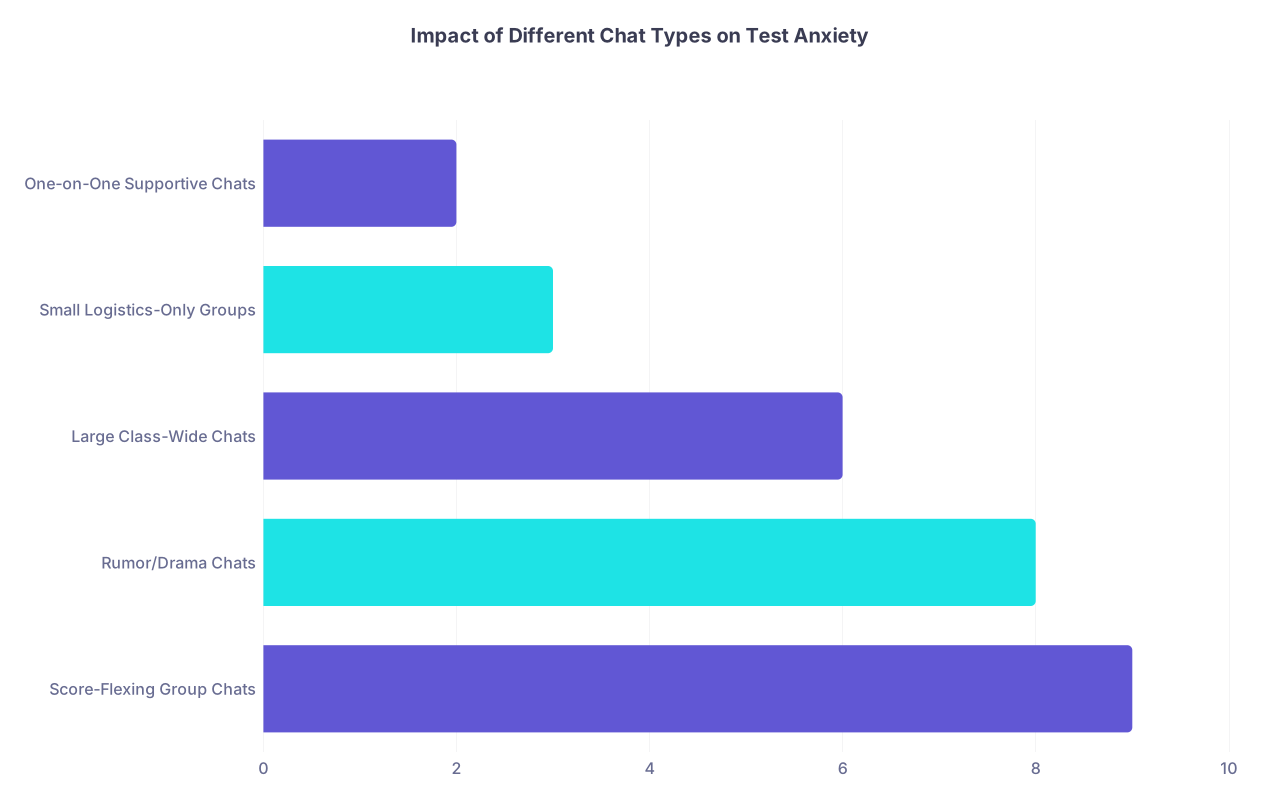
| Category | Value |
|---|---|
| Score-Flexing Group Chats | 9 |
| Rumor/Drama Chats | 8 |
| Large Class-Wide Chats | 6 |
| Small Logistics-Only Groups | 3 |
| One-on-One Supportive Chats | 2 |
Here is a sane, protective setup:
1. Clear chat categories
Logistics-only chats
- Purpose: exam times, room changes, official info.
- Rules: no scores, no panic, no long debates.
- Action: keep notifications on, but do not chat socially there.
Small, aligned study groups (2–5 people)
- Purpose: clarify concepts, share resources sparingly, keep each other accountable.
- Rules: no score posting, no post-exam autopsies, no schedule flexing.
- Action: be explicit about these rules upfront.
Personal support channels (1–3 close friends, private chats)
- Purpose: honest emotional check-ins, actual support.
- Rules: if venting > 10 minutes, shift to “What can we do next?”
- Action: voice messages or short calls often reduce misinterpretation and drama.
2. Red-list behaviors you will not participate in
Say no (even silently) to:
- Post-exam question breakdowns.
- Score comparison threads.
- Rumor amplification (“I heard…”) without sources.
- Late-night panic spirals.
You do not owe anyone your participation in conversations that damage your mental health. You can quietly opt out.
3. Default scripts to protect yourself
Use simple lines:
- Before the exam:
- “Muting this until after the exam, good luck everyone.”
- After the exam:
- “Not discussing questions, just glad that is over. Hope you all get some rest.”
- When someone panic-posts:
- “This sounds really overwhelming. Want to talk 1:1?”
- “I feel you. I am going to step away from chat and get some studying/rest in.”
You are not responsible for fixing group anxiety. You are responsible for not drowning in it.
Final Takeaways
Keep these core points in your head:
- Group chats magnify comparison, rumor, and panic. If your anxiety spikes after reading them, they are harming you more than helping you.
- You are allowed to mute, leave, and set rules. Protect your attention and your emotional bandwidth like they matter—because they do.
- Replace chaotic, loud group spaces with smaller, intentional, low-drama channels focused on logistics, real support, and actual learning.
Control the inputs, and your test anxiety stops being fed 24/7. That is how you finally give yourself a fair chance on exam day.