You, the exam, and the quiet disaster you are calling “coping”
It is 1:37 a.m. Two days before your shelf exam. Your Anki reviews are untouched, but your “one quick look” at Reddit has turned into a 90‑minute doom-scroll of other students’ scores and study schedules. Your heart is racing, your stomach feels like it is eating itself, and you just told yourself, “Fine. I’ll just stay up all night. Again.”
You tell yourself you are managing your test anxiety.
You are not. You are feeding it.
Most medical students do not blow their exams because they were lazy or unintelligent. They blow them because, under pressure, they fall back on red‑flag coping strategies that feel comforting in the moment and are absolutely toxic over a few weeks or months.
This is the stuff you must cut immediately. Not someday. Not “after this exam.” Now.
Let me walk you through the most common traps I keep seeing over and over in med students and early residents, and what they are quietly destroying.
1. All‑nighters and chronic sleep sacrifice: the “heroic” self‑sabotage
You know this one is bad. You have probably counseled patients about sleep and cognition. And yet, before every major exam, a wave of students suddenly decides the rules of physiology somehow do not apply to them.
The pattern is predictable:
- Sleep shrinks from 7 hours to 5, then to 3–4.
- “Just this week” becomes “basically the whole block.”
- Brain fog, irritability, and emotional volatility spike.
- Anxiety climbs, so you cut even more sleep to “catch up.”
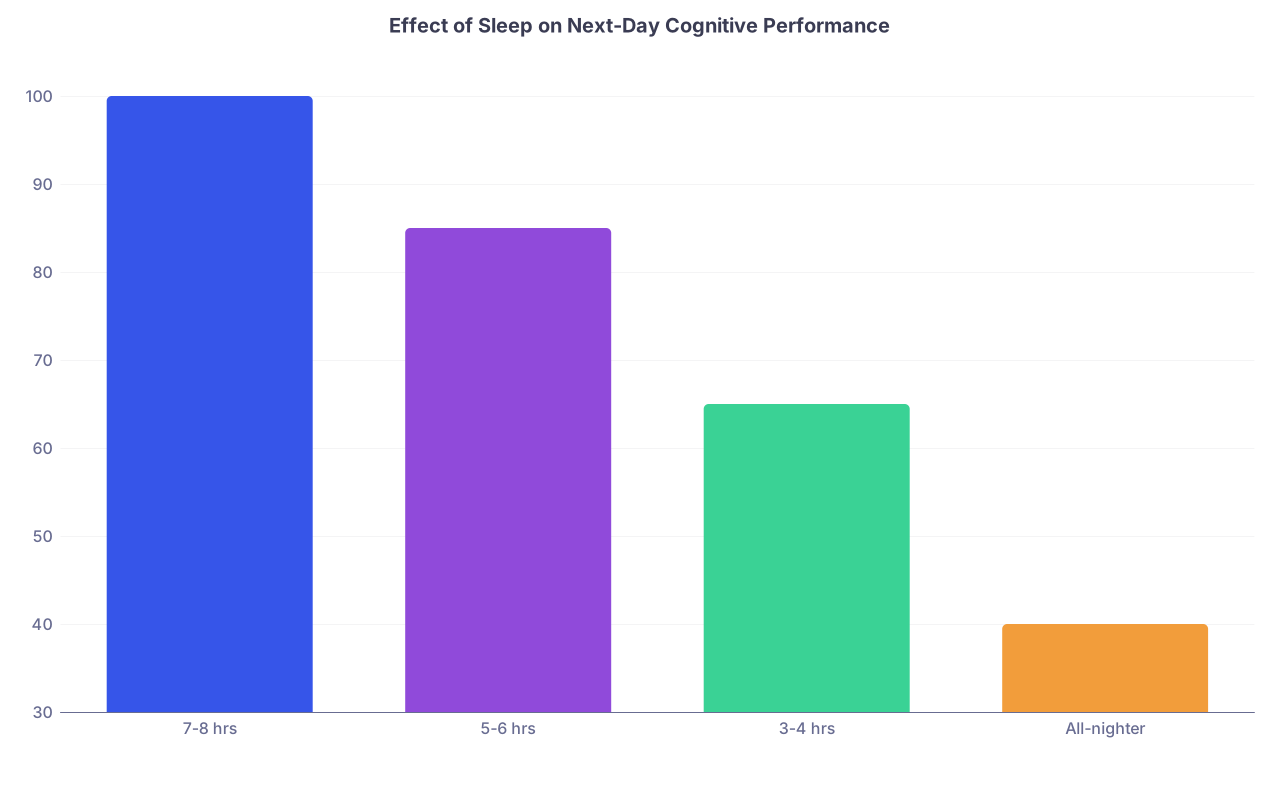
You call it grinding. I call it slowly frying your prefrontal cortex.
| Category | Value |
|---|---|
| 7-8 hrs | 100 |
| 5-6 hrs | 85 |
| 3-4 hrs | 65 |
| All-nighter | 40 |
That is roughly how big the performance hit can feel. Not precise data, but very accurate in practice.
Why this is a red flag, not a “necessary evil”
Acute, rare, end‑stage all‑nighter? Annoying but survivable. Chronic pre‑exam sleep restriction? That is a different beast.
Here is what actually happens when you trade sleep for more question blocks:
- You encode less. Cramming while sleep deprived does not “stick.” You may recognize the question format, but you cannot retrieve specifics under stress.
- You destroy test‑day consistency. With inconsistent sleep, you have no idea which version of your brain will show up on exam day.
- You amplify anxiety. Sleep debt makes your amygdala more reactive. The same NBME stem feels 2x more threatening.
I watched a very strong student tank Step 1 because of this exact pattern. She went from consistent 240+ practice tests to a 215 on the real thing. Her last two weeks: “I was sleeping 3–4 hours most nights and drinking energy drinks all day. I thought I had to push through.” That was not pushing. That was disabling herself.
The mistake to stop making
Stop treating sleep as optional in the final 7–10 days before an exam. That stretch is where many students do the most damage.
Non‑negotiables:
- Minimum 6 hours per night, ideally 7–8, especially the last 3 nights.
- No back‑to‑back late nights. One short night? Fine. Two or three in a row? Red flag.
- No caffeine after mid‑afternoon if it delays your sleep.
If this sounds impossible, that is the point: your current “plan” is not a plan. It is panic dressed up as work ethic.
2. Doom‑scrolling and obsessive score comparison: pouring gasoline on anxiety
You finish a block on UWorld or AMBOSS. Before even reviewing, you open:
- Reddit (r/Step1, r/Step2, r/medicalschool, etc.)
- Discord study channels
- Group chats comparing percent correct and NBME scores
You tell yourself you are “benchmarking” or “gathering information.” No. You are spiking your cortisol for sport.
I keep seeing students do this every single time anxiety spikes: they go looking for proof that they are behind, that everyone else is doing better, that they are doomed. It is like scratching a mosquito bite until it bleeds. Feels inevitable. Makes everything worse.
Why this is such a toxic habit
A few specific problems with this:
You only see the extremes
People post their 260s, their “I’m so dumb, I only got a 245,” their insane 12‑hour study schedules. You do not see the silent middle or the quiet recoveries.You anchor your expectations to nonsense
One person’s non‑representative NBME becomes your standard. You start thinking “I must hit X or I have failed,” even when X has nothing to do with your situation.You never let your brain down‑regulate
Every scroll is another hit of uncertainty and fear. Your nervous system never gets the memo that you are safe enough to learn.

Subtle red flags to look for
If you recognize any of these, you have a problem:
- You check forums right after a bad question block “to see if others struggled too.”
- You read test‑day horror stories more than success stories.
- You feel worse 9 times out of 10 after scrolling, but you keep doing it.
This is not “staying informed.” This is self‑harm disguised as research.
What to cut immediately
You do not need to quit the internet. You do need rules.
- No exam‑related social media or forums after a certain time (for most people, 7–8 p.m. works).
- No checking score‑comparison threads on days you take practice tests or NBME exams.
- Remove apps from your phone during dedicated or peak exam periods. Access from laptop only, with friction.
Sounds extreme? Compare that to losing 30–60 minutes of focus and peace of mind every single time you open those sites. Which is the real extreme choice.
3. Over‑reliance on substances: caffeine, benzos, beta‑blockers, and “just to take the edge off”
Let me be blunt. I have watched more than one med student slide from “occasional help” to “this is now a crutch and I do not know how to function without it.”
Test anxiety is the perfect breeding ground for that.
Common red‑flag patterns:
- Caffeine escalation: 1 coffee → 3 coffees → coffee + energy drinks → shaking hands on exam day.
- PRN benzos: prescribed (or “borrowed”) lorazepam/alprazolam before tests, sometimes creeping into routine nights.
- Off‑label beta‑blocker dependence: popping propranolol or metoprolol before every OSCE, oral exam, or standardized test.
- Alcohol as decompression: “I only drink to relax after a long study day.” Every day. For weeks.
| Substance | Early Use Pattern | Red-Flag Pattern |
|---|---|---|
| Caffeine | 1–2 cups/day | 400–800+ mg, all day |
| Benzos | Rare, supervised | Self-directed before every test |
| Beta-blockers | Occasional high-stress use | Needed for any performance task |
| Alcohol | Occasional social use | Nightly “decompression” |
Why this coping strategy backfires
You already know the lecture version. Here is the lived version:
You blunt your ability to learn actual coping skills
If every surge of anxiety is patched with a pill or drink, your brain never has to practice tolerating and riding out that wave.You increase baseline anxiety
Rebound anxiety and withdrawal (yes, even mild) make your day‑to‑day worse. Then you interpret that as “my anxiety is getting worse” instead of “my coping is getting worse.”You create exam‑day dependence
What happens when your beta‑blocker timing gets messed up? Or you cannot drink coffee on test day because your stomach is wrecked? Your brain panics: “I cannot do this without X.”
I am not saying zero medication. I am saying: if your entire exam plan rests on pharmacology instead of psychology and behavior, you are setting yourself up for a nasty fall.
What you need to stop doing
- Stop changing or adding meds on your own right before exams. No last‑minute SSRIs, no random PRN benzo strategy without a physician who actually knows your case.
- Stop escalating caffeine when you feel more anxious. Anxiety + high caffeine = worse performance, not better.
- Stop romanticizing “I just need a drink to turn my brain off.” That line has been the start of too many slow train wrecks.
If you think you are sliding into dependence, that is not a moral failure. It is a signal that you need to bring this to your own physician or therapist now, not after the exam.
4. Procrastination disguised as “optimizing” and over‑planning
You sit down to study. Your anxiety kicks up. Instead of starting questions, you:
- Build a new color‑coded Excel study tracker.
- Rearrange your Anki decks. Again.
- Watch 2 hours of “best Step 2 resources” videos on YouTube.
- Re‑write your calendar for the 5th time this month.
It feels productive. It is not. It is avoidance with good branding.

| Step | Description |
|---|---|
| Step 1 | Feel anxious about exam |
| Step 2 | Plan/organize instead of study |
| Step 3 | Temporary relief |
| Step 4 | Less actual learning |
| Step 5 | More anxiety later |
Why this is so seductive
Anxiety hates uncertainty. Real studying (questions, flashcards, recall) has uncertainty built in. You might get things wrong. You might feel stupid.
Planning, reorganizing, and researching resources give:
- Immediate sense of control.
- Zero risk of failure, because you are not actually testing yourself.
- A dopamine hit: “Look how structured I am now.”
So your brain learns: “When I feel anxious, I should plan more, not do the scary thing.” That is how people end up with beautiful schedules and mediocre scores.
Red flags you are stuck here
- Your schedule is precise but you rarely follow it beyond day 2.
- You keep switching resources “because X YouTuber said this one is better.”
- You spend more time deciding which questions to do than actually doing questions.
What to cut, starting now
- Cut “planning sessions” longer than 20–30 minutes. If you need 3 hours to plan, you are avoiding.
- Cut mid‑block massive schedule overhauls. Adjust, do not restart the whole system every week.
- Cut YouTube/Reddit “resource reviews” once you have a functional setup. Too many inputs, zero action.
Give yourself one simple rule: every study day starts with doing, not planning. 20–40 questions or 45–60 minutes of recall before you touch a calendar.
5. Isolation and secrecy: going dark when you need support most
A nasty one. High‑achieving med students hate looking “weak.” So when anxiety ramps up, they quietly disappear:
- Stop replying in group chats.
- Say they are “busy” or “fine” but never share specifics.
- Avoid faculty, deans, or student affairs because they “do not want it on their record.”
- Hide practice scores from partners or close friends.
They tell themselves they are “focusing” or “not wanting to burden others.” What they are really doing is cutting off every stabilizing force that could keep them from sliding into a full‑blown spiral.
Why this is dangerous, not just “independent”
Here is what happens when you isolate under test stress:
Your anxious thoughts never get reality‑checked.
“I am definitely going to fail and get kicked out” sounds reasonable if you never say it aloud to someone who can push back.You miss early rescue points.
Deans, learning specialists, or therapists can often adjust your exam timing, workload, or supports. But only if they know you are struggling.You become your only source of feedback.
And when you are anxious, your internal feedback is wildly unreliable.
I saw a student in third year who quietly failed multiple shelf exams in a row and told nobody until she was on the edge of repeating the year. She said, “I thought I just needed to try harder and not make it a big deal.” That secrecy cost her months of remediation she could have avoided with a single early conversation.
The mistake to stop making
Stop assuming that asking for support equals weakness or permanent black marks.
Cut these habits:
- “I’ll tell someone if I actually fail.” Too late. You talk when your trajectory changes, not when you have already hit the wall.
- “I do not want to bother anyone; everyone is stressed.” You are not the first anxious med student they have seen this week. You are not special in that way.
- “If I say it out loud, it becomes real.” It is already real. Silence does not erase it; it magnifies it.
You do not need to blast your anxiety in every group chat. But you do need one or two people who know the truth in real time.
6. Perfectionism and punishment: turning every mistake into a character assault
Last one, and it is huge.
You miss a block of UWorld questions. Instead of analyzing them, you:
- Call yourself “stupid,” “not cut out for this,” or worse.
- Ruminate for hours about what this “means” about your future.
- Double your planned workload for the next day as punishment.
- Refuse to move on until you feel “perfect” on that topic.
You are not just anxious. You are hostile toward yourself.
Why this wrecks your performance and your mental health
Perfectionism feels like high standards. It is not. It is rigid, fear‑driven thinking that makes you:
Learn slower
You spend too long obsessing over individual topics instead of building broad, test‑relevant competence.Burn out faster
Every day becomes a moral referendum on your worth as a future physician.Panic on test day
The moment you see something unfamiliar, your brain goes straight to “I am failing,” not “I can reason through this.”
Perfectionistic self‑talk is not “motivation.” It is chronic psychological stress. Your nervous system treats it like an ongoing threat. Then you wonder why your heart is pounding on every exam.
What you must stop doing
- Stop globalizing: “I missed cardiology questions” ≠ “I am terrible at medicine.”
- Stop over‑correcting: turning one bad day into a 14‑hour punishment session the next.
- Stop tying your entire identity to one exam. You are taking a test, not being judged by the universe.
You do not need to suddenly love yourself unconditionally. You do need to stop verbally beating yourself every time you see a red font score.
7. So what does cutting these red flags actually look like?
You do not fix test anxiety overnight. But you can stop making it worse this week.
Think in terms of subtraction, not addition. You probably do not need more apps, more techniques, more elaborate routines. You need to stop the handful of behaviors that are quietly poisoning your baseline.
Here is a minimal “cut list” you can implement immediately:
- Protect sleep the last 7–10 days before any major exam. No “heroic” all‑nighters.
- Put hard boundaries on doom‑scrolling and exam forum use.
- Stop escalating substances as a primary coping tool; talk to a professional if meds are in the picture.
- Cap planning time and force yourself into action (questions/recall) early each day.
- Break the isolation: one peer and one faculty/mentor who knows what is really going on.
- Drop the self‑punishment rituals after bad blocks; replace them with neutral error analysis and then move on.
None of this is glamorous. It is not Instagram‑worthy. It is just what keeps your brain intact enough to use the knowledge you actually have.
Key points to walk away with
- Most test anxiety disasters in medical school are made worse by how you cope, not just how anxious you are.
- The red‑flag strategies—sleep sacrifice, doom‑scrolling, substance crutches, obsessive planning, isolation, and perfectionistic self‑abuse—feel helpful in the short term but steadily destroy performance and resilience.
- Your first job is not to eliminate anxiety. It is to ruthlessly cut the habits that are feeding it and give your nervous system a fighting chance to do what you have trained it to do.