The night before an exam is where a lot of smart medical students quietly sabotage themselves.
They do not fail because they did not know enough. They fail because they panicked, crammed, and wrecked their brain in the final 12 hours.
Let me be blunt: if you keep treating the night before exams like a last-minute battlefield, you are voluntarily throwing away points. And sometimes entire grades. Especially in medical school, where cognitive load is already brutal.
This is your warning label. Here are the anxiety traps that ruin the night before – and how to stop walking into them.
1. The “Last-Minute Hero” Cram Trap
The worst mistake: believing you can meaningfully “add” knowledge the night before by brute force cramming.
You know the script:
- “I just need to go through micro one more time.”
- “I will re-read all the lecture slides quickly.”
- “If I do 400 more questions tonight, I’ll be solid.”
No. You will not.
The night before an exam, your hippocampus is not a bottomless storage unit. It is a fragile, overworked system that needs consolidation, not chaos. Cramming 6 more hours of new or barely familiar content does three damaging things:
- Crowds out sleep (which is where consolidation actually happens).
- Increases cognitive overload and makes everything blur together.
- Spikes anxiety when you inevitably find 20 things you “do not know.”
You go to bed (if you even do) thinking, “I am screwed.” Not because you actually are, but because you just plunged yourself into worst-case thinking right before sleep.
The smarter move:
- The night before is for light review and stabilization, not expansion.
- No new resources. No new decks. No brand-new question bank filters “just to see.”
- If you are looking something up, it should be to clarify, not discover.
Here is the rule I give students:
After about 6 p.m. the night before, nothing you learn should be fundamentally new. If it is, accept that it will not be your strength on this exam. Chasing it now is an anxiety project, not a performance strategy.
2. The “One More UWorld Block” Obsession
Question banks are powerful tools. Misused the night before, they turn toxic.
I have watched people crush a well-prepped exam because they insisted on:
- Doing “just 2 more” random timed blocks at 11 p.m.
- Reviewing every explanation in detail, spiraling over wrong answers.
- Letting one bad block convince them they are not ready.
Here is the trap:
When you are exhausted and anxious, your performance on questions does not reflect your true readiness. But your brain still believes the narrative: “I bombed this block. I am clearly not prepared.”
Result:
- Confidence crashes.
- Catastrophic thinking explodes.
- Sleep gets delayed or destroyed.
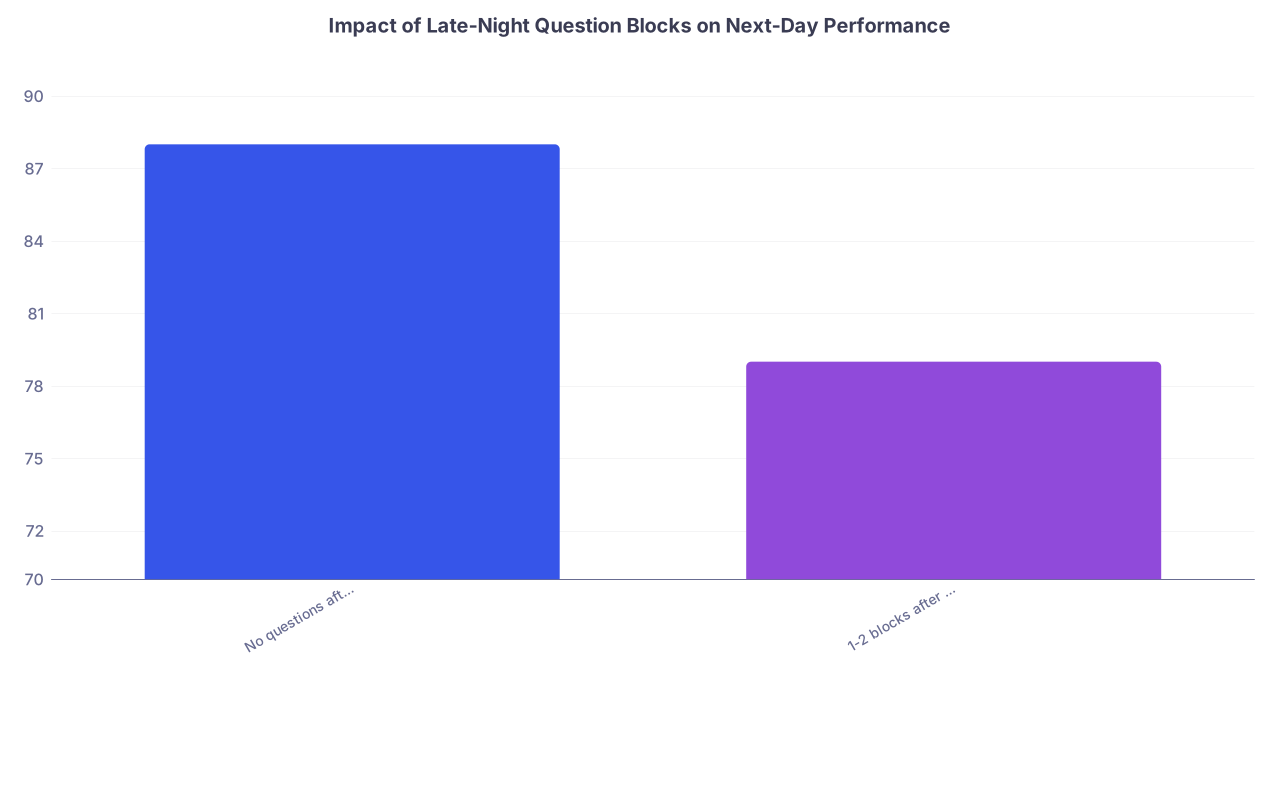
| Category | Value |
|---|---|
| No questions after 7 pm | 88 |
| 1-2 blocks after 9 pm | 79 |
That is the pattern I have seen repeatedly: scores higher when students set a hard cutoff, lower when they keep grinding late.
If you must do anything with questions the night before:
- Use untimed, mixed, low-stakes practice.
- Strict cap: 10–20 questions, only if you are still mentally fresh.
- Focus on maintaining pattern recognition, not testing yourself.
No late-night marathon blocks. No “prove to myself I am ready” test. That is what you should have done days ago, not at 10 p.m. the night before.
3. The Social Comparison Spiral (Group Chats, Reddit, Discord)
Another big mistake: keeping Signal, GroupMe, WhatsApp, Discord, and Reddit open the entire evening.
You know how this goes:
- Someone posts a 6-page “high-yield” summary you have never seen.
- Someone else flexes: “Just finished my third pass of Pathoma.”
- Another person dumps a list of ~50 obscure topics “they heard might be tested.”
And suddenly your calm collapses.
You were fine with your preparation 20 minutes ago. Now you are certain you are behind. So you:
- Abandon your plan.
- Open 3 new documents you will not retain.
- Stay up 2 extra hours chasing what other people are doing.
This is not studying. This is anxiety tourism.
During the last 24 hours, other people’s study habits are noise. Their panic is not your problem. Their “last-minute tips” are often random, unfiltered, and based on fear, not strategy.
What to do instead:
- Mute group chats the afternoon before the exam and do not unmute them until you are done.
- Avoid Reddit/Discord “exam threads” the night before. They are notorious stress amplifiers.
- If you truly need to coordinate logistics, do it earlier in the day.
Every notification is an invitation to doubt yourself. Decline the invitation.
4. Hunting for Brand-New “High-Yield” Resources
The night before is when desperation shopping kicks in:
- “Maybe I need that 20-page biochem sheet everyone talks about.”
- “There is a 3-hour ‘last-minute review’ video – I should probably watch it.”
- “Someone just uploaded a 100-slide summary, I must go through it.”
This is a classic anxiety trap: the illusion that salvation lives in a resource you have never touched before.
What actually happens:
- You overload yourself with a new format, new language, new structure.
- Nothing lines up with your existing mental framework.
- You walk away more confused, with a strong sense of “I missed everything important.”
If a resource was truly essential, you should have used it earlier. If you are discovering it the night before, it is almost certainly not the key to passing. It is just another distraction.
Your rule here:
- The night before the exam is closed ecosystem time.
- Use the same sources you have already used: your notes, your Anki decks, your annotated PDF, your prior summaries.
- If you write or review a cheat-sheet, build it from your own material, not someone else’s last-minute dump.
5. Catastrophic Thinking and “What If” Rehearsals
You can wreck a perfectly decent knowledge base just by letting your brain run unchecked for a few hours.
Common mental errors I see:
- “What if they test only the lectures I did not review well?”
- “What if I blank out and forget everything?”
- “What if I fail this exam and then fail the shelf and then never match?”
That chain of thought always ends at: “I will ruin my whole career.” All from one exam.
This is not harmless mental noise. Catastrophic thinking:
- Raises cortisol.
- Reduces sleep quality.
- Impairs working memory and recall the next day.
An exam is stressful. Fine. But anxiety is not an excuse to let your mind run a horror movie marathon all night.
Here is a simple pattern that works:
- Notice the thought: “I am thinking in worst-case extremes.”
- Replace it with something true and neutral, not fake-positive:
“I have prepared for weeks; this exam is important but not definitive.” - Redirect to a small, concrete task: 5 minutes of active recall, one short review list, or starting your bedtime routine.
If your thoughts are looping so badly you cannot focus on anything else, that is a sign to stop studying, not to push harder. You are past the point of useful input.
6. Destroying Sleep in the Name of “Just a Bit More”
Cutting even one hour of sleep the night before a high-stakes exam is a terrible trade.
I have seen students go from 80s on practice NBME to barely passing the real thing. Not because the exam was harder. Because they slept 3 hours, fueled by caffeine and panic.
Here is what sleep deprivation buys you:
- Slower recall on details you actually know.
- More careless mistakes (misreading stems, missing “except,” switching answers).
- Worse emotional regulation during the exam. One hard block rattles you more.
| Night-Before Sleep | Typical Effect on Performance | Common Student Mistake |
|---|---|---|
| 7–8 hours | Stable recall, better focus | Feeling guilty for stopping early |
| 5–6 hours | Noticeable slowdown, more errors | Staying up for “just one more topic” |
| ≤4 hours | Major impairment, panic-prone | All-night cram, heavy caffeine use |
Your brain consolidates memory in sleep. You are literally erasing some of your hard work by staying up late.
Hard rule I recommend:
- Set a non-negotiable bedtime the night before. Yes, even if you “do not feel ready.” You rarely will.
- Caffeine cutoff at least 6–8 hours before sleep.
- No bright screens in your face for at least 20–30 minutes before bed. Yes, that includes your phone.
You are not lazy for going to bed “early” the night before. You are protecting your score.
7. Over-Caffeinating and Under-Eating (Or Over-Eating Garbage)
The night before and morning of the exam are where people lose basic physiological common sense.
Two patterns I see constantly:
- Hammering caffeine late (energy drinks, extra coffee) to “power through.”
- Eating junk or skipping real meals because “I do not have time / my stomach is off.”
You are not a machine. You cannot drown your exhausted CNS in caffeine and expect precision thinking.
Late caffeine:
- Cuts into sleep.
- Raises baseline anxiety.
- Leads to jitteriness and heart racing the next morning.
Food mistakes:
- Huge greasy meals the night before → GI discomfort, poor sleep.
- Skipping dinner → low energy, irritability, harder time falling asleep.
- Morning of: either nothing (too anxious to eat) or a sugar bomb that crashes mid-exam.
If your body feels like trash, your mind will follow. Basic rules:
- Keep caffeine normal for you the day before. No “extra” late in the day.
- Eat a normal, balanced dinner. Moderate, not heavy. Protein + complex carbs + some fat.
- Plan your exam-day breakfast in advance. Something you know sits well: oatmeal, toast with peanut butter, eggs, yogurt + granola. No experiments.
This sounds boring. Good. Exams favor boring physiology.
8. Last-Minute Life Chaos: Logistics, Printing, Directions
Nothing spikes anxiety faster than preventable logistical crises at 10 p.m.:
- “Where is the exam room again?”
- “What time do we actually need to be there?”
- “My ID is…somewhere?”
- “My computer will not update… why is it updating now?”
You want the night before to be cognitively quiet, not cluttered with avoidable problems.
Set yourself up earlier in the day:
- Pack your bag: ID, pens, stethoscope if needed, snacks, water, chargers.
- Check testing location, route, and parking or transit details.
- Charge your laptop fully if it is a computer-based exam.
- Set multiple alarms and, if possible, a backup on another device.
Tiny details, big impact. You should not be printing forms or searching for your ID at 11:30 p.m.
9. Over-Reviewing Weaknesses and Ignoring Strengths
Here is another subtle exam-eve error: spending 90% of your last study time on your weakest topics.
On paper it looks “disciplined.” In reality:
- Weak areas take more effort and yield less retention in the short term.
- You are more likely to encounter confusion and failure cues (“I still do not get this”).
- You end the night feeling incompetent.
That is poison before sleep.
The night before, you are not rebuilding your entire foundation. You are polishing what is already there.
A better pattern:
- Split your time: perhaps 70% reinforcing strengths and medium areas, 30% gently touching the worst gaps.
- Focus on high-yield frameworks: big-picture algorithms, must-not-miss concepts, and patterns you rely on constantly.
- If a topic keeps refusing to click, accept that it will not be your power topic tomorrow. Stop obsessing.
The exam is not “Are you perfect?” It is “Can you execute a reasonable percentage of what you already know?” Protect that.
10. Going in with Zero Wind-Down Plan
Many students treat “stopping studying” as the end of the process. It is not. There is a gap between closing your laptop and actually falling asleep where anxiety loves to attack.
If you have no structural plan for that window, your brain will fill it with:
- Scanning through imaginary questions.
- Replaying worst-case scenarios.
- Randomly grabbing your phone to “check one last thing.”
Then suddenly it is 1:30 a.m.
You need a deliberate wind-down routine. Short, simple, repeatable. Think:
- 5–10 minutes of stretching or a walk.
- Quick shower.
- Light reading unrelated to medicine (paper book, not phone).
- Brief breathing exercise: for example, inhale 4 seconds, pause 2, exhale 6–8, repeat for a few minutes.
You are not trying to feel amazing. You are trying to pivot your brain from “problem-solving mode” to “offline mode.”
Putting It All Together: A Saner Night-Before Template
Here is what a non-self-sabotaging night before can actually look like.
Afternoon:
- Finish any serious studying by early evening.
- Clarify key formulas, frameworks, or lists you want to glance at once more.
Early evening:
- Light review of your own summary sheets or Anki marked cards.
- Quick check of logistics: bag packed, route set, alarms set.
Later evening:
- Stop all study input at a set time.
- Wind-down routine: something calm, low-stimulation.
- Bedtime that actually allows 7–8 hours before wake-up.
Morning of:
- Normal caffeine.
- Planned, simple breakfast.
- No frantic “just one more” video or thread-checking.
Is this perfect? No. You will still feel some anxiety. That is normal. But you will not be actively feeding it.

| Step | Description |
|---|---|
| Step 1 | Evening Before Exam |
| Step 2 | Anxiety spike & poor sleep |
| Step 3 | Moderate anxiety, ok sleep |
| Step 4 | Better sleep quality |
| Step 5 | Lower next-day performance |
| Step 6 | Stable performance |
| Step 7 | Study After 8 pm? |
FAQ (Exactly 5 Questions)
1. Is it ever okay to stay up late the night before if I am really behind?
Extremely rarely. If you are truly underprepared, a single late night will not fix that deficit. It will almost always do more harm than good by impairing sleep and increasing anxiety. Your best move, even when behind, is targeted, time-limited review and then protecting rest so you can perform at your actual ceiling rather than dragging yourself through fog.
2. What if I feel more anxious when I stop studying early?
That is common. Your brain equates “doing something” with safety. The key is to replace studying with a structured routine (reviewing your own concise notes, then a clear wind-down process), not just sitting in silence with your thoughts. Expect some discomfort. It does not mean you are unprepared; it means you are adjusting to not using panic as fuel.
3. Are group study sessions the night before always a bad idea?
In most cases, yes, they are risky. Group energy tends to drift toward panic, flexing, or overloading each other with last-minute minutiae. If you absolutely insist on meeting others, set strict boundaries: short duration, focus on big-picture concepts only, and end at a firm time so you still have space to decompress alone.
4. How do I handle the urge to check “just one more” topic in bed?
Do not keep your primary study device in bed. Physically separate your study area from your sleep area if possible. Tell yourself, “If it is truly critical and I do not know it by now, I am not going to master it at 11:45 p.m.” That is usually the truth. You can also keep a notepad by your bed: if a topic pops into your head, write it down, promise yourself you will look at it after the exam if needed, and let it go.
5. What if I actually sleep well but still feel anxious on exam morning?
That does not mean the sleep was pointless. You gave your brain the best chance to function despite the anxiety. Mild to moderate anxiety on exam day is expected and sometimes even helpful. Focus on controllables: breathing, pacing, hydration, and reading each question slowly and precisely. Do not interpret normal nerves as proof something is wrong.
Key points, so you do not miss them:
- Stop trying to rescue weeks of preparation in the final 12 hours with frantic cramming, new resources, and late-night question blocks.
- Protect sleep, physiology, and mental stability the night before; they are worth more points than any extra pass through obscure content.
- Cut the anxiety amplifiers: social comparison, catastrophic thinking, and unplanned late-night chaos. Your future exam scores will thank you.