
The way most medical students use question banks is making their test anxiety worse, not better.
Not a little worse. A lot worse. Panic-attacks-in-the-library worse. “I know more but feel dumber” worse.
If you are cramming UWorld, AMBOSS, or any other Qbank right up to your exam, telling yourself “more questions = more prepared,” you are walking straight into one of the most common and most destructive mistakes I see.
Let me walk you through why this happens, what it looks like in real life, and how to fix it before you burn yourself out or sabotage an exam you were actually ready to pass.
The Hidden Trap: When Question Banks Become Anxiety Engines
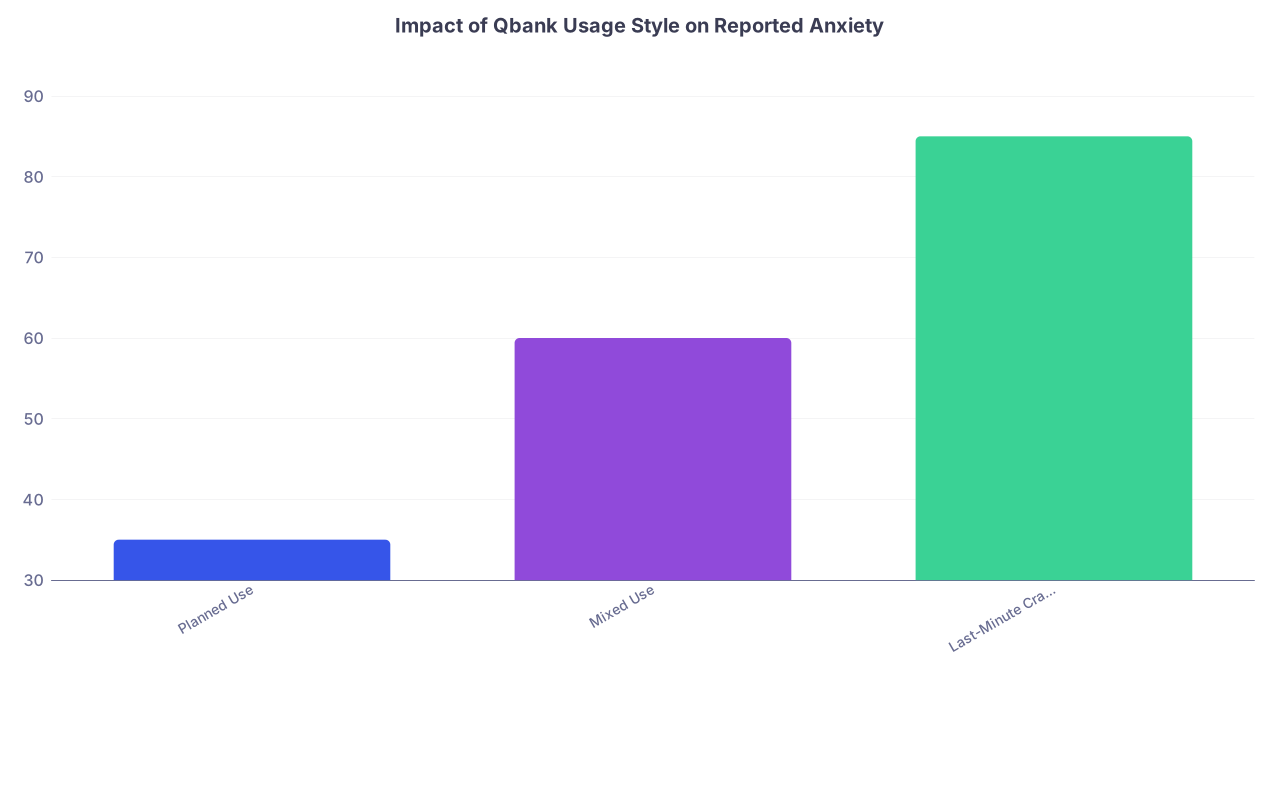
| Category | Value |
|---|---|
| Planned Use | 35 |
| Mixed Use | 60 |
| Last-Minute Cramming | 85 |
Question banks are not the enemy. Misusing them is.
Used correctly, Qbanks:
- Expose gaps in knowledge
- Build pattern recognition
- Train test-taking stamina
- Desensitize you to exam format
Used poorly—especially close to the exam—they:
- Amplify every self-doubt
- Create a constant “not enough” feeling
- Reinforce perfectionism and catastrophizing
- Turn every wrong answer into “I am failing” instead of “I learned something”
Here is the core problem: Cramming with question banks right before an exam drops you into continuous evaluation mode at the exact time your brain needs consolidation and confidence building.
You are essentially telling your nervous system, “You are being graded, judged, and possibly doomed” every 60–80 seconds. For hours. Days. Sometimes weeks.
Then people are shocked when their anxiety is through the roof on test day.
Do not be shocked. It is predictable.
Five Common Qbank Cramming Mistakes That Fuel Test Anxiety
1. Treating Percent-Correct as a Personality Test
You know this student. Maybe you are this student.
They open their Qbank stats page more than social media. They quote numbers in the hallway:
- “My UWorld average is 58%—does that mean I am going to fail?”
- “NBME says 230 but my AMBOSS percent-correct is trash.”
- “Everyone else is in the 70s; I am stuck in the 50s.”
The mistake: Treating your Qbank percent as:
- A verdict on your intelligence
- A prediction of your exact score
- A moral judgment on whether you “deserve” to be here
What this does to anxiety:
- Turns every session into a high-stakes evaluation
- Links your self-worth to a fluctuating number
- Trains your brain to brace for bad news every time you submit an answer
Over time, your nervous system learns: “Doing questions = emotional pain.” On test day, what are you doing? Questions. Under higher pressure. Same trigger, more stakes. Of course your anxiety spikes.
The healthier frame:
- Qbank accuracy is training data, not a report card
- Trends matter more than any one block
- Weaknesses identified = opportunities, not proof of failure
If you cannot open your stats page without your chest tightening, your relationship with data is broken. Do not keep feeding that beast.
2. Increasing Quantity While Ignoring Processing
A classic exam-week disaster: “I did 1,000 questions this week.”
They say this like it is an achievement. I hear: “I skimmed past 1,000 opportunities to actually learn.”
The mistake:
- Maximizing the number of questions
- Minimizing the depth of review
Concrete signs this is you:
- Reviewing explanations in 10–20 seconds each
- Only reading the explanation for the one correct answer, not the wrong ones
- Never writing down missed concepts
- Rarely re-checking the source material (First Aid, Pathoma, Anki, etc.)
- Doing multiple blocks back-to-back when your brain is already mush
What this does to anxiety:
- Your knowledge stays shallow and fragile
- You keep encountering variants of questions you “recognize” but cannot fully work through
- That “I have seen this before but still do not get it” feeling destroys confidence
Your brain registers a mismatch:
- Effort spent: Extreme
- Stability of understanding: Weak
That gap is rocket fuel for anxiety. “I am working so hard and still feel unprepared. Something is wrong with me.”
No. Something is wrong with your process.
A smaller number of questions + deep review usually leads to:
- Stronger memory traces
- More robust pattern recognition
- More justified confidence
That is what calms anxiety: earned confidence, not blind hope backed by brute-force volume.
3. Using Qbanks as Emotional Self-Harm the Week Before the Exam
This one is brutal, and I have watched it wreck people who were actually* ready.
The pattern:
- One week from Step 1, Step 2, shelf, or a big school exam
- Student feels nervous (normal)
- Decides the solution is to “cram harder”
- Starts doing several timed blocks a day, late into the night
- Every mediocre block spikes panic
- Sleep worsens, appetite drops, negative self-talk explodes
By 72 hours before the exam, they are:
- Sleep-deprived
- Emotionally frayed
- Interpreting every missed question as “I should postpone” or “I should not be a doctor”
Here is the harsh truth: Last-minute Qbank marathons are rarely about learning. They are about seeking reassurance.
“If I hit X% on this block, I will feel safe.”
But anxiety does not respect finish lines. You hit the number, feel relief for 5 minutes, then the doubt returns:
- “What about cardiology?”
- “What if the real test is harder?”
- “That block was probably just easier.”
So you do another block. The cycle repeats. And your anxiety tightens its grip.
There is a point where extra questions stop helping your knowledge and only damage your mental state. Most students blow right through that line because they are scared to ease up.
That fear is understandable. It is also costly.
4. Pairing Qbanks with Terrible Self-Talk
Same exact Qbank performance. Two completely different internal monologues.
Student A misses 40% of a block and thinks:
- “Interesting. My endocrine physiology is clearly weak.”
- “Good, I found this before the exam.”
- “These distractors are clever; I should catalog them.”
Student B misses 40% of a block and thinks:
- “I am an idiot.”
- “I am so behind. Everyone else is crushing it.”
- “If I cannot do this, how will I survive residency?”
Guess which student’s anxiety spirals out of control? It is not about the questions; it is about the interpretation.
Common poisonous narratives I hear word-for-word:
- “I am a bad test taker” (repeated like a mantra)
- “My brain just does not work like other people’s.”
- “If I do not hit X score, my whole future is ruined.”
- “I am wasting everyone’s time and money.”
Then they do questions in that headspace. Of course every wrong answer feels catastrophic. Of course each block adds to the pile of “evidence” that they are doomed.
This is not “just thoughts.” This is conditioning.
You are pairing:
- Stimulus: high-stakes exam-style questions
- Response: self-attack, catastrophizing, shame
By test day, your body has learned: “This situation = I am in danger.” That is anxiety.
You cannot mindset your way to a 270. But you can 100% anxiety-spiral your way from solid performance down to underperforming on game day.
5. Confusing Familiarity with Mastery
Cramming Qbanks often tricks you into a dangerous illusion: “I have seen this; therefore, I know this.”
That is not mastery. That is recognition.
Watch for these warning signs:
- You feel reassured just because a question looks familiar
- You use pattern matching (“flu-like symptoms, rash, okay this has to be X”) instead of reasoning
- You cannot explain out loud why the right answer is right and the wrong ones are wrong
- When you try to teach the concept, you stumble
The test will not be your Qbank slightly rephrased. It will be new questions built on the same concepts.
If your cramming focuses on:
- Checking off Qbank questions as “done”
- Relying on memory of stems
- Speed over understanding
Your anxiety on exam day will spike as soon as the questions feel even slightly different from what you crammed. Because the safety net—familiar patterns—is gone.
Your brain will go: “I do not recognize this exact wording. Therefore, I am not prepared. Therefore, I am in danger.” And there goes your working memory.
Real mastery feels different:
- You can reason through unfamiliar variants
- You can predict what they are really testing
- You are slower at first but much more stable under pressure
That stability is what steadies anxiety, especially in the first 10–15 questions when most people feel their heart rate jump.
The Anxiety-Aware Way To Use Question Banks
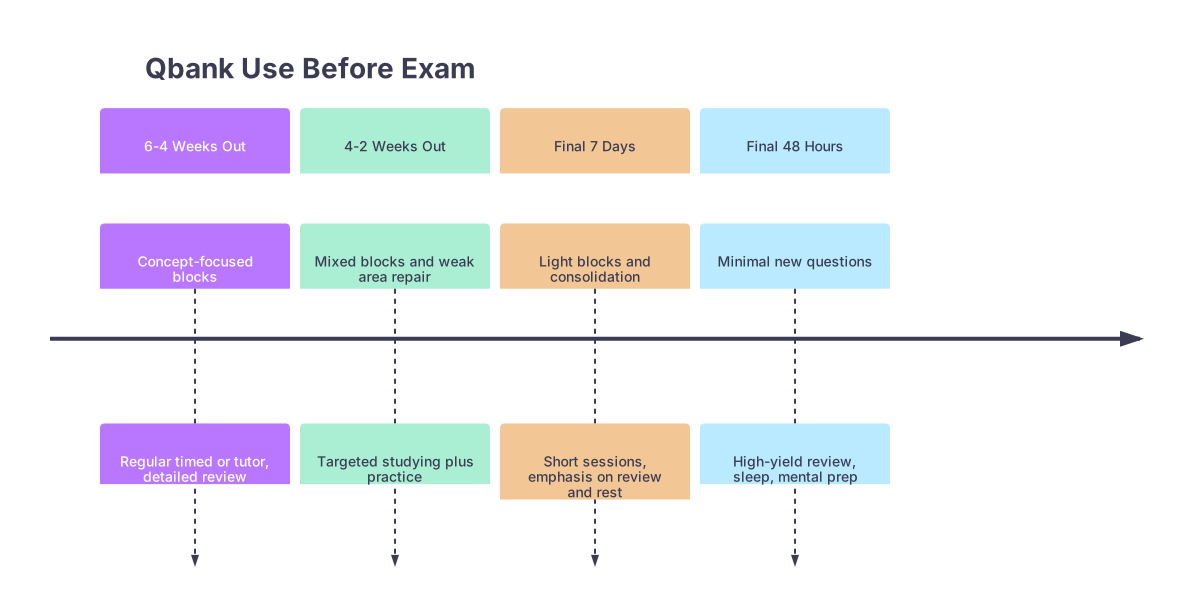
| Period | Event |
|---|---|
| 6-4 Weeks Out - Concept-focused blocks | Regular timed or tutor, detailed review |
| 4-2 Weeks Out - Mixed blocks and weak area repair | Targeted studying plus practice |
| Final 7 Days - Light blocks and consolidation | Short sessions, emphasis on review and rest |
| Final 48 Hours - Minimal new questions | High-yield review, sleep, mental prep |
You do not have to choose between “no questions” and “anxiety-inducing cramming.” There is a middle path.
Here is how to shift from anxiety-fueling use to anxiety-managing use.
1. Set the Right Goal for Each Block
Never sit down to do questions with a vague goal like “do as many as possible.”
Before each block, be explicit:
- “Goal: identify weak concepts in renal pathology”
- “Goal: practice timing under exam-like conditions”
- “Goal: train my approach to multi-step reasoning questions”
- “Goal: build familiarity with the exam interface and stamina”
Then judge the session by how well it met that goal, not by the raw percent-correct alone.
This reframes questions as training tools instead of a scoreboard.
2. Cap the Damage: Know Your “Anxiety Cutoff”
Anxiety has a tipping point. Beyond that, more questions do not help; they just:
- Drain confidence
- Reinforce panic
- Wreck sleep and memory consolidation
Your job is to learn your personal cutoff. Some signals:
- You are rereading questions without real focus
- You are checking your percent-correct mid-block
- Your self-talk becomes harsher and more absolute
- You are tempted to skip review because “it is too much”
When these show up, stop. Even if you “planned” more blocks. Preserving a functional brain for the next day matters more than squeezing in one more poorly-processed set.
The Critical Last Week: How Not To Sabotage Yourself
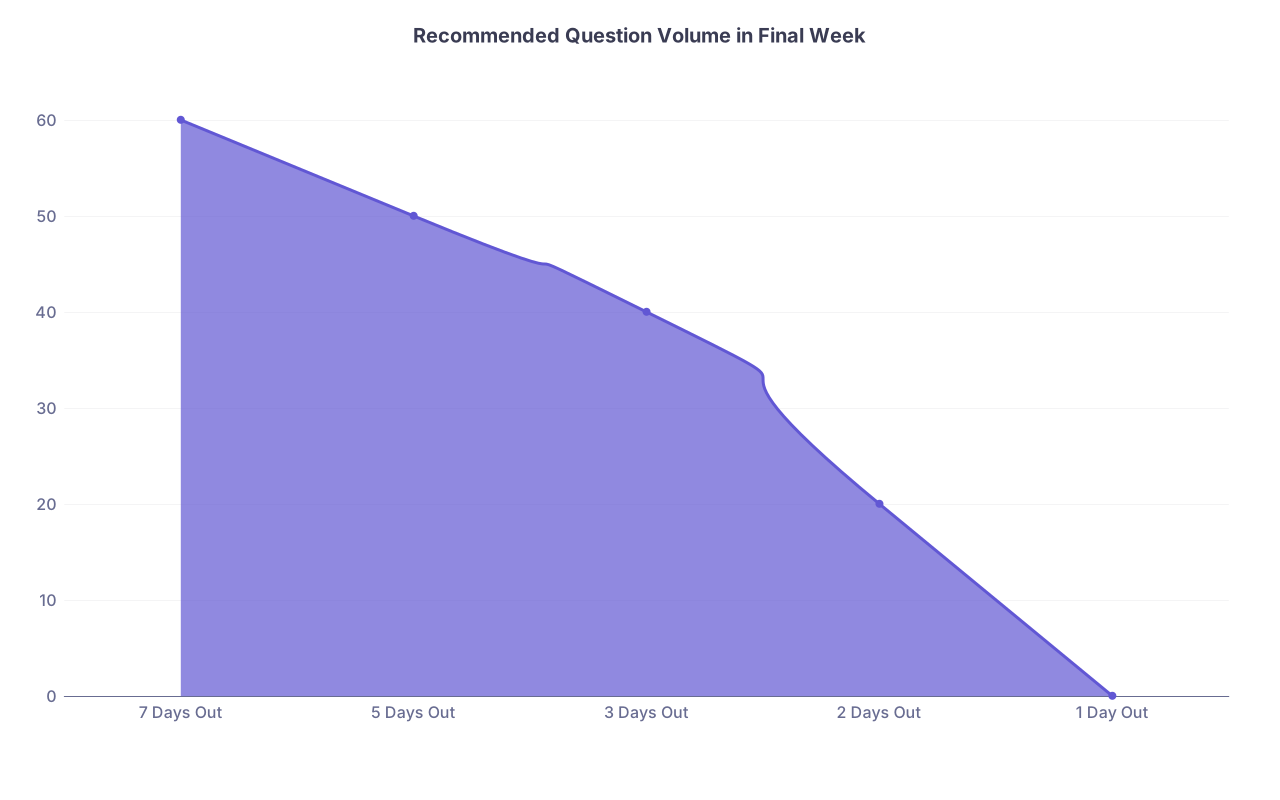
| Category | Value |
|---|---|
| 7 Days Out | 60 |
| 5 Days Out | 50 |
| 3 Days Out | 40 |
| 2 Days Out | 20 |
| 1 Day Out | 0 |
The last 7 days are where students most reliably destroy their own test performance with panicked Qbank cramming.
Here is the safer structure.
7–4 Days Before Exam
Focus:
- Identify final weak spots
- Reinforce high-yield concepts
- Keep anxiety in the “nervous but functional” range
Practical approach:
- 1 timed block per day (maybe 2 if you are processing well)
- Deep review of every block:
- Why you got each one right or wrong
- What tricked you
- What concept you need to shore up
- Targeted content review based on your misses
Things to avoid:
- Triple-block marathons
- Obsessing over daily percent-correct
- Comparing your stats to classmates
3–2 Days Before Exam
Focus:
- Consolidation, not expansion
- Mental state management
- Sleep protection
Practical approach:
- 0–1 short block per day (mixed, 20–40 questions, max)
- Quick review, no rabbit holes into obscure minutiae
- Light review of your personal weak list / formula sheet / key facts
- Practice your exam-day routine (wake time, meals, breaks)
Red flags:
- Panic-driven urge to “just do one more big block”
- Staying up late to squeeze in questions
- Using each missed question as proof you are not ready
The Day Before Exam
I have seen people ruin months of solid work by panicking the day before and blasting themselves with 160 fresh questions, finishing at midnight.
Do not do this.
Healthier plan:
- 0 new full blocks
- If you absolutely must do questions: 10–20 easy or previously-seen questions in the morning only, just to stay loose
- Brief review of things you know you mix up (e.g., specific murmur maneuvers, bugs and drugs, key formulas)
- Active anxiety management:
- Short walk or light exercise
- Relaxation technique you actually like (breathing, music, prayer, stretching)
- Screen cutoff before bed
The goal for the final 24 hours is not “learn more content.” It is “arrive with a brain that can access what you already know.”
Qbank cramming the day before the exam is one of the most common and most preventable ways to sabotage that.
Building a Question Bank Strategy That Protects Your Mental Health

You do not have to stop using Qbanks. You have to stop letting them control your nervous system.
Here is a simple structure that balances performance and sanity.
| Aspect | Anxiety-Safe Use | Cramming Pitfall Use |
|---|---|---|
| Timing in Study | Spread over weeks/months | Compressed into last few days |
| Block Goal | Specific skill or concept | “Do as many as possible” |
| Review Depth | Detailed, concept-focused | Superficial or skipped |
| Metric Focus | Trends, insights, patterns | Single-block percent-correct |
| Last 48 Hours | Minimal new questions, focus on rest | Multiple full blocks, rising panic |
Core rules to protect yourself:
Never use Qbanks as your primary source of reassurance.
They are tools, not therapists. If you are doing a block mostly to “see if I am still okay,” that is emotional gambling.Do not tie your identity to your percent-correct.
You are a developing clinician, not a walking Qbank stat line.Respect cognitive fatigue.
Once you are mentally drained, every extra question makes your anxiety louder and your learning weaker. Stop before that point, not after.Schedule off-ramps.
Build in specific days and times where you switch from question mode to consolidate-and-rest mode, especially in the final week.Treat your mental state as part of your exam prep.
Not separate. Not optional. If your anxiety is high enough that you cannot sleep, focus, or think clearly, then your test prep plan is broken, even if your content coverage looks “on track” on paper.
FAQ (Exactly 3 Questions)
1. If I stop cramming Qbanks right before the exam, won’t my score drop?
Not if you replace cramming with smarter work. The last few days are about:
- Solidifying what you already know
- Protecting sleep and cognitive function
- Keeping anxiety manageable
Most students overestimate how much new knowledge they gain from last-minute Qbank marathons and underestimate how much they damage their performance by increasing fatigue and panic. You are much more likely to underperform from exhaustion and anxiety than from not doing that extra 160 questions the day before.
2. How many questions per day is “too many” for anxiety?
There is no universal number, but there is a personal threshold. Watch for:
- You dread starting new blocks
- You rush through explanations just to “get through them”
- Your percent-correct becomes an obsession
- Your sleep and mood worsen on heavy-question days
For many students in the final weeks, 40–80 well-reviewed questions per day is plenty. If you are doing more than that and your anxiety is rising, your problem is not volume; it is process.
3. Should I switch to untimed/tutor mode if timed blocks spike my anxiety?
Earlier in prep, yes, tutor or untimed mode can be helpful for:
- Deep learning of new material
- Reducing panic while you build your approach
- Understanding question logic without the clock screaming at you
But you must eventually train under realistic timing. A balanced approach:
- Early: More tutor/untimed, concept focus
- Middle: Mix of tutor and timed blocks
- Final weeks: Mostly timed blocks, but fewer total questions and more attention to your mental state
If timed blocks trigger full-blown panic, scale back, address the anxiety directly (sometimes with professional help), then gradually reintroduce timing under safer conditions.
Remember:
- The way you use question banks can either train calm competence or wire in chronic panic.
- Last-minute Qbank cramming usually helps your anxiety more than your score—and not in a good way.
- Your goal is not to do the most questions; your goal is to walk into the exam with a rested brain, stable confidence, and enough solid understanding to let your knowledge show.