
Program directors do not care about your test anxiety story nearly as much as you think they do. They care about what you did about it.
That distinction is where most medical students get this completely wrong.
You’ve heard the advice: “Just explain your test anxiety in your personal statement.” Or, “Use your ERAS PD letter to tell your story, they’ll understand.” I’ve watched students cling to that line like a life raft after a rough Step 1, a mediocre shelf, or a failed OSCE.
Let me be blunt: a “test anxiety” narrative, by itself, almost never rescues a weak testing record. Sometimes it actively hurts you.
Let’s separate myth from data and then talk about what actually works.
What PDs Really Look At (Not What Reddit Says)
Forget the emotional narratives for a minute. Start with what’s on paper.
Every few years, the NRMP surveys program directors about what matters in selecting applicants. They rank factors and give average importance scores. It is not a mystery; it’s publicly available.
| Factor | Typical Rank / Role |
|---|---|
| USMLE/COMLEX scores/pass | Heavy screen, major importance |
| Clerkship grades / MSPE | Major importance |
| Letters of recommendation | Major importance |
| Class ranking / AOA | Moderate–high importance |
| Personal statement | Low–moderate importance |
Notice what’s not on there: “Compelling story about test anxiety.”
Program directors care about:
- Whether you passed key exams on time
- The pattern of your performance (getting better vs flailing)
- Evidence you’re reliable under pressure
They do not have time, or frankly the emotional bandwidth, to deeply analyze every applicant’s internal psychological narrative.
You’re one file among hundreds or thousands. They skim, they screen, they look for red flags. Test failures, late Steps, big gaps – those get attention. Your feelings about test-taking? Only if they’re directly tied to a clear pattern of improvement or safety risk.
The Myth: “If I Explain My Test Anxiety, They’ll ‘Get It’ and Overlook My Scores”
This is the most common fantasy I see:
“I’ll write about how I’ve struggled with test anxiety since middle school, how I froze during Step 1, how it doesn’t reflect what kind of doctor I’ll be. That will make them see beyond my numbers.”
No. Here’s what most PDs see when they read pure “I have test anxiety” stories:
- Questionable insight if it sounds like excuse-making
- Future risk: “Will this person freeze on in-training exams or board certification?”
- Time and resource drain: “Will they need constant hand-holding around testing?”
Let me translate how some of these essays land in PD-speak:
You: “I’ve always had trouble with standardized tests despite knowing the material.”
PD hears: “Chronic problem, not solved yet. May struggle with future high-stakes exams.”You: “I studied hard but my test anxiety got the best of me on Step 1.”
PD hears: “Under pressure, performance drops. Board pass risk?”You: “I want you to see that my test score doesn’t define me.”
PD hears: “They’re asking me to ignore the strongest validated predictor I have for board performance and in-training exam performance. I can’t.”
Is this cold? Yes. Also reality. Programs get hammered if their board pass rates drop. Sponsors, accreditation, reputation – all tied to whether residents pass.
So a pure “test anxiety” narrative with no evidence of adaptation is not just unhelpful. It’s a liability.
Where Test Anxiety Stories Sometimes Help (And Where They Backfire)
Test anxiety is not automatically taboo. It can be used, strategically, in a few specific ways. But the bar is higher than most students think.
Helpful pattern: Failure → Diagnosis → Intervention → Sustained Improvement
This is the only version that tends to work:
- You had a concrete adverse event (failed Step, shelf, major exam)
- You recognized it wasn’t just “bad luck”
- You actually got evaluated (disability office, counseling, PCP, therapist)
- You implemented specific, verifiable interventions
- Your performance after that point is objectively, measurably better
If that’s your story, you do not have a “test anxiety essay.” You have a remediation and growth essay, with test anxiety as supporting detail.
Program directors aren’t charmed by your suffering. They’re impressed by:
- Documentation: official support, formal diagnosis when relevant
- Changes: study structure, timing, accommodations, practice data
- Results: stronger Step 2 CK, better shelves, no more failures
That’s a completely different narrative than “I’m anxious; please understand.”
Now, the backfire scenarios. I see these constantly:
You talk about test anxiety, but your performance never actually improved.
PD translation: “So nothing changed. Risk persists.”You lean into the emotional weight more than the concrete actions.
PD translation: “Lots of feelings, little operational control.”You bring up test anxiety when they would not otherwise see a red flag.
PD translation: “I wasn’t worried about their testing until they told me I should be.”
If your Step 1 was pass on first try, Step 2 solid, shelves reasonable – and you devote precious personal statement space to test anxiety? You just created a concern that didn’t have to exist.
What the Data Actually Show About “Explaining” Poor Test Performance
PDs do not rely on vibes. They get burned for that. They rely on trends and probability.
Historically, USMLE/COMLEX scores:
- Correlate with in-training exam scores
- Correlate with board pass rates
- Are used in program accreditation reporting
That’s why they’re obsessed. They do not care if these scores are “unfair” or “don’t reflect your bedside manner.” They are constrained by the system.
So, if you have:
- Step 1: Fail → Pass
- Step 2 CK: Low or modest improvement
- Multiple shelf failures
Then a heartfelt test anxiety story does not neutralize those probabilities. It might provide context; it does not erase risk. Programs who ignore clear risk patterns and then have multiple residents fail boards pay for it later.
Here’s the actual calculus:
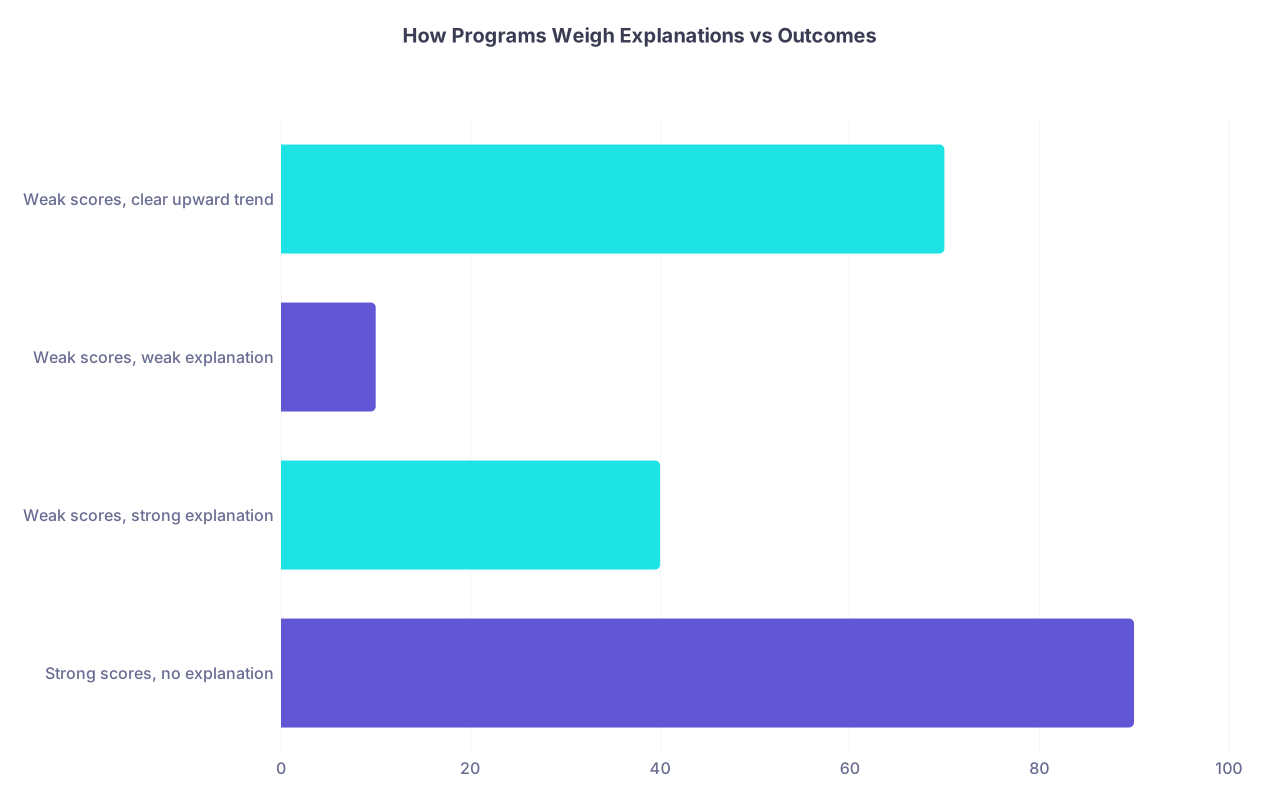
| Category | Value |
|---|---|
| Strong scores, no explanation | 90 |
| Weak scores, strong explanation | 40 |
| Weak scores, weak explanation | 10 |
| Weak scores, clear upward trend | 70 |
Interpretation:
- Good scores with no dramatic essay: almost always fine.
- Weak scores with “strong story”: helps a bit, but not magically.
- Weak scores with vague or blaming story: extremely risky.
- Weak earlier scores but clear, sustained improvement: much more persuasive than any anxiety narrative.
The consistent pattern in program director commentary is this: “Show me change in behavior and performance. Not just insight. Not just emotion.”
Where To Actually Address Test Anxiety (and How)
You don’t get many narrative spaces:
- Personal statement
- ERAS “experiences” and “adversity”/“impactful experiences” sections
- MSPE (Dean’s Letter) if your school comments on it
- Optional “additional info” fields
Most people misuse all of them. Here’s the evidence-based way to think about placement.
1. Personal Statement: Use Sparingly, and Only If It Explains a Clear Arc
Your personal statement should not be a 1,000-word ode to your anxiety.
It’s acceptable to include test anxiety if:
- There is a discrete, time-limited episode that impacted an exam
- You can show a before/after difference with actual scores or outcomes
- The focus is on what you learned, not how much you suffered
Example of what doesn’t work:
“I have struggled with anxiety around tests since childhood. On the day of Step 1, as I sat down at the computer, my heart raced and my palms were sweaty…”
That’s a psychotherapy intake note, not a residency essay.
A stronger version:
“After failing Step 1 on my first attempt, I realized that my test performance under pressure did not match my day-to-day mastery of content. I sought formal evaluation through student health, started structured CBT-based coaching, and practiced simulated test conditions weekly. The result was a 40-point improvement on my Step 1 retake and later a 240+ on Step 2 CK. More importantly, I now have a reproducible system for performing under stress that I’ve used on shelves and OSCEs.”
See the pattern? Briefly mention the anxiety, then hammer: evaluation → intervention → measurable result → reproducible strategy.
2. MSPE / School Letter: Let the Institution Carry Some of This
If your school is willing to include contextual language around an exam failure or leave, that often carries more weight than your personal essay. Why? Because it’s third-party language, not self-serving.
I’ve seen well-phrased MSPE lines like:
“After an initial Step 1 failure, the student worked with our learning specialist and counseling services, completed a structured test-taking program, and subsequently passed Step 1 and improved performance across clinical shelves.”
You do not need to re-litigate this for three paragraphs. One paragraph in your personal statement to expand on what you actually did is enough.
3. Interviews: This Is Where Your “Story” Lives or Dies
If your record raises red flags, someone will ask: “Can you tell me about your Step 1/Step 2 performance?”
They’re not inviting a therapy session. They’re checking:
- Do you own it, or blame it on everything else?
- Do you speak in concrete terms about changes you made?
- Do you sound like someone who now has tools, or someone still in crisis?
A good structure:
- Briefly name the problem (1–2 sentences)
- Take responsibility for any part you owned (study approach, timing)
- Describe specific interventions (learning specialist, CBT, mock exams, accommodations)
- Point to measurable improvement (scores, shelves, later performance)
- End with a forward-looking line about how you now handle pressure
If your story can’t support that structure, it’s probably not helping you.
If You Genuinely Have Debilitating Test Anxiety Right Now
Different conversation.
If your current anxiety is so severe that:
- You’re postponing exams repeatedly
- You’re failing internal assessments
- You’re considering hiding it from your school
Then your priority is not “How do I tell PDs this nicely?” Your priority is: “How do I get this under control before I stake my future on licensing exams?”
That means:
- Formal evaluation through student health or a psychiatrist/psychologist
- Evidence-based treatment: CBT, sometimes medication, sometimes both
- Exam accommodations when appropriate (and properly documented)
- Practice under simulated conditions, not just re-reading First Aid
You shore this up now, during medical school, so that by the time you apply, you’re not selling an active, uncontrolled problem. You’re presenting a resolved or well-managed one.
And yes, sometimes the honest, smart decision is to extend graduation, take a research year, or adjust your timeline. That is painful. It’s still better than pretending everything is fine and then blowing Step 2 or failing multiple in-training exams as a resident.
The Quiet Truth: Most PDs Have Seen Real Train Wrecks
This is context students miss.
PDs have seen residents who:
- Needed three attempts to pass Step 3
- Froze during codes or rapid responses
- Couldn’t be scheduled for nights during exam windows because they’d decompensate
Against that backdrop, your “I got 225 instead of 245 because of test anxiety” story doesn’t land the way you imagine. They’re not heartless. They’re just comparing you to people whose anxiety actually jeopardized patient care or program accreditation.
So yes, they care about emotional resilience and mental health. But they care even more about whether you have a track record of managing your vulnerabilities in a way that keeps patients, and the program, safe.
If You Still Want to Mention Test Anxiety, Use This Filter
Before you put a single word about test anxiety into ERAS, ask yourself three questions:
If I removed every mention of “anxiety” from this story, would there still be a clear arc of problem → intervention → improvement?
If not, you’re just trauma-dumping.Does my later performance objectively support the idea that I’ve learned to manage this?
Later shelves, Step 2, OSCEs – if they’re flat or worse, your story is not mature yet.Is this detail essential for understanding a visible red flag in my application?
If there’s no obvious testing issue on your transcript, you’re likely creating a liability, not providing helpful context.
If you can’t answer “yes” to all three, leave it out or minimize it. Focus your narrative on things you can defend with evidence.
The Reality, Boiled Down
You don’t need a long recap; you need the truth you’ll actually remember:
Program directors care much more about your testing outcomes and trends than your emotional story about test anxiety. A narrative without evidence of sustained improvement hurts more than it helps.
The only useful “test anxiety” story is one that shows clear evaluation, specific interventions, and objective performance improvement. Anything else looks like excuse-making or active risk.
Your real job in medical school is not crafting a sympathetic essay about your anxiety. It’s getting the problem under control now so that by the time you apply, you’re presenting a track record of resilience, not an ongoing crisis.