

Why High Test Scores Don’t Prove You’ve Beaten Test Anxiety
High scores are proof of performance, not peace of mind. People confuse those two constantly—and it messes up a lot of medical students.
In med school culture, the myth goes like this:
“If I scored 250+ on Step 1, or I’m always in the top quartile, I clearly don’t have test anxiety. That’s for people who fail.”
Wrong. That’s not how anxiety works. And it’s definitely not how the data looks when you stop cherry‑picking feel‑good stories and actually read the literature.
You can be on the right side of the score curve and still be absolutely wrecked on the inside every exam season. Many of you are. I’ve watched residents with 260+ Step 2 scores throw up in bathroom stalls before in‑service exams. I’ve seen M3s with “honors in everything” hand tremors so bad they can’t tap their NBME answer choices without mis-clicking.
They are “successful.” They are not fine.
Let’s dismantle the fantasy that your numbers automatically mean you’ve “overcome” test anxiety.
What Test Anxiety Actually Is (And Isn’t)

Most students think test anxiety = “I panic and do badly.”
So if you do well, you assume you don’t have it. That’s the first big error.
Test anxiety has two main sides that psychologists separate:
- Worry (cognitive) – racing thoughts, catastrophizing, intrusive “what if I fail and ruin my career?” mental loops.
- Emotionality / physiological arousal – heart racing, sweating, nausea, tremor, chest tightness.
Scores measure performance. Anxiety is about process. Those are different domains.
Here’s what the research keeps finding:
- High-achieving students can have equal or even higher levels of test anxiety compared with average performers.
- Anxiety doesn’t necessarily tank performance until it crosses a certain threshold. Until then, many high performers white‑knuckle through and still produce good scores—at a huge psychological cost.
The kicker: standardized tests and clerkship exams measure how many questions you got right in a short window. They do not measure:
- How early your brain started catastrophizing.
- How much sleep you lost.
- Whether your stomach was in knots for two weeks.
- Whether your sense of self-worth is fused to those numbers.
So when somebody says, “You can’t have test anxiety, look at your score,” what they’re really saying is, “I’m only capable of seeing suffering when it produces visible failure.”
That’s not insight. That’s laziness.
The Hidden Profile: High Achiever, High Anxiety
There’s a pattern I’ve seen over and over in medical students:
- MCAT 515+, Step scores above average.
- Known as “the reliable gunner” in their class.
- Always prepared, always early, overly detailed Anki decks, never “winging it.”
- Public image: calm, disciplined, “built different.”
- Private reality: catastrophic thinking every exam cycle, physical symptoms, dread days to weeks before every major test.
If you’re honest, you may recognize this mentality:
- “If I don’t crush this exam, my whole trajectory collapses.”
- “I got a 254. I should have gotten 260+. I’m slipping.”
- “If I ease off even a little, everything will fall apart.”
That’s not confidence. That’s fear dressed as discipline.
Here’s where the data supports what many of you feel but can’t articulate: high achievers score high partly because they are anxious and overcompensating. They study more hours, start earlier, review obsessively, and sacrifice recovery time. The system rewards that. But psychologically, it’s like constantly sprinting with a bear behind you.
You’re not “over” test anxiety. You’re powered by it.
Fear-Driven Preparation vs. Healthy High Performance
Let’s draw a line between two very different patterns I see in med students who both score well.
| Feature | Fear-Driven High Scorer | Healthy High Performer |
|---|---|---|
| Primary motivation | Avoid catastrophe / failure | Growth, mastery, curiosity |
| Sleep before big exams | Short, restless, fragmented | Slightly shorter, but solid |
| Thoughts day before test | “If I miss this, I’m done” | “I’ve done what I can” |
| Study pattern | Overstudying, no cutoffs | Planned intensity + boundaries |
| Post-exam reaction | Rumination, score‑obsession | Brief review, then detachment |
Both groups can walk out with a 245 or a 260.
Only one of them is not burning their nervous system like a candle at both ends.
The fear-driven crew often look “hardcore” on the surface:
- No days off for months before exam.
- Studying in every tiny gap: walking, eating, commuting.
- Reading Reddit score reports at 2 am, not because it helps, but because they can’t stop.
The problem is not the hours. It’s that the entire system is built on the assumption that disaster is always one misstep away. That’s textbook test anxiety—even if the result sheet says “pass with honors.”
Why High Scores Don’t Prove You’re Fine
Let’s be blunt. There are at least five reasons your great score is a terrible diagnostic tool for your mental state.
1. Scores only show the outcome of a single day
You know what your score doesn’t show?
- That you had diarrhea for three days before your exam.
- That you couldn’t eat breakfast because of nausea.
- That you compulsively rechecked your ID and permit 10 times on the way to the testing center.
You either knew the questions well enough or compensated hard enough to overcome the physiological noise. That’s all the score tells us.
2. Anxiety can be performance‑enhancing…until it isn’t
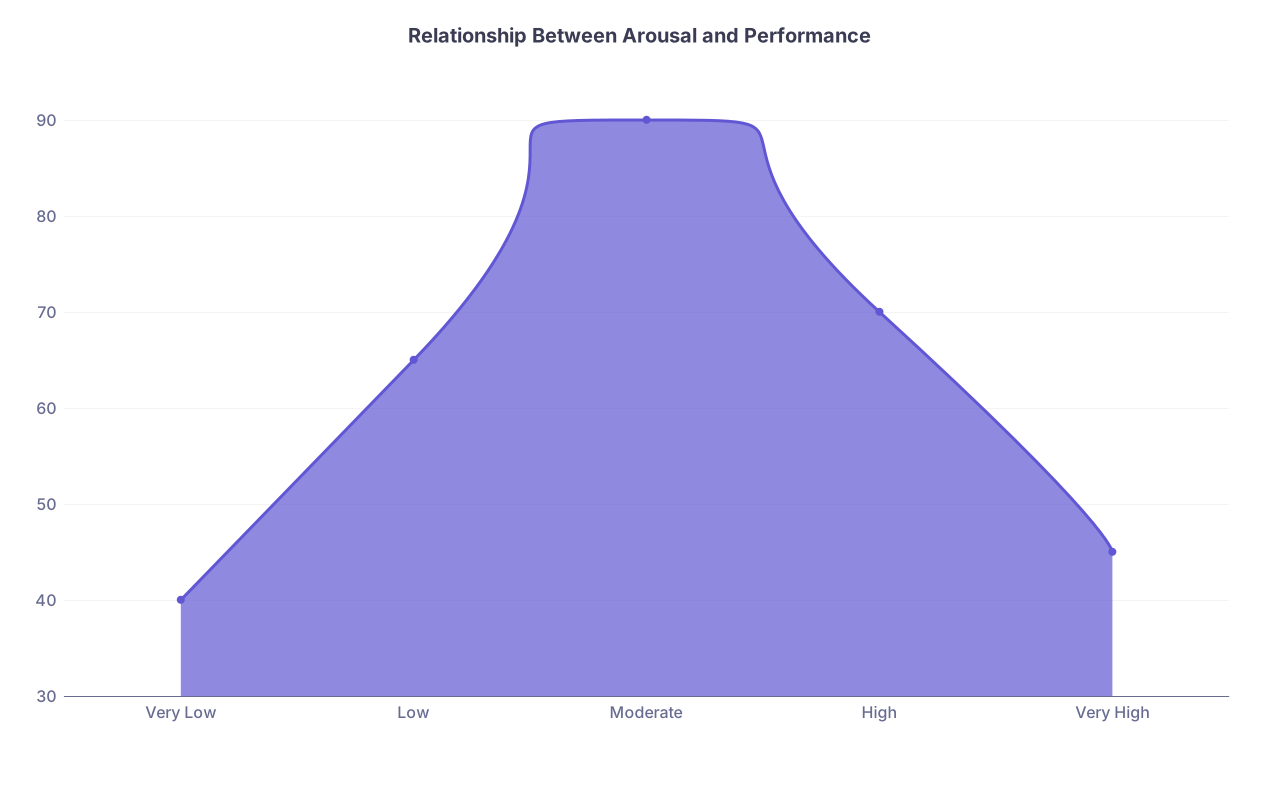
Anxiety follows a rough inverted‑U curve with performance. Too little arousal and you’re flat. Moderate arousal and you’re sharp. Too much and your prefrontal cortex starts tripping over itself.
| Category | Value |
|---|---|
| Very Low | 40 |
| Low | 65 |
| Moderate | 90 |
| High | 70 |
| Very High | 45 |
High performers with test anxiety are usually living on that right shoulder—high, but not yet catastrophic. It works. Until it suddenly doesn’t, usually at the worst possible time (Step 2, shelf exam on your weakest rotation, in‑service exam with fellowship implications).
The fact that your anxiety hasn’t tanked a major exam yet doesn’t mean it isn’t eating away at your bandwidth, health, and sanity.
3. Med culture normalizes pathological stress
You’re surrounded by people who:
- Call five‑hour sleep “fine, I feel okay.”
- Brag about studying through migraines.
- Joke about “vomiting in the Prometric bathroom, lol same.”
When the entire environment is warped, your internal calibration breaks. You stop recognizing anxiety as anxiety and start calling it “being serious” or “caring about my future.”
I’ve literally heard an attending say to a shaking MS2 before a shelf, “If you weren’t anxious, I’d worry you didn’t care.” That’s not motivation. That’s normalized dysfunction.
4. Perfectionism masks as competence
A lot of high‑scoring med students are not actually confident. They are simply perfectionistic.
Key difference:
- Confidence: “I’ll perform well enough. If I miss, I can adjust and recover.”
- Perfectionism: “Anything less than near‑perfect is failure and proof I’m slipping.”
Perfectionism correlates strongly with test anxiety. But on paper, perfectionists look like stars—until they crack.
Your score report does not distinguish between “healthy confidence” and “brittle perfectionism.” It just says “You got 89th percentile. Congrats.” It doesn’t tell you how much of your identity you mortgaged to get there.
5. Outcome-based validation feeds the anxiety loop
Let’s map the cycle a lot of you are trapped in.

| Step | Description |
|---|---|
| Step 1 | Strong fear of failure |
| Step 2 | Overprepare compulsively |
| Step 3 | High test score |
| Step 4 | External praise & relief |
| Step 5 | Belief: only extreme effort prevents disaster |
The high score doesn’t break the anxiety. It reinforces it. Your brain learns:
- “That was miserable… but it worked.”
- “If I suffer like that again, I’ll be safe again.”
- “If I don’t suffer like that next time, maybe I’ll fail.”
That’s why some of you get more anxious with each success, not less. The bar keeps rising. The story in your head gets harsher.
How To Actually Tell If You Still Have Test Anxiety
Forget your score for a second. Here are better questions:
- Do you start feeling dread weeks before exams, even when you’re adequately prepared?
- Do your physical symptoms (GI issues, insomnia, palpitations, headaches) ramp up specifically around testing periods?
- Do you feel like a “good” score only resets you to zero instead of bringing genuine pride or relief?
- Do you study far beyond the point of diminishing returns because you can’t tolerate the feeling of “enough”?
- After big exams, do you ruminate over questions, check answers obsessively, and mentally punish yourself for any misses?
If those resonate, your high score is coexisting with significant test anxiety. Not cancelling it.
Here’s a simple self‑check: Imagine a major upcoming exam. Now imagine this:
- You study a solid, well‑planned amount (not maximal).
- You get an average score—good enough for your goals, but not “flex on SDN” material.
- Nobody sees your numeric score except you and a dean; all they know is “passed.”
Does that feel tolerable? Or does it feel like identity death?
If that scenario feels existentially threatening, the anxiety is still in charge.
What The Data Actually Supports For Managing Test Anxiety
, Sedatives Only, Skills Training, CBT-Based Program](https://cdn.residencyadvisor.com/images/articles_svg/chart-effectiveness-of-test-anxiety-interventions-8176.svg "Effectiveness of Test Anxiety Interventions")
| Category | Value |
|---|---|
| Nothing | 5 |
| [Extra Studying](https://residencyadvisor.com/resources/test-anxiety-tips/does-more-content-review-really-fix-test-anxiety-evidence-says-no) | 15 |
| Sedatives Only | 10 |
| Skills Training | 35 |
| CBT-Based Program | 45 |
You’re in med school. You should demand evidence instead of vibes. The things people think help (“just grind more,” “take a benzo,” “you’re smart, you’ll be fine”) are not the things that show up strongest in the research.
The interventions that actually move the needle:
- CBT-based strategies (cognitive restructuring, graded exposure to test conditions, behavioral experiments).
- Skills training (time management, test‑taking strategy, realistic self‑assessment).
- Targeted arousal regulation (breathing protocols, paced exhale, pre‑performance routines).
The effect sizes for structured CBT‑style programs on test anxiety are moderate to large. Translation: this is not soft “self-care” fluff. This is as real as an antihypertensive lowering BP.
Meanwhile, “I’ll just study even more so I feel safe” tends to maintain the cycle. You can out‑study content gaps. You cannot out‑study a nervous system that’s learned “Test = threat to survival.”
Practical Shifts For High-Scoring, High-Anxiety Students
I’m not going to tell you to “just relax” or “care less.” That’s condescending and, more importantly, not how nervous systems work.
Here’s what I would push a high‑performing, anxious med student to actually do:
1. Measure the real cost
Track your next exam block like you’d track vitals:
- Sleep duration and quality.
- GI symptoms.
- Mood.
- Social contact.
- Exercise.
Not to guilt‑trip yourself—but to see in black and white what your current anxiety pattern is costing you. You’re good with data. Use it on yourself.
2. Stop using anxiety as your primary study signal
Your current rule might be: “If I still feel anxious, I haven’t studied enough.”
Flip it:
- Define “enough” ahead of time with actual numbers (hours, question blocks, passes of material).
- When you hit those numbers, you stop. Even if anxiety screams at you.
- That’s exposure work: teaching your brain that you can tolerate incomplete certainty and still be okay.
3. Detach self-worth from single‑day performance
This is the hard one. You’ve been rewarded your entire life for tying your identity to achievement.
You need an explicit counter‑story:
- “My value is not fluctuating with percentiles.”
- “This exam measures how I perform on this content, on this day, with this sleep, under this environment. That’s it.”
Write that down physically. Put it somewhere you’ll see it when your brain starts screaming that a 2‑point drop = career death.
4. Use arousal-regulation before you feel out of control
Most people wait until they’re spiraling to try breathing exercises. Too late.
Better:
- Build a 2–3 minute pre‑exam routine that you run every time—same seat posture, same breathing sequence (4 seconds in, 6–8 seconds out), same short cue phrase (“Calm body, sharp mind” or whatever works for you).
- Practice that routine while doing practice questions so your body associates it with focused performance, not desperation.
Why This Matters Long-Term (Beyond Exams)
Test anxiety in med school doesn’t magically disappear when the NBME stops chasing you. It just changes costume.
- In residency: procedure anxiety, code anxiety, in‑service exam anxiety.
- As an attending: lawsuit anxiety, M&M anxiety, “my patient will die and it’ll be my fault” anxiety.
If your only coping strategy is “crank my effort to 110% and white‑knuckle it until it’s over,” the system will eat you alive. Because there’s always another exam. Another high‑stakes moment. Another way to feel like you’re one mistake away from ruin.
High scores prove that you perform well under pressure. They do not prove that your relationship with pressure is healthy, sustainable, or remotely kind to yourself.
Years from now, you will not remember whether you scored a 242 or a 248 on that one exam you’re obsessing over right now. But you will absolutely remember whether your entire training felt like constant threat or like demanding but meaningful work. The numbers fade; the way you treated yourself through them doesn’t.


