The way most students handle the hours after an exam is sabotaging their mental health and future performance. And they do it every single block.
Let me be direct: post‑exam anxiety is not “just how it is in med school.” A huge chunk of it is self‑inflicted by patterns you can actually stop.
Below are the biggest mistakes I see over and over again right after an exam. If you recognize yourself in these, good. That means you can change them before they harden into residency‑level habits.
Mistake #1: The Immediate Post‑Exam Autopsy
You walk out of the exam room. Before your brain has even cooled down, someone says the cursed words:
“Hey, what did you put for the hypercalcemia question?”
And suddenly you are doing an unpaid, unhelpful pathology conference in the hallway.
Why this is so destructive
This “exam autopsy” is almost guaranteed to:
- Magnify your anxiety
- Create false memories of what you chose
- Overestimate how many questions you actually missed
- Wreck the rest of your day and sometimes your sleep
I have watched this scene three dozen times:
- Student feels “okay” walking out
- Twenty minutes of group question‑by‑question dissection
- Student now convinced they failed, can barely eat, cannot study for the next day’s activity
Nothing about their actual score changed. Only their anxiety.
The cognitive traps hiding inside the autopsy
You fall into several predictable mental traps:
- Negativity bias – Your brain hunts for mistakes and ignores questions you got right.
- Availability bias – You remember the confusing zebras, not the straightforward ones.
- Catastrophizing – One uncertain question becomes “I probably failed this block.”
- Social comparison – Someone sounds confident about the opposite answer, so you assume they are right and you are wrong.
You leave the conversation with a heavily distorted view of your performance. That distorted view drives stress, not the exam itself.
How to avoid this mistake
You do not need more discipline here. You need a rule.
Create a hard personal policy:
- No question discussion for at least 24 hours after any major exam.
- If your group starts in: “I don’t do post‑exam breakdowns. I’ll end up spiraling.” Then change the subject or physically walk away.
- If a friend really insists: “I am happy to talk big themes, but not specific questions or answer choices.”
If you truly want to review concepts:
- Do it with a trusted resource (UWorld, AMBOSS, lecture notes), not with half‑remembered stems in a hallway.
- Do it after you have decompressed and slept, not on adrenaline.
You are not being rude by protecting your brain. You are being smart.
Mistake #2: Treating Anxiety as a Performance Report
Here is the lie many students swallow:
“If I feel this anxious after the exam, I must have done badly.”
That belief alone spirals people into two days of misery.
Feelings are not feedback
Post‑exam anxiety usually reflects:
- Your perfectionism
- The stakes of the exam
- Your personality baseline (some of you live at 7/10 anxiety constantly)
- Sleep, caffeine, and cortisol levels
It does not reliably reflect your actual score.
I have seen:
- Students shaking, near tears, convinced they failed → end up in the 85th percentile.
- Students “weirdly calm” → barely pass.
- Class groups that all walked out thinking the exam was horrible → average scores totally normal because the exam was curved.
Your brain is a terrible grading service.
The two common misreactions
Students take that anxious feeling and do one of two unhelpful things:
Overcorrect into self‑punishment
- Decide they “slacked” (even if they studied 60 hours that week)
- Swear they will never take a break again
- Add more resources, more question banks, more hours
- Burn out faster, perform worse next block
Freeze and avoid
- Feel so ashamed they do nothing for 2–3 days
- Avoid opening email, checking grades, or looking at material related to that exam
- Lose valuable study time for the next block
Both responses are driven by the same error: believing anxiety = data.
A better frame
Adopt this stance instead:
- “Post‑exam anxiety is background noise, not a score report.”
- “I will not change my long‑term study system based on how I feel walking out of one exam.”
- “I only adjust plans based on actual score patterns across multiple assessments.”
Make a rule:
No major study plan changes until:
- You have at least two graded data points from that course or block
- You have slept at least once after getting the score
You are allowed to be uncomfortable. You are not allowed to redesign your entire life based on that discomfort.
Mistake #3: Refreshing the Grade Portal Like It Is Vital Signs
You know exactly what I am talking about.
- You know the grade will not be posted for at least 24–48 hours.
- You still check the portal 15 times that night.
- Every time you open it, your stomach drops, you cannot concentrate on anything, and you have to “regulate” all over again.
This is not planning. This is self‑torture dressed up as “being on top of things.”
What constant checking actually does
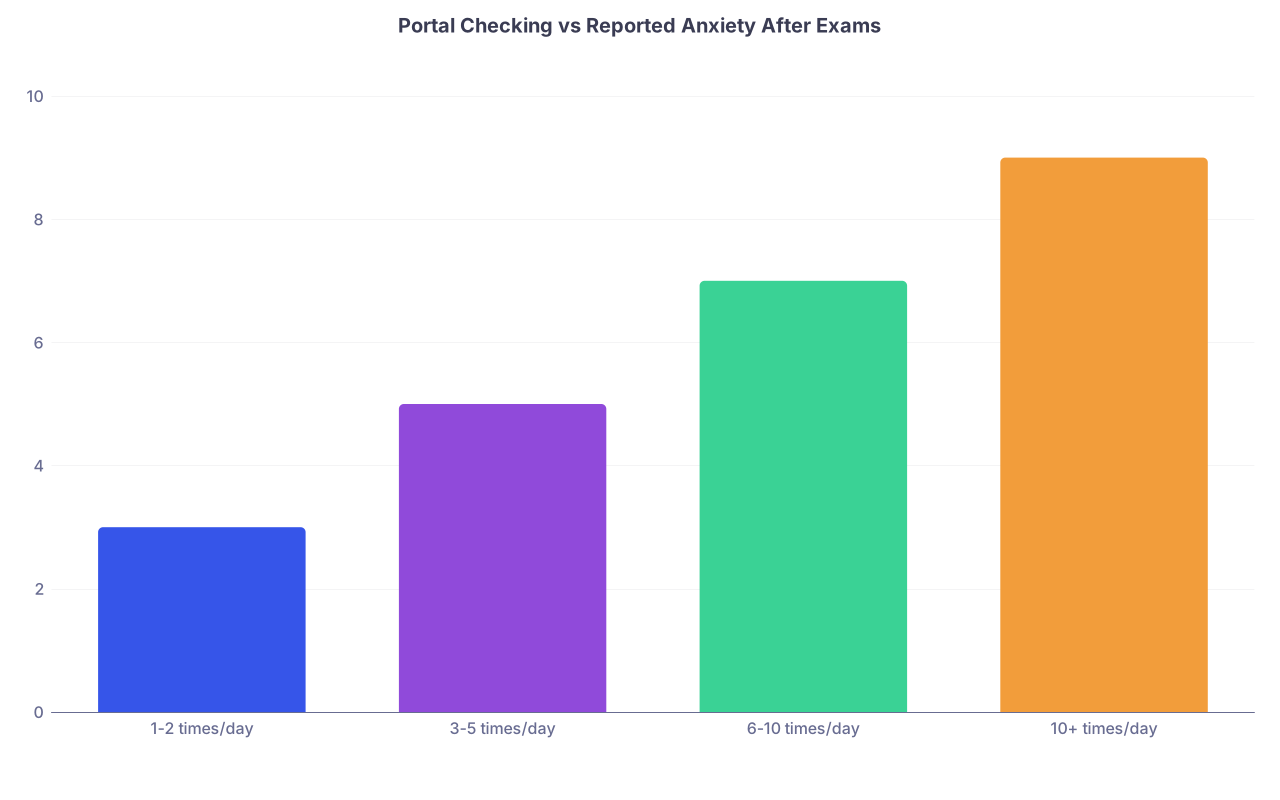
Let me put it bluntly: compulsive checking trains your brain to be more anxious.
- Each refresh = a mini “danger check”
- Your brain thinks: “This must be very important if we keep checking”
- Baseline anxiety goes up, not down
- You reinforce the idea that you cannot tolerate uncertainty
You are not “getting it over with.” You are making the pre‑score period as miserable as possible.
| Category | Value |
|---|---|
| 1-2 times/day | 3 |
| 3-5 times/day | 5 |
| 6-10 times/day | 7 |
| 10+ times/day | 9 |
(Scale 1–10 self‑reported anxiety, data pattern I see consistently in student wellness surveys.)
How to stop feeding this beast
Use structure, not willpower.
Set specific check windows
- Example: “I only check grades at 8 pm. Once.”
- Or: “I do not check until I get an email notification from the school.”
Move the portal
- Remove the bookmark from your browser bar.
- Log out fully so it takes real effort to sign back in.
- On your phone, move the app or browser icon to a different screen.
Pair checking with something neutral
- Sit down, take 3 slow breaths, then log in.
- If the grade is bad: you are already in a calmer state.
- If it is fine: you did not spend 48 hours paying in advance for pain that never came.
Rule of thumb:
If you are checking more than twice a day before grades are typically released, you are not being “responsible.” You are being hijacked.
Mistake #4: Letting One Exam Hijack the Entire Block Narrative
One block exam goes poorly (or you just think it did), and suddenly the story in your head becomes:
- “I am behind in this course.”
- “I am not a ‘cardio person.’”
- “Everyone else is adapting faster than I am.”
- “Maybe I do not belong in med school.”
That narrative then poisons how you approach the rest of the block:
- You pre‑decide that this block will be a struggle.
- You dread every lecture related to that subject.
- You overstudy the topic you struggled with and under‑prepare others.
- You walk into the next exam already tense and exhausted.
The math vs the drama
Often, the numbers are boring:
| Scenario | Exam Weight | Score | Cumulative Impact |
|---|---|---|---|
| Solid exam | 25% | 85% | Block average stays high |
| Weak exam | 25% | 70% | Overall drops modestly |
| Future exams | 75% | TBD | Plenty of room to recover |
One mediocre exam usually does not doom your grade, especially if:
- There is a final
- There are multiple quizzes/OSCEs/assignments
- Your school uses generous rounding or curves
But students mentally “fail the block” weeks before any final grade is calculated.
How to avoid this “block is ruined” thinking
You need to separate performance data from identity.
Instead of:
- “I am bad at renal.”
Use:
- “On this renal exam, I scored below my target. Why?”
Then, make a short adjustment list:
- 1–2 things you will do differently next time
- 1–2 things you will keep the same because they did work
If your written list has more than 4–5 changes, you are overreacting. You are trying to rebuild the plane mid‑flight.
Treat each exam as one data point, not a prophecy.
Mistake #5: Abandoning Recovery Like It Is Optional
Post‑exam, many students swing wildly between two extremes:
Zero break:
- Walk out of exam at 11:00
- In the library by 11:30 starting next block’s lectures
- Tell themselves they are being “hardcore”
Total collapse:
- Say “I deserve a break” and lose the next 36 hours to Netflix, phone scrolling, or doom thinking
- Feel worse, not better, because the “break” was not actually restorative
Both are mistakes.
Why no-break is a quiet disaster
Here is what I see with the no‑break crowd:
- By week 6–8, they are emotionally flat.
- Sleep becomes more fragmented.
- Retention drops because their brain never gets to consolidate.
- Motivation starts looking like resentment.
You are not a machine that can just process inputs forever. There is solid evidence that:
- Memory consolidation improves with sleep and downtime.
- Chronic stress impairs prefrontal function (exactly what you need for clinical reasoning).
Why unstructured “collapse” also backfires
The other group tells themselves they are resting, but:
- They stay on their phone the entire time.
- They keep rehashing the exam.
- They snack randomly and feel sick.
- They go to bed late, so the next day starts behind.
That is not rest. That is paralysis.
A simple post‑exam recovery framework
Use something like this (adjust times to your schedule):

| Step | Description |
|---|---|
| Step 1 | Exam Ends |
| Step 2 | Short Decompression 1-2 hrs |
| Step 3 | Light Structure 2-3 hrs |
| Step 4 | Evening Normal Routine |
| Step 5 | Optional Social Time |
Concrete version:
1–2 hours right after exam
- Eat a real meal.
- Walk outside or do light activity.
- No studying. No portal checks.
Next 2–3 hours
- Do low‑cognitive tasks: organize notes, light Anki, quick chores.
- If exhausted, short nap (20–30 min), not a 3‑hour blackout.
Evening
- Return to your normal sleep prep.
- 30–60 minutes of planning for the next day.
- Screens off at a reasonable time.
This is boring. That is exactly why it works.
Mistake #6: Turning Every Block into a Personality Test
Too many students secretly treat each exam result as an evaluation of who they are, not what they did.
You see variants of this:
- “I got a 72. I am not smart enough for derm.”
- “I missed that ethics question. Maybe I am not a good person.”
- “My shelf was average. I am clearly never going to match at a competitive program.”
That is not high standards. That is self‑abuse disguised as ambition.
Why this is so dangerous long‑term
If you repeatedly link scores to identity:
- You become terrified of realistic feedback.
- You chase validation instead of mastery.
- You stop taking reasonable risks (research, leadership, challenging rotations) because you “cannot afford to fail.”
- By the time residency hits, you are brittle. Every slightly negative evaluation feels like a character verdict.
I have watched excellent students burn out not because of hours or difficulty, but because their entire sense of self was riding on every single test.
Better questions to ask yourself
After an exam, instead of:
- “What does this say about me?”
Use:
- “What does this say about my system?”
- “What specifically confused me?”
- “Which resources were actually high‑yield for this test format?”
Then:
- Keep what worked
- Fix one or two specific weaknesses
- Refuse to let one exam rewrite your story
You are not a score report. Stop acting like you are.
Mistake #7: Isolating Yourself with the Wrong People (or No People)
Two opposite but equally harmful patterns:
Hiding away because you are ashamed
- You ghost your group chat.
- Skip the post‑exam lunch or debrief.
- Do not tell anyone you are worried because “everyone else did fine.”
Surrounding yourself with anxiety amplifiers
- The classmate who always says, “That was the hardest exam ever, I definitely failed,” even when they end up with honors.
- The person who immediately starts re‑hashing questions loudly in the hallway.
- The chronic comparer: “How many did you mark? I only marked 10…”
Both choices drive anxiety up.
Find “low‑drama realists”
Look for 1–2 people who:
- Are willing to say “That was rough,” but do not spiral.
- Can talk about other parts of life post‑exam.
- Respect boundaries like “let’s not dissect questions.”
- Do not equate worth with honors vs pass.
Spend your limited social bandwidth on them, not on adrenaline junkies who need to turn every experience into a crisis.
If nobody in your immediate circle fits that, fine. You can create structure alone:
- Short call with someone outside medicine.
- Ten minutes journaling about what felt hard, then closing the notebook.
- Quick check‑in with a counselor if post‑exam anxiety is chronic and debilitating.
Silence and chaos are both bad company. Choose something in between.
Mistake #8: Refusing to Look at Patterns… or Obsessing Over Every Detail
Lack of reflection and over‑analysis both hurt you. Just in different ways.
The “head in the sand” problem
Some students handle post‑exam anxiety by never looking back:
- They do not review missed questions when the exam is released.
- They never ask faculty for feedback.
- They do not track scores across time.
They say it is to “protect” their mental health. What it actually does is guarantee repeated mistakes.
You cannot improve what you refuse to measure.
The “post‑mortem autopsy report” problem
Others go in the opposite direction:
- They build color‑coded spreadsheets after every exam.
- They obsess over moving from 85 to 88 on low‑stakes quizzes.
- They dissect every distractor on questions they got right.
Their anxiety loves this because it feels like control. But most of that effort yields almost nothing.
You do not need a 20‑page statistical analysis for a mid‑block quiz. You need clear, simple patterns across months.
What “just enough” reflection looks like
A practical middle ground:
For major exams (block finals, NBME, shelf):
- Spend 45–90 minutes reviewing:
- Recurrent content gaps (e.g., “I consistently miss renal physiology”)
- Recurrent question types (e.g., misreading long stems, mismanaging time early vs late questions)
- Write down 2–3 specific changes for the next exam.
- Spend 45–90 minutes reviewing:
For small quizzes:
- Skim wrong answers.
- If you see the same topic appear 3+ times, flag it for a deeper review.

Keep the reflection structured, short, and aimed at behavior. Not self‑criticism.
Mistake #9: Underestimating the Cumulative Cost Block After Block
One episode of post‑exam anxiety will not break you.
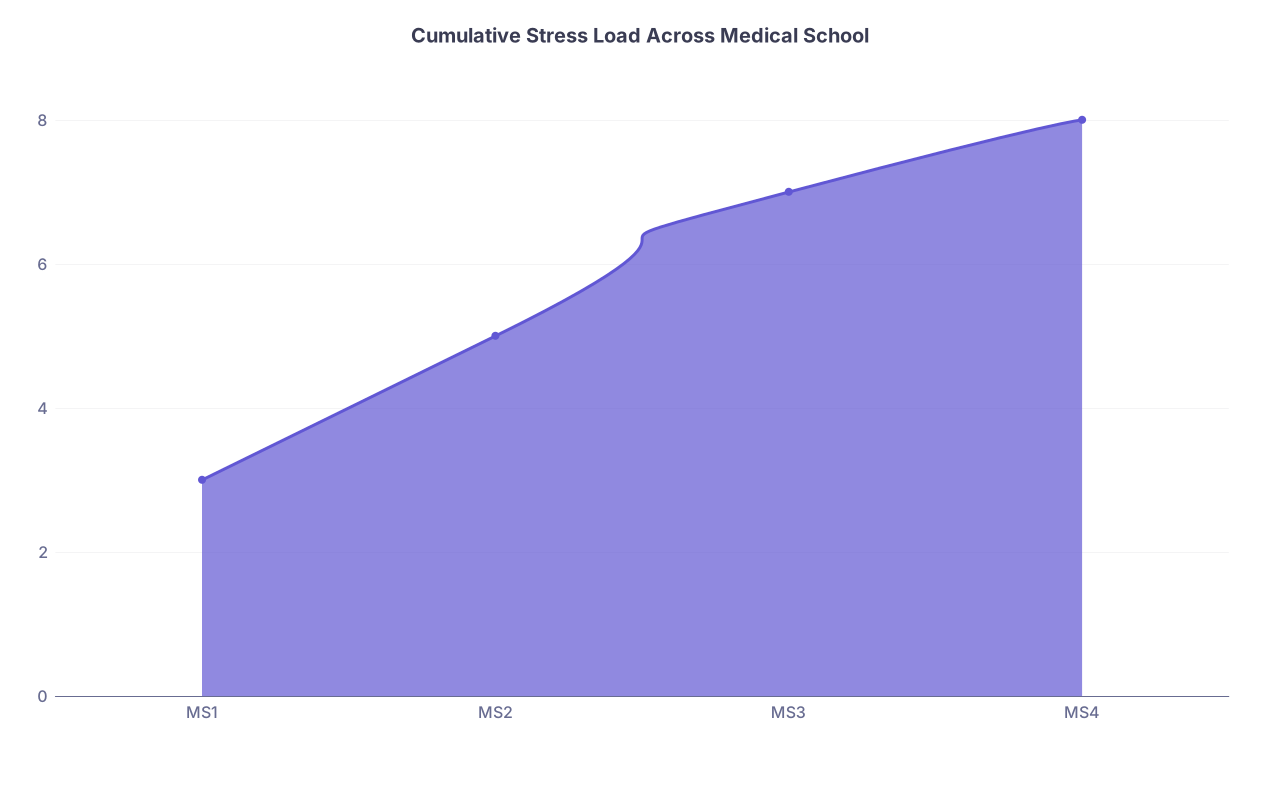
Ten or fifteen blocks of it, plus boards, plus OSCEs, plus shelf exams? Very different story.
Here is the pattern I see:
- MS1: “Yeah, I stress about exams, but it is fine.”
- MS2: Sleep more disrupted, mood swings around test days, irritability.
- MS3: Shelf after shelf, plus clinical responsibilities, minimal control over schedule. Old habits explode. Panic becomes more frequent.
- MS4: Step 2, sub‑Is, residency apps. People finally ask for help when they are already at the edge.
You cannot wait until Step 2 to care about your nervous system. By then the grooves are carved deep.
| Category | Value |
|---|---|
| MS1 | 3 |
| MS2 | 5 |
| MS3 | 7 |
| MS4 | 8 |
If you keep repeating the same post‑exam mistakes every block, you are not “just stressed this week.” You are training your baseline upward year after year.
The earlier you fix these patterns, the less repair work you will need later.
How to Actually Do This Differently Next Block
Do not try to fix everything at once. That is another mistake.
Pick two concrete changes for your very next exam cycle:
Examples:
- “No question discussions for 24 hours. I will say so out loud and walk away if needed.”
- “One grade‑portal check per day, at 8 pm, until grades post.”
- “Two‑hour structured recovery window right after exam: meal, walk, light admin tasks.”
- “45‑minute focused review of missed questions the day scores are released, then done.”
- “I will not make major study plan changes until I have at least two exam scores and one night’s sleep after each.”
Write them down. Tell one classmate. Treat them as seriously as you treat your Anki quota.
The Bottom Line
Three things to remember:
- Most of your post‑exam suffering is driven by habits you control: autopsies, compulsive checking, identity fusion with scores.
- One exam is data, not destiny. Adjust your system, not your self‑worth.
- Fixing post‑exam mistakes early is not optional “self‑care.” It is performance protection for the rest of med school and residency.
Do not wait for burnout to respect how you handle the hours after an exam. That window is where a lot of people quietly break. Do not be one of them.