
The way you handle a Step retake and visible stress tells program directors more about you than your score report ever will.
Students think the story ends at “Did I pass?” or “Is my score high enough?” That’s naïve. On the other side of ERAS, your retake and how you behave around it become psychological data. PDs, associate PDs, and seasoned faculty read them like lab results. Pattern recognition. They've seen thousands.
You’re not just “the person who retook Step 1.” You’re “the applicant who melted down,” or “the one who handled a disaster like a pro,” or “the one whose anxiety is going to blow up my call schedule.” Harsh? Yes. True? Also yes.
Let me walk you through what they’re actually inferring.
How Program Directors Really View a Step Retake
First hard truth: a retake is not automatically fatal. But it is never invisible.
When a PD opens your application, there’s a mental checklist. They won’t admit it on public webinars, but in committee rooms it sounds like this:
- “Why did they need a retake?”
- “Did they learn, or did they crumble?”
- “Is this a one-off, or a pattern?”
- “Can I trust this person on call at 2 a.m.?”
They’re not just asking “Can you study?” They’re asking “Can you recover?”
The three main stories a retake tells
Here’s the unspoken taxonomy they use:
The Technical Miscalculation Story
You didn’t respect the exam the first time. Poor prep strategy, complacency, timing issues. Then you corrected course, scored higher, and moved on.
Translation in the PD’s head: “Immature once, but teachable. Probably fine.”The Stress/Anxiety Story
You prepared, you cared, you studied… and you choked. Panic, insomnia, spiraling anxiety, maybe unfinished blocks on test day.
Translation: “This could happen again under pressure. Do I want that risk?”The Life Blew Up Story
Family illness, personal crisis, depression, medical issues. The exam became collateral damage.
Translation: “Real life happens. Did they show judgment and resilience afterward—or just chaos?”
They infer which story fits from three main data sources: your score timeline, your MSPE and deans’ comments, and how you talk about it in your application and interviews.
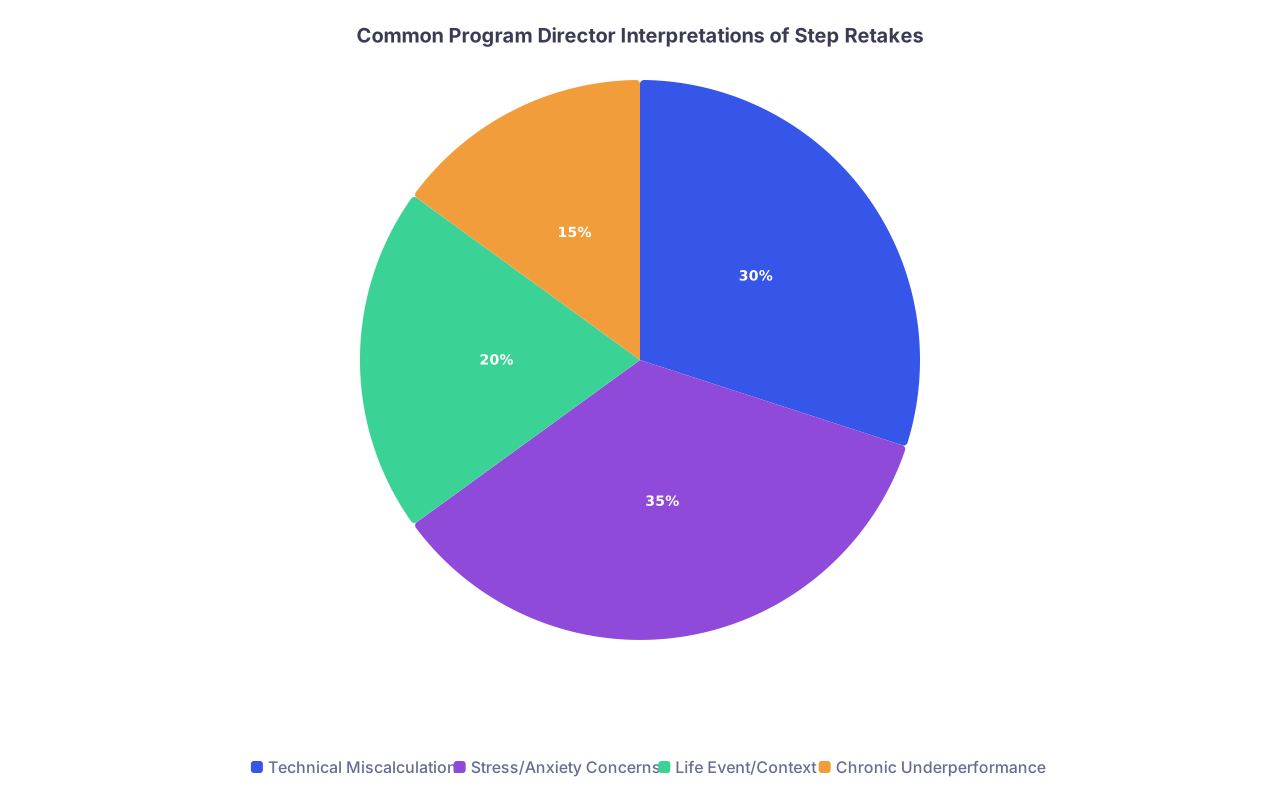
| Category | Value |
|---|---|
| Technical Miscalculation | 30 |
| Stress/Anxiety Concerns | 35 |
| Life Event/Context | 20 |
| Chronic Underperformance | 15 |
Those percentages aren’t from a published paper; they’re from what you hear when you sit in rank meetings year after year. Most faculty would nod.
What Your Score Pattern Whispers About You
PDs don’t stare at a single number. They stare at the pattern.
I’ve watched PDs at big-name IM and surgery programs pull up the USMLE transcript, lean back, and say nothing for ten seconds. That quiet is where your story is being written.
Scenario 1: Retake with a strong upward trend
Example:
First attempt Step 1 (pre-pass/fail era): 203
Second attempt: 227
Step 2: 241
What they actually say in the room:
- “Okay, clearly got their act together.”
- “First score worries me a bit, but Step 2 is reassuring.”
- “They can grow. They won’t stay stuck.”
This is the “late bloomer who figured it out” profile. It does not scare them much, especially in non-cutthroat specialties.
If Step 1 is pass/fail and you failed once, then got a solid Step 2 (say 235–245+) on the first attempt, many PDs frame it similarly: late correction, but correction nonetheless.
Scenario 2: Retake with a flat or small gain
Example:
First attempt Step 1: 205
Second attempt: 210
Step 2: 214
Behind closed doors, this gets very different language:
- “Ceiling might be low.”
- “This may reflect actual ability, not just a bad day.”
- “Could struggle on boards and in-service.”
This is the “persistent marginal performance” story. The anxiety piece gets layered in if your dean’s letter or personal statement hints at stress, overwhelm, or repeated leaves of absence.
Scenario 3: Big gap between knowledge and performance
Sometimes your school NBME or CBSE scores are high, but the real exam went badly. If that mismatch is documented or casually mentioned in letters, PDs start thinking anxiety, test environment issues, or self-sabotage.
I’ve literally heard an associate PD say:
“Her NBME trajectory was 230s to 240s and she scored in the 210s… that’s not content; that’s performance under stress. Can she handle codes?”
That sentence is the core of this whole topic.
How Stress Shows Up In Your Application (More Than You Think)
You think you’re just “being honest” about stress and anxiety. PDs hear it as a risk assessment.
They don’t care that you were stressed before a random block exam in M2. They care whether your stress starts to impair function when the stakes are real: shelf exams, clinical rotations, board exams, high-acuity situations.
Here’s how your stress leaks into your file.
1. The MSPE language
Deans’ letters and MSPEs are where the most damage quietly happens. Students rarely see it clearly.
You’ll see phrases like:
- “Required additional support during pre-clinical years”
- “Faced challenges managing test anxiety during Step preparation”
- “Needed extended time and additional resources to complete board exams”
- “Demonstrated improvement in coping with stress over time”
Program directors read between those lines. They’ve seen the truly catastrophically anxious student melt down mid-ICU month. They don’t want that again.
So they infer:
- Was this a one-time wobble or a chronic pattern?
- Did the student seek help early or drag chaos behind them?
- Did the school have to intervene formally?
When an MSPE says, “He worked closely with student wellness to develop strategies for managing test anxiety, and subsequent exam performance and clinical evaluations improved markedly,” that actually reassures people.
When it says, “She required multiple extensions and leaves to complete pre-clinical testing,” that triggers a very different reaction.
2. Letters of recommendation
Attending writers are not subtle when they’re worried. They won’t say “this student has crippling test anxiety,” but they will say:
- “He occasionally became overwhelmed during busy periods, but responded well to feedback.”
- “She sometimes needed reassurance in new clinical situations.”
- “May require additional support at the start of residency but is highly motivated.”
In a committee room, those phrases are code. When paired with a retake, they reinforce an anxiety narrative.
On the other hand, I’ve seen letters that explicitly reframe it:
“She failed Step 1 on the first attempt during a period of personal and academic stress. On our service, she was consistently composed, thoughtful, and calm with sick patients. Her performance under real-time pressure was notably better than on standardized tests.”
That kind of line can literally save an application. It tells PDs: the anxiety is exam-specific, not global meltdown.
How You Talk About the Retake: The Good, the Bad, and the Fatal
The way you frame your retake and stress—in your personal statement, the “adversity” or “challenge” essay, and in interviews—is where you either neutralize the concern or pour gasoline on it.
The fatal framing: Helpless and vague
This is what sinks people:
- “I’ve always struggled with test anxiety.”
- “I don’t really know what went wrong.”
- “The exam did not reflect my true ability.”
- “I just freaked out.”
Program directors hate vague hand-waving. It makes you sound like a perpetual victim of circumstances. If you cannot explain what you did differently, they assume you did nothing differently.
And here's the brutal part: if your story is simply “I get very anxious on big tests,” PDs jump forward in time and imagine you:
- On night float being asked to manage two crashing patients.
- Getting a low in-training exam score with boards still ahead.
- Falling apart during a complication in the OR.
They’re not just imagining your internal world. They’re imagining the collateral damage to their service.
The strong framing: Specific, accountable, and forward-looking
The story that works sounds more like this:
- Clear description of what contributed (over-scheduling, poor prep strategy, ignoring early warning signs, untreated anxiety).
- Explicit actions you took (therapy, meds adjustment, time management overhaul, board review course, NBME-based schedule).
- Measurable change in outcome (higher score, stronger shelf exams, no further exam delays).
- One line that connects the dots to residency: “Here’s why this won’t be a recurring problem in your program.”
For example, on the anxiety side:
“I’d always pushed through stress by just working harder, and that stopped being effective with Step 1. I developed insomnia, was studying 10–12 frantic hours a day, and my practice scores plateaued. After failing my first attempt, I met with our mental health provider and learned how badly I was reinforcing my own anxiety. We started targeted CBT around test-taking, scaled my hours to a structured 6–7 productive hours with breaks, and I stuck to an NBME-driven schedule. I passed comfortably on the second attempt and then scored 240 on Step 2 on the first try using the same system. I still get nervous, but I now have a predictable way to keep performance intact under stress.”
That’s a different candidate. That’s someone who took control.
What Programs Secretly Fear About “High-Anxiety” Applicants
Let me spell out the quiet part that PDs rarely say to students.
They are not mainly worried that your stress will hurt your feelings. They’re worried it will hurt:
- Patient care
- Team function
- Their accreditation and board pass rates
- Faculty bandwidth and morale
If they label you in their mind as “high-risk for destabilizing under pressure,” they move you down the rank list, even if your numbers improved.
Here’s what a PD is quietly evaluating when they see a retake plus documented or obvious anxiety:
Acute reliability
Will you freeze during a code? Will you vanish emotionally on a brutal night, leaving the other intern carrying everything?Chronic durability
Are you going to be in the program director’s office every month in tears, asking for schedule changes, leaves, or accommodations?Board risk
Will you drag down the program’s board pass stats, forcing them to pour resources into remediation?Workplace impact
Will seniors and attendings avoid working with you because they’re afraid you’ll unravel when it gets difficult?
That’s how harsh the calculus gets at some programs, especially in competitive or high-acuity specialties.
What Actually Reassures Program Directors About Your Stress
Now for the part students almost never understand: PDs don’t require you to be stress-proof robots. They need evidence that your stress is:
- Recognized
- Managed
- Non-destructive to function
The things that quietly reassure them are very specific.
1. A clean pattern after the retake
If your retake is followed by:
- Solid Step 2 on first attempt
- Passing all shelves without remediation
- Strong clinical evaluations with no mentions of “overwhelmed,” “frequently anxious,” or “needs significant emotional support”
They infer: “Whatever that was, it’s over, or at least under control.”
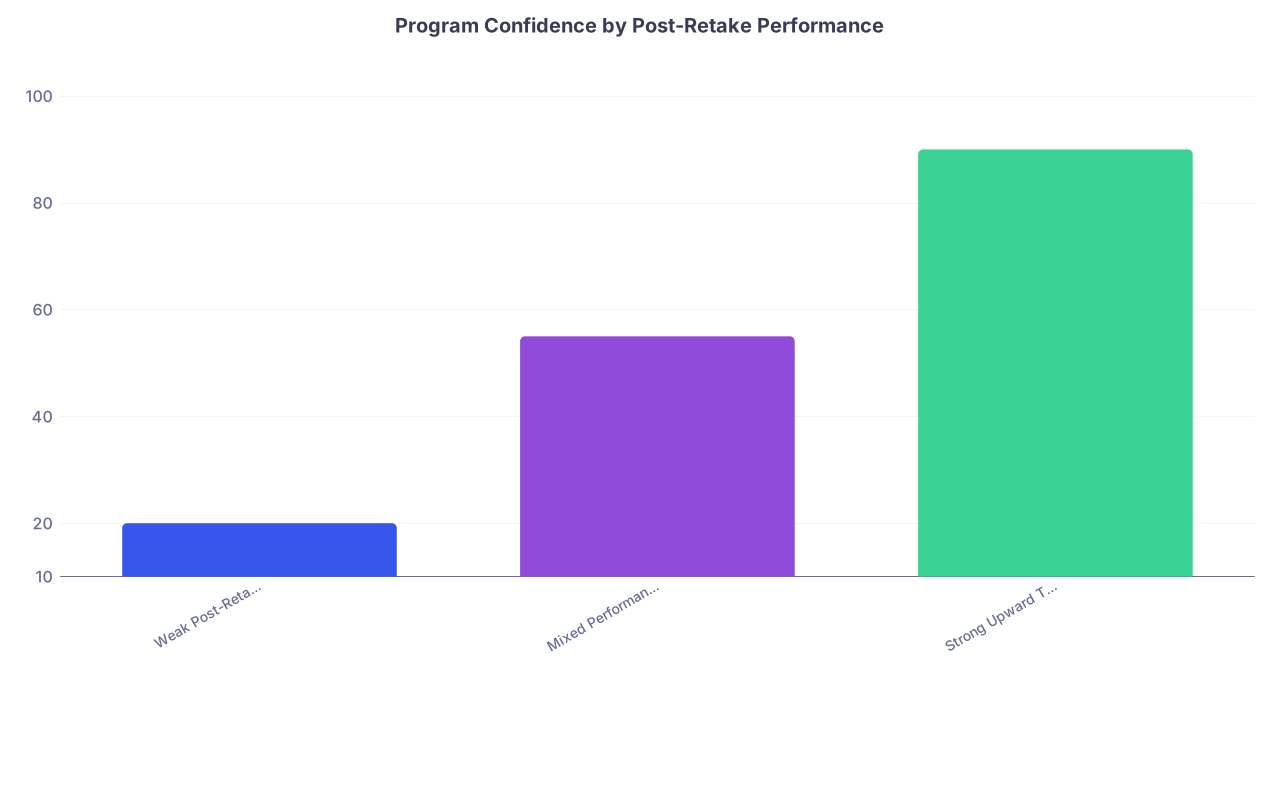
| Category | Value |
|---|---|
| Weak Post-Retake Trend | 20 |
| Mixed Performance | 55 |
| Strong Upward Trend | 90 |
I’ve seen PDs say, almost verbatim: “He failed Step 1, but Step 2 was great and there’s no other drama—this is fine.”
2. Professional ownership, not self-pity
In interviews, when an applicant says:
“I failed Step 1 because I studied in panic mode and didn’t treat my mental health as part of my preparation. That was unprofessional. I changed my approach, got help, and my subsequent performance shows that the new system works.”
That lands as mature. Self-aware. Low drama.
On the other hand:
“I’ve always been a bad test-taker and I just get really anxious.”
That lands as unsolved problem. A walking risk.
3. Documented, structured treatment or interventions
They don’t want the details of your therapy or medication. But if you calmly say:
“I worked with a psychologist on performance anxiety and I still use those tools.”
Or:
“I started medication with my PCP and we reached a stable regimen that’s worked for more than a year, including Step 2 and all my rotations.”
That says: this isn’t aspirational; it’s implemented. You are not showing up to their program hoping that stress magically resolves.
If You’re Still in Med School: How To Manage This Before It Becomes a Problem
You can’t rewrite the past, but if you’re pre-retake or in the middle of it, you still have room to shape the story PDs will eventually see.
I’ll be blunt: Most students wait until their anxiety is on fire and their practice exams are tanking. Then they go to wellness for a letter and a delay. That looks terrible from the program side.
The savvy move is earlier intervention with a performance frame, not a last-minute crisis frame.
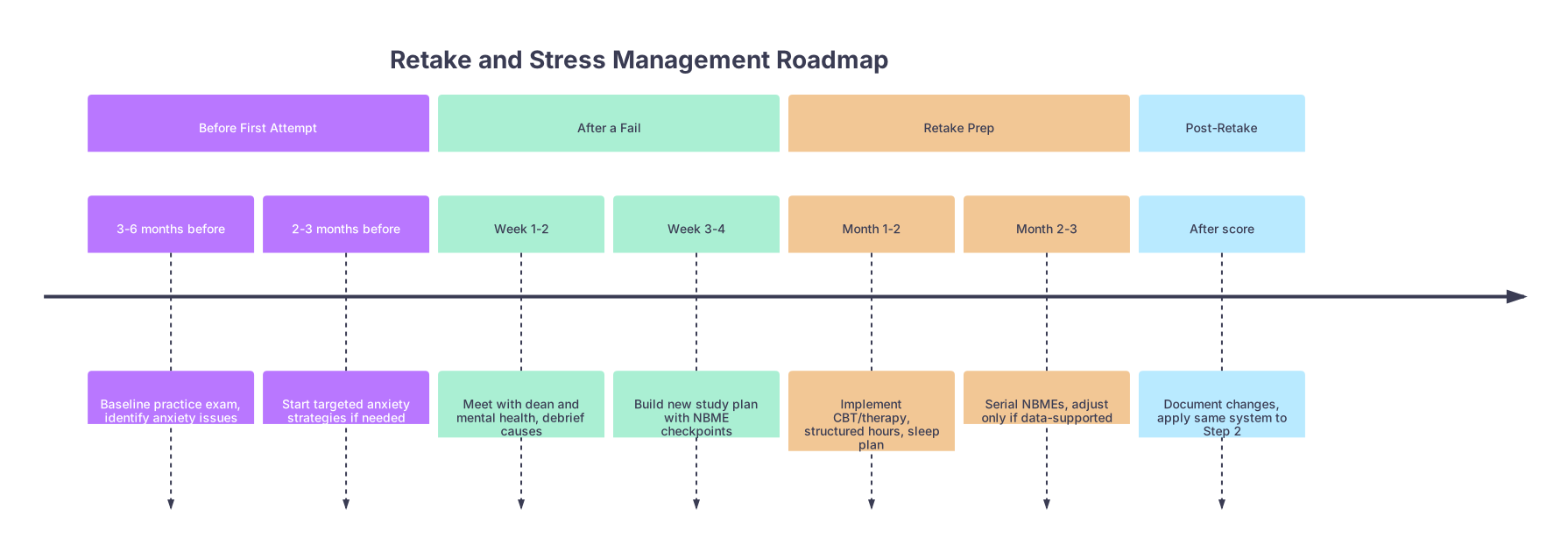
| Period | Event |
|---|---|
| Before First Attempt - 3-6 months before | Baseline practice exam, identify anxiety issues |
| Before First Attempt - 2-3 months before | Start targeted anxiety strategies if needed |
| After a Fail - Week 1-2 | Meet with dean and mental health, debrief causes |
| After a Fail - Week 3-4 | Build new study plan with NBME checkpoints |
| Retake Prep - Month 1-2 | Implement CBT/therapy, structured hours, sleep plan |
| Retake Prep - Month 2-3 | Serial NBMEs, adjust only if data-supported |
| Post-Retake - After score | Document changes, apply same system to Step 2 |
If you’re mid-crisis:
- Stop improvising. Get someone (faculty, dean, experienced resident) to help design a data-driven study plan. Practice exams every 2–3 weeks, not daily.
- Treat sleep and exercise as non-negotiable. PDs do not romanticize 3 a.m. Anki marathons. They see them as impulsive and unprofessional.
- Get actual mental health help. “Vent to my friends and watch YouTube” is not a treatment plan. PDs know the difference.
What you want, when they finally see your application, is the narrative: “I hit a wall, got help fast, rebuilt my system, and I’ve been stable and high-functioning since.”
How To Answer The Anxiety/Retake Question in Interviews
You will be asked about your retake. If there’s any hint of anxiety in your file, some attendings will poke at that too. Sometimes clumsily.
Here’s the structure that works. Simple, clean, controlled.
One sentence: label the problem directly.
“I failed Step 1 on my first attempt because my anxiety and my study strategy were both unmanaged.”Two to three sentences: what you changed, concretely.
“After that, I met with our learning specialist and a psychologist. We rebuilt my schedule around spaced repetition and weekly NBME checkpoints, and I started CBT-focused work on performance anxiety. I cut my hours to focused blocks, prioritized sleep, and stopped the 12-hour panic-study days.”One or two sentences: measurable proof of improvement.
“I passed comfortably on the second attempt and then scored 238 on Step 2 the first time using the same approach. My clinical rotations since then have been stressful in the usual ways, but I’ve stayed functional and composed.”One line connecting it to residency.
“That experience taught me that managing my mental state is part of being a professional, and I now treat that as seriously as I treat reading for my patients.”
What you must avoid:
- Long emotional monologues.
- Blaming the exam, the school, the prometric center, your family, or the universe.
- Ending on “I still struggle a lot, but I hope…”
Hope is not a system. PDs are listening for a system.
Programs Are Not All the Same About This
Some programs are hyper-conservative about any whiff of instability. Others are far more forgiving if they see growth.
| Program Type | Typical Attitude |
|---|---|
| Ultra-competitive academic (e.g., top 10 IM, Ortho, Derm) | Very cautious about any retake + anxiety; rank lists short and risk-averse |
| Mid-tier academic with strong support culture | Will accept retakes if post-retake trend and narrative are solid |
| Community programs with heavy service load | Worry about reliability more than prestige; want proof you won't melt down on call |
| Psych/FM/Peds with wellness emphasis | More open to mental health transparency if growth is obvious |
I’ve seen a community IM PD pass over a 250+ Step 2 applicant because of repeated leaves and anxiety language in the MSPE and rank a 230+ applicant with a single, well-managed retake much higher.
Why? Because the second one looked like someone who could be trusted.
The Quiet Upside: A Well-Handled Retake Can Actually Help You
Here’s the twist you won’t hear on Reddit: when framed and backed up correctly, surviving a retake and managing real test anxiety can become a plus in some PDs’ minds.
Not the score itself. The maturity it forces on you.
Faculty remember the snowflake students who shatter at the first rough feedback. They also remember the residents who have seen themselves fail, rebuilt, and come back calmer, humbler, more coachable.
If your application shows:
- A real failure
- Thoughtful analysis of what went wrong
- Concrete, sustained changes
- Stable, strong performance afterward
Then some PDs think: “This person has actually stress-tested themselves. They’ve already had their first big professional crisis, and they didn’t stay broken.”
That’s not a bad reputation to walk in with.
Three Things You Need To Get Right
Let’s end this cleanly. What program directors infer from your Step retake and stress comes down to three things:
Pattern: One crisis that never repeats is survivable. A scattered file full of delays, leaves, vague “stress issues,” and flat scores is not.
Ownership: If your story is “bad things keep happening to me,” you’re a risk. If your story is “here’s exactly what I changed and how it’s worked since,” you’re a grown professional.
Function under pressure: PDs don’t need you calm; they need you effective. Everything in your application should answer one question for them: “When things get hard here, will this person still show up and perform?”