

The biggest lie about test anxiety in medical school is that “if you really belong here, you’ll just push through it.” That is not how it actually works behind closed doors.
Every decent med school has quiet, semi-hidden support systems specifically for test anxiety—systems they rarely advertise, and often bury under vague labels like “academic support” or “student wellness.” Faculty and administrators know exactly how common crippling exam anxiety is. They also know they’re sitting on services they do not loudly promote, for a mix of political, legal, and optics reasons.
Let me walk you through what really exists, how it’s used, and how students who “magically bounce back” from failing shelves or NBME exams are actually getting help while everyone else silently drowns.
Why Med Schools Bury Test Anxiety Support
Most schools will happily brag about “holistic wellness,” free yoga, and therapy dogs. But explicit test-anxiety support? That stays in the shadows.
Here’s why:
Brand optics. No dean wants a parent or donor thinking, “Does this school admit students who can’t handle exams?” So programs talk about “performance optimization,” “resilience training,” or “learning skills”—not “you’re having panic attacks before every exam.”
Legal and accreditation paranoia. Once a school loudly acknowledges how many students suffer from disabling test anxiety, they risk ADA implications, disability accommodations demands, and scrutiny from LCME or other bodies. So they prefer individual quiet fixes over public acknowledgment of systemic pressure.
Culture of toughness. Attendings and some older faculty still believe, “If you can’t handle tests, you can’t handle residency.” Even the more compassionate ones know this attitude is alive and well. So instead of institutional campaigns, they funnel help through side doors: a “learning specialist,” a “confidential counselor,” or “academic coaching.”
They don’t want to open the floodgates. Programs fear that if they say, “We have robust test anxiety services,” suddenly every mildly stressed MS1 will flood those systems. So they make the help discoverable, but not obvious. You basically have to know what to ask for.
The result: you see classmates magically turning things around after bombing an exam, and no one tells you what actually changed. They got access to the quiet infrastructure you haven’t tapped yet.
The Real Menu of “Hidden” Supports
Let me be blunt: if your test anxiety is affecting your performance and you’re at an accredited medical school, there is almost certainly more support available than anyone has clearly told you.
Some of it is official. Some is unofficial, back-channel, or “don’t put this in an email” level.
1. The Learning Specialist Who Actually Does Test-Anxiety Work
Most med schools now have a “learning specialist,” “academic skills coach,” or “education psychologist.” Officially, they help with:
- Time management
- Study strategies
- Board prep planning
Unofficially? They’re the front line for test anxiety—especially for students who don’t want a “mental health diagnosis” on file.
You’ll hear phrases like:
- “We can help you optimize your performance under pressure.”
- “We can run a test-taking profile and work on test-day activation.”
Translation: they’ll walk you through concrete test-anxiety interventions—breathing protocols, cognitive restructuring, specific pre-test routines, and simulated exam conditions with graded exposure.
One real example I’ve seen:
At a mid-tier midwestern school, a second-year student failed two cardio and renal exams. They didn’t go to counseling. They were referred—quietly—to the learning specialist, who did:
- A two-hour session dissecting how anxiety showed up in the first 10 questions of every exam
- Practice exams in a private room where the student narrated their thoughts aloud, then the specialist froze them at the panic spike and trained them on pattern interruption
- A customized “first 10 questions protocol” for every exam (time limits, deep breathing checkpoints, and mandatory pause before changing any answer)
On paper: “Academic coaching.”
In reality: dedicated test-anxiety treatment without calling it therapy.
If your school has anyone with a title like “Director of Academic Support,” “Learning Skills Specialist,” or “Academic Success Coach,” that is your first hidden door.
2. The Counseling Center’s Quiet Tier for Med Students
Here’s a secret that counseling staff will never put in an email but will say in person if you ask the right way: many schools treat med students as a separate class of clients.
They won’t say “priority,” but:
- You get shorter wait times
- You often get assigned to clinicians who understand high-stakes testing
- The documentation is usually kept separate from academic records, with extra caution
Test anxiety is one of the top three reasons med students show up there. The counselors know that if they don’t help you manage panic before a shelf or OSCE, the downstream fallout—remediation, LOAs, board failures—is massive. Administrators quietly push them to catch you early.
What they rarely advertise: some centers run informal or “pilot” programs for performance anxiety:
- Test-day plans they draft with you (sleep, caffeine, arrival timing, warm-up questions, anxiety spikes management)
- Exposure sessions where you sit in a testing-like environment with rising stress and learn to ride it instead of fight it
- Rapid access right before boards or finals if you’ve already been seen by them
At one East Coast school, the rule among counseling staff was: “If the email subject line has ‘Step 1’ and ‘panic’ in it, we see them within 48 hours.” No policy document. Just a shared understanding.
You do not get this priority access if you show up vaguely asking for “stress management resources.” You get it when you say, clearly:
“I’m having test anxiety that’s interfering with my performance on high-stakes exams. I need support specifically for that.”
That phrasing flips a switch. Suddenly you fall into their “critical academic functioning” bucket.
3. Disability Services and the Back-Channel Accommodations
Most students wait too long to consider accommodations, because they think accommodations = weakness, or permanent label, or career-ending. Meanwhile, the students who quietly get 150% time and private rooms are pulling ahead.
Let me be very clear:
Many schools are far more willing to grant test-related accommodations than they publicly admit. They just need you to present it in the right framework.
What disability offices actually have the power to do:
- Grant extended time on written exams
- Approve a separate, low-stimulus room for test-takers with significant anxiety
- Allow breaks for brief calming exercises during long exams
- In some rare cases, split long exams into multiple sessions
The barrier is not legal—it’s documentation and narrative.
Here’s the “hidden truth” pattern:
- If you show up saying, “I’m stressed and don’t like tests,” you get nothing.
- If you show up with:
- a formal diagnosis (anxiety disorder, panic disorder, ADHD with severe exam anxiety)
- a letter from a licensed provider explicitly tying your symptoms to exam performance
- a history of significant functional impairment (failed exams, panic attacks, walking out mid-shelf)
…you suddenly fit their ADA framework and the doors open much faster.
Are schools thrilled about this? No. But once it lives in disability services, faculty can’t just “opt out”. That’s the part they don’t publicize.
| Support Type | How It’s Labeled Publicly | What It Actually Does |
|---|---|---|
| Learning Specialist | Academic skills / coaching | Covert test-anxiety interventions |
| Counseling Center | Wellness / personal counseling | Performance-focused anxiety work |
| Disability Services | Accommodation office | Extra time, private room, breaks |
| Academic Dean Meetings | Progress check-ins | Gate to back-channel resources |
4. The Academic Dean Who Acts Like a Bouncer
You know those “meet with the associate dean” invites after a failed exam or borderline performance? Most students walk in terrified. Which is fair. They control promotions, remediation, and ultimately your ability to graduate.
But here’s what you do not see:
Those deans also function as traffic controllers to all the quiet support systems I just mentioned.
I’ve heard these phrases in those offices:
- “We’ll frame this as an academic skills issue rather than a mental health label.”
- “I can make a call to get you in with X next week instead of in three weeks.”
- “Let’s route this through disability services now so it doesn’t blow up at Step.”
Translation: if you’re honest with them about test anxiety early, they’ll often unlock access you cannot get on your own.
The savvy students say things like:
“I understand the content, but on exam days my anxiety spikes so hard that my performance drops dramatically compared to practice questions. I need help with the performance side, not just more content.”
That tells the dean this is not just laziness or poor studying. It signals: “Potentially salvageable with the right support.” That’s when they start pulling strings.
5. Quiet Peer Networks and “Unofficial” Support
There’s another tier of support no one puts on a website: the upperclassmen and residents who’ve already gone through test anxiety hell and quietly survived.
Every class has:
- The person who failed an organ system block then passed the remediation and never talked about it again
- The one who choked on their first shelf exam and then crushed Step 2
- The one who took a leave of absence for “personal reasons” and came back calmer and sharper
Officially: they’re “happy to mentor juniors.”
Unofficially: they’ll tell you where the real help is, which faculty members to trust, and which offices actually do something when you say “test anxiety.”
One MS4 I know kept a private list of “safe people” for students with test anxiety at her school:
- 1 counselor who understood panic attacks in exam rooms
- 1 learning specialist who had test-taking strategy on lock
- 1 psych attending willing to write letters for accommodations
- 1 dean who was actually sympathetic, not punitive
She didn’t post this list. She handed it, physically, to first- and second-years who whispered, “I think I’m going to fail because I can’t stop panicking on exams.”
If you think you’re alone, you’re not. You’re just not talking to the people who’ll tell you the truth.
How Test Anxiety Actually Shows Up in Med School
Let me cut through a misconception: test anxiety in medical school is not just “being nervous.”
Here’s what program directors, deans, and learning specialists see when they look at your scores and behavior:
- Practice vs real exam split. You’re getting 70–80% on UWorld or school-style practice questions, then dropping to 40–60% on the real exam. Red flag for performance anxiety.
- The first-10-questions collapse. You bomb the start of every exam, then slowly stabilize. Anxiety front-loads your mistakes.
- Answer-changing pattern. You consistently switch from correct to incorrect answers under pressure. Classic cognitive doubt fueled by anxiety.
- Physiologic panic. Sweaty palms, racing heart, tunnel vision, blanking on simple facts you knew the night before.
- Avoidance behavior. You procrastinate practice tests, delay opening NBME forms, or “study indefinitely” and never test yourself—because every question feels like a threat.
Faculty may appear unsympathetic, but they recognize this pattern. The question is whether they see you as:
- An anxious high-performer who can be salvaged with support
- Or an unmotivated, underprepared student they’re expected to push along the pipeline until they break
How you present yourself—and whether you use the quiet systems—decides which box you land in.
Using These Systems Without Torpedoing Your Reputation
This is the part everyone worries about: “If I admit to test anxiety, will they think I’m unfit to be a doctor?”
The reality is more nuanced. Program directors don’t care if you once struggled with test anxiety. They care if, when pressure went up, you pretended everything was fine and then imploded.
Here’s how the students who quietly fix this manage their image:
They frame it as a performance problem, not a personality flaw.
“My anxiety undercuts me specifically during high-stakes exams; I’m working proactively on this because I want my exam performance to reflect my actual knowledge.”They act early, not after total disaster.
If you wait until you’ve failed multiple exams or a board, you look reactive. If you seek help after a close call, you look self-aware.They show a plan.
To a dean or advisor, saying “I’m working with counseling and the learning specialist, and we’re trialing X, Y, Z strategies” sounds responsible. It moves you from “problem” to “project with a plan.”They’re selective about who hears the full story.
They tell trusted faculty, peer mentors, and official support staff. They do not trauma-dump to random attendings on rounds or overshare with competitive classmates.
One more truth: most faculty have seen at least one star resident who had brutal test anxiety in med school but still became an excellent physician. Once they’ve seen that, they’re a lot less judgmental—if you demonstrate you’re actually doing the work to manage it.
Concrete Steps to Tap the Hidden Systems
Let me be very direct. If you’re stuck in a loop of dread before every exam, here’s the playbook the “insiders” use:
Email academic support / learning specialist with specific language.
Use something like:
“I’m struggling with test performance despite understanding the material, and I think anxiety during exams is a major factor. I’d like to work on concrete strategies for managing test anxiety and improving my exam performance.”Self-refer to counseling, but name the problem clearly.
“Test anxiety affecting academic performance” will get triaged differently from “general stress.”Ask disability services what documentation is needed—before a crisis.
Even if you’re not sure you’ll use accommodations, know the process and timeline. Many students only discover it takes months when they’re already burning.Talk to a trusted upperclassman you know is honest.
Ask directly: “Who at this school actually helps with test anxiety? Who understands it and doesn’t blow it off?”Document patterns.
Bring exam score distributions, practice versus real exam discrepancies, and any episodes of panic. It signals you’re serious and gives them something objective to work with.
The Ugly Truth About Step and Shelf Exams
Let’s address the board elephant in the room.
Step 1 going pass/fail helped some students’ generalized dread. It did not magically erase test anxiety. For many, the pressure just migrated to:
- Shelf exams
- Step 2 CK
- In-house cumulative exams
Behind closed doors, I’ve heard conversations like:
“He’s clearly anxious, but Step 2 is coming. Get him into counseling now; I don’t want a failure on our stats.”
“We should have gotten her accommodations last year. Now she’s up against CK and there’s no time.”
Schools care about their board pass rates. That selfish institutional motive can actually work in your favor—if you use it. When they realize your unaddressed test anxiety could become a Step failure, they suddenly become much more helpful.
This is why you do not wait until you’re registering for boards to say, “By the way, I’ve had disabling test anxiety for two years.”
You start now. During pre-clinicals. During early clerkships. Whenever you’re reading this.
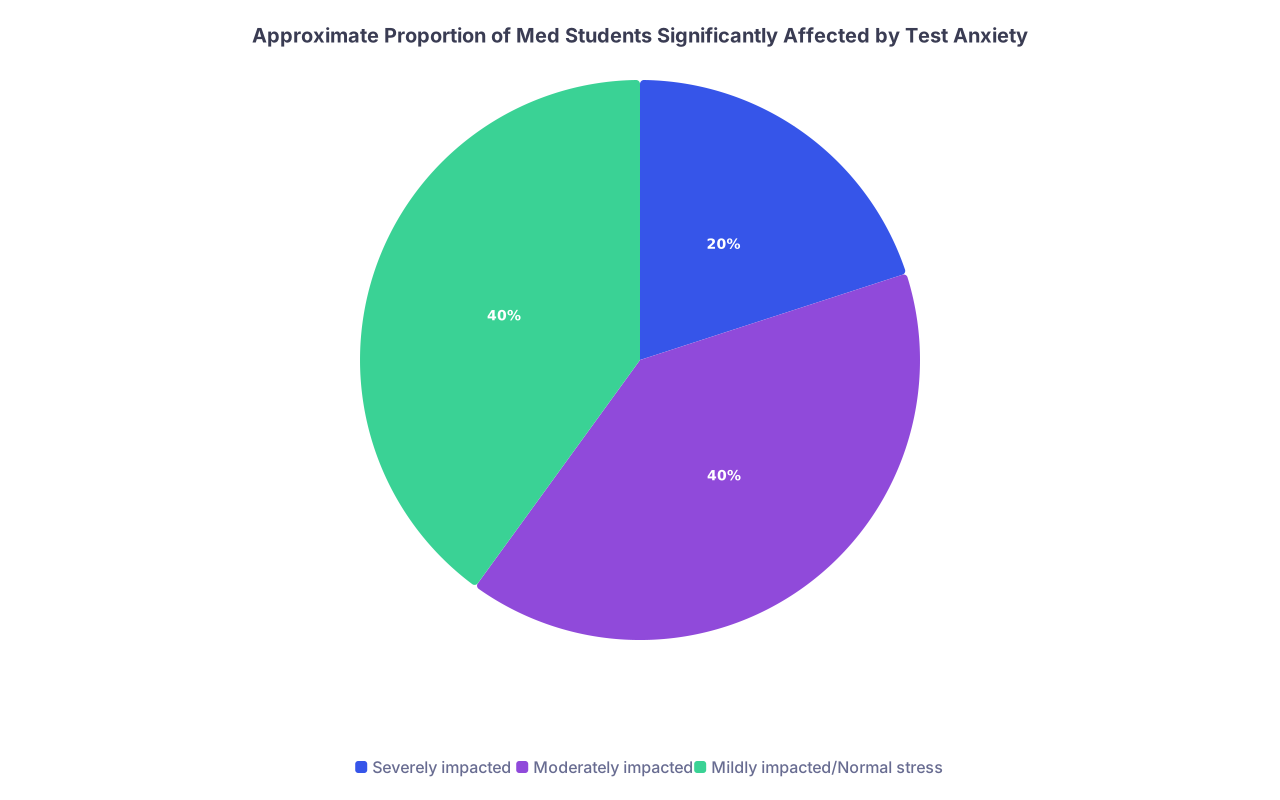
| Category | Value |
|---|---|
| Severely impacted | 20 |
| Moderately impacted | 40 |
| Mildly impacted/Normal stress | 40 |

| Step | Description |
|---|---|
| Step 1 | Test anxiety affecting performance |
| Step 2 | Learning Specialist |
| Step 3 | Counseling Center |
| Step 4 | Disability Services |
| Step 5 | Strategies + referral to counseling if needed |
| Step 6 | Academic Dean informed if exams at risk |
| Step 7 | Combined plan: strategies, therapy, possible accommodations |
| Step 8 | Who do you contact first? |
Final Reality Check
If you’ve read this far, here’s what I want sitting in your head when you walk into your next exam season:
You are not the only one. The number of med students with serious test anxiety is far higher than anyone says publicly. It’s just hidden behind professional masks and silent remediation.
Your school almost certainly has more help than it advertises. Learning specialists, counseling, disability services, dean-level back-channeling, and upperclass mentors—all quietly equipped to deal with exactly what you’re facing.
Test anxiety is not a fixed identity; it’s a solvable performance problem—if you treat it like one. The students who get better don’t rely on vibes and white-knuckling. They use the systems, even when the school doesn’t go out of its way to show them the doors.
Use the doors. Stop pretending you should be able to “tough it out” alone. That story is how good students quietly fail out. The quiet support systems are there—for the ones who go looking.
FAQ
1. Will seeking help for test anxiety hurt my chances for residency?
Not if you’re smart about it. Using school-based support—learning specialists, counseling, even disability services—does not show up on your transcript or MSPE as “this student had test anxiety.” What does hurt you is failing major exams or delaying graduation without a plan. Quietly handling the problem early makes you look more stable, not less.
2. Do accommodations like extra time or a private room follow me to Step and beyond?
They can, but only if you want them to and if you go through the proper documentation channels. NBME and similar bodies have their own standards, usually stricter than your school’s. Getting school-based accommodations first often helps build that documentation trail. You’re not locked in forever; you can reassess before each high-stakes test.
3. How do I know if what I’m feeling is “normal stress” or true test anxiety that needs help?
If your anxiety consistently drops your performance below what your practice work suggests, causes physical symptoms (panic, nausea, blanking), or leads to avoidance of practice tests or exams, that’s beyond “normal.” At that point, you’re not “just stressed”—you’re dealing with a performance-limiting condition. And you should treat it with the seriousness you’d give any other barrier to becoming the physician you want to be.


