
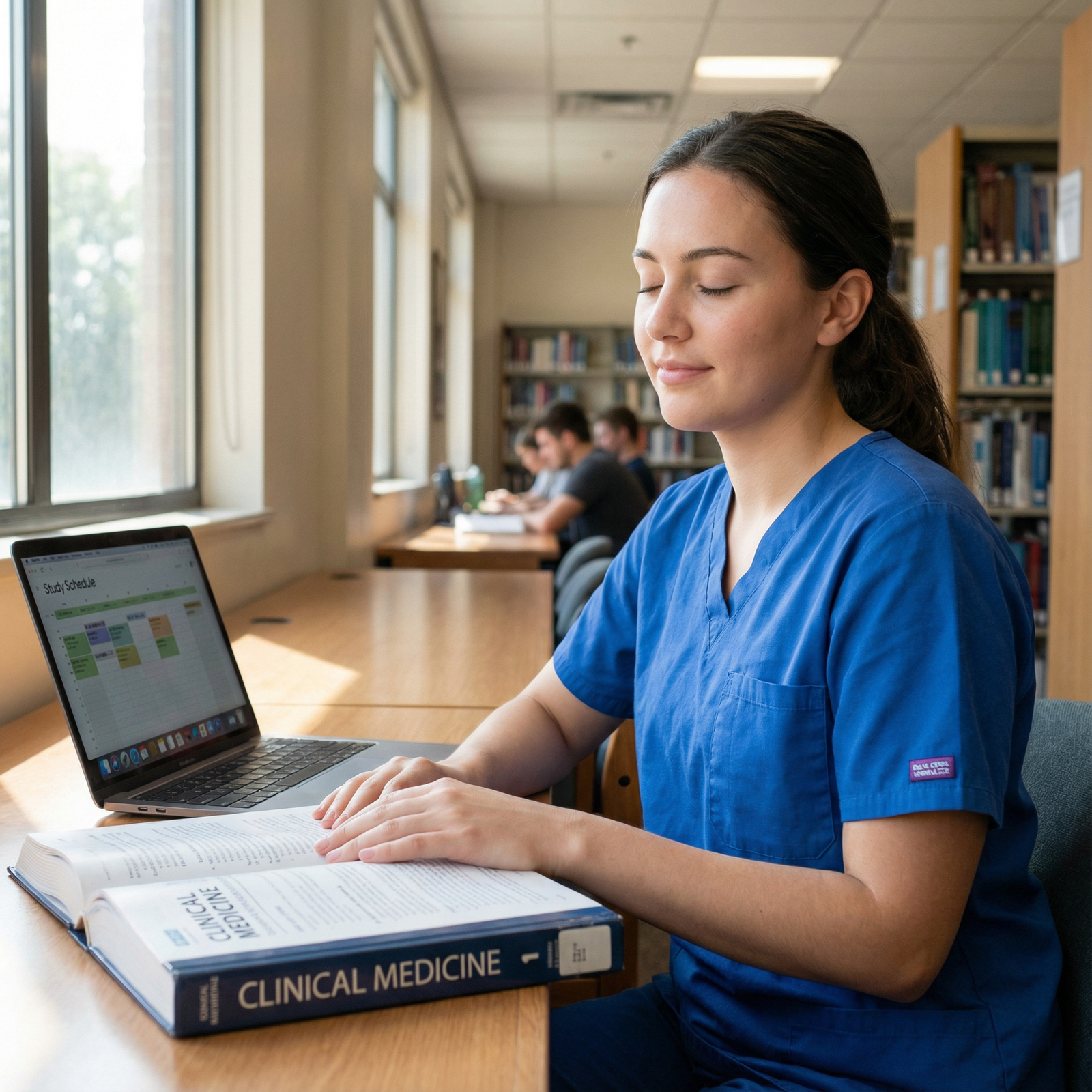
Mindfulness Techniques to Overcome Test Anxiety Before Exams
Introduction: Why Mindfulness Matters for Test Anxiety in Medical Training
High-stakes exams are a defining feature of medical school and residency—NBME subject exams, Step exams, OSCEs, in-training exams, boards, and more. These assessments often feel like make-or-break moments, and the pressure can quickly tip from motivating to overwhelming.
Test anxiety is common among high-achieving students and especially prevalent in medicine, where perfectionism, long study hours, and constant evaluation are the norm. Left unmanaged, test anxiety can:
- Disrupt concentration and memory
- Impair performance despite adequate preparation
- Erode confidence over time
- Negatively impact sleep, mood, and overall mental health
Mindfulness offers a practical, evidence-informed approach to Stress Management that you can integrate into your daily life and Study Techniques. Rather than trying to “fight” anxiety, mindfulness teaches you to notice it, understand it, and move through it more skillfully—so your brain is free to do what you’ve trained it to do.
This guide will walk you through:
- What test anxiety is and how it shows up in medical trainees
- Why mindfulness is uniquely helpful for exams
- Specific, step-by-step mindfulness techniques you can start using today
- How to combine mindfulness with effective study strategies
- Ways to build a sustainable, exam-season mental health routine
Understanding Test Anxiety in Medical School and Beyond
What Is Test Anxiety?
Test anxiety is a form of performance anxiety that occurs before, during, or even after an examination. It involves a combination of emotional, physical, and cognitive symptoms that can interfere with your ability to demonstrate what you actually know.
Common symptoms include:
Emotional and cognitive symptoms
- Persistent worry about failing or underperforming
- Catastrophic thinking (“If I don’t ace this exam, my career is over”)
- Racing thoughts, mental “blanking,” or difficulty recalling information
- Self-doubt and negative self-talk (“I’m not smart enough,” “Everyone else is more prepared”)
Physical symptoms
- Rapid heartbeat or palpitations
- Sweaty palms, trembling, or feeling shaky
- Headaches, stomach aches, nausea, or diarrhea
- Tight muscles, clenched jaw, or chest tightness
- Sleep disturbance: trouble falling asleep, frequent waking, or pre-dawn awakening
Behavioral symptoms
- Procrastination and avoidance of studying
- Overstudying without strategy (endless passive reading, re-highlighting)
- Checking and re-checking answers excessively during an exam
- “Cramming” the night before instead of following a planned schedule
In the context of medical training, these reactions are amplified by:
- The volume and complexity of information
- Frequent, high-stakes evaluations
- Comparison to peers in competitive environments
- Fear of letting down mentors, families, or program directors
Recognizing test anxiety is a necessary first step. It doesn’t mean you are weak or unprepared—it means your nervous system is doing what it was designed to do, just in the wrong context and intensity.
Why Mindfulness Helps with Test Anxiety and Mental Health
Mindfulness is the practice of intentionally paying attention to the present moment—your thoughts, feelings, bodily sensations, and surroundings—without judgment. Instead of getting caught in anxious narratives, you learn to:
- Notice thoughts as mental events, not facts
- Observe physical sensations with curiosity rather than fear
- Redirect attention back to the task in front of you
Research in medical students and residents has linked mindfulness with:
- Reduced anxiety and perceived stress
- Improved focus and working memory
- Better emotion regulation
- Lower risk of burnout and depressive symptoms
- Greater sense of resilience and well-being
For test anxiety specifically, mindfulness:
- Interrupts the cycle of worry → physical tension → more worry
- Helps you stay anchored to the question in front of you rather than future catastrophes
- Trains your brain to recover more quickly when you get stuck or flustered
- Supports healthier Study Techniques by increasing awareness of when you’re zoning out or mindlessly rereading
Mindfulness is not about “emptying your mind” or “getting rid of anxiety.” It’s about changing your relationship to anxiety so that you can study, recall, and think clearly—even when some nervousness is present.

Core Mindfulness Techniques for Managing Test Anxiety
Below are practical, step-by-step mindfulness practices tailored to medical students and residents. You don’t need to do all of them; start with one or two, then build from there.
1. Mindful Breathing: A Fast Reset for an Overloaded Mind
Mindful breathing is one of the most portable Stress Management tools. You can do it:
- Before opening your exam booklet
- During a difficult question block
- While waiting for exam results
- Anytime you notice your mind racing while studying
Basic Calming Breath (4–4–6)
Find a stable position.
Sit with your feet on the floor, spine reasonably straight yet relaxed, hands resting on your lap. You can also stand or lie down if needed (e.g., during a call-room break).Gently close your eyes or soften your gaze.
Allow your attention to turn inward.Inhale through your nose for a count of 4.
Feel your abdomen or lower ribs expand, like a balloon inflating.Pause and hold your breath for a count of 4.
Notice the stillness between inhale and exhale.Exhale slowly through your mouth for a count of 6.
Let your shoulders soften and your jaw unclench as you breathe out.Repeat for 5–10 cycles (about 2–5 minutes).
Each time your mind wanders, gently bring it back to the sensation of breathing.
When to use it for exams:
- 5 minutes before opening your exam
- Between sections or blocks
- After an especially challenging question
- During moments of panic (“I’m going to fail”)—to break the intensity of the thought
2. Body Scan Meditation: Releasing Exam-Related Tension
A body scan helps you notice where you hold stress (neck, shoulders, back, stomach) and teaches you to release it. Many students are surprised by how tense they are until they pay attention.
Simple Body Scan (10–15 minutes)
Lie down or sit comfortably.
If lying down, place your arms at your sides and legs slightly apart. If seated, rest your hands gently on your thighs.Take a few slow, deep breaths.
Let your exhale be slightly longer than your inhale.Begin at your toes.
Gently bring your attention to your toes and feet. Notice sensations—warmth, coolness, tingling, pressure.Move upward gradually.
Progress through:- Feet and ankles
- Calves and knees
- Thighs and hips
- Abdomen and lower back
- Chest and upper back
- Hands, arms, and shoulders
- Neck, jaw, face, and scalp
At each region, notice and soften.
If you find tension (tight jaw, knotted stomach), imagine breathing into that spot and exhaling some of the tension away.Finish with 2–3 deeper breaths.
Slowly open your eyes and reorient to your environment.
How this helps with Test Anxiety:
- Reduces physical symptoms that can be misinterpreted as “I’m not ready”
- Increases body awareness so you can catch tension early (e.g., clenching your jaw during question blocks)
- Promotes better sleep when done before bed in the days leading up to the exam
3. Mindful Visualization: Rehearsing a Calm Exam Experience
Visualization harnesses your imagination to create a mental “rehearsal” of a calm, focused exam experience. This can directly counter catastrophic images of freezing or failing.
Exam Day Visualization (5–10 minutes)
Sit or lie in a quiet place.
Turn off notifications and minimize interruptions.Close your eyes and take 3–5 calming breaths.
Imagine the full exam scenario in detail:
- Arriving at the testing center or lecture hall early
- Checking in, organizing your materials
- Sitting at your station or desk, feeling grounded in your body
See yourself responding calmly to stressors:
- Encountering a difficult question and pausing for one mindful breath
- Skipping and returning to challenging items without spiraling
- Using your training and reasoning skills effectively
Emphasize positive outcomes:
- Completing the exam feeling tired but satisfied
- Walking out thinking, “I did my best with what I knew”
- Feeling proud of your preparation and composure
End with an affirmation.
Silently repeat a realistic phrase:- “Nervousness is normal; I can still think clearly.”
- “I don’t need to be perfect to do well.”
- “I’ve prepared; now I trust my training.”
Over time, your brain begins to associate exam situations with calm focus rather than panic, which can significantly lower baseline Test Anxiety.
4. Progressive Muscle Relaxation (PMR): Training Relaxation on Demand
PMR involves systematically tensing and then relaxing muscle groups. It teaches your body the difference between tension and relaxation—crucial when you’re keyed up before a big exam.
PMR Routine (10–15 minutes)
Choose a comfortable position.
Sit back in a chair or lie down.Starting from your feet, work upward:
- Feet: Curl toes tightly for 5 seconds, then release.
- Calves: Flex calves as if pressing on a gas pedal, hold 5 seconds, release.
- Thighs: Squeeze thighs together or press them into the chair, hold, release.
- Abdomen: Gently tighten, hold, release.
- Hands and arms: Make fists and tense forearms, hold, release.
- Shoulders: Shrug shoulders toward ears, hold, release.
- Face and jaw: Squeeze eyes shut, clench jaw (gently), hold, release.
After each release, notice the contrast.
Mentally label it: “This is what relaxation feels like.”Finish with a few slow, deep breaths.
When to use PMR:
- The night before an exam to aid sleep
- After long study blocks to reset your body
- During particularly stressful rotations or exam periods
5. Mindful Journaling: Reframing Anxious Thoughts
Mindful journaling combines self-reflection with cognitive restructuring, helping you see anxious thoughts more clearly and challenge unhelpful patterns.
Exam-Focused Journaling Routine (10–15 minutes per day)
Schedule a consistent time.
For example, 10 minutes after dinner or right after you finish your last study block.Step 1 – “Dump” your worries (3–5 minutes).
Write freely about:- What you’re afraid will happen
- Self-critical thoughts (“I’m behind,” “I can’t keep up”)
- Physical sensations you’re noticing
Step 2 – Question your thoughts (3–5 minutes).
Use prompts like:- “What evidence supports this fear? What evidence goes against it?”
- “How have I handled challenging exams in the past?”
- “If a friend wrote this, what would I say to them?”
Step 3 – End with gratitude or strengths (2–3 minutes).
List 3 things you’re grateful for or proud of that day, such as:- “Reviewed cardiology murmurs thoroughly”
- “Asked for help when I felt stuck on nephrology”
- “Took a 10-minute walk instead of doom-scrolling”
Over time, this practice:
- Reduces the emotional intensity of worries
- Reinforces your strengths and effort, not just outcomes
- Supports overall Mental Health during intense exam seasons
6. Using Mindfulness Apps and Digital Tools Strategically
Several apps offer guided meditations and structured programs for anxiety and stress management:
- Headspace: Short sessions (3–10 minutes) for focus, test anxiety, and sleep
- Calm: Breathing exercises, body scans, and relaxing soundscapes
- Insight Timer: Large library of free meditations, including student- and exam-focused practices
- Ten Percent Happier: Science-based mindfulness content, often helpful for skeptical high-achievers
Tips for medical students and residents:
- Bookmark 2–3 favorites (e.g., a 5-minute pre-exam breathing practice, a 10-minute body scan for nighttime).
- Use “micro-meditations” (1–3 minutes) between study blocks.
- Download offline sessions for exam weeks when you may have unpredictable schedules.
Integrating Mindfulness into Your Study Routine and Exam Strategy
Mindfulness is most effective when woven into your existing Study Techniques, not treated as an “extra” task.
Creating a Sustainable Mindfulness Practice Schedule
Consider a layered approach:
Daily (5–15 minutes total)
- 5 minutes of mindful breathing in the morning or before your first study block
- 5 minutes of journaling or visualization in the evening
During study sessions
- 1–2 minutes of mindful breathing every 25–50 minutes (e.g., between Pomodoro cycles)
- A 5-minute body scan or PMR once or twice a day during heavy studying
Week of the exam
- Keep mindfulness practices brief and consistent, not overly long or new
- Prioritize sleep and gentle movement (short walks, stretching) as part of your stress management
Combining Mindfulness with High-Yield Study Techniques
Mindfulness doesn’t replace studying—it optimizes it. Here’s how to integrate the two:
1. Mindful Pomodoro Technique
- Study for 25–45 minutes with full focus on a single task (e.g., UWorld block, Anki review, reading a specific guideline).
- Take a 5–10 minute break that includes:
- 1–3 minutes of mindful breathing
- A short walk, stretching, or water break
- During the break, avoid scrolling social media or engaging in stressful conversations—this can spike anxiety and lower focus.
2. Mindful Question Practice
When doing practice questions (e.g., UWorld, NBME):
- Before starting a block, take 3 calming breaths.
- When you hit a tough question:
- Notice your reaction: “I feel my heart rate rise, I’m thinking ‘I have no idea.’”
- Take one slow breath, then calmly apply test-taking strategies (eliminate obviously wrong answers, reason stepwise).
- After the block, when reviewing:
- Observe any harsh self-talk and gently reframe it: “This is data, not a judgment of my worth.”
3. Mindful Reading and Note Review
- While reading, notice the moment your mind wanders or you find yourself rereading the same line.
- Pause, take a single mindful breath, and either:
- Re-engage with the material with intention, or
- Switch tasks if your focus is truly exhausted.
Using Mindfulness to Navigate the Exam Day Itself
On exam day, mindfulness can help you stay steady:
Before the exam:
- Arrive early to avoid rushed panic.
- Do 3–5 minutes of breathing or a short body scan while seated.
- Use a simple phrase: “Some anxiety is normal; I can still perform well.”
During the exam:
- If you blank on a question:
- Pause, feel your feet on the floor or hands on the desk.
- Take one slow breath, then re-read the question calmly.
- If still stuck, make your best educated guess and move on. This is mindfulness in action—letting go and refocusing.
After the exam:
- Notice urges to endlessly ruminate or compare with peers.
- Set a time-limited “debrief window” (e.g., 15–20 minutes to reflect or vent). After that, gently redirect your attention back to the present using breath or grounding techniques.

Protecting Your Mental Health During Exam Seasons
Mindfulness is one powerful tool, but managing Test Anxiety in medicine also requires broader mental health and lifestyle supports.
Build a Supportive Environment
- Peer support: Study with a partner or group that is constructive, not anxiety-amplifying.
- Mentors: Talk to upper-level students or residents who can normalize your fears and offer practical tips.
- Professional help: If your anxiety significantly interferes with studying, sleep, or daily functioning, consider speaking with a mental health professional. Cognitive-behavioral therapy (CBT), sometimes combined with mindfulness approaches (MBCT), can be especially helpful.
Respect Sleep, Nutrition, and Movement
Even in busy rotations or intense study periods:
- Aim for as close to 7–8 hours of sleep as possible. Chronic sleep deprivation worsens anxiety and impairs memory.
- Eat regularly—low blood sugar mimics anxiety symptoms and makes test anxiety feel worse.
- Incorporate short bouts of movement (5–15 minutes: walking, stairs, stretching) to discharge nervous energy and reset focus.
Set Realistic Expectations
- Feeling some anxiety is normal and even adaptive; your goal is better management, not total elimination.
- Progress is often gradual—you may still feel anxious, but you’re able to refocus faster and think more clearly.
- Mindfulness is a skill; like clinical reasoning, it improves with consistent practice.
FAQs: Mindfulness, Test Anxiety, and Medical Exams
1. How long does it take for mindfulness techniques to help with test anxiety?
Most students notice some immediate benefit from simple breathing exercises (e.g., feeling slightly calmer, clearer) the very first time they try them. However, the deeper effects—such as reduced baseline anxiety and greater resilience under stress—typically emerge after several weeks of regular practice (even 5–10 minutes a day). Think of it like building a mental muscle: consistency matters more than intensity.
2. Can mindfulness really improve my exam performance, or just how I feel?
Mindfulness primarily targets how you relate to stress, but this can indirectly improve performance. By reducing intrusive worry and physical tension, your working memory and concentration are freed up to process questions more effectively. Many students report fewer “blanking” episodes, better pacing, and improved recall of information they’ve already studied. It’s not a shortcut to knowledge—good study techniques are still essential—but it helps you access what you know under pressure.
3. What if my mind keeps wandering during mindfulness exercises?
Mind-wandering is normal and expected—especially in anxious, high-achieving students. The goal is not to have a perfectly still mind; the goal is to notice when your mind has wandered and gently bring it back to your breath, body, or chosen focus. Every time you do this, you’re literally training your attention. Think of each “wandering and returning” as one repetition in a mental workout.
4. Should I focus more on mindfulness or on studying if I’m short on time?
Studying remains your primary responsibility; mindfulness is there to support your learning and mental health, not compete with them. If time is very tight, aim for brief but consistent practices—such as 3 minutes of breathing before question blocks, or a 5-minute body scan before bed. These short practices can stabilize your Stress Management enough to make your study time more efficient and less exhausting.
5. How do I know if my test anxiety is severe enough to seek professional help?
Consider seeking help from a counselor, psychologist, psychiatrist, or your school’s wellness resources if:
- Anxiety regularly prevents you from starting or completing study sessions
- You experience panic attacks or frequent physical symptoms (chest pain, shortness of breath, severe GI distress) related to exams
- You have persistent sleep disturbance, low mood, or loss of interest in usual activities
- You’re using substances (e.g., alcohol, stimulants, sedatives) to cope with exam anxiety
- You’ve tried self-help strategies, including mindfulness, but still feel overwhelmed
Professional support can work alongside mindfulness and good study habits to create a comprehensive plan for your mental health.
Mindfulness is not about becoming a perfectly calm person who never feels nervous. It’s about learning to meet your stress response with awareness, kindness, and skill—so you can bring your full training and intelligence to the exam in front of you. With consistent practice, these techniques can transform test anxiety from an overwhelming barrier into a manageable part of your medical school life and exam journey.


