How to Create a Positive Study Environment to Reduce Test Anxiety in Medical School
Test anxiety is common in high-pressure fields like medicine, where your performance on a few intense exams can influence your future training and career. It’s not only about what you know; it’s about whether you can access that knowledge under stress.
One of the most underused but powerful tools for managing Test Anxiety is your study environment. A well-designed space can improve concentration, support Mental Wellness, and set you up for consistent Academic Success. Conversely, a chaotic or poorly planned environment can fuel avoidance, distraction, and anxiety.
This guide expands on practical, evidence-informed strategies to help medical students and residents create a positive study environment and daily routine that supports learning, performance, and well-being.
Understanding Test Anxiety in High-Stakes Training
What Is Test Anxiety?
Test anxiety is a specific form of performance anxiety: a combination of emotional, cognitive, and physical symptoms that arise in evaluative situations such as exams, OSCEs, shelf exams, or board exams.
Common symptoms include:
- Physical: racing heart, sweating, GI discomfort, tension, headaches, shallow breathing, poor sleep
- Cognitive: intrusive worries (“I’m going to fail”), mental blanking, difficulty concentrating, catastrophizing future outcomes
- Emotional/Behavioral: irritability, avoidance of studying, procrastination, emotional outbursts, or perfectionism-driven overstudying
Research suggests that a significant proportion of students across health professions experience Test Anxiety—often at higher rates than the general college population due to the intensity and stakes of training.
For medical learners, Test Anxiety is often amplified by:
- Pressure to match into competitive specialties
- Fear of failure and its perceived impact on identity and career
- Constant comparison to peers
- Cumulative fatigue from long study and clinical hours
Why Your Study Environment Matters for Test Anxiety
Your Study Environment doesn’t just influence how much you get done; it shapes how your brain and body feel while studying. This, in turn, affects:
- Focus & Recall: A structured, predictable environment improves encoding and retrieval of information.
- Stress Regulation: Calm, organized surroundings signal safety, helping reduce baseline arousal.
- Habits & Consistency: A dedicated, well-designed space makes it easier to start and sustain focused work.
- Mental Wellness: A supportive environment can buffer burnout and emotional exhaustion.
In other words, you can’t always control the exam—but you can control the conditions under which you prepare for it.
Step 1: Choose the Right Study Location for Consistent Focus
The first step to a positive Study Environment is selecting a location that reliably supports your focus, energy, and comfort.
Prioritize Quiet and Predictability
For most people, fewer external distractions mean better attention and lower anxiety.
Consider:
- Libraries or dedicated study rooms: Often ideal for deep work, especially in medical schools with quiet floors or carrels.
- Reserved spaces: Many schools allow reserving small rooms—perfect for practice OSCEs, question banks, or group study.
- Home study corners: A specific desk, chair, and setup reserved only for study can train your brain to shift into “focus mode.”
If total silence makes you uneasy, opt for low-level background noise (more on this later), but avoid spaces where you’re constantly being interrupted.
Evaluate Physical Comfort and Accessibility
A space can be quiet but still poor for learning if it’s physically uncomfortable or hard to access.
Look for:
- Ergonomic seating: A chair with back support and a desk at a comfortable height to avoid neck and back strain.
- Reliable power and internet: Essential for question banks, digital notes, and video lectures.
- Proximity: A location that’s easy to reach decreases the friction of starting study sessions, especially on busy clinical days.
If you’re rotating through different hospitals, consider having:
- A primary base (e.g., your home desk) and
- A mobile setup for on-call rooms, lounges, or hospital cafeterias (laptop/tablet, small notebook, headphones).
Step 2: Organize and Optimize Your Physical Study Space
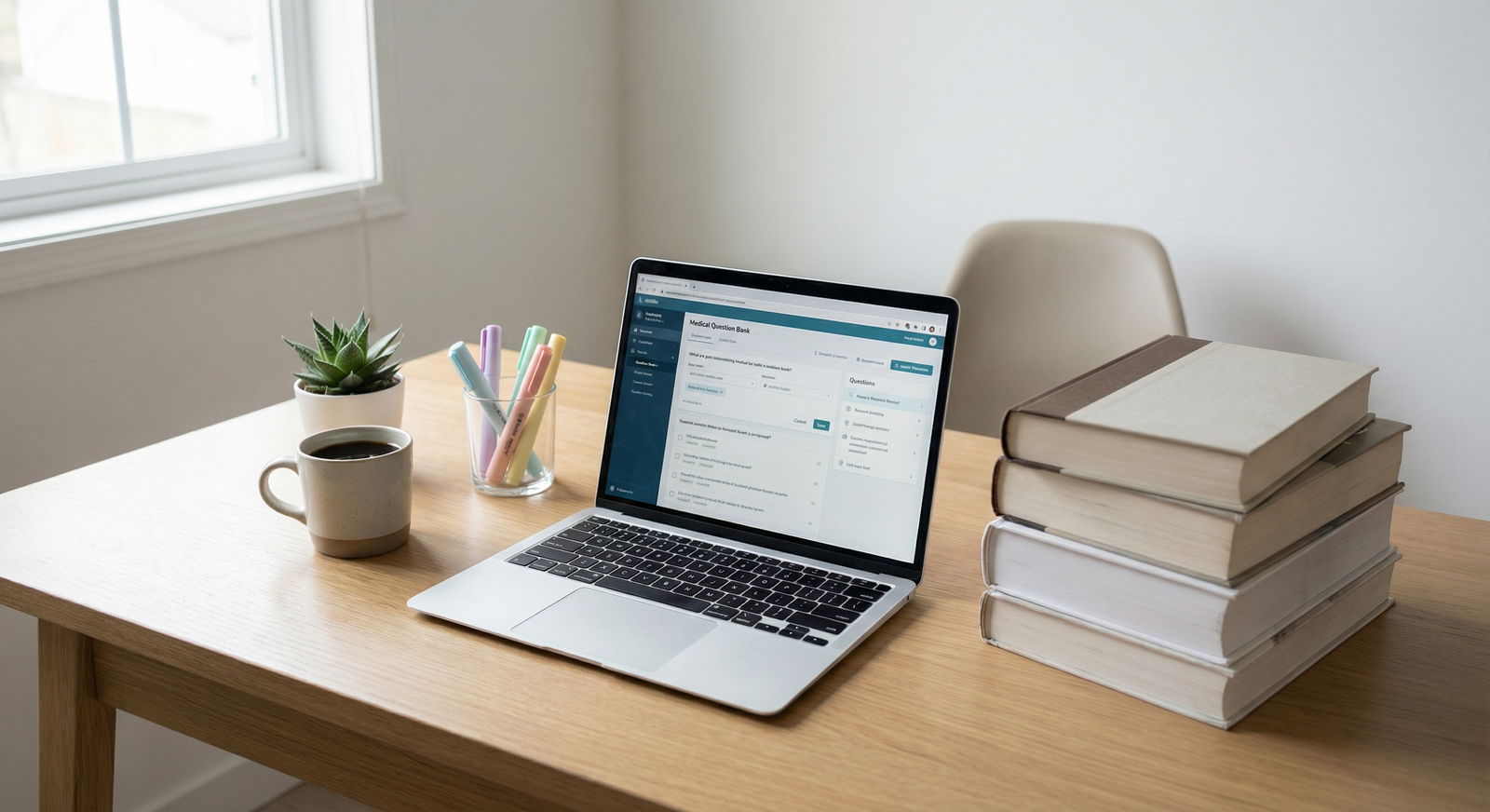
Once you have a location, the next step is to create a physical environment that promotes clarity and reduces cognitive load.
Declutter to Reduce Cognitive Overload
Visual clutter competes for your attention and can amplify feelings of chaos and anxiety. A clear space supports a clear mind.
Actionable steps:
- Limit your desk to essentials:
- Current textbook or iPad
- Notebook or whiteboard
- Laptop
- Pen/highlighter set
- Water bottle or tea
- Create “zones”:
- Reading zone (books/tablet)
- Note-taking zone (notebook/keyboard)
- Quick-reference zone (flashcards, syllabus)
- End-of-day reset: Take 3–5 minutes after each session to restore order. This makes it easier and less stressful to restart the next day.
In a small apartment or shared housing, a rolling cart or single drawer dedicated to study materials can help you quickly set up and put away your space.
Keep Resources Accessible But Not Overwhelming
Medical students often drown in resources: multiple textbooks, several Q-banks, apps, recorded lectures, flashcards. An unfiltered pile on your desk can trigger anxiety and decision fatigue.
Try:
- Designated materials per block or exam:
- Example: For Step 1/Level 1: 1 primary book + 1 question bank + 1 flashcard deck, physically or digitally prominent.
- Out-of-sight storage: Materials not relevant to your current block or upcoming exam should be shelved or stored elsewhere.
- Checklists: Keep a simple visible list (sticky note or small whiteboard) of:
- “Today’s tasks” (e.g., 40 UWorld questions, 2 Anki decks, 1 lecture)
- “This week’s goals” (e.g., finish renal phys review)
This reduces the feeling of “I’m supposed to be doing everything all at once,” which often drives Test Anxiety.
Step 3: Use Light, Temperature, and Sensory Cues to Support Focus
Your brain responds constantly to environmental signals. Optimizing sensory inputs can improve Focus Techniques and reduce stress.
Use Lighting to Protect Energy and Mood
Poor lighting can cause eye strain, headaches, and fatigue—especially during long study blocks.
Best practices:
- Maximize natural light:
- Study near a window when possible. Natural light has been associated with better mood and alertness.
- Use layered lighting:
- Overhead light + adjustable desk lamp with a neutral or daylight bulb.
- Avoid harsh contrast:
- Don’t work in a dark room with only a bright screen; it strains the eyes and can increase fatigue.
If you study at night:
- Use warm, lower-intensity lighting in the last 1–2 hours before bed.
- Activate blue-light filters or night mode on devices to protect sleep quality, which is crucial for both memory consolidation and anxiety management.
Maintain a Comfortable Temperature and Air Quality
Temperature extremes are distracting and can reduce your effective study time.
Aim for:
- Moderate temperature: Around 68–72°F (20–22°C) works well for most people.
- Good ventilation: If air feels stuffy or you’re getting frequent headaches, consider:
- Opening a window when possible
- Using a fan or small air purifier
Even minor physical discomfort can compound Test Anxiety, especially during long exam prep periods.
Step 4: Personalize Your Space to Support Motivation and Mental Wellness
A positive Study Environment should feel like a supportive ally, not a punishment cell.
Add Small, Intentional Personal Touches
Minimalism is useful, but sterile environments can feel demoralizing. Add elements that calm or inspire you without becoming distracting.
Ideas:
- Plants: Even one small plant can:
- Improve perceived air quality
- Add a sense of calm and vitality
- Motivational cues with balance:
- A short quote about perseverance or growth mindset
- A sticky note reminding you: “Progress, not perfection,” or “This exam does not define my worth.”
- Visual reminders of your ‘why’:
- A picture from a meaningful clinical experience
- A short statement like “Future pediatrician,” “Future surgeon,” or “Here to help patients, not chase scores”
Keep decorations limited and purposeful. If your desk starts to feel like a bulletin board, the benefit flips into distraction.
Build a Study Ritual to Trigger Focus
Your brain responds to cues and routines. Consistent pre-study rituals can reduce the anxiety of starting and make focus more automatic.
Example 5–10 minute ritual:
- Clear and reset the desk.
- Prepare water or tea.
- Open your planner or digital schedule.
- Take 5 slow, deep breaths or do a 1-minute grounding exercise.
- State your intention:
- “For the next 50 minutes, I’m focused only on cardio questions.”
Over time, this sequence becomes a powerful Focus Technique, training your mind to shift into exam-prep mode more easily.
Step 5: Manage Noise and Digital Distractions
Control Noise to Protect Concentration
Noise is one of the most common triggers of frustration and distraction.
Options:
- Noise-canceling headphones: Especially helpful in shared apartments, hospital lounges, or coffee shops.
- Earplugs: Simple, portable, and effective when you can’t control the environment.
- Background sound: For some, gentle sound can enhance focus:
- Lo-fi instrumental music
- Classical music without lyrics
- Brown or white noise (many apps and websites exist)
Experiment with what best supports your concentration and anxiety levels. If music with lyrics pulls your attention, switch to instrumental only.
Tame Digital Distractions Intentionally
Phones, notifications, and open browser tabs may be the biggest threats to deep work—and they also feed Test Anxiety by interrupting learning, then making you feel “behind.”
Strategies:
- Phone out of reach: Put it in another room or a drawer during focused blocks.
- Use “Focus” or “Do Not Disturb” modes: Turn off nonessential notifications, especially social media, email, and messaging apps.
- App and website blockers: Tools like Freedom, Cold Turkey, or FocusMe can lock you out of distracting websites during study periods.
- Single-task your digital workspace:
- Only the tabs you need (e.g., Qbank, PDF, note app)
- Close extra windows like email, online chat, shopping, or social media
These changes create a digital Study Environment aligned with your goals instead of constantly fighting them.
Step 6: Structure Your Time: Breaks, Movement, and Schedules
Even the best physical setup cannot compensate for poor time structure. A positive environment works best when paired with smart time management.
Use Structured Focus Blocks and Rest
Long, unbroken marathons of study often lead to exhaustion, reduced retention, and escalating anxiety.
Consider:
- Pomodoro-style approach:
- 25–50 minutes of focused work
- 5–10 minutes of break
- After 3–4 cycles, take a longer 20–30 minute break
- Match block length to task:
- 25 minutes: flashcards, rapid question review
- 40–50 minutes: dense reading or explanation videos
- 60–90 minutes: full question blocks + careful review
During breaks:
- Stand, stretch, walk, or do a few light exercises.
- Avoid diving into social media “rabbit holes” that can extend a 5-minute break into 30.
Physical movement improves circulation, energy, and mood—all crucial for sustaining Academic Success over weeks and months of exam prep.
Create a Flexible but Clear Study Schedule
Ambiguous study plans increase anxiety. A written schedule reduces uncertainty and decision fatigue.
Build your schedule around:
- Big-picture timeline:
- Example: “6 weeks until Step 2: weekly content targets, daily question goals.”
- Daily structure:
A sample day for a pre-clinical student:- 8:00–10:00 – Lecture review + notes
- 10:15–11:15 – Qbank (40 questions timed)
- 11:15–12:00 – Review rationales
- 13:00–14:00 – Anki/flashcards
- 14:15–15:15 – Systems-based content review
- 15:30–16:00 – Light reading or summary notes
Include:
- Buffer time: for unexpected tasks, fatigue, or longer question reviews.
- Protected time for rest: evenings off, social connection, exercise, and sleep—these are key to Mental Wellness and long-term performance.
The goal is not a rigid, punitive schedule but a stable framework that guides your effort and reduces last-minute panic.
Step 7: Integrate Mindset and Mental Wellness Into Your Study Space
Your mental state and environment are deeply interconnected. Even a perfect desk can’t compensate for relentless self-criticism or catastrophic thinking.
Use Your Space to Support a Healthy Mindset
Intentionally use your Study Environment as a cue for self-compassion and resilience:
- Short affirmations near your workspace:
- “I am learning, not proving.”
- “One exam does not define my worth as a future physician.”
- Reframe anxiety:
When you feel anxious at your desk, try:- “This anxiety is a signal that I care. I can channel it into preparation, not panic.”
- Track progress visually:
Use a simple checklist or progress bar to mark:- Chapters completed
- Practice tests taken
- Flashcard streaks
Visible progress counters the frequent medical-school feeling of “no matter what I do, it’s not enough.”
Practice Brief Mindfulness and Grounding Techniques
You don’t need an elaborate meditation practice to benefit from mindfulness in your Study Environment.
Simple 1–3 minute practices:
- Box breathing: Inhale 4 seconds, hold 4, exhale 4, hold 4. Repeat 4–6 times at your desk.
- 5–4–3–2–1 grounding:
- Name 5 things you can see
- 4 you can feel
- 3 you can hear
- 2 you can smell
- 1 you can taste
- Mini body scan: Briefly notice tension in shoulders, jaw, neck, and hands; release consciously.
Use these:
- Before starting study blocks
- When you notice spiraling thoughts about failure or scores
- After a difficult practice test
These simple techniques lower physiological arousal, supporting better focus and more effective learning.
Real-World Applications: Medical Student Case Examples
Case Example 1: Turning a Chaotic Apartment Into a Calm Study Zone
A second-year medical student living with roommates noticed increasing Test Anxiety before exams. Her desk was piled with notes, snacks, unopened mail, and random items. She felt overwhelmed and avoided studying there.
After restructuring her Study Environment:
- She cleared everything nonessential from the desk.
- She stored extra resources in a closed bin, leaving only the current block textbook, laptop, and a notebook.
- She added one small plant and a single index card that read: “Learn today; trust yourself on test day.”
- She switched to 40-minute focused blocks with 10-minute movement breaks, using noise-canceling headphones.
Within two weeks, she reported:
- Less dread when sitting down to study
- Better concentration and fewer “doom-scrolling” episodes
- More confidence during practice exams
Case Example 2: Hospital-Based Study for a Busy Clerkship Student
A third-year student on surgery, working 60–80 hours per week, struggled to find time and space for Step 2 prep. Studying at home late at night led to exhaustion and poor retention.
He redesigned his Study Environment and approach:
- Chose a quiet corner in the hospital library as his “surgery study base.”
- Kept a small bag ready with a laptop, headphones, and one notebook.
- Dedicated a 60–90 minute afternoon block (most days) to a Qbank in that same spot.
- Used his commute home as mental decompression time (no studying), and protected his bedroom as a non-study “rest-only” space.
Result:
- More consistent daily question practice
- Less overlap between “bedtime” and “study stress”
- Reduced Test Anxiety approaching the shelf exam
FAQs: Study Environment, Test Anxiety, and Exam Success
Q1: What if I can’t find a truly quiet place to study (e.g., shared housing, busy hospital)?
In noisy environments, aim for controlled sound rather than total silence:
- Use noise-canceling headphones or earplugs.
- Listen to low-volume white noise or instrumental music.
- Identify “quieter windows” in your schedule (early morning, late evening, or mid-afternoon hospital lulls). Even a slightly noisy but predictable environment can be workable if you consistently use it and control distractions.
Q2: How can I reduce distractions from my phone and social media while studying?
Treat your digital environment like part of your Study Environment:
- Put your phone in another room or in a drawer during focus blocks.
- Turn on “Do Not Disturb” or Focus mode, allowing only urgent contacts.
- Use app/website blockers during scheduled study times.
- If you need your phone for timers or apps, place it face-down and on silent, with notifications off for social platforms.
Q3: Is it necessary to always study in the same location to reduce Test Anxiety?
Not strictly, but consistency helps. Many students benefit from:
- Having one primary study base (home desk, library seat).
- Supplementing with secondary locations (coffee shop, hospital library) for variety or schedule constraints. What matters most is:
- Predictable setup (same tools, similar structure).
- Clear mental association: “When I sit here, I focus.”
Q4: How can I manage Test Anxiety on actual exam day using environment-related strategies?
You can’t control the exam room, but you can:
- Simulate test conditions while studying (timed blocks, same calculator, similar seating).
- Have a pre-exam ritual: light breakfast, short walk, 5 minutes of deep breathing.
- Bring allowed comfort items (layered clothing, water if permitted).
- Use brief grounding exercises in your seat if anxiety spikes.
The more your body recognizes “this feels like practice,” the less overwhelming test-day anxiety tends to be.
Q5: Can these Study Environment strategies help with burnout and overall Mental Wellness, not just exams?
Yes. A positive, well-organized environment:
- Reduces daily friction and decision fatigue.
- Supports consistent habits (sleep, exercise, focused work).
- Reinforces boundaries between work and rest. Over time, this promotes better Mental Wellness, lower chronic stress, and more sustainable performance throughout medical school and residency.
By intentionally shaping your Study Environment—physically, digitally, and mentally—you’re not just making it easier to get through another exam block. You’re building a sustainable system that protects your focus, supports your Mental Wellness, and enables long-term Academic Success in one of the most demanding training paths there is.