Introduction: Group Study as a Powerful Tool Against Test Anxiety
Test anxiety is a familiar companion for many medical students and pre-meds. High-stakes exams, dense content, and intense competition can turn even well-prepared learners into nervous test-takers. Symptoms like racing heart, sweaty palms, intrusive “what if I fail?” thoughts, and mental blocks during exams are common—and they can significantly undermine performance and confidence.
An often underused but highly effective strategy for managing test anxiety is structured group study. When thoughtfully planned, collaborative learning doesn’t just help you “cover more material”—it can directly reduce anxiety, improve recall under pressure, and boost your sense of academic control.
This enhanced guide explains how to design and use group study to reduce test anxiety effectively, particularly in the context of medical school and other demanding programs. You’ll find practical, evidence-informed study strategies that harness the power of group dynamics for academic success while protecting your mental health.
Understanding Test Anxiety in High-Stakes Learning Environments
Before you can use group study to your advantage, it helps to understand what test anxiety is—and what it isn’t.
What Is Test Anxiety?
Test anxiety is a specific form of performance anxiety that arises in situations where you’re being evaluated—exams, OSCEs, standardized tests, shelf exams, and board exams. It has both psychological and physical components:
- Cognitive symptoms
- Racing thoughts (“I’m going to fail,” “I can’t remember anything”)
- Difficulty concentrating or reading questions carefully
- Blackouts or “mind going blank” during the test
- Physical symptoms
- Rapid heartbeat, sweating, trembling
- Nausea, stomach discomfort
- Headaches, muscle tension
- Emotional symptoms
- Fear, dread, irritability
- Feeling overwhelmed or out of control
In medical training, these reactions are amplified by high stakes and long-term implications: board scores, residency applications, scholarships, and progression through the program.
Common Drivers of Test Anxiety
Several factors frequently fuel test anxiety, especially in rigorous programs:
- Fear of failure and perfectionism
- Internal pressure to always perform at the top of the class
- Belief that anything less than an excellent score is unacceptable
- High-stakes consequences
- Single exams determining course grades or progression
- Standardized exams affecting career opportunities
- Lack of perceived control or preparation
- Feeling behind on content despite long study hours
- Not knowing “how” to study effectively, especially for application-based exams
- Negative past experiences
- Previous poor exam performance despite hard work
- Traumatic testing situations (e.g., freezing in an OSCE station)
- Isolation and comparison
- Studying alone and catastrophizing what others might be doing
- Constant social media or peer comparison
How Group Study Helps Break the Anxiety Cycle
Thoughtfully designed group study can counter several of these drivers:
- Reduces isolation and normalizes anxiety (“I’m not the only one feeling this way”)
- Increases perceived control through structure, shared resources, and clear goals
- Provides immediate feedback and clarification, reducing uncertainty
- Allows for active learning, which improves long-term retention and exam performance
- Offers emotional support, encouragement, and practical coping strategies from peers
The key is not just “studying with friends,” but using intentional group study strategies that promote both learning and emotional safety.
Core Benefits of Group Study for Test Anxiety and Academic Success
Well-run group study can be one of the most powerful tools for academic success in medical and health professions education. Beyond content coverage, it changes how you feel and perform around exams.
1. Shared Accountability and Consistent Study Habits
When you agree on meeting times and goals, you’re less likely to procrastinate or abandon your study plan due to anxiety.
- Knowing others are counting on you reduces last-minute cramming
- Regular meetings create structure and predictability—both are calming for anxious minds
- You’re more likely to keep up with material, instead of facing overwhelming backlogs
Example: A group that meets every Tuesday and Friday to review the week’s lectures prevents content from piling up and lowers pre-exam panic.
2. Diverse Perspectives and Clinical Reasoning
In medicine especially, no one thinks exactly the same way about clinical problems.
- Different members may explain a physiology concept using different analogies
- Someone might know a helpful mnemonic or visual that others haven’t seen
- Group discussion mirrors clinical team reasoning, which is closer to real practice
This diversity of perspective:
- Makes difficult concepts “click” more easily
- Helps you understand multiple ways a question could be asked on an exam
- Builds flexible thinking, which is critical for application-style questions
3. Reduced Isolation and Emotional Support
Studying alone for long periods can amplify worry and catastrophic thinking. Collaborative learning provides:
- Real-time reassurance (“I struggled with that lecture too”)
- A safe space to voice fears, frustrations, and doubts
- Validation that you’re not alone in feeling overwhelmed at times
This social support doesn’t just feel good—it directly reduces physiologic stress and test anxiety levels.
4. Increased Motivation and Engagement
Studying complex material is easier when you’re not doing it alone.
- Group study can be more enjoyable and less monotonous
- Healthy peer pressure can encourage you to prepare and participate
- You’re more likely to attempt practice questions you might avoid alone
An engaging group makes it easier to sustain effort over weeks of exam prep, rather than burning out early.
5. Efficient Resource Sharing and Strategy Exchange
In demanding programs, time is your scarcest resource.
- Share high-yield summaries, Anki decks, practice questions, and note templates
- Exchange study strategies and exam tips that have actually worked for peers
- Avoid reinventing the wheel or wasting time on ineffective resources
Over time, the group becomes a collective intelligence that is more effective than any individual working in isolation.

Designing Effective Group Study: Strategies That Actually Work
Not all group study is helpful. Without structure, sessions can drift into socializing or unfocused review that doesn’t reduce anxiety or improve scores. The following strategies will help you design purposeful, anxiety-reducing group sessions.
1. Establish Clear, Shared Goals for Every Session
Ambiguous goals lead to unfocused study and increased anxiety about “not doing enough.”
Before each session:
- Define what you will cover (e.g., “Cardiac physiology: preload, afterload, pressure-volume loops”)
- Specify how you will work (e.g., “20 board-style questions then debrief,” “Teach-back of assigned topics”)
- Agree on outcomes (e.g., “By the end, everyone can explain the Frank-Starling curve without notes”)
Example for Step/Board prep:
- Session goal: “Review Type II and III hypersensitivity reactions and associated clinical diseases”
- Method: 15 minutes rapid review, 10 questions from a QBank, 25 minutes debrief and teach-back
Clear goals make progress visible—which is highly reassuring when you’re anxious.
2. Choose a Study Environment That Supports Focus and Calm
Your environment has a direct effect on your stress level and concentration.
Ideal characteristics:
- Quiet or low background noise
- Good lighting (preferably natural light)
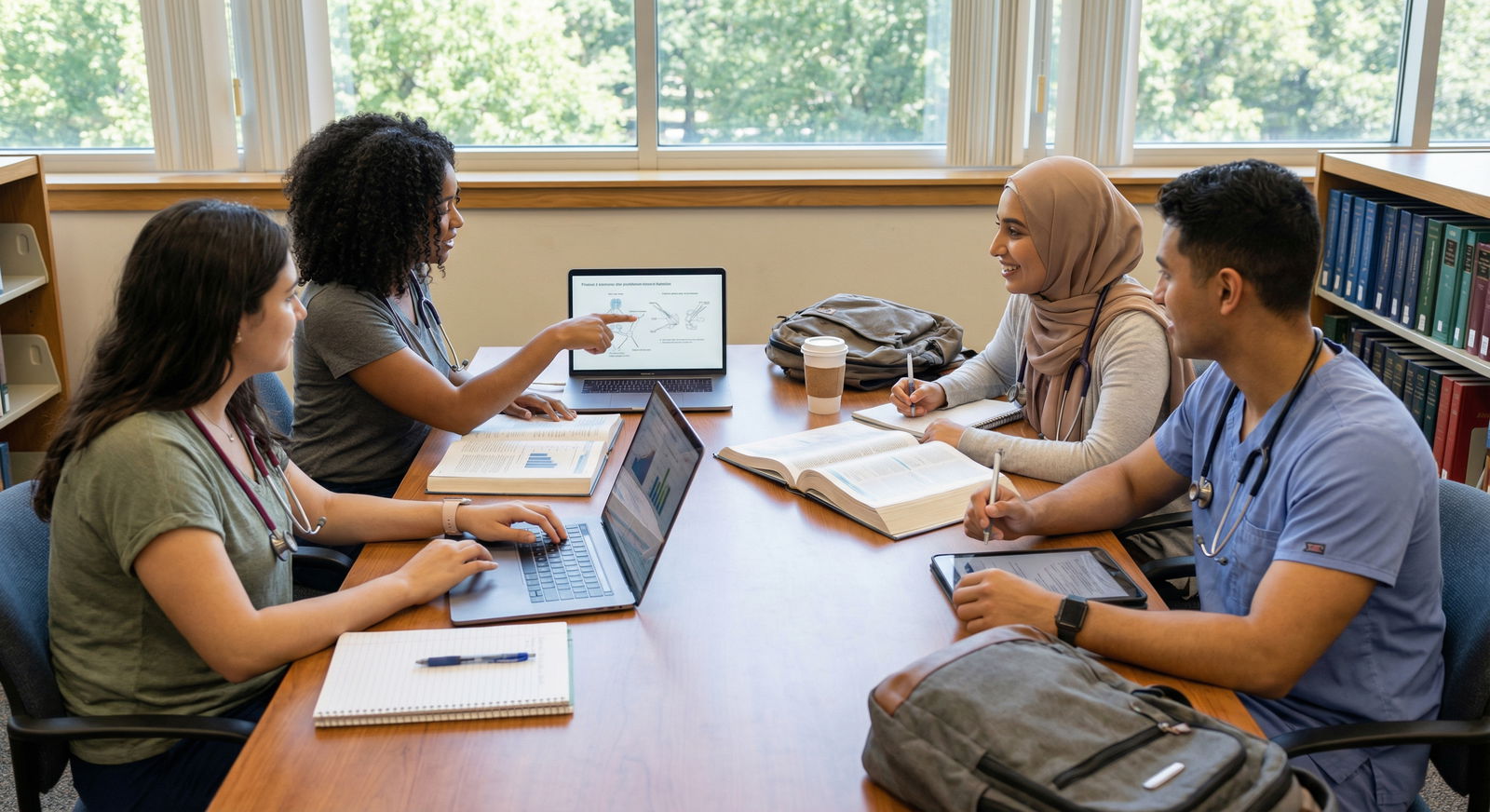
- Comfortable seating, enough table space for books and laptops
- Minimal interruptions (turn notifications off or use Do Not Disturb)
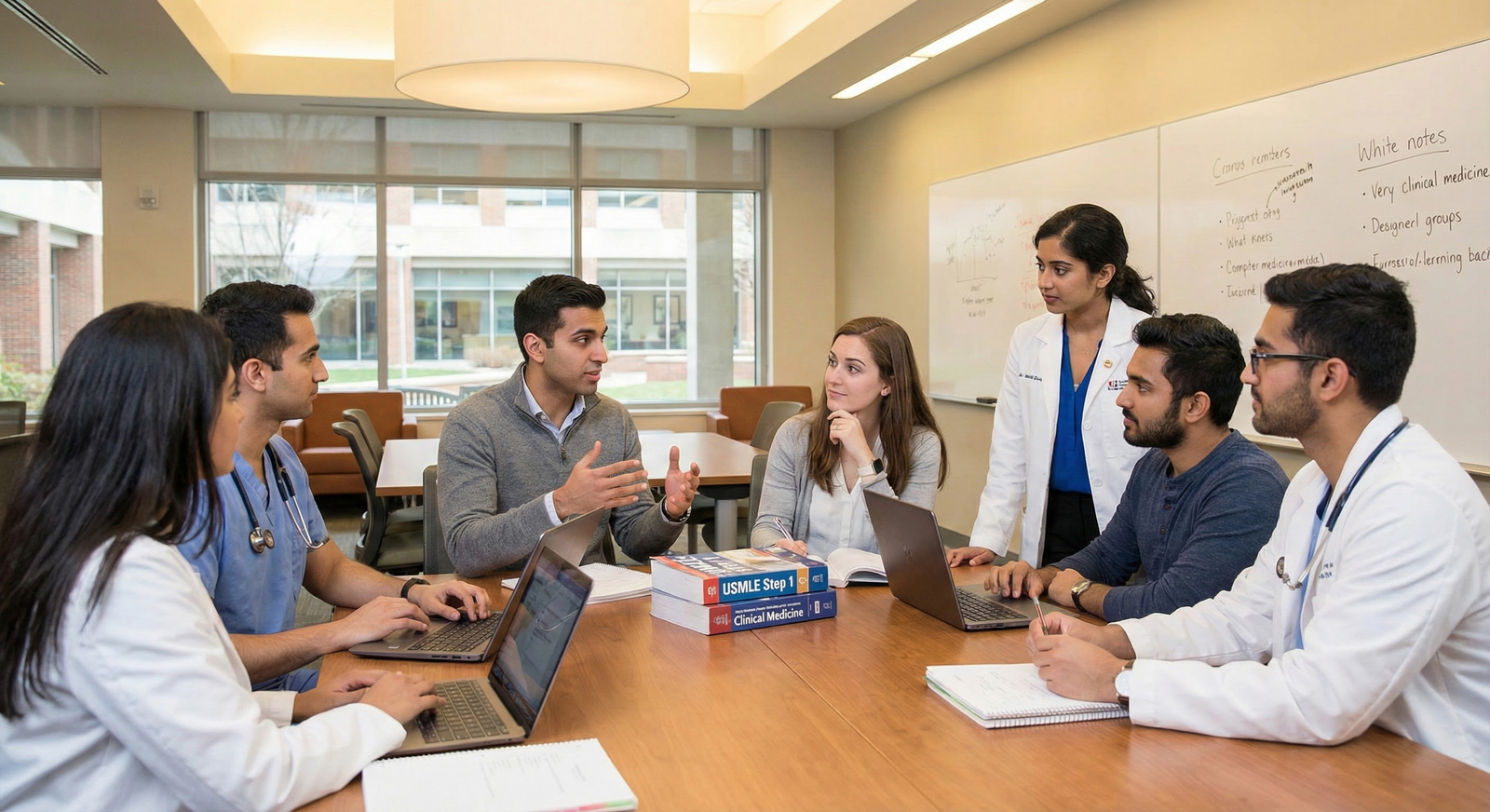
- Access to whiteboards or digital note-sharing for collaborative explanation
Think of your space as part of your test anxiety management plan: a calming, predictable environment can help condition your body to associate group study with focused, steady work rather than panic.
3. Use a Variety of High-Yield Study Techniques
Monotony breeds disengagement. Rotate through several active learning methods that are known to improve retention and performance.
a. Structured Discussion and Concept Mapping
- Assign each member a subtopic to review briefly before the session
- Have them explain it to the group while others ask clarifying questions
- Use a whiteboard or shared document to build a concept map
Example: For nephron physiology, draw and label each segment, then collectively add transporters, hormones, and associated drugs.
b. Question-Based Learning (QBL)
Questions are one of the most powerful Study Strategies for exam success.
Options:
- Everyone completes 10–20 board-style questions individually beforehand
- During the session, go question-by-question:
- Ask: “What is this question really asking?”
- Discuss why each answer choice is right or wrong
- Extract a short, high-yield teaching point from each question
- Rotate who leads the explanation for each question
This format builds exam stamina, improves question interpretation, and reduces anxiety by making the test format feel familiar and manageable.
c. Peer Teaching (“Teach-Back”)
Teaching forces you to organize and clarify your understanding.
- Assign each member a topic in advance (e.g., “one endocrine disorder” or “one antibiotic class”)
- Give them 5–10 minutes to teach it without reading directly from notes
- Group asks questions and fills in any gaps together
Peer teaching is particularly effective for medical students preparing for complex exams like boards or OSCEs—it mirrors the kind of explanation you’ll need to give to patients and colleagues.
d. Flashcards and Rapid Recall Rounds
For detail-heavy subjects (pharmacology, microbiology, anatomy):
- Use shared flashcard decks (digital or physical)
- One member prompts; others must recall the answer and a clinical association
- Add a time element (e.g., “5-second limit”) to simulate test pressure gently
This method helps bridge the gap between knowing and recalling quickly under stress, which directly addresses test anxiety.
4. Emphasize Active Learning and Equal Participation
Passive listening in group study is no better than passive lecture-watching.
Build in structures that promote active engagement:
- Round-robin explaining of concepts
- “Think-pair-share”: think individually, discuss in pairs, then share with group
- Assign rotating roles: facilitator, timekeeper, note-summarizer, question-writer
If someone is quieter, explicitly invite their input:
- “Alex, how did you think about this question?”
- “Sara, can you walk us through how you’d explain this to a patient?”
When everyone contributes, the collaborative learning environment feels psychologically safer and more empowering, which helps ease anxiety.
5. Integrate Emotional Check-Ins and Support
Medical culture doesn’t always make space for vulnerability, but your study group can.
At the start or end of a session, do a brief check-in:
- “On a 1–10 scale, how anxious are you about the upcoming exam?”
- “One thing that’s stressing me out this week is…”
- “One thing I’m proud of in my studying this week is…”
This:
- Normalizes anxiety as a shared, manageable experience
- Opens the door to share coping strategies (e.g., sleep routines, exercise, mindfulness apps)
- Strengthens trust so members feel comfortable asking “basic” questions
You can also agree on non-judgmental language:
- Avoid: “You don’t know that?” or “That’s easy”
- Use: “This one took me a while too,” “Let’s walk through it together”
A supportive emotional climate directly reduces the emotional intensity of test anxiety.
6. Develop a Shared Study Schedule and Division of Labor
A group study schedule enhances consistency and lowers stress by making preparation more predictable.
Steps to create it:
- Map out all exam dates, assignments, and major deadlines
- Identify weekly group meeting times that work for everyone
- Assign themes to each meeting (e.g., “cardio week,” “GI week,” “behavioral science week”)
- Divide preparation tasks:
- One person creates a mini-outline
- Another finds or writes 5–10 practice questions
- Another gathers key images, diagrams, or tables
The schedule reduces last-minute scrambling and helps everyone see that there is enough time—counteracting a major source of test anxiety.
7. Build in Short, Intentional Breaks and Relaxation
Studying for long stretches without breaks backfires, especially when anxious.
During group sessions:
- Use the Pomodoro technique (e.g., 50 minutes study, 10 minutes break)
- During breaks, try:
- Brief guided breathing (e.g., 4–7–8 breathing)
- Two minutes of stretching or walking
- Short mindfulness exercise (focusing on senses for 1–2 minutes)
As a group, you can:
- Agree not to use breaks for doom-scrolling or comparing scores
- Instead, use them for light conversation or quick relaxation practices
Over time, your body learns that study time is not continuous stress—it includes recovery, which reduces baseline anxiety.
8. Use Technology to Enhance Collaborative Learning
Technology can make group study more flexible and efficient, especially when schedules are tight.
Tools and approaches:
- Shared docs (Google Docs, Notion) for group notes, summary sheets, and question banks
- Digital whiteboards (Miro, Zoom whiteboard) to draw pathways and diagrams
- Messaging platforms (WhatsApp, Slack, GroupMe) for quick questions and scheduling
- Virtual study rooms (Zoom, Teams) for remote or hybrid sessions
Consider using:
- Shared Anki decks and tagging “group-reviewed” cards
- Polling or quiz apps (Kahoot, Quizizz) to add low-stakes, fun assessment
This infrastructure keeps collaboration going even when you can’t be physically together—and continuity helps maintain academic success and reduce last-minute exam panic.
9. Celebrate Progress and Small Wins
Anxiety narrows your focus to what you haven’t done. Intentionally notice what you have accomplished.
Ideas:
- End each session with each member naming:
- One concept they understand better now
- One question they can now solve independently
- After major milestones (e.g., finishing renal physiology), plan a small celebration:
- Coffee run
- Short social hangout
- Group message acknowledging the progress
Celebrating wins helps your brain link studying with positive emotions, which can gradually weaken the association between studying and anxiety.

Practical Considerations: Making Group Study Work Long-Term
Choosing the Right Study Group Members
The people you study with matter as much as the strategies you use.
Helpful characteristics:
- Similar level of commitment and seriousness
- Willingness to prepare before meetings
- Respectful communication style
- Openness to feedback and shared leadership
- Reasonably aligned academic goals (e.g., similar exam timelines)
Watch out for:
- Chronic lateness or lack of preparation
- Dominating or dismissive behavior
- Turning every session into a comparison of scores or rankings
It’s okay to adjust your group if the dynamic is harming rather than helping your test anxiety and learning.
Setting Ground Rules to Protect Focus and Psychological Safety
Early on, agree on guidelines such as:
- Start and end on time
- Phones on silent or face-down during focused periods
- One person speaks at a time; no interrupting
- No shaming for not knowing something
- Confidentiality around personal concerns shared in the group
Written, shared ground rules make it easier to address problems later without personalizing them.
Troubleshooting Common Group Study Challenges
- One person dominates discussions
- Use structured turn-taking (round-robin, role rotations)
- Gently say, “Let’s pause and hear from others before we move on”
- Sessions drift off-topic
- Assign a rotating timekeeper/facilitator
- Park off-topic questions in a “parking lot” list to revisit if time allows
- Uneven participation or contribution
- Assign specific roles or prep tasks to each member
- Ask privately if there are barriers (burnout, health, family issues) and adapt
Effective groups evolve over time; adjusting structure is part of the process.
FAQs: Group Study, Test Anxiety, and Academic Success
1. How often should group study sessions be held to help with test anxiety?
For most medical students, 1–3 structured sessions per week works well. Frequency depends on:
- Exam timeline (e.g., daily sessions closer to boards)
- Personal study style and stamina
- Clinical or rotation schedule
Aim for a rhythm that:
- Is consistent enough to provide structure and reduce last-minute cramming
- Still leaves ample time for individual study, question banks, and rest
If anxiety is high, even a short weekly check-in session can be grounding and reassuring.
2. What if one member dominates discussions or corrects others harshly?
This is common and can increase anxiety if not addressed.
Possible solutions:
- Use structured formats (e.g., each person gets 2–3 minutes to explain, then group discussion)
- Establish a ground rule about respectful, non-critical language
- Rotate roles (facilitator, explainer, question-leader) so no one person controls the session
- If needed, have a gentle, private conversation explaining the impact of their style and asking for collaboration in making the group feel safe for everyone
If the dynamic does not improve, it’s okay to reconsider group composition to protect your learning and mental health.
3. Can group study help with all types of exams (MCQs, OSCEs, oral exams)?
Yes—group study can be adapted to nearly all exam formats, though methods will vary:
- MCQ/Board exams: Question-based learning, flashcards, concept mapping, teach-back
- OSCEs and clinical skills: Role-playing standardized patient encounters, practicing physical exam sequences, giving each other feedback
- Oral exams or viva voce: Simulated oral questioning in pairs or small groups, practicing concise explanations
For clinical exams in particular, collaborative learning is highly effective because it mirrors real clinical teamwork and communication.
4. How do we handle conflicts, mismatched commitment, or personality clashes in the group?
Conflict doesn’t automatically mean the group is failing, but it must be addressed:
- Revisit and clarify shared goals and ground rules
- Discuss logistics (e.g., expectations for punctuality and preparation)
- Use “I” statements: “I feel rushed when we go off-topic because I’m anxious about the exam”
- Consider making the group smaller or restructuring roles
If repeated efforts don’t help and the group consistently raises your anxiety instead of lowering it, it may be time to:
- Politely exit the group
- Form a new group with members who share your approach and level of commitment
5. What if someone in the group isn’t contributing effectively or is consistently unprepared?
This situation can create resentment and reduce efficiency.
Approach it with curiosity first:
- Ask privately if there are external stressors or health issues
- Explore whether they feel intimidated or unsure how to prepare
Then:
- Offer clear expectations (e.g., “We’d really appreciate if everyone attempts at least 10 questions before each meeting”)
- Adjust roles (e.g., they might start as note-summarizer or timekeeper until they feel more confident)
If the pattern continues and disrupts the group’s function, the group may need to kindly suggest that a different structure or smaller group might suit them better.
By intentionally designing your group study using the strategies in this guide, you can transform it from casual review into a powerful tool for Test Anxiety management, deeper learning, and sustainable Academic Success. Collaborative learning isn’t just about dividing the workload—it’s about building knowledge, confidence, and resilience together.