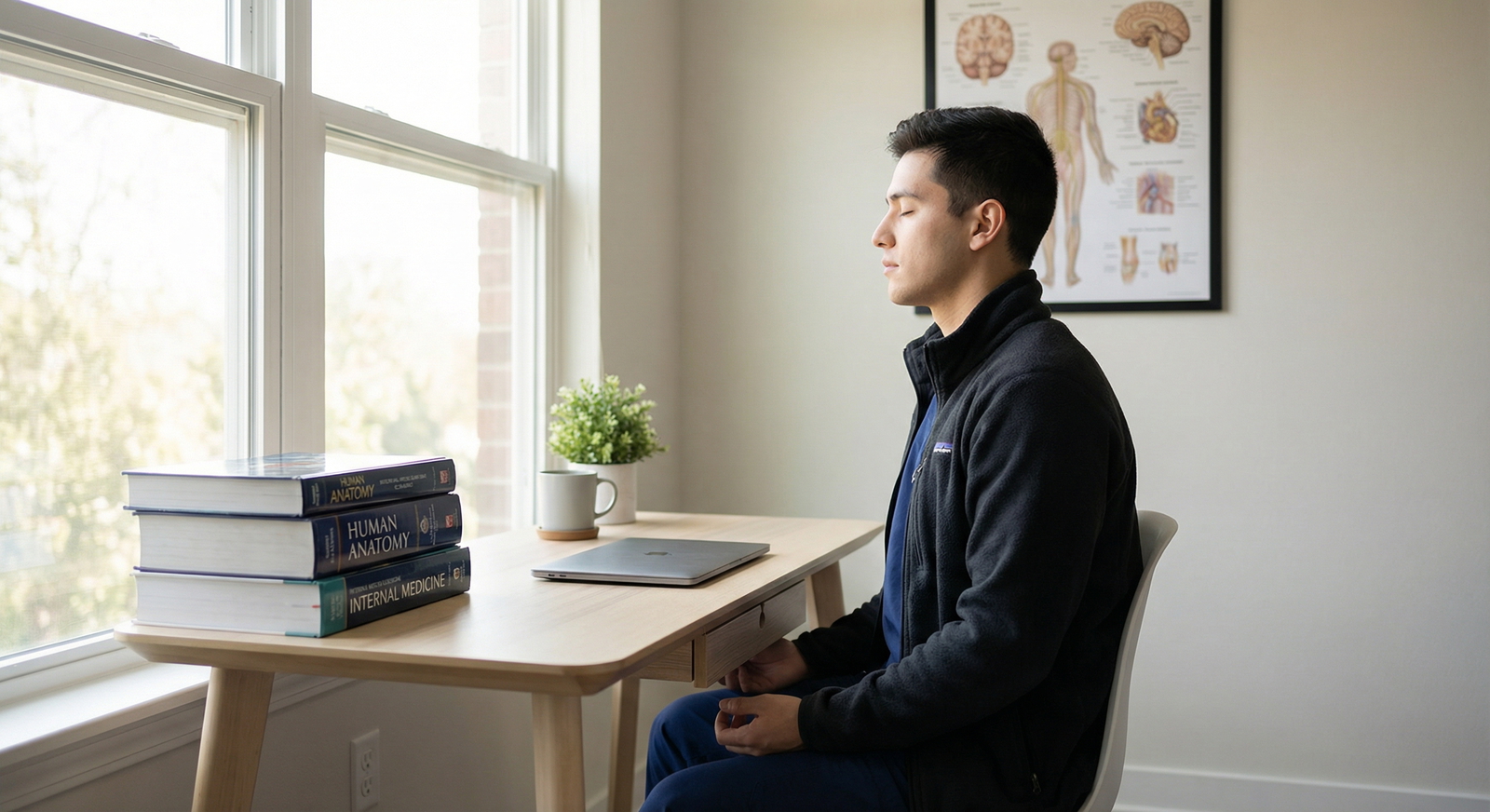
Introduction: Test Anxiety in the High-Pressure World of Medical Training
For medical students and residents, exams are more than just grades—they can influence clerkship placements, residency applications, scholarships, and even long-term career trajectories. In this environment, test anxiety and academic stress are common, and sometimes severe.
A certain level of anxiety can sharpen focus and improve performance. But when anxiety becomes overwhelming—interfering with sleep, concentration, or even the ability to sit through an exam—it turns into a serious mental health concern that deserves attention and support.
Unfortunately, a lot of what students hear about test anxiety is inaccurate or oversimplified. Misconceptions like “only unprepared students are anxious” or “you just need to study harder” can prevent learners from seeking help and using effective coping strategies.
This guide debunks common myths about test anxiety, explains what’s really going on physiologically and psychologically, and offers practical, evidence-informed tools you can start using today. Whether you’re in pre-med, medical school, or residency, you’ll find strategies that are relevant to your stage of training.
Understanding Test Anxiety: More Than Just “Nerves”
Test anxiety is a specific form of performance anxiety that occurs before, during, or even after exams or high-stakes evaluations (standardized tests, OSCEs, board exams, in-service exams, etc.). It sits at the intersection of academic stress, cognitive patterns, and physical responses.
Common Symptoms of Test Anxiety
Test anxiety can show up in four major domains:
1. Physical symptoms
- Racing heart, sweating, trembling
- Shortness of breath or chest tightness
- Nausea, stomach aches, or diarrhea
- Headaches or muscle tension
- Feeling dizzy or “lightheaded”
- Trouble falling or staying asleep before the exam
2. Emotional symptoms
- Intense worry, fear, or dread about the exam
- Irritability, frustration, or feelings of helplessness
- Shame or embarrassment about struggling
- Low mood or hopelessness related to performance
3. Cognitive (thinking) symptoms
- Racing thoughts or mental “blanking out”
- Catastrophic thinking: “If I fail this, my career is over.”
- Difficulty concentrating or recalling information
- Over-focusing on minor mistakes during the exam
4. Behavioral symptoms
- Procrastination or avoidance of studying
- Avoiding practice questions or mock exams
- Rushing through the test or repeatedly checking answers
- Overreliance on last-minute cramming
Test anxiety exists on a spectrum. It can be mild and manageable, or severe enough to mimic a panic attack. Either way, it is common—and it is treatable.
Debunking 5 Major Myths About Test Anxiety
Myth 1: “Test Anxiety Only Affects Weak or Unprepared Students”
In medical training, this myth is particularly damaging. High-achieving students often assume that if they’re anxious, they must be “not cut out for medicine” or “not smart enough.” This is simply not true.
Reality: High Performers Are Often Among the Most Anxious
Many top performers experience intense academic stress precisely because they:
- Hold themselves to very high standards
- Fear disappointing mentors, family, or peers
- Tie their self-worth to grades or exam scores
- Have a history of success and feel they “can’t afford to fail”
A student consistently scoring in the top percentiles can still experience debilitating anxiety if they internalize the belief that anything less than perfect is failure.
Key point: Test anxiety says nothing about your intelligence, capability, or future success. It reflects how your brain interprets and reacts to pressure—not your academic worth.
Myth 2: “All Anxiety Is Bad and Should Be Eliminated”
It’s common to view anxiety as purely negative, a sign that something is “wrong” with you. But biologically, anxiety serves a purpose.
Reality: Some Anxiety Can Enhance Performance
Anxiety is part of your body’s fight-or-flight response, designed to keep you alert in potentially dangerous or high-stakes situations. A moderate level of arousal:
- Increases attention and alertness
- Boosts motivation to prepare
- Improves reaction time and focus
This concept is captured in the Yerkes–Dodson Law, which suggests:
- Too little arousal → boredom, low motivation, poor performance
- Optimal, moderate arousal → peak performance
- Too much arousal → panic, freezing, impaired performance
For exams, the goal is not to eliminate anxiety but to bring it into the optimal range—enough to keep you engaged and focused, but not so much that you feel overwhelmed or shut down.
Myth 3: “If You Just Study Enough, Your Test Anxiety Will Disappear”
Academic culture often reinforces the belief that “more studying” solves everything. While preparation is crucial, it is not a cure-all for anxiety.
Reality: Preparation Helps, But It’s Only Part of the Equation
You can be extremely well-prepared and still feel intense test anxiety if:
- You struggle with perfectionism (“I never know enough.”)
- You engage in negative self-talk (“I always mess up under pressure.”)
- You’ve had a past bad test experience that you haven’t processed
- You tie your identity entirely to your scores
Effective management of test anxiety requires a dual strategy:
- Solid, structured, efficient study habits
- Psychological and behavioral tools to manage your emotional and physical response to stress
Ignoring the emotional side is like strengthening the engine without checking the brakes and steering.

Myth 4: “You Should Keep Your Anxiety to Yourself”
Many students, especially in competitive environments, feel they must appear composed at all times. They worry that admitting anxiety will make them look weak, uncommitted, or less competent.
Reality: Silence Increases Shame and Isolation
Avoiding conversations about mental health and test anxiety can:
- Increase feelings of isolation—“Everyone else is fine except me.”
- Delay access to effective support and student support services
- Reinforce stigma around help-seeking
When you talk openly (with trusted peers, mentors, or professionals), you often discover:
- Your peers are struggling with similar fears
- Faculty and advisors may have gone through the same challenges
- There are more resources and coping strategies available than you realized
Medical training is already demanding. You don’t need to go through it alone.
Myth 5: “Test Anxiety Is Permanent—You’ll Always Be ‘An Anxious Test-Taker’”
Many students begin to see test anxiety as a fixed part of their identity:
“I’m just not a good test-taker.”
“I always panic during exams.”
Reality: Test Anxiety Is Highly Modifiable
Test anxiety is shaped by experiences, learned thinking patterns, and physiology—all of which can change with:
- Structured practice and exposure (simulated exams)
- Cognitive-behavioral techniques
- Mindfulness and relaxation training
- Professional mental health support
You may never feel 100% calm before every exam, and that’s okay. But you can significantly reduce the intensity and impact of anxiety, to the point where it no longer controls your performance or well-being.
Recognizing Your Personal Triggers for Test Anxiety
Understanding what specifically sets off your anxiety is a powerful first step. Different students have different triggers, even if the outward symptoms look similar.
Common Triggers in Medical and Health Professions Training
1. Past negative experiences
- Failing or underperforming on a key exam (e.g., Step/Level, OSCE, shelf exams)
- Freezing during oral exams or being “pimped” on rounds
- Feeling humiliated by a harsh evaluation or comment
These experiences can create a conditioned response: your body starts reacting as if every exam is that past failure all over again.
2. Negative self-talk and internal narratives
- “If I don’t honor this rotation, my future is ruined.”
- “Everyone else understands this except me.”
- “I have to get this perfect or I shouldn’t be here at all.”
These thoughts rarely feel like “thoughts”—they feel like facts. Recognizing them as mental events, not truths, opens the door to change.
3. Peer comparison and competitive environments
- Constantly hearing about others’ scores, study hours, or resources
- Group chats filled with “I did 400 questions today” or “I got a 260”
- Ranking culture around clerkships and residency matching
Comparison tends to increase anxiety and reduce self-efficacy, even if you’re performing objectively well.
4. Perfectionism and fear of failure
- Viewing anything less than an A or a top percentile as a failure
- Equating performance on one exam with overall worth or future success
- Feeling unable to tolerate uncertainty or imperfection
Perfectionism often masquerades as “high standards,” but it can be a major driver of academic stress and test anxiety.
Evidence-Informed Strategies for Managing Test Anxiety
Managing test anxiety is not about one magic technique. It’s about building a toolkit of strategies targeting different parts of the anxiety cycle: preparation, thoughts, emotions, body, and environment.
1. Build Efficient, Confidence-Building Study Habits
Why it matters: When your study plan is chaotic, anxiety has more room to grow. A structured approach increases both mastery and confidence.
Practical approaches:
- Spaced repetition: Use tools like Anki or other flashcard systems to revisit material at increasing intervals.
- Active learning:
- Practice questions (UWorld, AMBOSS, NBME-style)
- Teaching peers or explaining concepts out loud
- Building concept maps or summary sheets
- Study scheduling:
- Break content into daily and weekly goals
- Schedule blocks for review, questions, and rest
- Include buffer time for unexpected events
Tip: End each study session with 5–10 minutes of quick review. This reinforces gains and gives your brain a sense of closure, reducing rumination.
2. Practice Mindfulness and Relaxation Techniques
Why it matters: Test anxiety often includes physiological over-activation. Mindfulness and relaxation counteract this by activating the parasympathetic nervous system (“rest and digest”).
Simple tools you can use:
Box breathing (4–4–4–4):
- Inhale for 4 seconds
- Hold for 4 seconds
- Exhale for 4 seconds
- Hold for 4 seconds
Repeat for 1–3 minutes before or during an exam.
Progressive muscle relaxation:
- Starting at your feet, tense each muscle group for ~5 seconds, then release for 10–15 seconds
- Move upward (calves, thighs, abdomen, shoulders, face)
- Helps reduce physical tension linked to anxiety
Brief mindfulness practice (5–10 minutes):
- Focus on your breath or bodily sensations
- When your mind wanders (it will), gently bring it back without judgment
- Consistency (daily) matters more than duration
During the exam:
If you feel panic rising, briefly pause, take 3 slow breaths, and ground yourself (“I know how to do this. I’ve prepared. One question at a time.”).
3. Use Cognitive-Behavioral Techniques to Challenge Unhelpful Thoughts
Why it matters: A major driver of test anxiety is not just the exam, but the story you tell yourself about what the exam means.
Steps in a simple CBT-based approach:
Identify the thought
Example: “If I don’t get in the top quartile on this exam, I won’t match anywhere.”Examine the evidence
- Is this 100% true?
- Do you know people who matched with lower scores or non-linear paths?
- Are there many other factors in residency selection (letters, clinical performance, interviews)?
Generate a more balanced alternative
- “This exam is important, but it is one data point, not my entire career.”
- “Even if I underperform, I can adjust, seek support, and improve on the next one.”
Practice replacement
When the original thought appears, consciously substitute the more balanced thought. Over time, this becomes more automatic.
You can also work with a therapist trained in Cognitive Behavioral Therapy (CBT), which has strong evidence for treating various forms of anxiety, including test anxiety.
4. Leverage Social and Institutional Support
Why it matters: Isolation fuels anxiety. Support reduces it.
Sources of support:
Peer study groups:
- Normalize shared struggles
- Divide and conquer complex topics
- Practice teaching and oral questioning
Faculty mentors and advisors:
- Can help you put performance in perspective
- Offer practical strategies for specific exams in your program
- Sometimes share their own experiences with failure or anxiety
Student support and mental health services:
- Campus counseling centers
- Wellness offices in medical schools
- Peer support programs or affinity groups
What to say when asking for help:
- “I’ve been having a lot of anxiety around exams, and it’s affecting my performance. Can we talk about strategies or resources?”
- “I’d like to work on coping strategies for test anxiety. Are there any workshops, counseling services, or people you recommend?”
5. Simulate Testing Conditions to Desensitize Anxiety
Why it matters: Your brain often reacts strongly to unfamiliar or high-stakes environments. Simulation helps reduce this “novelty” effect.
How to simulate test conditions:
- Use full-length practice exams (timed, with breaks as in the real test)
- Sit at a desk, use only permitted materials, follow real rules
- Avoid phones and distractions—treat it like the real thing
After each simulation:
- Review not only your content gaps, but also:
- When anxiety peaked (beginning, middle, or end of test)
- What thoughts appeared
- Which coping strategies helped
Over time, your brain learns: “I can handle this environment; I’ve done it before.” This reduces the intensity of test anxiety on exam day.
6. Maintain a Healthy Lifestyle to Support Mental Health
Why it matters: Your brain is part of your body. Sleep deprivation, poor nutrition, and inactivity all increase vulnerability to anxiety.
Key lifestyle pillars:
Sleep:
- Aim for 7–9 hours whenever possible
- Avoid all-night cramming right before major exams
- Keep a regular sleep-wake cycle, especially in the week leading up to the test
Nutrition:
- Balanced meals with protein, complex carbs, and healthy fats
- Moderate caffeine—enough to feel alert, not so much that you’re jittery
- Stay hydrated; dehydration can mimic anxiety symptoms
Movement:
- Even 20–30 minutes of walking, stretching, or light exercise can significantly reduce academic stress and anxiety
- Movement breaks can improve concentration during long study days
Boundaries and rest:
- Schedule breaks and off-days into your study calendar
- Protect at least small pockets of time for activities unrelated to medicine (hobbies, time with friends, creative outlets)
Frequently Asked Questions About Test Anxiety in Medical Training
Q1: Can I completely eliminate test anxiety?
In most cases, the goal is not total elimination—some anxiety is normal and can even be helpful. What you can do is:
- Significantly reduce the intensity and frequency of overwhelming anxiety
- Learn coping strategies that help you stay functional and focused
- Change your relationship with anxiety, so it feels manageable rather than catastrophic
Many students find that, over time, with practice and support, test anxiety becomes a background signal instead of a dominating force.
Q2: How do I know when my test anxiety is severe enough to seek professional help?
Consider reaching out to a mental health professional or your school’s student support services if:
- Anxiety is causing you to avoid exams or important evaluations
- You experience panic attacks or intense physical symptoms (e.g., chest pain, feeling like you can’t breathe) around tests
- Your sleep, appetite, or daily functioning are significantly affected
- You feel persistently hopeless, depressed, or have thoughts of self-harm
- Your performance has declined despite reasonable preparation
Professionals such as psychologists, psychiatrists, or counselors can offer tailored interventions, including CBT, skill-building, and, when appropriate, medications.
Q3: Are there specific resources or tools for students with test anxiety?
Yes. Consider exploring:
- Campus resources:
- Academic skills centers
- Wellness offices and counseling services
- Test-anxiety or performance-anxiety workshops
- Apps and online tools:
- Mindfulness apps (e.g., Headspace, Calm, Insight Timer)
- CBT-based apps that help track and challenge negative thoughts
- Platforms offering practice exams in simulated conditions
- Books and guides:
- Texts on performance psychology, CBT for anxiety, or study skills for medical students
Your school’s wellness or student support office often maintains a curated list of resources specifically for your program.
Q4: How can I support a classmate or friend dealing with test anxiety?
You don’t need to have all the answers to be helpful. You can:
- Listen without judgment: Let them share their fears and experiences.
- Normalize, but don’t minimize:
- “A lot of us feel this way around exams; you’re not alone.”
- Avoid: “Just relax, it’s not a big deal.”
- Encourage support-seeking: Offer to help them connect with a mentor, advisor, or mental health professional.
- Study together: Gentle accountability and shared preparation can reduce isolation and academic stress.
- Respect boundaries: Some people need space before or after exams. Ask what’s helpful rather than assuming.
Q5: What if I’ve already had a major exam “disaster”? Is it possible to recover academically and emotionally?
Yes. Many excellent physicians, residents, and fellows have:
- Failed or underperformed on major exams
- Repeated steps, levels, or clerkships
- Needed to pause, seek support, and rebuild
Recovery typically involves:
- Academic review: Identifying specific content and strategy gaps
- Emotional processing: Working through shame, fear, or negative self-beliefs
- Structured plan: Creating a realistic, supported pathway to the next attempt
- Support network: Advisors, mentors, mental health professionals, and peers
A single exam does not define your career. How you respond, adapt, and grow afterward often matters more in the long run.
Conclusion: Redefining Your Relationship with Test Anxiety
Test anxiety is not a personal failure, a sign of weakness, or proof that you don’t belong in medicine. It is a common, understandable response to a demanding, high-stakes environment.
By debunking myths, recognizing your specific triggers, and applying practical strategies—ranging from structured study habits to mindfulness, CBT techniques, and professional support—you can move from feeling controlled by anxiety to managing it effectively.
You don’t have to wait until the next crisis to start. Pick one small strategy from this guide to implement this week—maybe a daily 5-minute breathing practice, a more structured study schedule, or a conversation with a trusted mentor. Over time, these small steps can transform both your performance and your overall mental health and well-being throughout medical school and beyond.