Challenging the Myth That Only Weak Students Seek Anxiety Help
Why is the kid with the 260 Step score quietly seeing a therapist, while the student barely passing pharm is bragging that they “never needed help, just grind”? Something’s backward here—and it is not what you think.
The idea that “strong” students just tough it out while “weak” students need help for anxiety is one of the most damaging myths in medical school culture. It keeps high performers suffering in silence and lets systems off the hook for being psychologically brutal.
Let me be clear from the start: needing help for anxiety says almost nothing about your intelligence, work ethic, or eventual success as a physician. It says a lot about your environment, your wiring, and whether you’ve been told the truth about how performance actually works.
Let’s dismantle this properly.
What the Data Actually Shows About Who Gets Anxious
The myth: “The smart ones handle it. The anxious ones just can’t hack it.”
Reality: higher-achieving students are often more anxious, not less. And they seek help more when they feel safe enough to.
There’s data on this. Multiple studies in medical education show:
- Prevalence of anxiety in medical students ranges from about 25–45% in many cohorts.
- Rates are often higher among high-achieving, perfectionistic students.
- Test anxiety is not a low-GPA disease; it’s a performance-pressure disease.
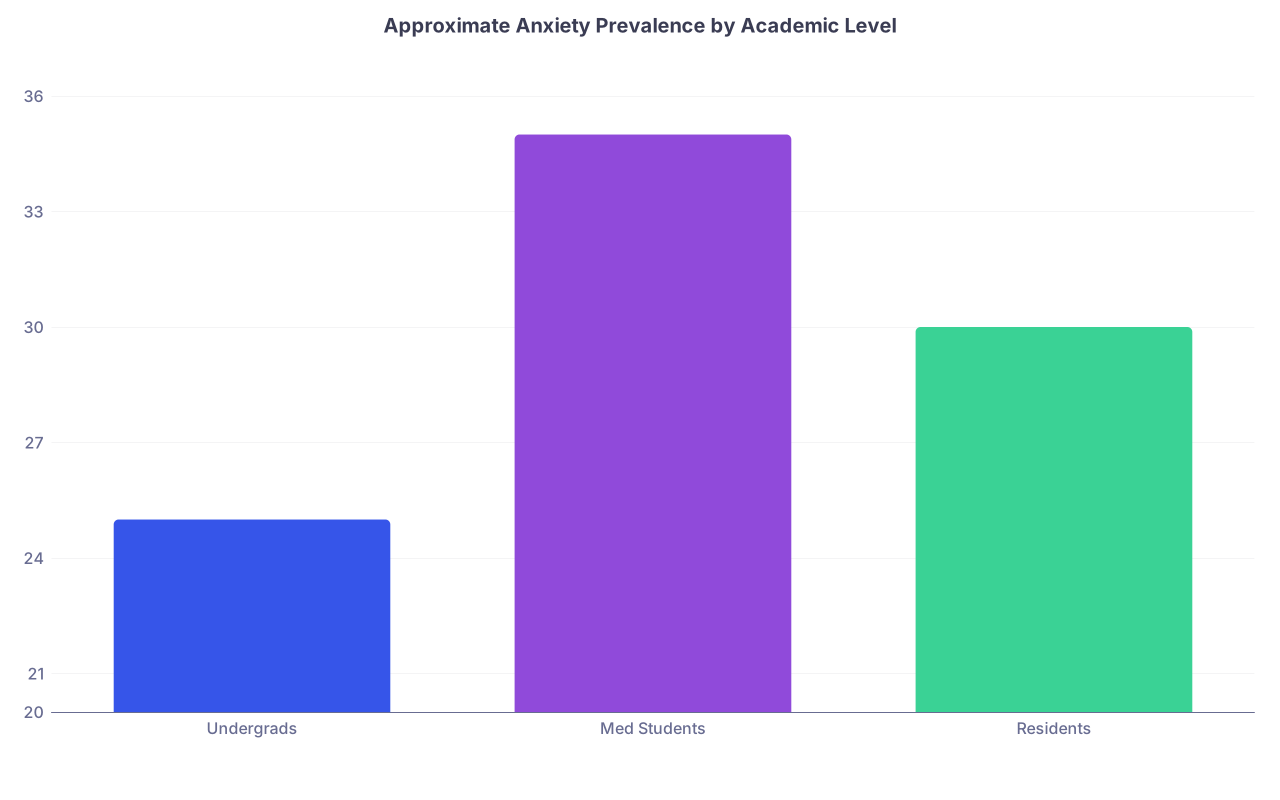
| Category | Value |
|---|---|
| Undergrads | 25 |
| Med Students | 35 |
| Residents | 30 |
Those numbers shift by study and country, but the pattern’s boringly consistent: medical training environments are anxiety factories. Not just for the “weak.” For everyone.
Here’s the quiet truth most students don’t say out loud in the library:
- The student doing Anki until 2 am every night? Often convinced any drop in performance means career death.
- The MD/PhD with multiple first-author papers? Frequently terrified of finally being “found out” as not that smart.
- The “chill” classmate who jokes about bombing the exam? Sometimes actually detached, burned out, or too ashamed to admit how anxious they are.
The difference is not who has anxiety. The difference is who admits it and who knows what to do about it.
Why High Performers Are Actually Prime Candidates for Anxiety
Let’s walk through the logic. Because the myth completely ignores basic psychology.
1. Perfectionism is a double-edged scalpel
You already know the classic med-student profile: conscientious, high-achieving, hates failure, often oldest child, very attached to external validation. That personality gets you into medical school. It also makes you a sitting duck for anxiety.
Perfectionism predicts:
- More worry about mistakes
- More catastrophic thinking (“If I miss this question, my entire career is over”)
- More procrastination (because the work must be done “perfectly” or not at all)
That’s textbook test-anxiety fuel.
2. The stakes feel higher for the strongest students
If you’re aiming for derm, ortho, neurosurg—you are under no illusions. You know the Step scores. You know the research arms race. You know that each exam is another data point in a long statistical battle.
Ironically, the higher your previous performance, the more there is to lose:
- The 260 student is terrified of dropping to “just above average”
- The 240 student is scared of dipping below specialty cutoffs
- The barely-passing student? Already living in worst-case territory
Who do you think is more likely to spiral in their own head?
3. Smart brains are really good at creating worst-case scenarios
Anxiety is imagination misused.
Bright, analytical people are excellent at building complex if-then trees in their minds:
“If I freeze on this OSCE… then I’ll get a bad eval… then my Dean’s letter will signal concern… then competitive programs will screen me out… then I’ll match somewhere I hate… then I’ll be miserable for life…”
That chain can be constructed in about 0.8 seconds. During an exam stem.
And no, that’s not “weak.” That’s a powerful brain stuck running the wrong script.
The “Strength” Myth Is Mostly Culture, Not Reality
Let’s call out what’s really going on when people say only weak students seek help.
They’re not describing data. They’re describing a culture built on:
- Macho resilience worship (“I survived, so you should too”)
- Generational denial (“We had it harder; you’re just soft”)
- Ignorance of performance psychology
I’ve sat in rooms where attendings brag, “We never had wellness, we just handled it.” Then you later learn about their divorces, drinking, depressive episodes, or the residents who quit under them.
White-knuckling your way through training isn’t strength. It’s just untreated pathology that made it across the finish line.
Let’s be blunt:
- Calling help-seeking “weak” is lazy thinking.
- It keeps the system comfortable and unchanged.
- It pushes problems underground until they explode in residency, when the stakes are much higher and the hours are worse.
The students who quietly start therapy, see performance coaches, or use test-anxiety interventions early? They’re not fragile. They’re running an upgrade while everyone else keeps rebooting the same buggy operating system.
What Test Anxiety Actually Does to a Strong Student
Test anxiety isn’t just “feeling nervous.” It’s a physiological and cognitive chain reaction that directly sabotages performance—especially for high-knowledge students.
Here’s what I’ve watched play out dozens of times:
- Student with an excellent knowledge base walks into the exam.
- Heart rate spikes, hands sweaty, tunnel vision.
- Working memory bandwidth drops because half their cognition is running anxious self-talk: “I’m blanking. I’m screwing this up. What if this keeps going?”
- They miss questions they can easily explain 30 minutes later outside the room.
This is not an intelligence problem. It’s a bandwidth problem.
An anxious high-performer often has:
- Great long-term memory (they did the work)
- Impaired short-term access under pressure
- Tons of intrusive performance-evaluating thoughts hijacking working memory
You don’t fix that with more Anki. You fix it with anxiety management, cognitive restructuring, exposure, sometimes medication, sometimes sleep, sometimes addressing underlying perfectionism—and yes, sometimes professional help.
Who Actually Uses Help — And Who Pretends They Don’t
Here’s the piece nobody ever tells you plainly: the Venn diagram of “strong student” and “uses help for anxiety” has a huge overlap. It’s just mostly hidden.
In a typical med school class, if you could see behind the curtain, you’d find:
| Group | Quiet Reality |
|---|---|
| Top 10% of class | Many in therapy or coaching |
| Middle 60–70% | Mixed: some white-knuckling, some in care |
| Bottom 20–30% academically | Often least likely to seek help |
Why are struggling students often the least likely to use anxiety support?
Because by the time they’re in trouble, shame is enormous. They’ve internalized the “weak = needs help” story. So they avoid the one thing that might actually change the trajectory.
Meanwhile, your classmate matching ortho:
- Saw a therapist for performance anxiety in M2
- Started low-dose SSRI in dedicated board study
- Learned breathing and cognitive tools for acute test stress
- Never told you, because they don’t feel like explaining it to people who still think this is about strength
Guess which one looks “stronger” on Match Day?
What Evidence-Based Help Actually Looks Like (Not the Fluffy Stuff You’re Imagining)
The myth assumes that “anxiety help” is just venting and being told to think happy thoughts. That’s not real treatment and it’s certainly not what high-performing students need.
For test anxiety in medical school, the interventions that actually have evidence tend to include:
Cognitive-behavioral therapy (CBT)
Identifying distorted thoughts (“If I don’t ace this, I’m done”), testing them against data, and building more accurate internal narratives. Not “positive thinking”—accurate thinking.Exposure and simulation
Practicing exams under realistic conditions so your nervous system stops treating test day like an ambush. Dress rehearsal for your stress response.Physiological regulation
Breathing techniques, muscle relaxation, pacing, sometimes medication. Not for “calm vibes,” but to keep your sympathetic surge from frying your working memory.Skills training
Study planning, question strategy, managing review vs. new learning. Because half of what people call “anxiety” is actually “I truly don’t have a plan and I know it.”
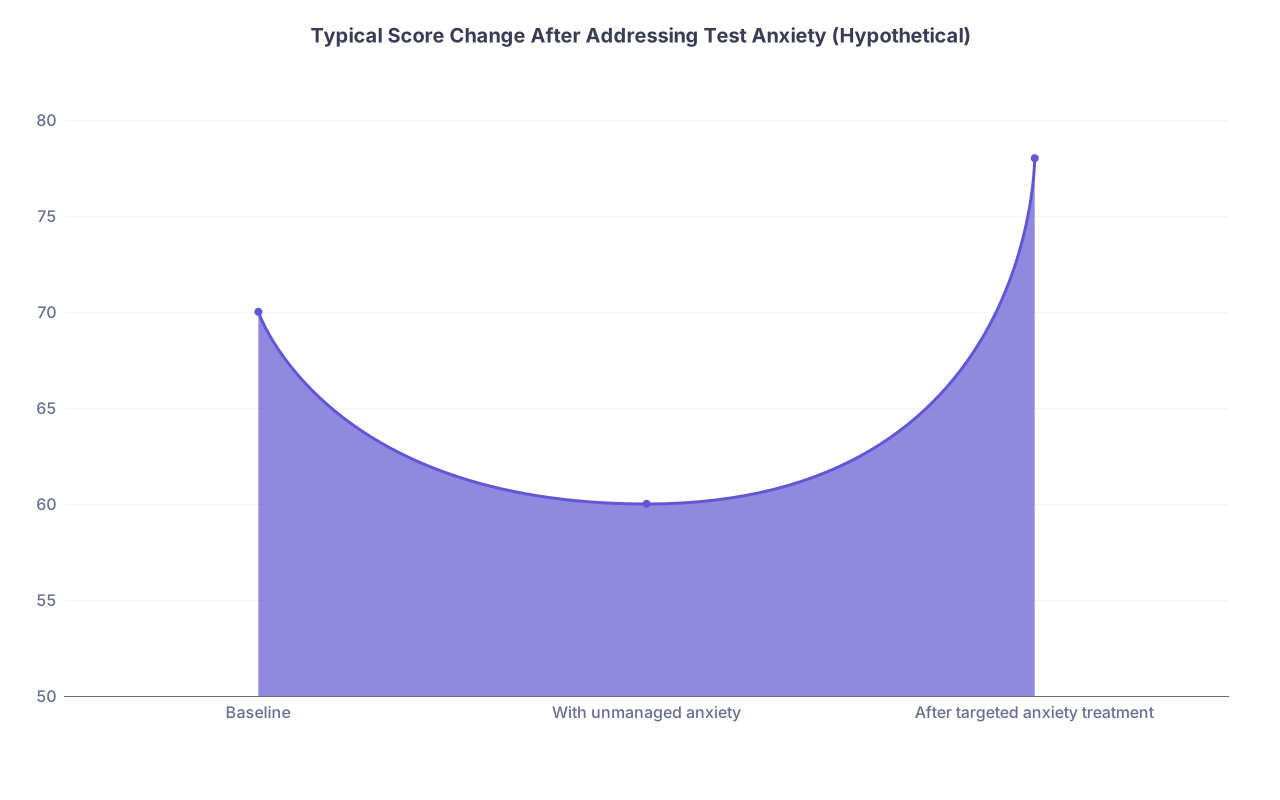
| Category | Value |
|---|---|
| Baseline | 70 |
| With unmanaged anxiety | 60 |
| After targeted anxiety treatment | 78 |
Again, hypothetical numbers. But that pattern? I’ve seen it often: students who “know enough” but are underperforming, then jump 10–15 percentage points once the anxiety piece is treated.
Not because they magically got smarter. Because they finally had access to what they already knew.
The False Binary: “Handle It Yourself” vs “Break Down and Seek Help”
Another hidden myth under this whole conversation is that there are only two categories:
- The strong, who handle everything internally.
- The weak, who “can’t cope” and need outside help.
That’s nonsense.
Real life looks more like this spectrum:
- Self-tweaks: improving sleep, exercise, better spacing of study, basic breathing work.
- Peer support: talking to classmates who are actually honest, using peer-led groups.
- Institutional resources: learning specialists, test-anxiety workshops, wellness offices.
- Professional care: therapy, psychiatry, coaching, structured programs for anxiety.
Most high-functioning students benefit from using multiple tiers over time. No one brags, “I set my own broken femur because I’m strong.” They let orthopedics do their job. But with mental health and anxiety? Suddenly everyone thinks DIY is a moral victory.
It is not.
Sometimes DIY works. Sometimes it is just slow-motion failure with good intentions.
If You’re Anxious and High-Performing, Here’s the Uncomfortable Truth
Let me talk directly to you for a moment.
If you’re:
- Doing fine or even great on paper
- But losing sleep before every exam
- Burning hours with anxiety loops instead of efficient study
- Feeling like each test is a referendum on your worth
…your problem is not a lack of strength. Your problem is that you’re running a high-level operating system with zero attention to memory management and error handling.
The strongest move in that situation is not more grind. It’s better tools.
That may mean:
- Telling your PCP the truth about your anxiety and asking about options.
- Using counseling services even if you feel “not bad enough” (you’re exactly who they’re built for).
- Working with a performance psychologist or coach who understands med exams.
- Treating “managing anxiety” as seriously as “reviewing cardiology.”
Not because you’re fragile. Because you’re ambitious and you like stacking the odds in your favor.
The Culture Will Be Slow To Change. You Don’t Have To Be.
Medical education changes on a geological time scale. People still glorify 36-hour call like it proves anything other than poor system design. Waiting for the culture to fully validate mental health help is a losing strategy.
You have two options:
Internalize the myth. Prove you’re “strong” by suffering in silence, white-knuckling your way through, and hoping you don’t crack at a critical point in your training.
Treat your brain like you treat your future patients: identify dysfunction early, intervene with evidence-based tools, and adjust over time.
Only one of those aligns with the scientific mindset you’re supposedly being trained to use.
Years from now, you won’t be proud that you “never needed help.” You’ll care whether you protected your capacity to learn, think clearly under pressure, and still recognize yourself in the mirror when it’s all done.