White-knuckling your way through Step 1 or COMLEX Level 1 prep is a guaranteed way to make your anxiety worse, not better.
You don’t “fix” test anxiety the night before the exam. You train for it. Just like you train for the questions.
This 12-week countdown is exactly that: a training plan for your nervous system, synced to your study schedule. Week by week, I’ll tell you what to do and when. At each point, you’ll know:
- What to focus on academically
- What to do specifically for anxiety
- What to absolutely stop doing
If you follow this, your brain will know the exam routine so well by test day that there’s very little left to panic about. You’ll still be nervous. But not hijacked.
Overview: 12 Weeks of Test Anxiety Training
At this point, you should see your 12 weeks as three phases:
| Phase | Weeks | Main Goal |
|---|---|---|
| Foundation | 12–9 | Build structure, baseline coping, lower chaos |
| Exposure & Simulation | 8–5 | Practice “being anxious and performing” |
| Peak & Taper | 4–1 | Lock in routines, refine, then protect your brain |
Let’s walk it forward chronologically.
I’ll assume a typical exam day:
- Step 1: ~8 hours, 7 blocks
- COMLEX Level 1: ~8–9 hours, multiple sections, annoying interface
Adjust details if your schedule differs, but keep the structure.
Weeks 12–9: Foundation Phase – Stop the Chaos
At 12 weeks out, your number one enemy is unstructured panic.
Your job in this phase: make your life boring and predictable.
Week 12: Set the Frame
This week, you should:
Lock in your test date.
- Pick the actual Step 1 / Level 1 date. Commit. No more “maybe June?”
- Put it on every calendar you own.
Build a realistic weekly schedule.
You need three blocks per weekday:- Content / questions (4–6 hours)
- Exercise / movement (20–40 minutes)
- Anxiety training (10–20 minutes)
Write it out. Not “in your head.” On paper or digital calendar.
Start a 5-minute daily anxiety log.
At the same time each evening, jot:- Anxiety rating (0–10)
- Triggers (e.g., “saw classmates’ Anki counts on Reddit”)
- What helped / made it worse
Don’t overthink. 3–4 bullet points. This will show patterns you can actually work with.
Learn one core breathing skill.
You’re going to use this hundreds of times:- Physiological sigh (30–90 seconds)
- Inhale through nose
- Quick second inhale to “top off”
- Long, slow exhale through mouth
- Repeat 3–5 cycles
Practice once in the morning, once at night. Set a timer.
- Physiological sigh (30–90 seconds)
What to stop this week:
- Doom-scrolling Step/COMLEX forums
- Comparing NBME/UWorld percentiles with friends (you’ll fix this later)
Week 11: Build Basic Routines
At 11 weeks, you should be replacing randomness with ritual.
Standardize your sleep window.
- Pick an 8-hour window that roughly matches exam day timing.
- Example: If your exam starts at 8 AM, aim for 11 PM–7 AM or 10 PM–6 AM.
- Effort now saves misery later.
Lock in one daily movement habit.
Not heroic. Not “marathon training.” Just non-negotiable.- 20–30 min walk
- 15–20 min YouTube yoga
- Light strength or bodyweight circuit
Same time daily (before or after study). You’re training your body out of “chair = anxiety prison.”
Set up your study environment.
- One primary study spot that mimics test conditions:
- Desk, upright chair, no bed, minimal clutter
- Remove most distractions from that zone:
- Phone in another room or use app blocker
- Tell the people you live with about your “exam season” and boundaries.
- One primary study spot that mimics test conditions:
Create a ‘panic protocol’ card.
On an index card or sticky note:- First line: “This is anxiety, not danger.”
- Then: 3 specific steps you’ll do when panic spikes:
- 60 seconds of physiological sighs
- Stand up, walk to sink, splash water on face
- 1-minute “name 5 things you see, 4 you feel, 3 you hear” grounding
Keep this card at your desk and in your bag.
Week 10: Reduce Cognitive Noise
At 10 weeks, you should subtract more than you add.
Cut your digital anxiety triggers.
- Mute or unfollow:
- Reddit r/Step1 / r/COMLEX if they spike you
- Group chats where everyone flexes scores
- Check school email and one dedicated app (UWorld, AnKing) at set times. Not all day.
- Mute or unfollow:
Clarify your actual test goals.
For Step 1 / COMLEX Level 1 (now pass/fail for many), anxiety often comes from imaginary cutoffs.- Decide: “I’m training to comfortably pass + build knowledge for Step 2 / Level 2.”
- If you’re aiming for competitive specialties, fine. But even then, Step 1/Level 1 is now more about not failing than heroic scores.
Begin 1–2 daily mini-exposures to anxiety.
You don’t fight anxiety by avoiding it. You teach your body it’s survivable.Twice a day:
- Set a 2-minute timer
- Close your eyes, imagine:
- Sitting at the Prometric station
- Timer counting down in block 6
- Feeling your heart race
- While you imagine, do your breathing. Don’t try to erase the anxiety. Let it be there while you breathe.
That’s exposure. Short, controlled, deliberate.
Weeks 9–6: Skill Building & Early Exposure
Now you shift from “foundation” to “deliberate practice” with your anxiety.
Week 9: Introduce Timed Work
At 9 weeks, you should start pairing anxiety skills with real exam conditions.
Do your first fully timed question block weekly.
- Step: 40 questions in 60 minutes
- COMLEX: 50 questions in 70–75 minutes (depending on your resource)
- Sit upright. Desktop or laptop. No phone. No pausing.
Immediately after the block, run a 3-step debrief:
- Rate anxiety during block (0–10)
- List 3 moments you wanted to quit / check phone / escape
- Write exactly what you did in those moments (or wish you’d done)
Next block, you’ll test those interventions.
Start “on-demand reset” practice.
Once per day during studying:- Randomly stop
- Close your eyes, notice tension (jaw, shoulders, chest)
- Do 3 physiological sighs
- Drop shoulders, unclench jaw, then resume
You’re wiring a new default: stress → reset, not spiraling.
Week 8: Map Your Anxiety Triggers
At 8 weeks, you should know what actually spikes you. Not guess.
Upgrade your daily log to include “trigger categories”: Common ones:
- Performance comparison (“Classmate got 75% on UWorld, I got 54%”)
- Time pressure (“3 hours went by, I only did 20 questions”)
- Content gaps (“Forgot all of renal phys”)
- Catastrophizing (“If I fail, I won’t match, my life is over”)
Tag each spike with 1–2 of these. Patterns will appear fast.
Create 1-sentence counter-scripts.
For each trigger, write one blunt, realistic line you’ll use:- Comparison: “Their prep has nothing to do with my pass.”
- Time pressure: “Speed comes later. Today I focus on accuracy.”
- Content gaps: “Of course there are gaps; that’s why I’m studying.”
- Catastrophizing: “Failing would suck, not end my life. Plan B always exists.”
Keep these on a note in your study area.
Do one “morning anxiety rehearsal” per week.
On one day:- Wake up, follow your future exam-morning routine (same wake time, breakfast, brief stretch)
- Sit down and do a 40-question block as “Block 1” of your exam
- Treat it like game day — no checking notifications first
You’re teaching your body: “We know this script.”
Week 7: Tighten the Exam-Day Routine
At 7 weeks, you should start stabilizing the behaviors you’ll keep until test day.
Standardize your pre-study routine. Same 10–20 minutes each day:
- Wake / shower / teeth
- 5 minutes of light movement or stretching
- 2–3 minutes breathing
- Make coffee/tea/water
- Sit down, no phone
Ritual reduces decision fatigue and pre-study dread.
Introduce short “discomfort sprints.”
Once or twice daily:- Study for 25 minutes with zero checking email, messages, or browsing
- When you feel the urge, mentally label it: “urge to escape”
- Do 1 slow breath, then keep going
This is the same muscle you’ll use in hour 7 of your exam.
Check your inputs:
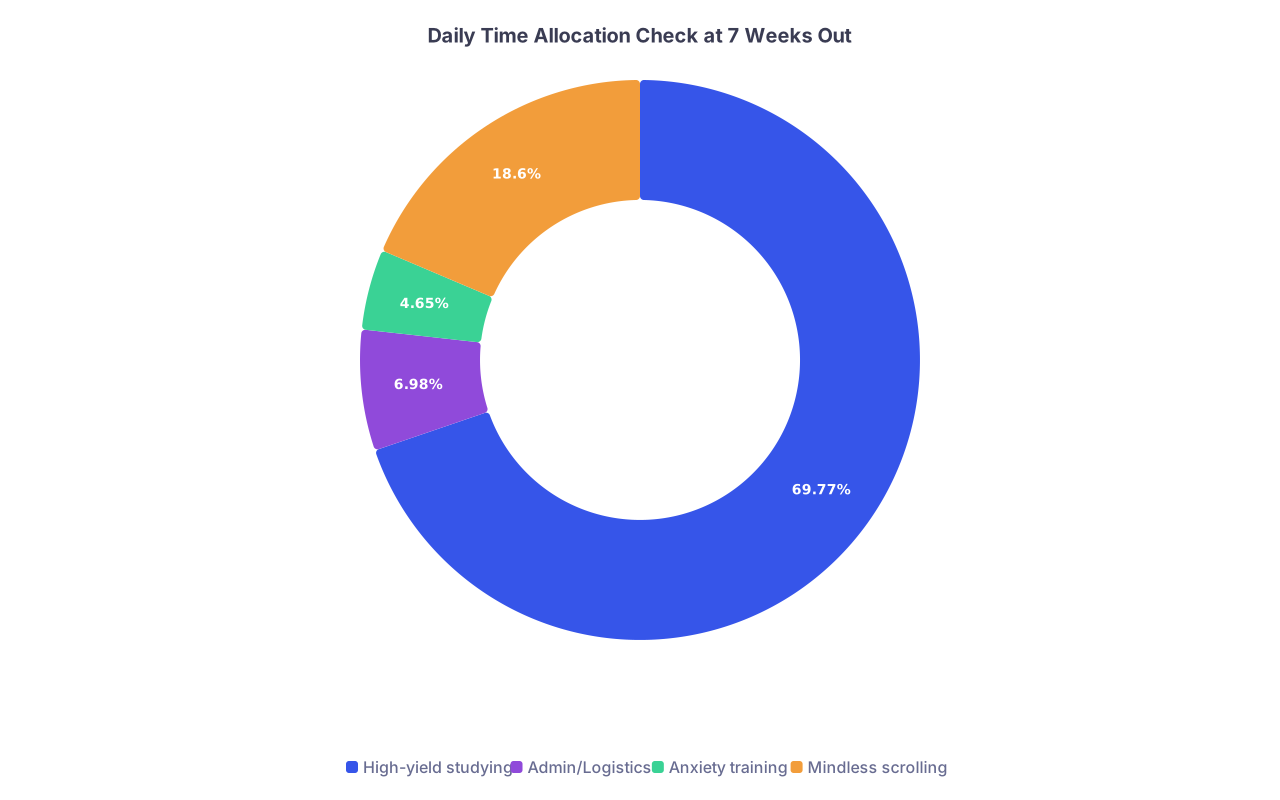
| Category | Value |
|---|---|
| High-yield studying | 300 |
| Admin/Logistics | 30 |
| Anxiety training | 20 |
| Mindless scrolling | 80 |
If the “mindless scrolling” wedge is bigger than “anxiety training” you have your answer for why you feel out of control.
Weeks 6–3: Full Simulation & Peak Anxiety Training
Now we increase exposure: full-lengths, more intense feelings, more deliberate recovery.
Week 6: First Full-Length Practice Exam
At 6 weeks, you should sit a serious mock exam.
Pick your poison:
- Step: NBME or UWorld self-assessment
- COMLEX: COMSAE or COMBANK/TrueLearn simulated exam
Run it like the real thing:
- Wake up at test-day time
- Same breakfast you plan for test day
- Same clothes you’d wear
- Timer on, minimal breaks, no answering texts in between blocks
Expect higher anxiety than usual. Plan for it. During the exam:
- When anxiety spikes, do one cycle of slow exhale between questions (not 2 minutes of breathing — just one slow reset breath)
- Don’t perfectionistically review every question. Keep moving.
Post-exam debrief (later that day, not immediately):
- Rate anxiety per block 1–7 (or each COMLEX section)
- Identify when your performance dropped (typical crash: blocks 3–5)
- Note sleep, caffeine, and nutrition that day
Keep this debrief. You’ll compare later.
Week 5: Build Recovery as a Skill
At 5 weeks, you should learn that how you recover determines how long anxiety owns you.
Schedule 1 “hard day, soft evening” per week.
- Hard morning: long question blocks, active recall, timed sets
- Soft evening:
- No medical content after a set time (e.g., 7 PM)
- Light physical activity
- Non-medical hobby or low-key social time
- Protect sleep like it’s another exam.
Practice “cognitive defusion” once per day.
When you notice a sticky thought (“I’m going to fail”), respond like this:- Say (out loud if you can): “I’m having the thought that I’m going to fail.”
- Repeat it once more, slightly slower.
- Notice that you can observe the thought rather than merge with it.
Takes 10 seconds. Over weeks, it makes a huge difference.
Refine what actually works for you.
From your logs:- Circle 2–3 strategies that consistently help (walks, calling a friend, short naps, specific playlists)
- Drop the ones that don’t (doom research, changing resources constantly)
By now you should have a personal anxiety toolkit, not a random grab bag.
Week 4: Second Full-Length, With Strategy
At 4 weeks, you should run another mock exam and test your coping under pressure.
Second full-length, same rules as Week 6.
But this time:- Use your block-by-block anxiety strategies deliberately
- Use the same snacks/drinks you plan for the real day
- Keep breaks timed and purposeful (bathroom, snack, quick stretch, brief breathing)
Compare debriefs: Look at Week 6 vs Week 4 side by side:
- Did your anxiety spikes shift?
- Did performance drop later or earlier?
- How did sleep, caffeine, and pre-exam routine differ?
Lock in test-day logistics. By end of Week 4, you should:
- Confirm your test center location, route, and parking
- Decide your exam-day bag contents (earplugs if allowed, snacks, water, ID, jacket)
- Choose exact breakfast and backup options
No new decisions about logistics after this week. Decision fatigue = anxiety fuel.
Weeks 3–1: Taper, Protect, and Final Rehearsal
Here’s where people usually blow it by cramming and spiraling. Don’t.
Week 3: Reduce Volume, Keep Structure
At 3 weeks, you should pull back slightly on raw hours and double down on consistency.
Cut overall study time by ~10–15%, keep the same daily skeleton.
Example:- Was: 10 hours → Now: 8.5–9 hours
- Keep start time, break times, pre-study routine identical.
Shift from learning to consolidating.
- Fewer brand-new topics
- More mixed question sets, flashcards, and review of your weakest systems
Daily 10-minute “exam visualization.”
- Sit quietly
- Walk yourself mentally from waking up → arriving at center → finishing last block feeling drained but functional
- Imagine anxiety showing up — and you using your real tools
This isn’t “manifesting.” It’s training.
Week 2: Final Systems Check
At 2 weeks, you should stop changing plans. No new resources. No new heroic fixes.
Run one last half-day simulation.
- 3–4 blocks back-to-back, full timed
- Use full exam-day routine from wake-up to finish
- This is not about score; it’s about process
Do a reality check on your numbers.
Using your practice exams, ask:- Are you consistently in a pass range for Step/COMLEX?
- If not, talk to an advisor now, not 3 days before. Delaying a few weeks beats walking into a likely fail.
Define your “good-enough” performance. Write down:
- “On exam day, a good-enough performance is:
- Staying for the full exam
- Using my coping strategies when I spike
- Not changing answers impulsively out of panic
- Finishing all blocks with at least 2–5 minutes to spare”
Notice that “feel completely calm” is not on that list. Because that’s not realistic.
- “On exam day, a good-enough performance is:
Week 1: Taper and Protect Your Brain
This final week is not for cramming everything you missed. It’s for walking in with a nervous system that still has battery left.

| Step | Description |
|---|---|
| Step 1 | 7 Days Out |
| Step 2 | Light Review & Routines |
| Step 3 | 3-4 Days Out: Last Timed Blocks |
| Step 4 | 2 Days Out: Minimal New Content |
| Step 5 | Day Before: No Question Banks |
| Step 6 | Exam Day: Execute Routine |
7–4 Days Out
At this point, you should:
Keep hours modest.
- 6–8 hours/day
- Mostly review and light question sets
Avoid all group score talk.
If someone tries to compare NBMEs, your script is:
“I’m off score talk this week. I’m just sticking to my plan.”Rehearse exam-day morning twice.
Pick two days:- Wake and eat exactly as you will on test day
- Do a 40–60 question block as “Block 1” at the same clock time as your actual exam start
- Practice parking/walking route if feasible (or at least drive by the center)
3–2 Days Out
At 3–2 days out, you should stop pretending you’re going to ‘catch up’ on months of material.
No more than 4–6 hours of light work.
- Targeted review of your worst 2–3 systems
- A few small timed sets to keep the rhythm
- No full-lengths, no huge new decks
Lock your exam-day checklist:
- ID, scheduling permit
- Snacks (nothing unfamiliar or super heavy)
- Water bottle (if allowed)
- Layers (some centers are fridges, some are saunas)
- Route and backup route to center
Put everything in your bag the day before.
Day Before the Exam
Here’s where strong students sabotage themselves. Don’t.
At this point, you should:
Stop question banks by midday.
- Morning: light review (formula sheet, high-yield topics, skim notes)
- After lunch: no more medicine content
Do a body + environment reset.
- Clean your desk / room enough that you don’t wake up in clutter
- 20–30 minutes of light exercise or walk
- Prepare clothes, breakfast ingredients, and exam bag
Plan your wind-down.
- No Step/COMLEX Reddit
- Low-stimulation TV, reading, or conversation
- Aim for bed at usual time; don’t overreact if you’re not perfectly sleepy
If sleep is patchy the night before, it’s fine. One bad night doesn’t kill performance; chronic exhaustion does. You avoided that.
Exam Day: Run the Script, Not Your Feelings
You will be anxious. That’s baked in. The goal is not zero anxiety. The goal is “anxious but functional.”
At this point, you should:
Follow your rehearsed morning routine exactly.
No new foods. No last-minute cram. No asking peers about resources in the parking lot.Use micro-coping in the exam:
- Between questions: one slow exhale when you feel pressure rising
- Between blocks:
- Bathroom
- Snack and sip of water
- 2–3 slow breaths
- Remind yourself: “One block at a time.”
End of exam: do not autopsy.
Your brain will want to replay every question you “definitely got wrong.” Don’t feed it.- Eat
- Hydrate
- Move
- Watch something mindless or talk to someone who won’t quiz you about specifics
Your job is done. Let the score report handle itself.
Key Takeaways
- You don’t “fix” test anxiety with motivational quotes the night before Step 1 or COMLEX Level 1. You train for 12 weeks: exposure, routine, and recovery.
- The more you simulate the entire exam experience—morning routine, blocks, breaks, and recovery—the less power your anxiety has on game day.
- Your goal isn’t to feel calm; it’s to perform well while feeling anxious. That’s what this 12-week plan is built to teach your brain to do.