7 Test Anxiety Habits That Quietly Tank Your USMLE Score
What if the thing dragging your USMLE score down is not your knowledge at all—but the way you panic, cram, and second‑guess yourself in the weeks and minutes before the exam?
I have watched smart, disciplined students with 240–250 practice ranges walk out with scores 20–30 points lower. Not because they “forgot everything.” Because their anxiety habits choked their performance.
The worst part? Most of them had no idea which habits were quietly wrecking them. They just thought they were “bad test takers.”
Let’s go through the seven anxiety-driven habits that reliably sink USMLE scores—and what to do instead before you burn another test date.
Habit 1: Treating Question Banks as a Score Report, Not as Training
If you open your question bank and immediately scroll to the percentage instead of the explanations, you are making this mistake.
Anxious test-takers obsess over:
- “What’s my percent correct today?”
- “Did my block average go up or down?”
- “Am I above the curve?”
Calm, high-scorers obsess over:
- “Why did I miss this?”
- “What pattern fooled me?”
- “What anchor can I create so I never miss this concept again?”
When anxiety runs the show, your entire q‑bank behavior becomes distorted:
- You rush through questions just to see the score.
- You avoid harder blocks because a low percentage will “ruin your day.”
- You redo “easy” systems to feel good, instead of working on your weak zones.
You are training your brain to chase comfort, not competence.
Here is how that tanks your real exam:
- You have a fragile ego around questions → any hard block on test day rattles you.
- You never sit with the discomfort of “I do not know this well,” so you do not fix gaps.
- You turn off your analytical brain because you are emotionally chasing a number.
Correct the habit:
- Hide or ignore the score first. Some q‑banks allow hiding percent correct until after review. Use that feature. If not, train yourself: glance once, then forget it.
- Force yourself to write a 1–2 line “miss reason” for each wrong question:
- Misread stem?
- Did not know fact?
- Knew concept but fell for distractor?
- Track patterns weekly, not daily. Your anxiety wants to zoom in on every block. Stop. Look at trends over 5–7 days, not single sessions.
If every study session ends with “My percent dropped, I’m doomed,” you are training anxiety, not knowledge.
Habit 2: Cramming New Resources in the Final Month “Just in Case”
The last four weeks before your exam are when anxious students do something especially destructive: they add more resources.
They see someone on Reddit post “I used these 4 extra decks and 2 more PDFs and scored 265.” Suddenly:
- You install a new Anki deck with 10,000 cards.
- You download another “high‑yield” review PDF.
- You open a new small q‑bank “for extra exposure.”
And your brain goes from focused to fragmented.
Here is the ugly truth: at the end of your dedicated period, depth beats breadth. Most students already have enough resources. They lack consolidation and recall.
What this anxiety habit does:
- You dilute your review of high‑yield core content with a thousand extra low‑yield facts.
- You increase daily workload to something inhuman, then feel behind all the time.
- You never see the same concept enough times to truly own it.
So on exam day:
- You vaguely recognize everything.
- You deeply know almost nothing.
- Under time pressure, vague familiarity collapses.
Compare two students in the final 3 weeks:
| Aspect | Calm Student | Anxious Student |
|---|---|---|
| Resources used | 1 q-bank, 1 book, Anki | 3 q-banks, 3 PDFs, 2 decks |
| Daily focus | Review and mixed blocks | “Cover everything” once |
| Practice test use | Scheduled, fully reviewed | Taken impulsively, half‑reviewed |
| Mental state | Tired but stable | Constantly behind and panicked |
Guess who usually scores closer to their NBMEs? The one who stopped resource creep.
Correct the habit:
- Set a “resource freeze date.” At 6–8 weeks out, make a list of what you will use. After that date, you do not add new major resources.
- Label everything as “primary” or “optional.” Primary gets repeated. Optional is only touched if you are ahead.
- In the final month, prioritize:
- Mixed timed blocks
- Thorough review of wrongs
- Rapid passes through existing notes, not new ones
“Just in case” resources late in the game are almost always anxiety, not strategy.
Habit 3: Destroying Your Sleep to “Steal” Extra Study Hours
This one is brutal because it feels so logical in the moment.
You feel behind. Scores are inconsistent. So you do what anxious, hardworking people do: you sacrifice sleep. You push bedtime from 11 pm to 1 am… then 2 am. You wake up early for “one more block.”
On paper, you gain hours. In reality, you are trading high‑yield brain function for low‑quality grind.
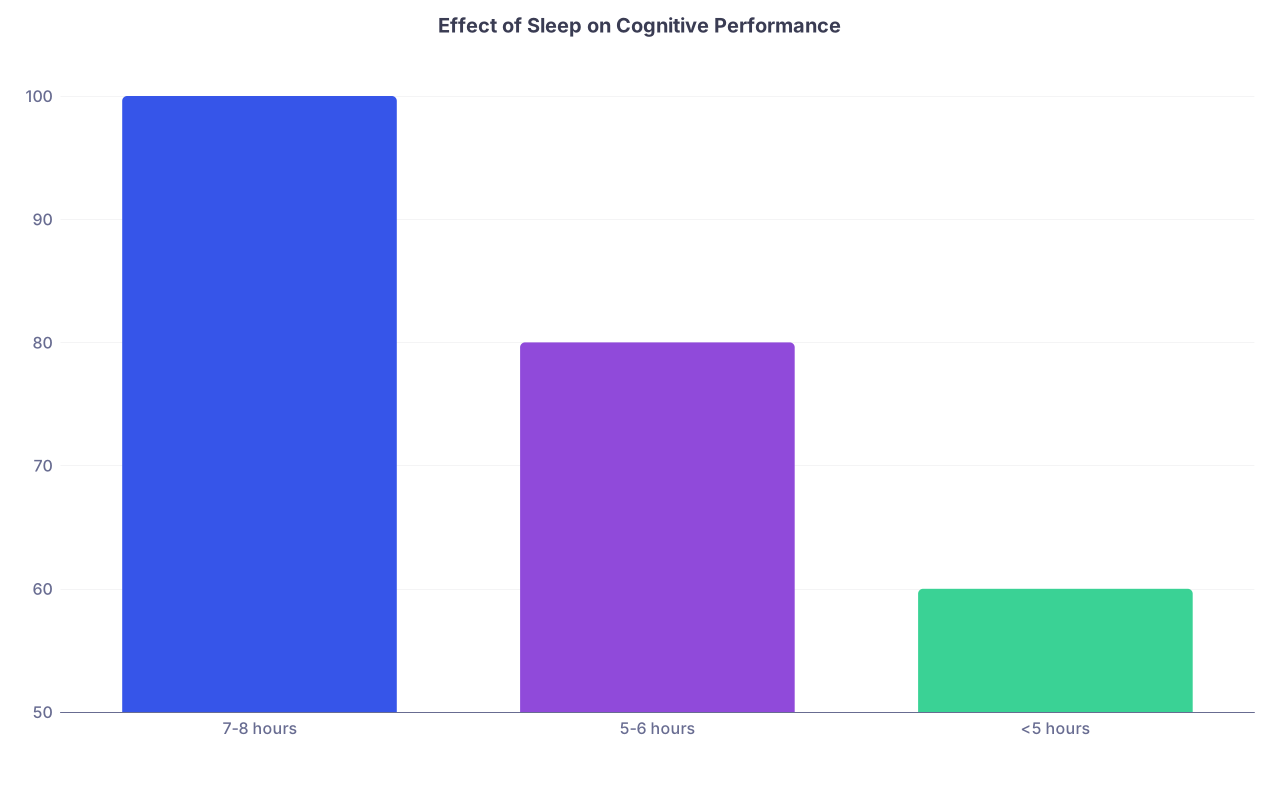
| Category | Value |
|---|---|
| 7-8 hours | 100 |
| 5-6 hours | 80 |
| <5 hours | 60 |
Chronic short sleep before a high‑stakes exam does a few predictable things:
- Increases baseline anxiety and irritability.
- Slows processing speed. You read more slowly. Re‑read more often.
- Worsens working memory. You cannot keep all the details of a complex stem in your head.
- Lowers frustration tolerance—so one bad block ruins your entire day.
On USMLE this translates directly into:
- Timing out on question blocks you should have finished.
- Misreading critical phrases (“no murmur heard” vs “harsh systolic murmur”).
- Missing multi-step reasoning questions because you lose the thread halfway.
I have watched students add 10–15 “study hours” a week by cutting sleep, only to lose 20–30 points on test day from reduced performance.
Correct the habit:
- Treat sleep like a scored section of the exam. Minimum target: 7 hours, non‑negotiable in the final 2–3 weeks.
- Measure honestly. Don’t call 1 am–7 am “6 hours” when you phone time and tossing cut into it. Protect real sleep.
- Build a pre‑sleep buffer (30–45 minutes). No q‑bank, no discussions about scores, no social media score posts. Light content only (light reading, stretching, shower, etc.).
If you would not show up drunk or sedated to Step 1, stop showing up sleep‑deprived. Physiologically, they look disturbingly similar on cognitive testing.
Habit 4: “Checking Your Worth” With Constant Practice Tests
NBMEs, UWSA, Free 120—these are powerful tools. Used correctly, they show trend and highlight weak spots.
Used anxiously, they become self‑harm with answer choices.
Here is what the anxiety version looks like:
- You have a bad q‑bank week → you impulsively schedule an NBME “just to see where I am.”
- You cannot tolerate uncertainty for more than a few days without taking another “diagnostic.”
- You take a full‑length exam, get a score you do not like, then immediately sign up for the next one instead of deeply reviewing the first.
All of that does one thing: it conditions your brain to pair assessment with threat.
Now, when you see an exam interface, your heart rate jumps before question 1. You are not evaluating knowledge. You are evaluating self‑worth.
The math is ugly too. Every practice test costs:
- 4+ hours of intense cognitive effort
- 4–8 hours of proper review if done right
- A full day of emotional fallout if done wrong
If you take them recklessly whenever you are anxious, you:
- Burn time you could use to fix weaknesses.
- Create random score scatter you cannot interpret.
- Arrive at test day emotionally drained from 8–10 prior “mini test days.”
Correct the habit:
- Schedule practice tests in advance (every 2–3 weeks, usually) and stick to that plan unless there is an exceptional reason.
- Define the purpose of each exam beforehand:
- Trend check?
- Tolerance for 7 blocks?
- Targeting certain systems?
- Commit to full review before the next one. No back‑to‑back panic exams. You must squeeze learning out of each test before you take the next.
If you are taking practice tests more to “reassure yourself” than to learn, you are letting anxiety run your calender.
Habit 5: Catastrophic Self-Talk During and After Question Blocks
You know this one. You miss two questions early in a block and the mental script starts:
- “I am blowing this entire exam.”
- “Everyone else is doing better than me.”
- “If I cannot get this simple endocrine question, I have no chance.”
That is not motivational. It is performance poison.
Anxious self-talk does not just feel bad. It:
- Steals working memory bandwidth.
- Increases muscle tension and heart rate.
- Makes you rush, click, and move just to escape the discomfort of uncertainty.
I have seen people derail entire NBMEs after one tough block because the internal commentary turned abusive.
On test day, this usually shows up in two ways:
- Block 1 feels hard → you decide you are failing → you mentally check out of Block 2–3.
- You obsessively replay past questions during your break instead of resetting.

| Step | Description |
|---|---|
| Step 1 | Hit a hard question |
| Step 2 | Feel anxious |
| Step 3 | Self-talk: Im failing |
| Step 4 | Speed up / misread |
| Step 5 | Miss more questions |
| Step 6 | Stronger belief: Im doomed |
You cannot prevent hard blocks. You can prevent the psychological spiral.
Correct the habit:
- Pre-write neutral test-day scripts. Examples:
- “Hard blocks are normal. Everyone is getting hammered by some sections.”
- “My job is to give each question my best 90 seconds, not to predict my score.”
- “I have missed questions before and still hit my practice scores. Nothing new here.”
- Practice the script during q‑bank blocks now. Do not wait for test day. Each time your brain starts “I’m failing,” replace it with your pre‑written line. Out loud if you have to.
- Ban post‑block autopsies during the test. Once you hit “End Block,” you do not get to mentally re-answer questions during break. Eat, hydrate, stretch, bathroom. That is it.
You will not eliminate anxiety entirely. You can stop it from running the show mid‑exam.
Habit 6: Ignoring Your Physical Body Until Test Week
Test anxiety is not just in your head. It is in your heart rate, your breathing, your gut.
Yet many med students approach USMLE prep as if the body is just a vehicle to drag the brain to the desk. Then wonder why test day feels like an out-of-body panic experience.
Patterns I see constantly:
- No breakfast during dedicated, then experimenting with breakfast on test day.
- Random caffeine use—3 coffees one day, none the next.
- Never doing full 7‑block simulations, so they have no idea what their body feels like at hour 6.
Then on the actual day:
- Heart pounding, hands cold and shaky.
- Crash in energy around Block 5.
- Sudden GI issues because they ate foods their body is not used to at that time.
This is not “weakness.” It is poor preparation. You trained content. You never trained the system that has to carry that content for 8 hours.
Correct the habit:
- Standardize your “test body routine” at least 2–3 weeks before.
- Wake time similar to test day.
- Same style of breakfast on heavy study days.
- Consistent caffeine dose and timing.
- Do at least one full 6–7 block simulation at the actual testing time of day. Not on a random evening. Not broken into chunks.
- Practice a 60–90 second physical reset you can use between blocks:
- 5 slow breaths: in for 4 seconds, hold 4, out for 6–8.
- Shoulder rolls, neck stretch.
- Brief walk during break (if possible) instead of doom-scrolling.
Your brain sits on top of a nervous system. If that system is in a panic state, no amount of knowledge feels accessible.
Habit 7: Studying in “All‑Or‑Nothing” Bursts Instead of Sustainable Routines
This one is sneaky because it masquerades as dedication.
You might recognize yourself in this pattern:
- Weeks of half‑hearted studying.
- Panic spike: “My exam is only X weeks away.”
- Intense, almost desperate, 12–14 hour days for several days straight.
- Total burnout. Then 1–2 days of collapse, guilt, and shame.
- Repeat.
Your anxiety pushes you into unsustainable sprints, then your nervous system shuts down in self-defense.
On paper, your total hours might look fine. In reality:
- Your memory formation is inconsistent.
- You keep interrupting learning sequences with burnout days.
- You associate studying with misery → more anxiety each time you sit down.
By exam month, you are not only exhausted. You also have no stable sense of, “This is what a normal, good study day looks like for me.”
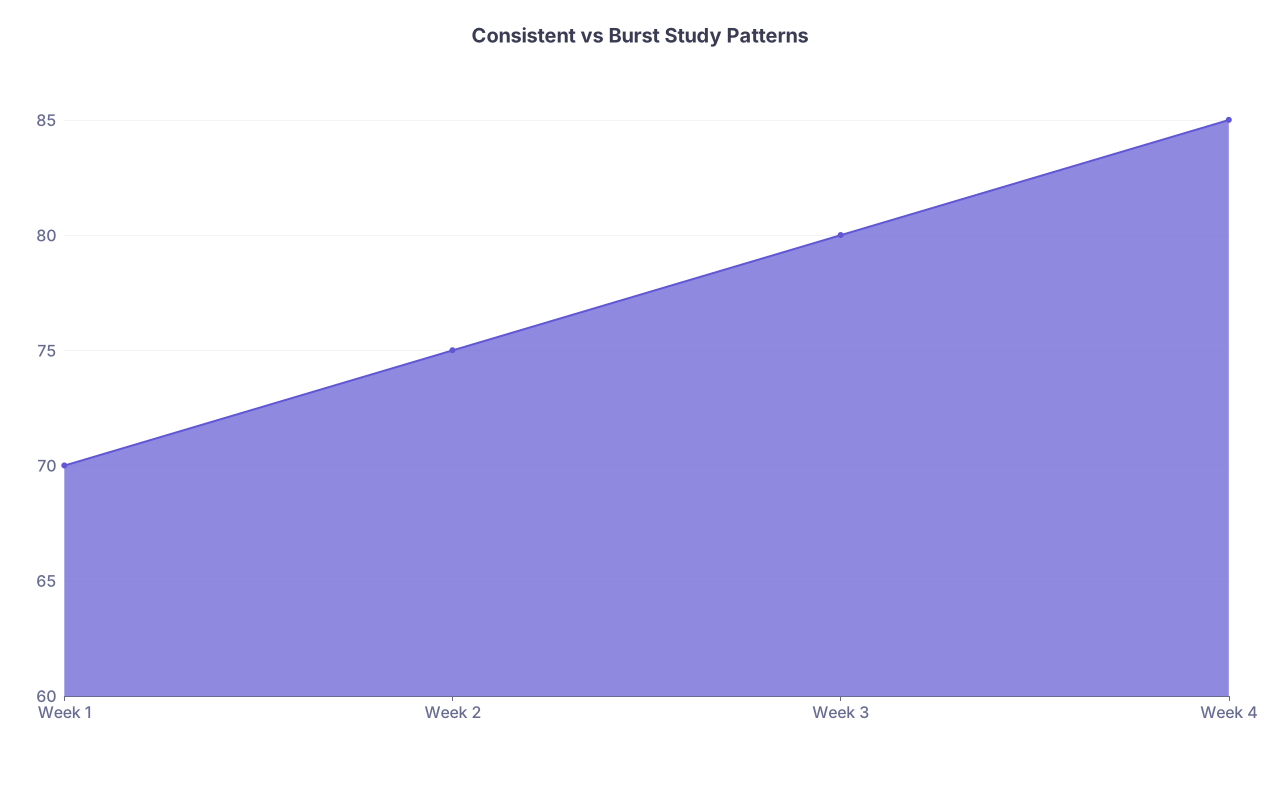
| Category | Value |
|---|---|
| Week 1 | 70 |
| Week 2 | 75 |
| Week 3 | 80 |
| Week 4 | 85 |
(The chart above imagines consistent “output” increasing over time. The burst-and-crash model would look like jagged spikes and valleys.)
Correct the habit:
- Decide your minimum viable day. Example:
- 2 timed q‑bank blocks.
- 1–2 hours of targeted review.
- 30–60 minutes of Anki or concept review. If you do more, great. But this is the non‑negotiable floor.
- Cap your maximum day. No, really. If you exceed 10 hours of actual focused work daily for multiple days, you are almost certainly borrowing from future days.
- Track streaks, not hero days. Put a mark for every day you hit your minimum. Your goal is 10–14+ consecutive days of minimum‑or‑better, not 2 “monster days” and a crash.
Consistency is the opposite of anxiety’s favorite pattern: overreact then collapse.
How to Actually Start Fixing These Habits (Without Overhauling Your Life)
You probably see yourself in at least two or three of these. Maybe all seven. That is normal. Most smart, driven people drift into anxiety patterns when something high‑stakes is on the line.
The mistake is not having anxiety.
The mistake is pretending your anxiety habits are “just how I am” and letting them chew through a once‑per‑career exam.
So here is your concrete next step—today, not “later this week.”
Next step (do this now):
Grab a sheet of paper (or a note app) and write down the 7 habits as a checklist. For each one, rate yourself from 1–5:
- 1 = “Not really me”
- 3 = “Shows up sometimes”
- 5 = “This is absolutely me”
Then:
- Circle your top 2 highest scores.
- Under each, write one specific behavior you will change for the next 7 days. Examples:
- For sleep: “No study after 11 pm, phone in another room.”
- For q‑banks: “Write a 1‑sentence miss reason for every wrong.”
- For self-talk: “Use pre‑written neutral script during every timed block.”
- Put that paper somewhere you cannot avoid—the wall above your desk, taped to your laptop.
You do not need to fix everything at once. But if you quietly keep these anxiety habits alive, do not be surprised when your score quietly drops.
Open your calendar right now and block out one half‑day in the next week for a test‑day simulation plus full review. That is where you start turning these from abstract mistakes into concrete improvements.