
A third‑year sat in my office last winter, white coat still on, pager going off every ten minutes. He’d just failed a major shelf exam after scoring in the 90th percentile on every question bank. The official story was “bad test day.” The real story? His school had been quietly flagging him for stress for months—and no one told him what that actually meant.
Let me walk you through the stuff advisors never spell out in emails or wellness workshops. Because exam stress in medical school is not just a “feel your feelings” issue. It’s tracked, discussed, and sometimes used against you—or, if you know how the game works, used for you.
What “Stress Flags” Really Are (And How They’re Used Behind Closed Doors)
Every med school with even a halfway modern student affairs office has some version of this: a risk list.
They won’t call it that. They’ll call it “students of concern,” “learner well-being meeting,” “academic progress committee prep,” or some other gentle label. But every few weeks, key people sit in a room and talk about which students might be about to implode.
Here’s what you’re not told: excessive or recurring exam stress behavior is one of the biggest triggers that gets your name on that list.
Not just failing exams. The way you handle the pressure around them.
This can include things like:
- Repeated last-minute “urgent” emails about needing accommodations for every major exam
- Multiple check-ins with different advisors about the same upcoming test, sounding panicky and spiraling
- Step or shelf date changes that keep getting pushed, again and again, with vague reasons
- Frequent sick calls or “not feeling well” on or right before exam days
- Pre‑exam breakdowns that result in you being pulled out of clinical duties or simulations
Advisors, deans, and course directors will never say, “We’re flagging your exam anxiety.” Instead, they’ll use phrases like:
- “We’re keeping an eye on you.”
- “Let’s just make sure you have appropriate supports.”
- “We’ll review your progress again after the next exam block.”
Translation: they’re documenting patterns. Patterns that can matter later when promotions, remediation, or even professionalism questions come up.
Let me be blunt: having stress around exams is normal. Being known in the office as “That student who melts down around every exam” is not where you want to be. The distinction matters.
The Three Types of Exam Stress Students We Talk About
When faculty and advisors talk about exam stress, we’re not thinking in DSM diagnoses. We’re thinking: how much work will this student create for us, and how likely are they to crash?
That sounds harsh. It’s accurate.
Roughly, students fall into three buckets during these behind-the-scenes conversations:
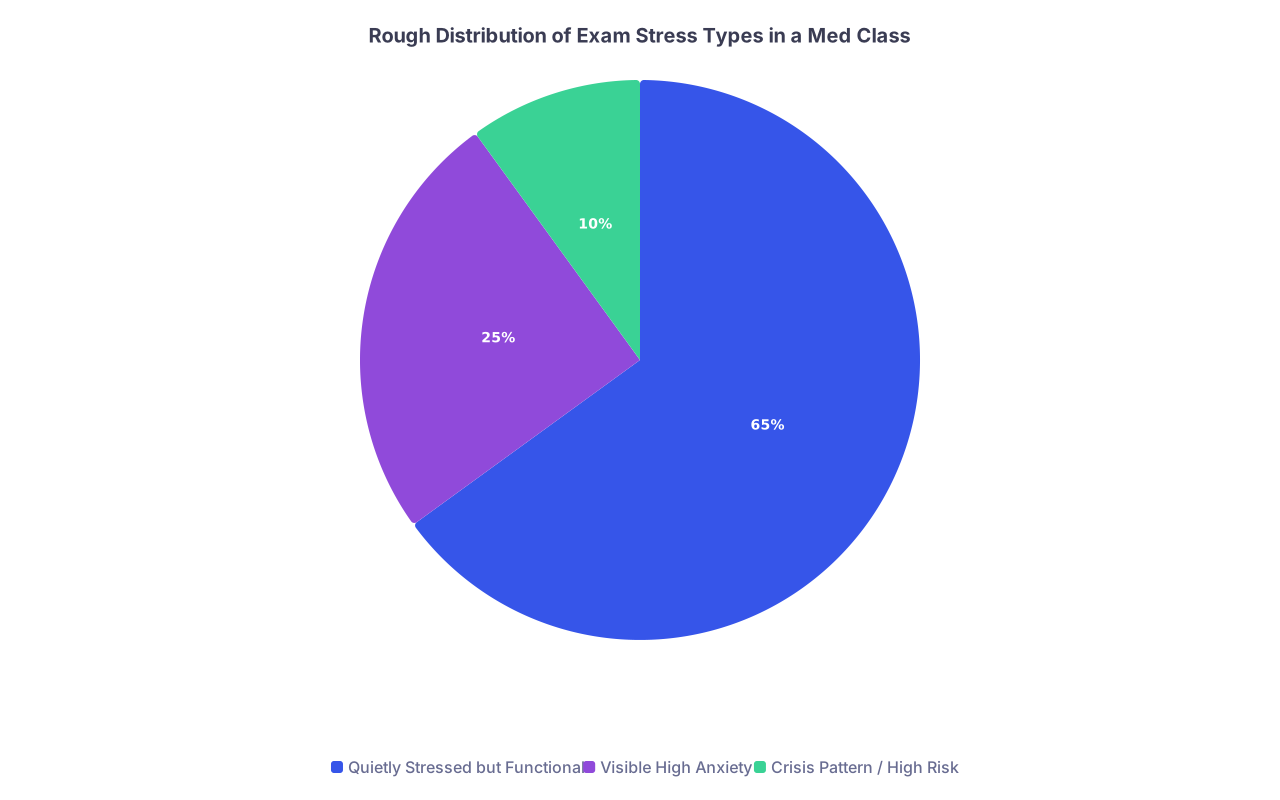
| Category | Value |
|---|---|
| Quietly Stressed but Functional | 65 |
| Visible High Anxiety | 25 |
| Crisis Pattern / High Risk | 10 |
1. Quietly Stressed but Functional
These are the students losing sleep, drinking too much coffee, maybe crying in the shower—but outwardly they show up, take the exam, pass or even excel, and don’t create institutional work.
They might drop a comment like, “I was so anxious I thought I’d faint,” but they don’t ask for date changes, don’t repeatedly email the course director, and don’t miss mandatory events.
Faculty view them as “normal med student stressed.” Nobody flags them. Nobody meets about them. They suffer in private.
2. Visible High Anxiety
These students show obvious stress: they talk about panic attacks, ask for reassurance repeatedly, and are frequent flyers in the advisor’s calendar. But they still get it done—exams taken on time, generally passing.
These students get “soft flags.” Advisors know their names. They might say in meetings:
- “He’s anxious but very conscientious.”
- “She’s struggling with confidence, but her results are fine.”
If you’re here, you’re on the radar but not seen as a problem… yet.
3. Crisis Pattern / High Risk
This is where the exam stress flags become very real.
Characteristics that push you into this group:
- Repeated exam absences or last-minute cancellations
- Multiple failed attempts clustered together
- Documented panic attacks specifically on or right before test days
- Emails from attendings about you freezing, crying, or walking out of OSCEs
- Extended leaves framed around “test anxiety”
These students are absolutely discussed in formal meetings. The phrases used about them are telling:
- “Does this student have the resilience to complete the program?”
- “We may need to consider a leave or deceleration.”
- “Is this an anxiety disorder affecting fitness for duty?”
That last phrase—“fitness for duty”—is the one you never want associated casually with your name.
What Advisors Won’t Tell You About Documentation And Patterns
Here’s something I’ve seen play out again and again: a student thinks each event is separate. One bad exam. One panicky email. One sick call.
The institution sees a timeline.
They build a case history in their head—even if it never gets formally written as, “This student has test anxiety.”
Picture this internal narrative:
- M1 Fall: “Sent a long, distressed email night before anatomy exam, asked to delay.”
- M1 Spring: “Requested delay for physiology exam due to ‘overwhelming anxiety.’”
- M2: “Moved Step 1 date 3 times, cited stress and feeling unprepared, despite good QBank scores.”
- M3: “Called out sick morning of shelf. Reported panic attack.”
No single bullet kills you. The pattern does.
And advisors almost never say:
“Listen, you’re starting to build a documented pattern of exam avoidance and acute anxiety. This will eventually trigger serious conversations about your progression and reliability.”
Instead, they say supportive things like, “We understand. Take care of yourself. Let’s regroup after the exam.”
That feels kind and trauma‑informed. It’s also incomplete. You deserve to know when your choices are creating a narrative about you inside the system.
The Ugly Truth About Formal “Test Anxiety” Labels
Students come into my office saying, “I think I should get formally diagnosed with test anxiety. Then the school has to help me, right?”
Sometimes. But here’s what you need to understand that no wellness lecture spells out:
A formal diagnosis is a double-edged sword inside institutional memory.
In disability services, it unlocks accommodations—extra time, quiet room, breaks. Good.
In promotions and professionalism conversations, it can quietly raise a question:
“Can this student function safely in a high‑pressure clinical environment?”
No one will write that in an email. They won’t say it to your face. But I have heard it said, out loud, in closed rooms.
Where it helps you:
- Access to accommodations for written exams
- Potential for structured Step/Level accommodations
- Clear framework to explain prior struggles (“we now understand why…”)
Where it can quietly hurt:
- Hesitation about giving you certain high-pressure away rotations
- Reluctance to advocate strongly if you then have multiple exam failures despite accommodations
- Subconscious bias: “Always needs special conditions”
You shouldn’t avoid help because of that. But you should go in with eyes open. If you pursue accommodations, your goal is not “document my fragility.” Your goal is: “demonstrate that with appropriate structure, I perform consistently and safely.”
That framing matters.
How Exam Stress Flags Threaten You Long-Term (And How They Don’t)
Let’s separate myth from reality.
What schools won’t do just because you’re anxious:
- They won’t write “test anxiety” in your MSPE as a big red warning. (Too messy legally, too subjective.)
- They won’t report your mental health issues directly to residency programs.
- They won’t block you from graduating solely because you saw psychiatry or therapy.
What they might do when stress flags are persistent and severe:
- Require you to take a leave or decelerate “in your best interest”
- Place you on formal academic probation after failures clustered around exams
- Treat your anxiety-driven behaviors as professionalism issues (no-shows, late cancellations, breakdowns mid-rotation)
- Be very cautious in how enthusiastically they describe your reliability and performance in your MSPE
That last one is big. The letter doesn’t say:
“John has uncontrolled exam anxiety that makes him unreliable.”
It says things like:
- “John has required additional support during high-stakes assessments.”
- “With structured oversight, John can perform at the expected level.”
- “She continues to work on managing stress in demanding settings.”
Those sentences are read by program directors as: we’ve had concerns.
So no, exam stress flags alone won’t destroy your future. But when they pile up along with poor coping behavior, no insight, and no visible improvement, they turn into a story residency directors can smell from a mile away—even when no one explicitly names it.
Signals You’re Quietly Being Flagged For Exam Stress
Most students don’t realize they’ve crossed that line from “normal anxious” to “we’re worried about you” until they’re already in trouble.
Here are the signals on our side of the table, translated into plain language.

Your advisor starts “checking in” before every major exam.
That’s not random kindness. That’s monitoring.You’re encouraged to apply for accommodations when you didn’t ask.
It often means: “We think you’ll struggle without formal structure and we want documentation.”You’re told to “loop in” multiple people before an exam.
Course director + student affairs + wellness? That’s a risk management plan.You get language like “We need to see a sustained pattern of stability.”
Translation: our trust in your performance under pressure is currently low.Your leave, deceleration, or Step delay is framed as “protective.”
Behind the scenes, they’re trying to prevent an ugly failure that triggers bigger committee actions.
None of this is inherently malicious. Schools are protecting you, your classmates, and their board score metrics and accreditation status. All at once.
But if you don’t know how they’re reading your behavior, you’ll keep making moves that increase your risk category.
How To Look Stable Even When You’re Anxious As Hell
You can be very anxious and still be perceived as solid, reliable, and promotable. I’ve seen severely anxious students match competitive specialties because they understood one thing:
Pre-planned, structured coping looks mature. Last-minute chaos looks risky.
The anxiety level might be identical. The institutional perception is not.
So what do the students who avoid bad flags actually do differently?
They front-load their vulnerability and control the narrative.
Instead of five separate panicked emails before five different exams, they have one calm, strategic conversation early:
- “I have significant anxiety around exams. Here’s what I’m already doing about it.”
- “I’m working with a therapist/psychiatrist/coach and have a plan.”
- “This is how I want to structure my exam periods so my performance is consistent.”
Then, they stick to the plan. They don’t keep adding exceptions, extensions, or last-minute changes.
The behind-the-scenes reaction to that kind of student is very different:
- “Yes, she’s anxious, but she’s organized about it.”
- “He’s insight-oriented and follows through with treatment.”
- “She has a plan and doesn’t create emergencies for us.”
Those students might be just as high-strung internally. On paper and in meetings, they’re labeled as “appropriately managing stress.”
The Playbook: Handling Exam Stress Without Becoming “The Problem Student”
Now we get to the part no wellness handout gives you: how to have serious exam anxiety and not become the subject of dreaded committee discussions.
1. Build a documented plan that you own
When you walk into a meeting with an advisor, you want to sound like a colleague presenting a case, not a drowning person grabbing at anything.
Something like:
“I’ve noticed a pattern where my anxiety spikes in the two weeks before major exams. To address this, I’ve already: started weekly therapy, scheduled check-ins with a mentor, and mapped out a consistent study and sleep schedule. I’d like to keep all my exam dates as scheduled, but I want you to know I’m taking this seriously and proactively.”
What we hear in that:
- Insight
- Ownership
- No immediate institutional burden
Contrast that with:
“I’m so overwhelmed. I don’t know if I can do this exam. Can I push it a few weeks? I just don’t feel ready.”
That’s how you accidentally create the “unstable / high-risk” narrative.
2. Use accommodations strategically, not reactively
If you have a real anxiety disorder, get evaluated early. Not three days before Step.
Then think long game:
The goal of accommodations isn’t to escape pressure forever. It’s to give your nervous system enough room to show what your actual cognitive ability is.
That means:
- Use them consistently, not only when you’re desperate
- Pair them with active treatment and coping skills, not as the only intervention
- Treat each accommodated exam as data: “With this set-up, I perform at X level reliably.”
That’s the story you want faculty to see—improvement and stability under defined conditions.
3. Do not weaponize illness on exam days
You call out sick morning of a test more than once? You are absolutely on a list.
If you’re truly unwell, fine. But if anxiety is the driver, use that language honestly ahead of time.
Better:
“Over the past month, my anxiety has escalated and I’m concerned about my functioning in the upcoming exam. Can we discuss options now rather than me having a crisis the day of?”
Worse:
Five 3 a.m. emails over the semester, each on the eve of an exam, saying you “might have COVID” but never got tested.
Everyone knows what’s really going on. And they don’t label that as “anxiety.” They label it as “unreliability” and “lack of professionalism.”
4. Make your “lowest point” the turning point—on the record
If you’ve already had a meltdown, a leave, or multiple exam catastrophes, you’re not doomed. But you do need a very clear narrative pivot.
Faculty love a redemption arc. They do not love a chronic pattern.
You want someone in that promotions room to be able to say:
“Yes, she struggled significantly in M2 with exam anxiety and needed a leave. But since returning, she’s passed every assessment on schedule, engaged with treatment, and has had no further episodes.”
How do you give them that ammo?
You literally say:
“I know my performance last year raised serious concerns. My goal this year is to show you a different pattern. Here’s how I’m doing that…”
Make it easy for them to say you’ve turned a corner. Do not drift back in like nothing happened and hope no one remembers.
Behind-The-Scenes Reality: What We Actually Care About
Let me strip all the institutional language away.
At the core, when faculty talk about exam stress, they’re asking three basic questions about you:
Can this person show up and perform under predictable, high-stakes conditions?
Read: exam days, codes, nights on call.If they struggle, do they communicate early and constructively—or do they explode on game day?
Read: are they going to blindside us?Do they show a trajectory of learning and stabilizing, or a flat or worsening pattern?
Read: is investing more time in them likely to pay off?
You don’t need to be calm. You don’t need to be naturally resilient. You need to show you can be managed—by yourself and within the system.
The students who terrify institutions are not the ones who cry in counseling. They’re the ones who look fine, deny issues, then implode mid-OSCE, walk out of their Step exam, or disappear before a shelf.
You never want to be the surprise.

| Step | Description |
|---|---|
| Step 1 | Normal Anxiety |
| Step 2 | Visible Repeated Distress |
| Step 3 | Last-Minute Changes / No-Shows |
| Step 4 | Pattern Documented in Meetings |
| Step 5 | Formal Concerns: Leave/Probation |
| Step 6 | Proactive Plan & Treatment |
| Step 7 | Stable Performance |
| Step 8 | Flags Fade Over Time |
FAQ: What Academic Advisors Never Tell You About Exam Stress Flags
1. If I talk honestly about my exam anxiety, will that automatically get me “flagged”?
Honest conversation alone? No. In fact, a single candid, well-framed meeting often reduces risk because we see insight and planning. What gets you flagged is a combination of patterns: repeated crises around exam days, last-minute cancellations, failures without follow-through, and behaviors that disrupt courses or rotations.
If you walk in and say, “I have significant exam anxiety, here’s my plan, here’s who I’m working with,” that reads as responsible. If you show up only when everything’s on fire and ask for exceptions each time, that’s when people start putting your name on the mental risk list.
2. Can exam stress or an anxiety diagnosis keep me from matching?
Not by itself. Residency programs do not see your therapy notes, your DSM labels, or your disability paperwork. They see your transcript, exam attempts/scores, MSPE, and letters. What hurts you is when exam stress leads to multiple failures, delayed Steps, extended leaves without a strong comeback, or letters that subtly question your reliability under pressure.
Plenty of residents in top specialties have full-blown anxiety disorders. The common denominator among the ones who match well isn’t being calm. It’s having a clear pattern of: got help, built structure, stabilized, and then performed consistently.
3. Should I delay my big exam (Step/shelf) because I feel too anxious?
Sometimes yes—but not because you “feel anxious.” Because your performance indicators say you’re not ready. If your QBank percentages, practice NBME scores, and recall are solid but you’re panicking, the issue is usually mental, not knowledge. Repeated delays for anxiety, with good objective preparation, look bad and build that avoidance narrative.
A better move: get a rapid, targeted plan—brief therapy, concrete test‑day strategies, maybe short-term meds if appropriate—and sit for the exam on a timeline you commit to in advance with your advisor. One deliberate delay with a clear rationale is survivable. Serial last-minute delays are a red flag.
4. I’ve already had a meltdown/leave/probation related to exam stress. Is my career over?
No. But you’ve lost the luxury of being vague or passive about it. You’re in “prove it” territory now. That means you need a clean, sustained stretch of on-time exams, stable performance, and visible engagement with treatment or support. You want at least one faculty or dean who can honestly say in a letter or meeting, “They had a rough period, but they did the work and have been solid since.”
Internally, the story has to shift from “chronic problem” to “contained episode, now resolved or well-managed.” That shift doesn’t happen with words alone. It happens with a boring, drama-free year of consistent, non-chaotic exam behavior.
If you strip everything else away, remember this: med schools and residencies are not allergic to anxiety. They’re allergic to unpredictability. Your job isn’t to become fearless. It’s to turn your exam stress from a recurring crisis into a known quantity with a clear plan and a stable track record. The system will never say that to your face. But that’s how it actually works.