

Panic on exam day is not a personality flaw. It is a solvable technical problem.
If you have ever sat down for an exam, read the first question, and felt your brain go blank, you know exactly what I am talking about. Hands sweating, heart pounding, every fact you studied last week suddenly gone. That is acute test anxiety. And if you are in medical school, it is not a minor nuisance. It is a threat to your career.
You do not fix this by “just relaxing” or “thinking positive.” That advice is useless under real exam pressure. What you need is a protocol – something specific, timed, and repeatable that you can run when things start going south.
Here is that protocol: a 15-minute, step‑by‑step rescue sequence designed for test day, not for some idealized self-care Sunday. Built for when you are already in trouble.
The Core Idea: You Are Not Calming Down, You Are Rebooting
Acute test anxiety is a physiologic overreaction in the wrong context.
Your brain sees the exam as a threat → triggers fight/flight → pumps out adrenaline → cognitive bandwidth crashes. Working memory tanks. You cannot think clearly, recall details, or interpret vignettes well. You are not “stupid.” You are flooded.
You cannot reason your way out of a flood. You have to reset the system.
The 15‑minute rescue protocol does three things in this order:
- Interrupt the panic loop (physiology first)
- Reboot cognitive function (get working memory back online)
- Stabilize performance (switch into a low‑anxiety, high‑output mode)
You will use this:
- Right before the exam (if you are spiraling)
- Immediately after you sit and feel the surge
- Mid‑exam if you freeze or blank out
Let’s walk through it minute by minute.
The 15-Minute Rescue Protocol (Step‑by‑Step)
Overview at a Glance
| Block (Minutes) | Focus | Primary Tool |
|---|---|---|
| 0–2 | Stop the spiral | Grounding + micro-physical reset |
| 2–7 | Calm the physiology | Box breathing + muscle release |
| 7–11 | Cognitive reboot | Directed recall + self-priming |
| 11–15 | Exam re-entry plan | Tactical strategy + first-5 questions rule |
You can memorize this as: Stop – Breathe – Reset – Execute.
Minutes 0–2: Stop the Spiral (Grounding + Micro Reset)
You sit down. The exam starts. You feel it:
- Heart racing
- Tunnel vision
- Thoughts like: “I’m not ready, I’m going to fail, my career is over”
This is where most people either white‑knuckle through or completely melt down. Both are bad strategies.
You will spend 2 minutes doing something that feels counterintuitive: not answering questions.
Step 1: Hard Ground (30–45 seconds)
You must drag your brain out of the future (“I’m going to fail”) and into the present.
Silently, to yourself:
- Plant your feet flat on the floor. Feel the pressure through your shoes.
- Press your back into the chair. Notice contact points – shoulders, lower back, thighs.
- Touch something with texture – the edge of the desk, your ID badge, your pen.
- Name (in your head) 3 things you can see, 3 things you can feel, 3 sounds you can hear.
Do this quickly. Do not make it a ritual. The point is to snap your focus out of the catastrophe narrative and into physical reality.
Step 2: Micro Physical Reset (45–60 seconds)
Your sympathetic system is overactive. You need a fast, physical downshift.
Sequence:
- Jaw release: Unclench your jaw completely. Let your tongue rest on the floor of your mouth.
- Shoulder drop: Shrug shoulders up hard for 3 seconds, then let them fall. Repeat once.
- Hands: Make two tight fists for 3 seconds, release fully. Repeat once.
- Posture: Sit upright, not slumped. Open chest slightly. Chin level. This is a “ready” posture that actually improves breathing mechanics.
Do not worry about looking weird. In a Prometric-style room, nobody is paying attention. And if they are, they are too anxious themselves to care.
By the end of minute 2, your body is a notch less wired. That is all you need right now.
Minutes 2–7: Calm the Physiology (Box Breathing + Muscle Release)
Now you run a structured breathing protocol. Not “deep breaths.” Those are too vague.
Use box breathing, which I have seen work on surgeons before first cases, residents before code exams, and yes, students who thought they were going to fail the Step.
Step 3: Box Breathing – 8 Cycles (About 4 Minutes)
Here is the exact pattern:
- Inhale through nose for 4 seconds
- Hold for 4 seconds
- Exhale through mouth for 4 seconds
- Hold for 4 seconds
That is one cycle = 16 seconds.
8 cycles ≈ just over 2 minutes. If you have time, go to 10–12 cycles (3–4 minutes). On a long exam like Step or shelf, this investment is trivial and performance‑saving.
Execution tips:
- Keep eyes on the screen but let your gaze soften. You are not reading yet.
- Count the seconds in your head: “In – 1, 2, 3, 4… Hold – 1, 2, 3, 4…”
- On each exhale, think one phrase only: “Slow is fast.”
That phrase is important. It replaces the mental noise with a simple directive. You are telling your nervous system: doing this slow is how you go fast later.
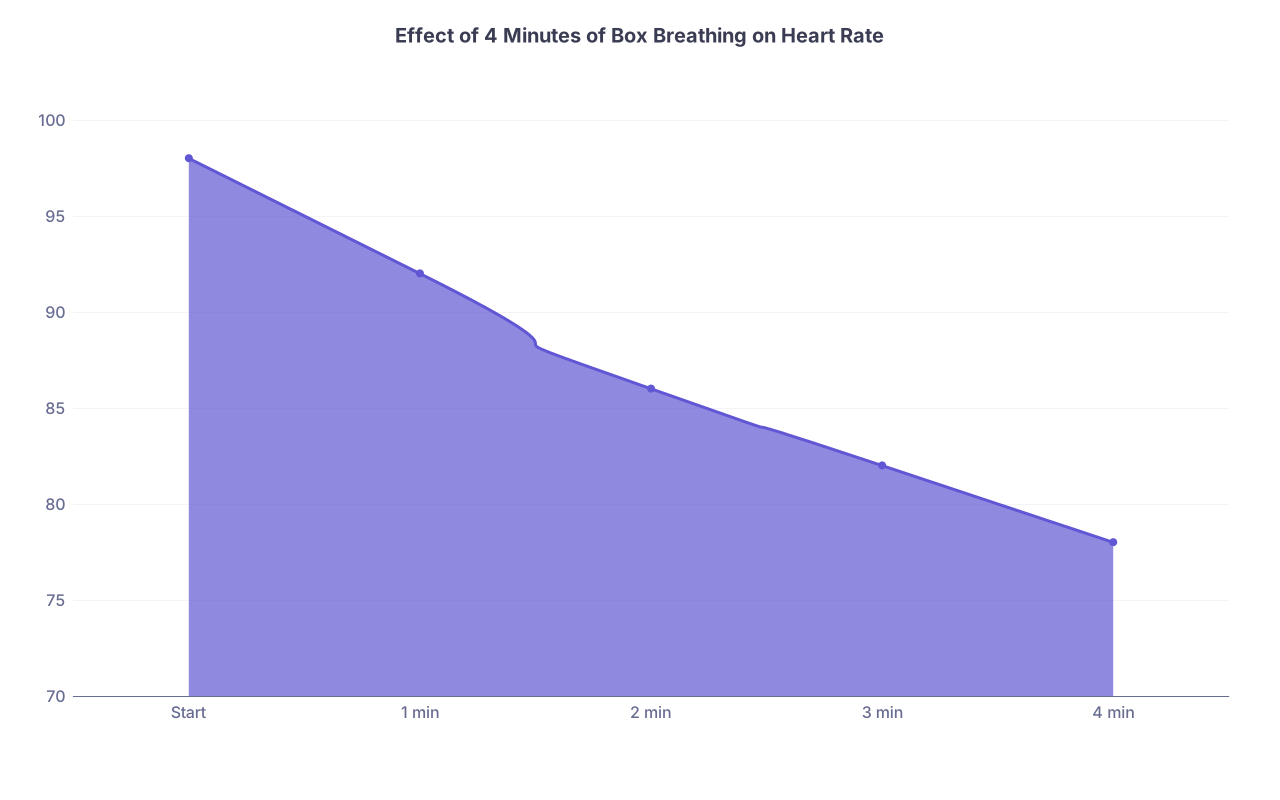
| Category | Value |
|---|---|
| Start | 98 |
| 1 min | 92 |
| 2 min | 86 |
| 3 min | 82 |
| 4 min | 78 |
That is a realistic pattern I have seen on actual wearables in anxious students.
Step 4: Targeted Muscle Release – Neck / Hands (1–2 Minutes)
While you keep an easy, slightly slower breathing rhythm (no need for strict counting now), do a very short muscle reset in the two areas that usually hold the most tension:
Neck release (30–45 seconds)
- Gently drop your chin toward your chest.
- Slowly roll your head half‑circle to the left, then to the right. Once each side.
- Keep movement small. You are in an exam, not a yoga class.
Hand/forearm release (30–45 seconds)
- Extend both arms forward under the desk (if possible), shake hands loosely for 5–10 seconds.
- Let them rest on the desk with fingers loose, not clawed over the mouse or keyboard.
By minute 7, your physiologic spike is coming down. You will not feel perfectly calm. That is fine. You just need to be functional, not zen.
Minutes 7–11: Cognitive Reboot (Get Your Brain Back Online)
Now that the alarm system is turning down, you need to restart exam‑mode thinking.
Trying to jump straight into complex vignettes can re‑trigger panic. So you use a short cognitive warm‑up.
Step 5: Directed Recall Preview (1–2 Minutes)
You are not going to “review” content. That ship has sailed. What you are doing is priming recall pathways so your brain sees it is still capable of pulling information.
In your head only, quickly run through 3–5 mini prompts from high‑yield topics you know reasonably well.
Examples:
- “Causes of anion gap metabolic acidosis – MUDPILES: methanol, uremia, DKA, propylene glycol, iron/INH, lactic acidosis, ethylene glycol, salicylates.”
- “Cardiac cycle heart sounds – S1: mitral/tricuspid closure; S2: aortic/pulmonic; S3: rapid filling; S4: stiff ventricle.”
- “Nephrotic criteria: proteinuria >3.5 g/day, hypoalbuminemia, edema, hyperlipidemia.”
You pick your usual anchors: a favorite mnemonic, a diagram you always imagine, a disease you can describe cold.
The point: you are proving to your own brain, in real time, “I still know things. Access is working. I am not blank.”
Step 6: Self-Talk Reset Script (1–2 Minutes)
Most anxious students use atrocious self‑talk:
- “I’m going to fail.”
- “Everyone else is more prepared.”
- “I always screw exams up.”
You cannot afford that. You need a rehearsed, neutral‑to‑confident script. Keep it short. Memorize it. Say it in your head exactly as written.
Here is a template that works:
“My job is not to be perfect. My job is to earn points.
I have taken hard exams before and passed.
I will take one question at a time and keep moving.
Panic wastes time. Process earns points.”
If that sounds cheesy to you, good. Write your own. But write it in advance and keep it under 4 sentences. Then you run it here.
You are not trying to “believe” it 100 percent. You are trying to dilute the catastrophe story enough that it stops hijacking your focus.

Minutes 11–15: Exam Re-entry Strategy (Execute, Do Not Drift)
You have about 4 minutes left in your 15‑minute window. This is where people either:
- Drift aimlessly into the exam and lose another 10 minutes, or
- Overcompensate and rush, making sloppy mistakes.
You will use a deliberate re-entry strategy.
Step 7: The First-5 Questions Rule (3–4 Minutes)
You control the first moves you make. And early momentum matters.
Rule: The first 5 questions are not about maximum difficulty. They are about stabilizing your process.
Here is the strategy:
- Start the exam or return from your pause.
- For each of the first 5 questions:
- Do a 10-second read of the stem. Do not skim faster than that.
- Identify the question type in your head: diagnosis / mechanism / next step / risk factor / most likely finding.
- If you are at least 60% sure you can answer with a reasonable attempt:
- Eliminate obvious wrong choices.
- Choose your best answer.
- Mark for review only if there is a specific reason (e.g., need to recall a threshold value).
- If you are completely lost or your anxiety surges again:
- Pick the least wrong answer based on pattern recognition.
- Mark and move on. Maximum 45–60 seconds on a “bad” question.
You are teaching your brain: “We move. We do not get stuck. We rack up points steadily.”
By question 6 or 7, most students find:
- Their breathing is more natural
- Their focus is on the question, not the exam outcome
- Their confidence is at least slightly improved
At that point, the protocol has done its job.
How to Use This During Different Exam Phases
You will not always have a clean 15‑minute block. So let us adapt.
Scenario 1: Pre-Exam Waiting Room (Full 15 Available)
Use the full protocol in this order:
- Minutes 0–2: Grounding + micro reset
- Minutes 2–7: Box breathing (8–12 cycles) + brief muscle release
- Minutes 7–11: Directed recall + self-talk script
- Minutes 11–15: Visualize your first‑5 questions rule and the physical act of starting
You can do almost all of this without anyone noticing.
Scenario 2: Right After Exam Start (10-Minute Version)
You read the first question and feel the panic spike. You cannot spare 15 whole minutes.
Run this condensed in-exam version:
- Grounding + micro reset: 1–2 minutes
- Box breathing: 4–6 cycles (about 1–2 minutes)
- Self-talk script: 30 seconds
- Start questions using the first‑5 questions rule immediately
Total lost time: ~5 minutes.
Total performance gain: often the difference between underperforming and hitting your practice range.
Scenario 3: Mid-Exam Freeze (5-Minute Hard Reset)
You are halfway through. You get a brutal question block. Your accuracy falls apart. You feel the spiral start again.
Use a 5-minute hard reset:
- Look at the exam clock. Decide: “I am buying back my brain in the next 5 minutes.”
- 2 minutes: Box breathing (8 cycles) at your station.
- 1 minute: Self-talk script + quick directed recall (2 prompts).
- 2 minutes: Back to questions with strict time caps per item (e.g., 75 seconds).
You will not do this more than once per block. It costs time. But a five‑minute rescue that salvages the remaining 60–90 minutes is a good trade.

| Step | Description |
|---|---|
| Step 1 | Feel panic rising |
| Step 2 | Run full 15-min protocol |
| Step 3 | Run 5-min condensed start |
| Step 4 | Run 5-min hard reset once |
| Step 5 | Begin exam with first-5 rule |
| Step 6 | Resume with time caps per question |
| Step 7 | Where are you? |
What You Need To Prepare Before Exam Day
If you try to improvise this protocol under stress, you will forget half of it. You must pre-load it.
1. A One-Page Protocol Card (Memorized or Written)
Write a stripped-down version you can rehearse the week before:
- Stop: Grounding (3-3-3 senses) + physical micro reset
- Breathe: 8–12 cycles box breathing
- Reset: 3 recall prompts + script
- Execute: first‑5 questions rule
You cannot bring notes into most exams, obviously. But writing and practicing the card burns the steps into your head.
2. A Personal Self-Talk Script
Do this now, not the night before:
- Write 3–4 lines.
- Make them specific, performance-focused, not generic positivity.
Example alternative:
“I have prepared as well as I reasonably could.
My job is to earn points, not be perfect.
I will manage my time and keep moving forward.
I can tolerate discomfort and still perform.”
Then read it out loud once a day in the week leading up.
3. A Rehearsal Under Mild Stress
You need at least one practice run:
- Take a full‑length practice block (e.g., 40 questions, 60 minutes).
- Halfway through, deliberately pause and simulate anxiety (remind yourself of what is at stake, look at missed questions, etc.).
- Then run the 5‑minute hard reset and finish the block.
This teaches your brain: I have a plan when things go bad. That belief alone cuts anxiety.
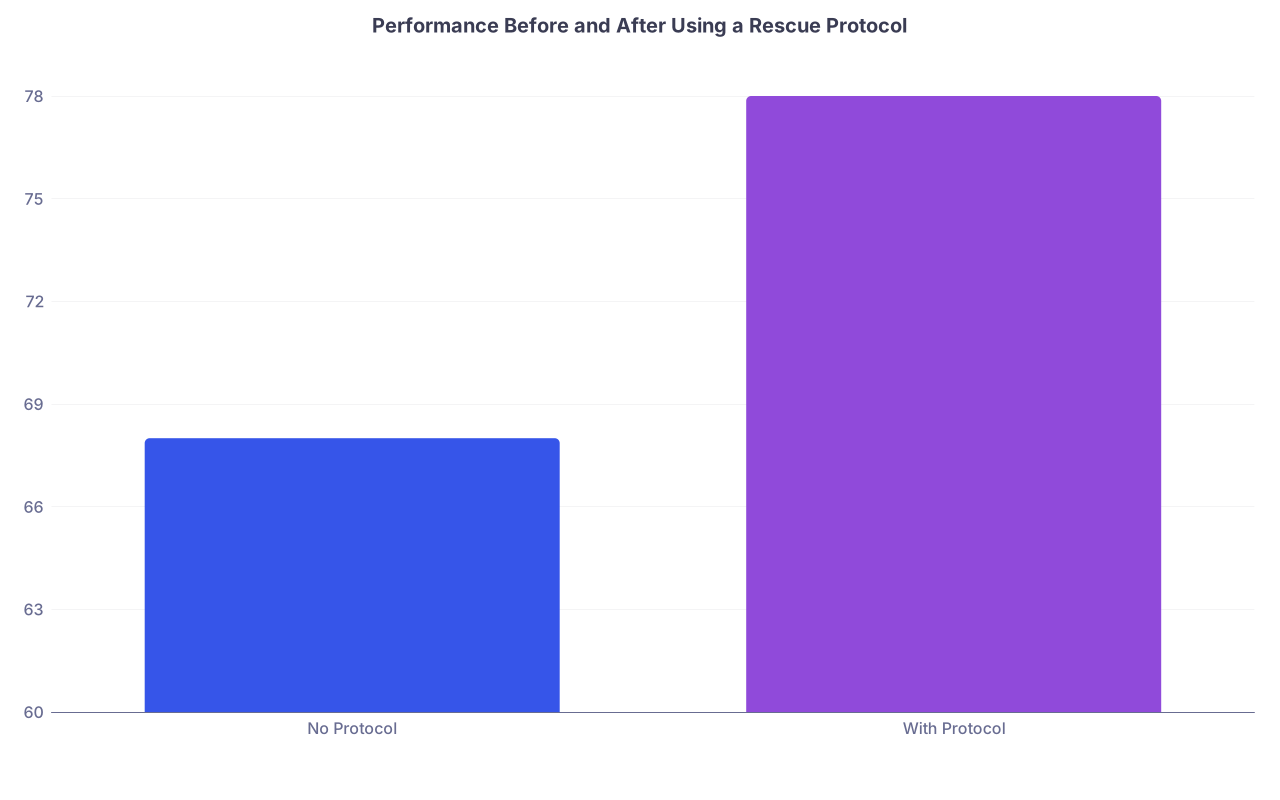
| Category | Value |
|---|---|
| No Protocol | 68 |
| With Protocol | 78 |
A 10‑point jump in percent correct between “no plan” and “with plan” is not fantasy. I have watched exactly that in medical students across multiple practice exams.
Mistakes That Worsen Acute Test Anxiety (Avoid These)
Some of you are unknowingly pouring gasoline on the fire. Here is what to stop doing, bluntly.
1. Last-Minute Cramming in the Hallway
Standing outside the testing room, reading First Aid or Anki on your phone:
- Increases cognitive load
- Amplifies “I do not know enough” thoughts
- Trains your brain to associate exam entry with frantic input, not focused output
Fix: Stop new input 30–60 minutes before. At most, glance at 1–2 calm, familiar summary pages, then switch to the protocol: breath, grounding, script.
2. Time Obsession During the First 10–15 Minutes
Staring at the clock every 90 seconds while your anxiety is highest is a great way to tank performance.
Fix: During your initial 15‑minute window, you look at the clock only at the start and end of your protocol. Then again after your first 5–7 questions.
3. Question Perfectionism
Spending 3 minutes wrestling with a single question early because you “should” know it is a disaster. That is how you both increase anxiety and run out of time.
Fix:
- Enforce a hard cap per question (e.g., 75–90 seconds, depending on exam).
- Remember: You are there to maximize total points, not to solve every puzzle.

4. Catastrophic Thinking Between Blocks
Walking out of a block muttering “I failed, that was horrible” is how you poison the next one.
Fix:
- As soon as a block ends, forbid post-mortem until the entire exam day is done.
- If your brain starts replaying questions, use a pattern interrupt phrase, e.g., “Not helpful. Next block. Earn points.”
How This Fits with Longer-Term Anxiety Management
This protocol is not a replacement for ongoing work if you have chronic anxiety or panic disorder. It is a day‑of performance tool.
Lots of medical students need both:
- Long‑term: therapy (CBT, ACT), lifestyle changes, sometimes medication under proper supervision.
- Short‑term: a clear test‑day strategy so months of prep are not wasted in a 20‑minute panic.
Think of this protocol as your emergency airway cart for test anxiety. You hope you do not need it. You will be grateful it is there when you do.

Final Tight Summary: What You Actually Do
Keep it simple. On exam day, here is what you execute:
Stop the spiral (0–2 minutes)
- Ground: 3 things you see / feel / hear
- Quick physical reset: jaw, shoulders, hands, posture
Calm physiology (2–7 minutes)
- 8–12 cycles of box breathing (4–4–4–4)
- Brief neck and hand release
Reboot cognition (7–11 minutes)
- Recall 3–5 familiar prompts silently
- Run your 3–4 line self‑talk script
Re-enter with a plan (11–15 minutes)
- Start the test using the first‑5 questions rule
- Keep moving; no question gets to hold you hostage
Acute test anxiety on exam day feels like your brain has betrayed you. It has not. You are dealing with a misfiring threat system. Run the protocol. Buy back your clarity. Then go earn your points.


