The way you are handling your racing thoughts before exams is inefficient and fixable.
You do not have “test anxiety” in some mystical, untouchable way. You have an unstructured brain trying to manage a high‑stakes situation without a system. That is what we are going to fix.
This is not another “just breathe and think positive” piece. You have already tried that. It failed. You need a workflow that:
- Catches the racing thoughts in real time
- Turns them into specific, solvable tasks
- Fits into a packed medical school schedule
- Can be repeated before every exam without reinventing the wheel
Here is the workflow I teach students who go from near-panic before exams to walking in with a predictable routine.
Step 1: Capture Everything (Stop Letting Thoughts Free-Roam)
Racing thoughts win when they stay in your head. Your first move is not to calm down. It is to externalize.
You need a 10–15 minute “mental download” process. No more. This is not journaling for feelings. This is triage.
Do this as soon as you notice your thoughts spinning about an upcoming exam, or at least 5–7 days before a major test (block exam, NBME, shelf, Step).
The 10–Minute Brain Dump Protocol
Grab:
- One sheet of paper or a blank doc
- A timer set for 10 minutes
- No phone, no emails, no notes open
Write down everything that is bouncing around your head related to the exam. Not in sentences. In fragments. Example:
- “Did not touch cardiomyopathies”
- “UWorld blocks too slow”
- “Keep forgetting nephrotic vs nephritic”
- “Sleep has been garbage”
- “Panicking about biostats again”
- “What if I freeze on first question”
- “Still behind on lectures 23–30”
- “Need to email Dr. L for accommodations?”
No structure. No filtering. Just capture.
At the end, you should have a messy list that looks like a stressed person’s brain. Perfect. Now we move from chaos to categories.
Step 2: Sort Thoughts Into Four Buckets
Racing thoughts are dangerous because they blur together:
- Real preparation issues
- Logistics problems
- Performance fears
- Random noise
You cannot solve “I am going to fail this exam.” You can absolutely solve “I have not done any pathology questions yet.”
So you force every item into one of four buckets:
- Content Gaps – things you do not know or have barely touched
- Practice & Skills – doing questions, timing, test-taking habits
- Logistics & Environment – when, where, what you need ready
- Mental Noise – unhelpful predictions, self-criticism, vague dread
Draw four columns on the same page and rewrite each thought into a column. Example:
Content Gaps
- Did not touch cardiomyopathies
- Keep forgetting nephrotic vs nephritic
- Biostats formulas still fuzzy
- Micro for parasites basically untouched
Practice & Skills
- UWorld blocks too slow
- Timing off by last 10 questions
- Keep changing right answers to wrong
- Never review explanations properly
Logistics & Environment
- Sleep has been garbage
- Not sure what time I want to test
- Need to figure out where to take practice NBME
- Need snacks/drinks for exam day
Mental Noise
- What if I freeze on first question
- I am behind everyone else
- I passed last time by luck
- I am just bad at standardized tests
Already your brain feels less out of control, because now it sees categories of problems instead of a single tsunami.
Next step: convert each bucket into actions.
Step 3: Turn Buckets Into Specific, Bounded Tasks
You are going to build a Calm Test Plan from these buckets. The rule is simple:
No vague goals. Every item must be an action you can schedule on a calendar.
“I need to know cardiology better” is useless.
“Do 40 cardiology questions and review weak topics” is usable.
Work bucket by bucket.
A. Content Gaps → Targeted Micro-Blocks
For each content item, define:
- The resource you will use
- The size of the chunk
- The time box (how long you will spend)
Example conversions:
“Did not touch cardiomyopathies” →
- Task: Watch Boards & Beyond cardiomyopathies video + 15 Anki cards on cardiomyopathies
- Time: 45–60 minutes
“Biostats formulas still fuzzy” →
- Task: 1-hour focused session: re-learn PPV/NPV, sensitivity/specificity with 20 practice questions from UWorld biostats filter
“Micro for parasites basically untouched” →
- Task: 30 minutes sketchy micro parasites video + 20 image-based flashcards
Your rule: no single content task exceeds 60 minutes. If it does, break it.
B. Practice & Skills → Structured Reps, Not Endless Questions
Racing thoughts around practice often come from you doing questions without a structure. “More questions” is not a plan.
For each practice concern, specify:
- Number of questions
- Mode (timed vs tutor)
- Review method
Example conversions:
“UWorld blocks too slow” →
- Task: 3 timed blocks of 10 questions (random) with a 15-minute timer each, focusing on finishing with at least 2 minutes to spare
“Keep changing right answers to wrong” →
- Task: For next 40 questions, track every answer change. Only allow changes for clear reasons (new info, misread stem). Afterwards, review each change and mark whether it improved or worsened your score.
“Never review explanations properly” →
- Task: For next 20 questions, spend at least 3 minutes per question in review: identify “what did I miss?” and do 1–2 targeted flashcards for that concept.
Now your practice sessions are experiments, not self-punishment.
C. Logistics & Environment → Checklists, Not Vague Worry
Logistics anxiety explodes because nothing is explicit. So you build micro-checklists.
Common items:
- Exam date/time confirmed
- Transportation planned, backup option identified
- What you are eating the night before and morning of
- What you are bringing (ID, snacks, layers, earplugs, meds)
- When you will stop studying day before
Example conversions:
“Sleep has been garbage” →
- Task: For 5 nights before the exam, screens off by 11 p.m., in bed by 11:30 p.m., no caffeine after 3 p.m., quick 10-minute wind-down (stretching or light reading, not notes).
“Not sure what time I want to test” →
- Task: Experiment with two timed practice blocks at your potential exam time this week. Pick the time when you feel mentally sharpest and schedule by [specific date].
“Need to figure out where to take practice NBME” →
- Task: Reserve a quiet room in library for 4 hours on Saturday, simulate real exam (arrival time, breaks, no phone).
Once logistics are explicit, that whole category of racing thoughts calms down.
D. Mental Noise → 2–3 Counter-Statements + One Rule
You cannot schedule away “I am a failure.” But you also cannot just ignore it.
You treat mental noise like background error messages. You do not debate each one. You label them and replace them with standard responses.
Process:
- Pick your top 3 recurring negative thoughts
- Write 1–2 grounded counter-statements for each
- Choose one behavior rule linked to each thought
Example:
Thought: “What if I freeze on first question?”
- Counter: “I have a script. If I freeze, I take a 5-second breath, reread the last two lines of the stem, and eliminate one option.”
- Behavior rule: On every practice block this week, deliberately pause on at least one question and rehearse that script.
Thought: “I’m just bad at standardized tests”
- Counter: “My scores improved from 55% to 68% over the last three weeks when I changed my review method. Bad test takers do not improve like that.”
- Behavior rule: When this thought shows up during study, I must finish the block before I am allowed to check my score. No mid-block score checking.
Write these on a small card or note in your phone. That becomes your Mental Error Message Manual. You do not improvise responses while anxious. You execute what you wrote when calm.

Step 4: Build a Simple Weekly Calm Test Plan
Now you have raw material. You still need a workflow—a repeated pattern that turns all this into a calendar that your brain trusts.
Here is a baseline weekly structure for medical school exams (block exam, NBME, or shelf) that already accounts for racing thoughts:
| Day (Before Exam) | Primary Focus | Content Tasks | Practice Tasks | Mental & Logistics |
|---|---|---|---|---|
| Day -7 | Big-picture triage | ID major gaps | 20-40 Qs | Brain dump + plan |
| Day -6 to -5 | Content focus | 3–4 blocks/day | 20-40 Qs/day | Sleep targets |
| Day -4 | Mixed practice | Light review | 2 full blocks | Logistics checklist |
| Day -3 | NBME / full-length | None heavy | 1 simulated | Post-exam debrief |
| Day -2 | Patch holes | Targeted review | 20-30 Qs | Test-day script |
| Day -1 | Wind-down review | Flashcards only | 10–20 easy Qs | Confirm everything |
| Day 0 | Exam day | None | None | Execute routine |
You adjust details based on your exam, but the skeleton stays the same.
How to Populate the Plan (Real Example)
Let’s say it is Day -7 for an NBME:
- Do the 10-minute brain dump
- Sort into the four buckets
- Choose:
- 3–5 content tasks
- 2–3 practice/skills tasks
- 3 logistics tasks
- 2 recurring mental noise patterns
Now slot them into the 7 days:
- Put heavy content earlier (Day -7 to -5)
- Put simulation/full NBME on Day -3 or -4
- Put patching + light review + mental scripts on Days -2 and -1
Write this on an actual calendar (digital or paper). You should end with something like:
Monday (Day -6):
- 9–10 a.m. – Cards: cardio path (video + 15 Anki)
- 1–2 p.m. – 20 UWorld questions timed, focus: cardiology
- 4–5 p.m. – Review questions in depth
- 11 p.m. – Screens off
Tuesday (Day -5):
- 8–9 a.m. – Biostats formulas + 20 questions
- 2–3 p.m. – 10-question timed block, track answer changes
- 7–7:15 p.m. – Mental script rehearsal (review negative thoughts + counters)
Your schedule does not need to be packed every hour. It does need clarity.
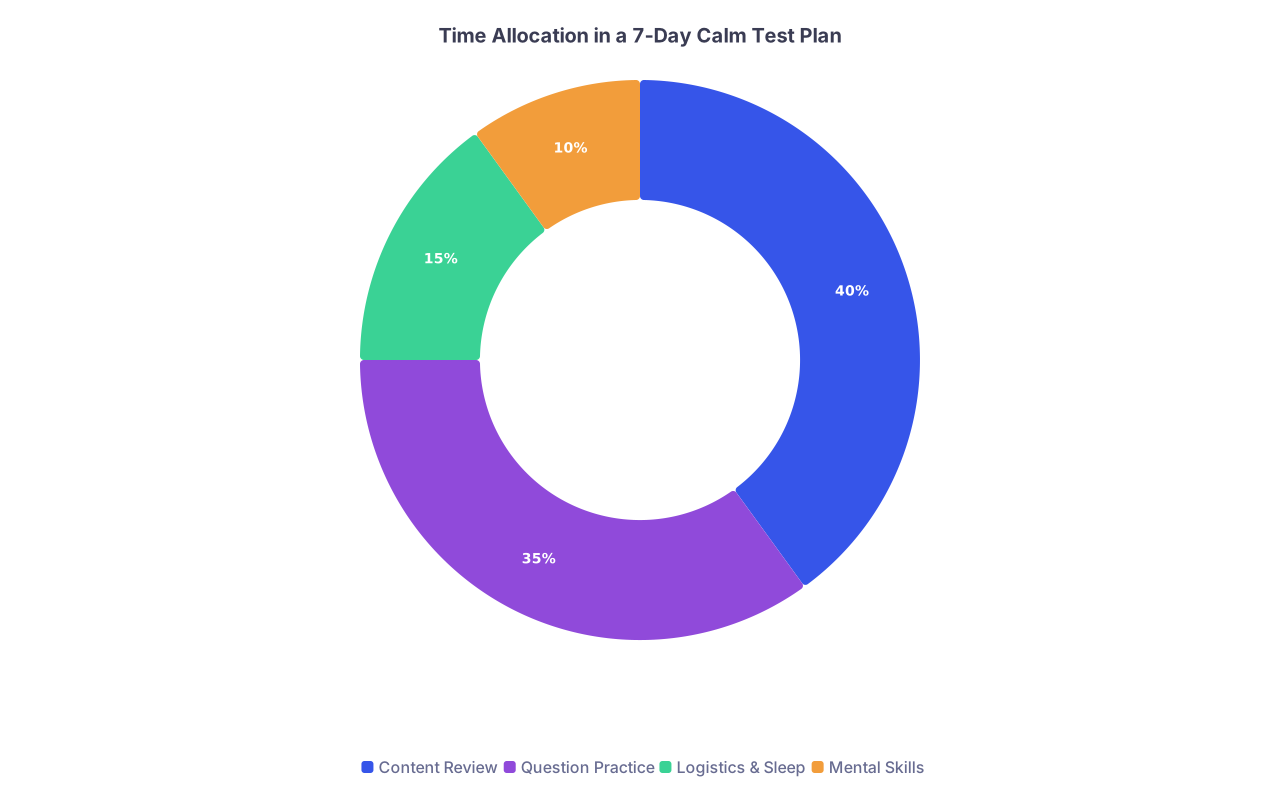
| Category | Value |
|---|---|
| Content Review | 40 |
| Question Practice | 35 |
| Logistics & Sleep | 15 |
| Mental Skills | 10 |
Step 5: Create a 3-Part Pre-Test Routine for the Night Before and Morning Of
Most students sabotage themselves in the last 24 hours. Not with content. With chaos.
You need a locked-in 3-part routine:
- The evening boundary
- The morning warm-up
- The “first 10 minutes” test script
1. The Evening Boundary (Day -1)
Your only job the night before is to convince your nervous system you are not about to be eaten by a tiger.
Hard rule: No new resources. No “just checking that one rare disease.”
Your evening plan:
- 30–60 minutes of light review only
- Flashcards you already know reasonably well
- High-yield summary sheets you have seen before
- 10–15 minutes: logistics check
- Clothes out
- Snacks ready
- ID, keys, headphones, glasses/contacts laid out
- Confirm test time, route, arrival time
- One calming activity for at least 20–30 minutes
- Walk
- Light TV
- Shower
- Talk with a non-med friend or family
Set a latest study cutoff. For most students: 8–9 p.m. After that, no content. Only logistics, then wind-down.
If you find yourself tempted to reopen material at 11:30 p.m., that is not “dedication.” That is fear. And it will cost you points.
2. The Morning Warm-Up
You should not walk into a high-stakes exam with your first question of the day being a real one.
Design a 20–30 minute warm-up:
- 5 minutes light stretching or breathing
- 10–15 minutes of easy to moderate questions or flashcards that you usually get right
- 5 minutes mental script review (from your Mental Error Message Manual)
Zero scoring. Zero checking percentages. The goal is to build momentum, not evaluate yourself.
Pick content you are strong in. You want your brain thinking, “Right, I know how to do this,” not “Wow, I still do not know leukemias.”
3. The First 10 Minutes Script
Most catastrophic spirals start in the first 5–10 minutes:
- You stare at the first question too long
- You hit your first unknown and panic
- Your heart rate spikes and you start “future failing” the entire test
You need a mechanical script for those minutes, so you are following steps instead of your fear.
Example script:
Before starting: 3 slow breaths, exhale longer than inhale
First question: read last 2 lines of stem first (what is being asked?)
If stuck >60 seconds:
- Eliminate 1 obviously wrong option
- Make your best guess
- Mark for review
- Move on without re-reading the entire stem
Every 10 questions:
- Quick micro-check: “Am I breathing? Am I reading questions fully?”
- Shoulder drop, unclench jaw, 3 breaths
This is not “relaxation.” This is a procedure. Like a code blue algorithm. You do not wait to feel calm to run it.
Write the first-10-minutes script on paper or memorize it by rehearsal during practice blocks.

| Step | Description |
|---|---|
| Step 1 | Racing Thoughts |
| Step 2 | 10-Min Brain Dump |
| Step 3 | Sort into 4 Buckets |
| Step 4 | Convert to Tasks |
| Step 5 | 7-Day Calm Test Plan |
| Step 6 | Evening & Morning Routine |
| Step 7 | First 10 Minutes Script |
| Step 8 | More Predictable Performance |
Step 6: Install the Workflow As a Habit, Not a One-Off Fix
If you use this system once and abandon it, your brain will treat it like a fluke. The power comes from repetition.
Here is how you turn this into a standard operating procedure:
Create a reusable template
- One page or doc with sections:
- Brain Dump
- Content Gaps
- Practice & Skills
- Logistics
- Mental Noise
- Weekly Plan
- Test-Day Scripts
- One page or doc with sections:
Attach it to your exam calendar
- For every scheduled exam, add a reminder 7 days before: “Run Calm Test Plan template.”
Run mini-versions for smaller tests
- For quizzes or short exams, do a 5-minute version: quick brain dump, 1–2 tasks in each of 3 categories, 5-minute morning warm-up.
Post-mortem after each exam (15 minutes)
- What parts of the plan helped?
- Where did anxiety still spike?
- One change for next time
Over 3–4 exams, you will see patterns. For example:
- Your sleep always falls apart 3 days before → add firmer bedtime rules those days
- You always panic on first biostats question → move biostats into every warm-up set
Your Calm Test Plan becomes personalized instead of generic.

Step 7: Handle Worst-Case Spirals During the Exam
Even with a good plan, sometimes your brain melts mid-exam. Racing thoughts hit anyway. Here is the emergency workflow for in-exam spirals.
The 60–30–10 Rescue Protocol
When you notice:
- Heart racing
- Mind thinking “I am failing, I have no idea, I cannot do this”
- Urge to click randomly or give up
You run this sequence:
60 seconds: Step Back Physically
- Take your hands off the mouse/keyboard
- Look away from the screen (down at your lap or desk)
- 4–6 slow breaths (inhale for 4, exhale for 6)
You are not doing this to feel “zen.” You are just taking your brain from full panic to slightly less panicked—enough to think.
30 seconds: Ground in Procedure
Remind yourself of 2 fixed things:
- Your time rule (e.g., “No more than 90 seconds per question on first pass”)
- Your guess-and-move rule (eliminate one, pick the best, mark, move)
Silently say: “Follow the rules, not the feelings.”
10 seconds: Commit to the Next Micro-Action
Your only job is the next question, not the entire exam.
- Read the last 2 lines of the next stem
- Decide what type of question it is (diagnosis, next best step, mechanism, etc.)
- Move through the algorithm you practiced
You can run this protocol as many times as needed. Most students find they only need it 1–3 times per block once they have practiced in advance.
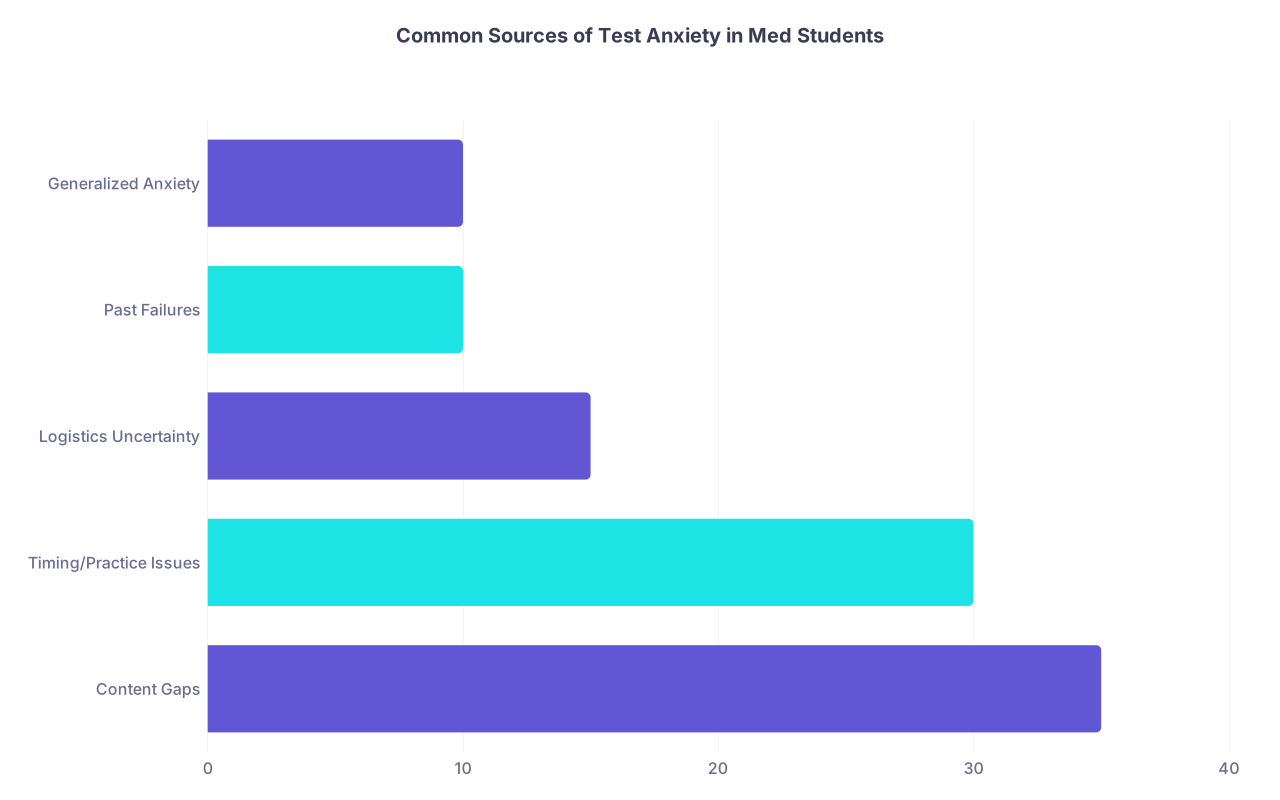
| Category | Value |
|---|---|
| Content Gaps | 35 |
| Timing/Practice Issues | 30 |
| Logistics Uncertainty | 15 |
| Past Failures | 10 |
| Generalized Anxiety | 10 |
Step 8: Know When This Is Not Enough (And What to Do)
This workflow will help most medical students who experience situational test anxiety. But some of you are dealing with something heavier:
- Panic attacks days before or during every major exam
- Physical symptoms so strong you cannot sleep or eat
- Long history of anxiety or mood disorders
- Prior exam failures that still feel traumatic
If you recognize yourself there, you still use this plan. But you also:
- Talk to student health or a therapist about targeted treatment (CBT for test anxiety is very effective)
- Ask about whether formal accommodations make sense (extra time, reduced-distraction room, breaks)
- Loop in your dean’s office early if you are heading into boards or high-stakes exams
You are not weak for needing more than a workflow. You are smart for stacking tools.

Put It All Together
You do not beat racing thoughts with generic reassurance. You beat them with structure:
- Capture the chaos
- Sort it into buckets
- Convert to specific tasks
- Lay out a simple 7-day plan
- Lock in evening, morning, and first-10-minute routines
- Practice the same system until your brain recognizes it as “how we do tests now”
This is how you walk into exams less like a victim of your anxiety and more like a clinician running a protocol.
Your Action Step Today
Do this right now, even if your next exam is two weeks away:
- Set a 10-minute timer.
- Do a brain dump about your next exam on a single sheet of paper.
- Draw the four columns (Content, Practice, Logistics, Mental Noise) and sort every item.
- From that list, write one content task, one practice task, and one logistics task you can do in the next 48 hours.
You do not need to fix your test anxiety today. You need to prove to your brain, today, that those racing thoughts can be turned into a plan.