
Practical Script: How to Ask for Test Accommodations Without Fear
It is 8:07 p.m. The exam is in three weeks. Your chest is tight just looking at the schedule. You know you need extended time, or a quiet room, or breaks so your brain does not short-circuit halfway through block 2.
You also know you have been avoiding one thing: actually asking for accommodations.
You keep thinking:
- “They will think I am weak.”
- “What if they say no?”
- “What if this goes in my ‘file’ and affects residency?”
- “I do not have the right words. I will sound dramatic.”
You are not alone. I have watched smart, capable med students white-knuckle exams for years rather than send one email. Then finally they ask, get support, and say the same sentence every time: “I should have done this a year ago.”
So let us fix this. You need:
- A clear plan of who to talk to and in what order.
- Concrete email and in-person scripts you can actually use.
- A way to manage the fear so you do not bail halfway through.
You will get all three.
Step 1: Understand What You Are Asking For (So You Do Not Over-Explain)
You are not begging for a favor. You are requesting an evidence-based, legally supported modification to how you take tests, so that the exam measures your knowledge, not your impairment or anxiety physiology.
Typical medical school test accommodations fall into a few buckets:
Time-related
- 1.25x or 1.5x time
- Stop-the-clock breaks
- Extra break time between blocks (especially for ADHD, anxiety, diabetes, GI issues)
Environment-related
- Reduced-distraction or private room
- Seating near exit / restroom
- Noise-canceling headphones or earplugs (if allowed by policy)
Format-related
- Paper exam instead of on-screen (rare in med school but common on internal quizzes)
- Use of a screen reader or magnification software
- Larger font or high-contrast settings
Medical / functional accommodations
- Permission to have snacks, glucometer, rescue inhaler at desk
- Permission to stand/stretch during exam
- Access to medication at specified times
| Need/Condition | Typical Accommodation |
|---|---|
| ADHD | 1.5x time, quiet room |
| Generalized anxiety | Extra breaks, quiet room |
| Test anxiety/panic | Stop-the-clock breaks |
| Visual issues | Magnification, larger font |
| Medical conditions | Snacks, med access, breaks |
You do not have to know exactly what you need in technical terms. But you should have:
- A concrete description of what happens during exams (e.g., “I lose 15–20 minutes to panic symptoms”).
- A couple of specific changes that would directly help.
You are asking for functionally reasonable changes, not an easier test.
Step 2: Know Who to Contact (and Who Not To)
The fear gets worse when the path is fuzzy. So draw a simple map.
In most U.S. med schools, the chain looks like this:
Disability / Accessibility Services Office
- They determine eligibility and write the accommodation letter.
- They know the legal side. They have seen every version of this.
- You start here in almost all cases.
Student Affairs / Dean of Students
- Often involved in implementing school-level exam accommodations.
- You might meet with them after Disability Services approves.
Course Director / Exam Coordinator
- They implement logistics for specific exams.
- You usually do not start with them. You come to them with an official letter.
For NBME, USMLE, COMLEX, shelf exams
- Separate application, often long and annoying.
- Your school and Disability Services can help assemble this.
If you are tempted to start by “just asking the course director quietly” without documentation: do not. That is how you end up with inconsistent treatment and zero protection if someone changes their mind.
Step 3: Pre-Work – What to Gather Before You Reach Out
You will reduce your fear if you walk in prepared. Two buckets: paperwork and story.
A. Documents (gather what you can, do not obsess if it is not perfect)
Ideally you bring:
- Prior diagnostic evaluations (psych, neuropsych, psychiatrist, therapist letters)
- History of past accommodations (MCAT, undergrad, SAT/ACT, previous schools)
- Medical documentation if relevant (e.g., psychiatrist note, neurologist, PCP)
If you do not have any of this:
- That is not the end. It just means they may require an evaluation now.
- Start the process anyway. Waiting will not make it easier.
B. Your functional story (the 60-second version)
You want a crisp, factual explanation of:
- What your condition is (diagnosed or suspected).
- How it shows up during exams.
- What it costs you in terms of performance.
- What changes would directly reduce that barrier.
Very concrete. Example:
“I have long-standing panic attacks that intensify during timed exams. On block exams, I typically lose 15–20 minutes to racing heart, shortness of breath, and tunnel vision. My practice scores at home without strict time limits are 15–20% higher than my in-school scores. Extra time and the ability to take brief stop-the-clock breaks when panic symptoms spike would allow the exam to reflect my actual knowledge rather than the acute anxiety episodes.”
That is the level of clarity you want.
Step 4: Email Script to Disability / Accessibility Services
You are going to write a short, calm email. Your goal is not to prove anything yet. Your goal is to get a meeting scheduled.
Copy, paste, and edit this:
Subject: Request for Meeting – Exam Accommodations
Body:
Dear [Office/Coordinator Name],
I am a [MS1/MS2/MS3/MS4] student at [School Name]. I am writing to request an appointment to discuss potential testing accommodations.
I have a history of significant difficulty with high-stakes exams related to [brief description: e.g., ADHD, test anxiety with panic attacks, a medical condition], which continues to affect my performance on medical school exams.
I would like to review my situation and understand what documentation is needed to determine eligibility for accommodations, including for upcoming [course exams / NBME shelf exams / Step 1 / Step 2 CK].
I can be available [give 3–4 time windows over the next week]. Please let me know what works best or if there are forms I should complete before our meeting.
Sincerely,
[Full Name]
[Class Year]
[Student ID (if appropriate)]
That is it. You are not writing your life story in this email. You are opening the door.
If you feel yourself over-explaining, stop. Hit send.

Step 5: What to Say in the Meeting – A Simple Framework
Once you get the meeting, the fear kicks up again. So use a simple 4-part structure:
- History
- Current impact
- What has helped / past accommodations
- What you think you might need now
You can literally bring a written outline and glance at it. That is normal.
Here is a spoken script you can adapt:
“Thanks for meeting with me. I have had [diagnosis or description: for example, ‘significant test anxiety and panic symptoms’ or ‘ADHD, diagnosed in undergrad’] for [X years].
In non-test settings, I function well. I keep up with coursework and clinical duties. But during timed exams, I experience [describe symptoms concisely: racing thoughts, inability to focus, physical symptoms, cognitive slowing].
On our exams, this looks like [give specifics: losing the first 10–15 minutes to anxiety, unable to finish last block, misreading stems]. My performance on untimed or practice questions is consistently higher than my timed exam scores.
In the past, I have had [or: I have not had] formal accommodations. At [prior school/testing], I received [1.5x time, quiet room, breaks], and it made scores align better with my actual knowledge.
For upcoming [course exams/shelves/Step], I am hoping we can explore accommodations like [list 1–3: extra time, reduced-distraction room, extra breaks] so the exams measure what I know rather than my symptoms.”
That is enough to start a productive conversation. You do not need a dramatic story. You need clear, functional impact.
Step 6: Scripts for Talking to a Dean or Course Director
After Disability Services approves accommodations, you may still have to talk to:
- Student affairs / dean
- Course or clerkship directors
- Exam coordinators
This part makes students nervous because it feels more personal. Here is the key: you are not asking them to judge your diagnosis. You are asking them to implement an institutional decision.
Your approach should sound like this:
“I have been approved for testing accommodations through our Disability Services office. I wanted to touch base about how to implement those for [course/clerkship] exams.”
If they already have the official letter:
- You do not have to re-explain your entire medical history.
- You do not have to justify whether you “deserve” this.
Here is a short, practical script:
“Hi Dr. [Name], I wanted to briefly discuss exam logistics. I have a letter from Disability Services approving accommodations including [1.5x time and reduced-distraction room]. Could we review how that will work for the upcoming [exam name]? I want to make sure I follow the correct process and do not miss any steps.”
If someone asks something inappropriate like “What exactly is wrong with you?” you are allowed to pull it back:
“I prefer to keep the specific diagnosis between myself and Disability Services. The letter outlines the approved accommodations, and I am happy to work with you on the logistics of implementing them.”
You are not being difficult. You are enforcing boundaries.
Step 7: Handling Pushback and Stigma (With Actual Lines to Use)
Sometimes people say the wrong thing. Or something that sounds supportive but is actually dismissive.
You may hear:
- “Are you sure you need extra time? You are doing fine.”
- “Everyone gets anxious. Med school is hard for all of us.”
- “You do not look like you have ADHD.”
- “Will this really prepare you for residency?”
Here is how you respond without escalating, and without backing off.
1. “You are doing fine, I do not think you need that.”
“I appreciate your confidence in me. The accommodation process has already been reviewed and approved by Disability Services based on my history and documentation. My goal is to have exam conditions that allow my performance to reflect my actual knowledge, and these accommodations are part of that.”
2. “Everyone gets anxious.”
“That is true. The difference for me is that the level of anxiety and physical symptoms significantly disrupts my ability to read and process questions, and that pattern has been documented over time. The accommodations are targeted to reduce that barrier, not to remove normal stress.”
3. “This will not prepare you for real life / residency.”
“Residency will absolutely be demanding. But even as a resident or attending, we adjust work environments and schedules around people’s medical and cognitive needs all the time. Accommodations do not remove standards. They help ensure the exams are measuring what they are supposed to measure.”
If someone outright refuses to implement documented accommodations:
- That is not a conversation you keep one-on-one.
- You escalate to Disability Services and student affairs immediately.
You can write:
“Dear [Name],
I wanted to follow up regarding implementation of my approved testing accommodations for [exam]. My understanding from Disability Services is that these accommodations apply to all formal exams. Could you clarify how they will be put in place for this course?
I have copied [Disability Coordinator / Dean of Students] to ensure we are all aligned on the process.
Thank you,
[Your Name]”
You are making it clear you are not going to quietly accept non-compliance.
Step 8: Managing Your Own Fear Before and After You Ask
The fear around this is not purely rational. It is often old: “If I admit I need help, something bad will happen.” So you need a small, concrete protocol to keep yourself from bailing.
A. Before you send the first email
Write the email in a text document first
- Take 5 minutes. Use the template above.
- Remove extra explanation. Keep it short.
Set a 10-minute decision timer
- Literally: start a 10-minute timer on your phone.
- You are not allowed to edit the email beyond small wording tweaks.
- When the timer ends, you either hit send, or you intentionally choose “not today” and write down why.
-
- You will probably feel a rush right before hitting send. That does not mean you are doing the wrong thing. That is just your nervous system interpreting vulnerability as danger.
- Name it: “This is anxiety, not a signal to stop.”
B. Right after you send
Have a script ready for your own brain, because it is going to say unhelpful things like “Now they think you are weak” or “You just ruined your reputation.”
Your counter-script, out loud if you can:
“I requested a standard educational support process. This is normal. Lots of med students do this. I am allowed to access the same systems everyone else can.”
And then you shift attention on purpose. 15 minutes of something that is not school:
- Walk outside
- Quick bodyweight workout
- Call a friend and talk about anything except med school
You are interrupting the “rumination loop” that makes you want to unsend the email.
Step 9: If You Do Not Have a Formal Diagnosis Yet
This is extremely common. You are in med school. You have always “managed.” Now the system stress-tests you and cracks show up.
You are allowed to say this:
“I have not had a formal evaluation yet, but I am experiencing significant symptoms that impair my performance on exams. I would like guidance on both the evaluation process and any interim steps that might be possible.”
They may:
- Refer you for a psych or neuropsych evaluation
- Suggest you work with campus mental health
- Explain what temporary or provisional measures (if any) they can offer while evaluation is pending
Do not let “I do not have a perfect diagnosis” delay you 6–12 months. Start now. Evaluations often take that long to schedule anyway.
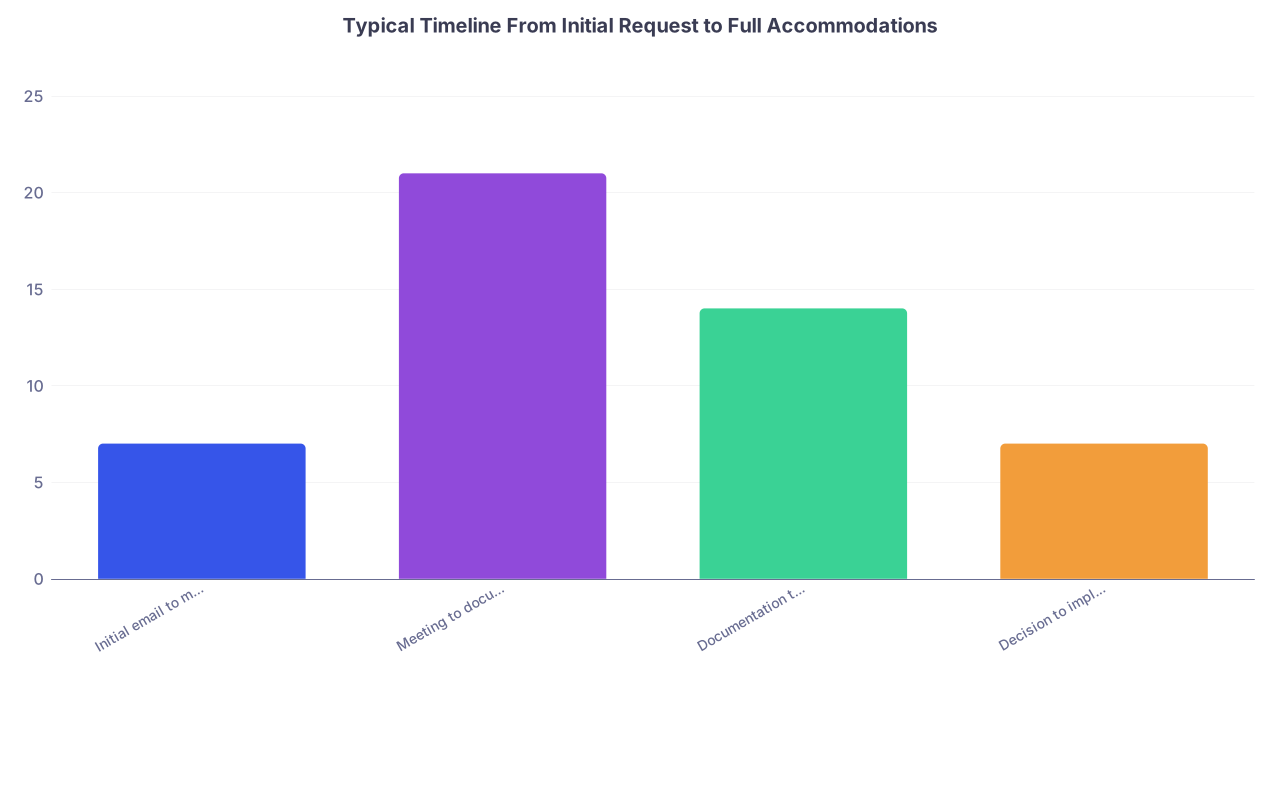
| Category | Value |
|---|---|
| Initial email to meeting | 7 |
| Meeting to documentation | 21 |
| Documentation to decision | 14 |
| Decision to implementation | 7 |
Step 10: Special Case – Asking for Accommodations for Step 1/Step 2 or COMLEX
High-stakes board exams have their own systems: USMLE, NBME, COMLEX. The applications for accommodations are notoriously tedious.
You handle this in two stages.
Stage 1: Internal approval and documentation
You need:
- Formal diagnosis and eval (often within last few years)
- History of impairments and functional impact
- History of prior accommodations (med school and earlier)
Work with:
- Disability Services
- A clinician who knows how to write board-style documentation (psych, neuropsych, psychiatrist)
Stage 2: Application to the testing body
Your script to your school:
“I am planning to request accommodations for [Step 1/Step 2 CK/COMLEX Level 1]. Could we set up a time to review what documentation is needed? I want to make sure I start early enough so the request can be processed well before my planned exam date.”
Do this 6–9 months before you plan to test. Earlier is safer.

| Step | Description |
|---|---|
| Step 1 | Decide to seek boards accommodations |
| Step 2 | Meet with Disability Services |
| Step 3 | Confirm diagnosis & need eval? |
| Step 4 | Complete eval / gather records |
| Step 5 | School prepares documentation |
| Step 6 | Submit to USMLE/COMLEX |
| Step 7 | Wait for decision |
| Step 8 | Schedule exam with accommodations |
| Step 9 | Appeal or adjust plan |
If you are denied, that is not the end:
- You can appeal with stronger documentation
- You can adjust test date while you sort it out
- You can still use school-level accommodations in the meantime
Step 11: A Reality Check on “Fairness” and Identity
Many med students stay stuck because they are secretly running this thought:
“If I get accommodations, my success is not real.”
Let me be direct: that is nonsense.
- A blind surgeon using adaptive equipment is not “cheating.”
- A type 1 diabetic taking breaks to check glucose is not “cheating.”
- A student with panic attacks taking brief stop-the-clock breaks is not “cheating.”
You are not asking to change what you have to know. Only how you demonstrate it.
The exam is supposed to assess medical knowledge and reasoning. Not:
- Your cortisol spike threshold
- The speed of your reading under fight-or-flight
- How long you can hold your bladder
If accommodations mean your score suddenly jumps 10–20 percentile points, that does not mean you bought extra knowledge. It means you finally removed the bottleneck that had nothing to do with medicine in the first place.
Step 12: Putting It All Together – A One-Week Action Plan
If you want something concrete, use this 7-day protocol.
Day 1–2: Prepare
List your specific exam problems
- “Lose first 15 minutes to panic”
- “Never finish sections on time even when I know content”
- “Cannot focus with noise; heart races; mind blanks”
Draft your 60-second functional story
Gather any old documentation (emails, evals, past accommodation letters)
Day 3: Send the email
- Use the script to Disability Services
- Set a 10-minute timer and send it
- Tell one trusted person you did it (accountability helps)
Day 4–5: Meeting prep
- Write down 3–4 specific accommodations that would likely help
- Practice saying your 60-second story out loud once or twice
- Put all documents in a single PDF or folder
Day 6–7: Meeting and follow-up
- Attend meeting, use the 4-part structure (history, impact, past help, request)
- Ask: “What is the expected timeline? What are the next steps?”
- If they need documentation you do not have, schedule the eval now
- Once approved, email course directors/deans with the short implementation script

Step 13: What Success Actually Looks Like
It is not dramatic. No slow-motion Hollywood scene.
Success looks like:
- You sit down for your exam in a smaller room.
- The timer is longer or you know you have scheduled breaks.
- Your brain still gets anxious, but you do not lose 20 minutes to pure panic.
- You can actually read each question once. Then twice if needed.
- When you walk out, your score reflects the work you put in, not your physiological ceiling.
I have seen students go from “barely passing” to “solidly above average” just by aligning testing conditions with their brains. Not because they worked harder. Because they stopped sabotaging themselves by refusing support.
Quick Recap: The 3 Things to Remember
- You are not asking for a favor. You are using a standard, legal educational process to make exams measure your knowledge, not your limitations.
- Lead with function, not drama. Briefly describe what happens during tests, how it affects performance, and what specific changes would help. Let Disability Services handle the legal and diagnostic details.
- Use scripts so fear does not run the show. Copy the emails, practice the 60-second story, and follow the 7-day plan. Hit send even if your heart is pounding. The discomfort lasts minutes. The benefits can last your entire career.