

Winging a conversation about disabling exam anxiety with faculty is a mistake. You need a plan, not a vent session.
You are in medical school. You will be tested. Often. Hard.
If anxiety is repeatedly blowing up your performance, and you keep trying to “just study harder,” you are wasting time.
The leverage point that most students ignore: strategically involving faculty and the system around you. Not just therapy. Not just breathing exercises. System-level help.
What follows is a stepwise plan. You will prepare, you will script, and you will walk into that conversation knowing exactly what you want and how to ask for it.
Step 1: Get Extremely Clear On The Problem (Before You Talk To Anyone)
Do not book a meeting with faculty until you can explain your problem in two sentences.
You are not just “anxious.” You are dealing with a specific pattern that is interfering with exams. You need to name it and describe it.
A. Map out your anxiety pattern
Take 20–30 minutes and write this down, in bullets:
What happens before the exam
- How early does anxiety show up?
- Night before? Week before? As soon as exams are mentioned?
- What does it look like?
- Can’t sleep, nausea, racing thoughts, catastrophizing, avoidance, overstudying, etc.
- How early does anxiety show up?
What happens during the exam
- Physical: heart racing, sweating, shaky hands, tunnel vision.
- Cognitive: blanking on material you knew, rereading questions, misreading stems, losing track of time.
- Behavioral: leaving early, skipping questions, crying, asking to go to the bathroom just to breathe.
What happens after the exam
- Rumination, replaying questions, checking answers obsessively.
- Drop in confidence. Loss of motivation. Dreading the next exam.
Be concrete. For example:
- “On NBME-style exams over 60 questions, by question 15 I feel my chest tighten, I reread questions 3–4 times, and I run out of time. On practice blocks at home I score 78–82%. On actual school exams I’ve scored 62–68%.”
That is the level of detail faculty can work with.
B. Collect actual data from your performance
You want evidence that your anxiety is exam-specific and performance-limiting, not just vague distress.
Gather:
- Practice test scores vs. real exam scores
- Course exams vs. shelf exams vs. in-house quizzes
- Situations where you perform fine (presentations, OSCEs, oral exams) vs. where you fall apart (high-stakes multiple choice, timed tests)
Put this into a simple comparison.
| Context | Score Range | Notes |
|---|---|---|
| Untimed Qbank Blocks | 78–85% | At home, low pressure |
| Timed Qbank Blocks | 70–78% | Mild anxiety, manageable |
| In-house Written Exams | 62–70% | Major anxiety, time issues |
| OSCE / Clinical Skills | Pass / High Pass | Anxiety minimal |
If your practice performance is consistently stronger than your real exam results under time pressure, that is exactly the pattern faculty and disability services recognize as test anxiety.
C. Write a one-paragraph “case summary” of yourself
You will use this language later when you email or talk with faculty.
Template:
“I am a [MS1/MS2/MS3/MS4] student who has been performing well in coursework and practice questions, but my anxiety during high-stakes written exams is severely impairing my performance. My practice scores (untimed and lower pressure) are usually [X–Y%], but on actual exams they drop to [X–Y%]. During exams I experience [brief list of symptoms]. This has led to [course failures, marginal passes, remediation, etc.]. I am looking for structured help and possible accommodations to reduce the impact of disabling exam anxiety on my performance.”
Write this once. Edit it until it sounds sharp and honest.
Step 2: Decide Who To Talk To First (And In What Order)
Randomly grabbing whichever faculty member walks by is how you get half-baked advice and no real change.
You want a sequence.
For most medical schools, the optimal order looks like this:
Confidential support / documentation
- Student mental health / counseling center
- Or an outside therapist / psychiatrist
- Goal: Get professional documentation that your anxiety is clinically significant and functionally impairing.
Disability / accessibility services
- Formal channel for accommodations (extra time, separate room, breaks, etc.)
- They usually require documentation before doing anything.
Education leadership
- Course director, block director, or Assistant/Associate Dean for Student Affairs / Education.
- These are the people who can implement changes or advocate for you within the curriculum.
Trusted faculty mentor or advisor
- Someone who knows you and can add institutional “weight” to your situation.
If you already have a strong relationship with a mentor who “gets it,” you can swap 3 and 4. But keep disability services early. They are the gatekeepers for exam accommodations.
Step 3: Get Documentation (Even If You Think You “Should Not Need It”)
You might be tempted to skip this. Do not.
You are dealing with disabling exam anxiety. Not just “I get nervous.” If it interferes with function consistently, you want it in the record.
A. Schedule a focused evaluation
Tell the mental health provider up front that:
- You are a medical student.
- The problem is performance-impairing test anxiety.
- You need:
- Diagnostic clarity (e.g., “unspecified anxiety disorder,” “generalized anxiety disorder with performance anxiety,” etc.).
- Documentation for possible accommodations.
Bring:
- Your written “case summary.”
- Your score comparison table.
- Examples of how anxiety affects your sleep, studying, and daily functioning during exam periods.
B. Ask explicitly for a letter
You want a short, clear letter that includes:
- Your diagnosis or provisional diagnosis.
- A statement that your anxiety significantly impairs performance in high-stakes exams.
- Recommended accommodations (examples: extended time, reduced-distraction environment, breaks, ability to pause for panic, flexible scheduling if attacks are severe).
You do not need every intimate detail of your life in this letter. Faculty and offices want functional impact and recommendations, not your entire trauma history.
Step 4: Plan Your Conversation Strategy With Faculty
Now we get to the core: how to talk to faculty about this in a way that gets results instead of pity.
You need three things going in:
- A clear objective
- A tight story
- A specific ask
A. Set a clear objective for each meeting
Examples:
With course director:
“I want to explore whether adjustments in exam format or logistics are possible this term while I work with disability services.”With Associate Dean:
“I want your guidance and support in implementing accommodations and preventing further academic damage while we address my disabling exam anxiety.”With faculty mentor:
“I need strategic advice and an advocate as I work through disability services and curriculum leadership.”
If you walk in just to “share how hard it has been,” you will get sympathy and nothing structural.
B. Script your core story (2–3 minutes max)
Use this structure in your own words:
Baseline competence
- “Outside of high-stakes written exams, I have been doing well: [clinical feedback, quizzes, preclinical courses, research, etc.].”
Pattern of breakdown
- “However, on multiple major exams, my anxiety spikes to a level where my performance drops below what my knowledge would predict.”
Objective evidence
- “My practice scores are [X–Y%], but on test day I have scored [X–Y%]. I have already failed / nearly failed [courses or shelves] despite strong prep.”
Functional description
- “During exams my heart starts racing, my mind goes blank, I reread stems over and over, and I lose track of time. It is consistent enough that I now dread assessments.”
Action already taken
- “I have not ignored this. I am working with [counseling / outside therapist], and I have documentation describing this as disabling test anxiety and recommending accommodations.”
Your ask
- We will define this in Step 5.
Practice this out loud. Literally. Twice. Your anxiety will spike in the meeting; muscle memory helps.
Step 5: Know What You Can Reasonably Ask For
Vague asks get vague responses. You want to walk in with 2–3 specific, reasonable, actionable requests.
Common, realistic accommodations or supports for disabling exam anxiety:
- Extended exam time (1.25x or 1.5x)
- Reduced-distraction testing room
- Ability to take scheduled breaks
- Option to start earlier in the day (or at a time that matches your best functioning)
- Splitting a long exam into two sessions if policy allows
- Access to a “mock” testing environment to practice under similar conditions
- For clinical years: flexibility in scheduling shelf exams after a ramp-up period
Do not assume they will volunteer these. You ask.
Sample phrasing for your “ask”
Pick based on context.
With disability services:
“Based on my pattern of performance and the severity of my symptoms during exams, I am requesting 1.5x time, a reduced-distraction room, and scheduled brief breaks. These are consistent with the recommendations in my clinician’s letter.”
With a course director (once disability approves or while in process):
“I am working with disability services regarding formal accommodations. For this block, would it be possible to take the exam in the reduced-distraction room and start 30 minutes earlier, given the documented exam anxiety I am addressing?”
With an Associate Dean, if things have already gone badly:
“I have failed [X] because of disabling exam anxiety. While I work with mental health and disability services, I want to develop a concrete plan to prevent further failures and to catch up without compromising my training.”
You are not begging. You are describing a legitimate barrier and requesting standard, evidence-based accommodations.
Step 6: Structure The Actual Meeting (Minute By Minute)
Walking into a meeting like this without a mental outline is how students end up crying, apologizing, and leaving without anything concrete.
Here is a simple structure that works.
A. Opening (1–2 minutes)
- Thank them briefly for their time.
- State your objective for the meeting.
Example:
“Thank you for meeting with me. I would like to explain a pattern of disabling exam anxiety that has been affecting my performance and get your guidance on what support and accommodations are possible.”
B. Present your concise story (3–5 minutes)
Use your script from Step 4. Bring a one-page handout if it helps:
- Bullet summary of:
- Your performance pattern
- Key symptoms during exams
- Actions taken (therapy, documentation)
- Your specific requests
Faculty love concise, concrete information they can glance at.
C. Present documentation (2–3 minutes)
- Briefly show the letter (offer to send securely if needed).
- Highlight the line or section that mentions:
- Diagnosis / nature of the condition
- Functional impairment
- Recommended accommodations
You do not need to read it aloud. They can skim.
D. Make your specific request (2–3 minutes)
Use one or two clearly worded sentences. Then stop talking. Let them respond.
Silence sometimes feels uncomfortable. Resist the urge to fill it with more apologizing.
E. Negotiate and clarify (5–10 minutes)
Expect:
- They might say:
- “We need to coordinate with disability services.”
- “We can do X but not Y because of school policy.”
- “Here is what we have done for other students.”
- You respond with:
- “That would help. Could we also consider…”
- “If we cannot do Y, is there any flexibility in Z?”
Write down any commitments or next steps while you are in the room.
F. Close with a clear summary (1–2 minutes)
You say something like:
“To confirm, I will send you the letter from my clinician and contact disability services. You will check what is possible for the next exam in terms of [accommodation]. We will touch base again in [timeframe]. Is that accurate?”
Then thank them again, briefly. Leave.
Step 7: Follow Up In Writing (Same Day, Short And Direct)
Verbal conversations evaporate. Emails do not.
Same day (or next morning at the latest), send a short follow-up email.
Template:
Subject: Follow-up on exam anxiety and accommodations
Dear Dr. [Name],
Thank you again for meeting with me today to discuss the impact of disabling exam anxiety on my performance.
As we discussed:
- I am working with [mental health provider] and have documentation supporting exam-related accommodations.
- I will contact disability services to formalize these accommodations.
- You will explore options for [extended time / reduced-distraction room / scheduling adjustments] for upcoming assessments in [course/block].
I appreciate your support as I work to address this and continue progressing through the curriculum.
Best regards,
[Your Name]
[MS2, Class of 20XX]
Attach documentation only through whatever secure channel your school uses (never just slap a psych note into a random email).
Step 8: Coordinate Faculty Support With Actual Anxiety Treatment
Accommodations alone will not fix this. They buy you space to actually treat the anxiety.
You need a dual track:
- System / environment changes (what you are asking faculty and the school to do).
- Internal changes (what you and a therapist/psychiatrist will do).
A. Work with a therapist on very specific exam-anxiety targets
Generic “talk therapy” once a month will not cut it.
You want skills like:
- Cognitive restructuring of catastrophic thoughts (“If I fail this exam, my career is over.”)
- Exposure to test-like conditions (timed blocks while anxious, without escape)
- Panic management skills:
- Brief grounding exercises (5–5–5 senses)
- “Name the fear” scripts
- Breathing protocols you can do without looking weird in an exam room
B. Build a pre-exam routine that is non-negotiable
You will discuss it with your therapist, but you will own it:
- Sleep plan (cutoff for studying the night before)
- Morning-of protocol:
- Light food
- Short walk
- One brief relaxation exercise
- In-exam micro-strategy:
- Start with 3 “warm up” questions you can answer
- Pre-planned action for when you feel panic rise (e.g., “I will pause, plant my feet, do 4 slow breaths, read the stem once, then move on.”)
The point: so that when you talk to faculty again (and you will), you are not the student saying, “I just freak out.” You are the student saying, “I am doing A, B, and C. With accommodations D and E, my performance is improving.”
Step 9: What To Do If Faculty Or Admin Blow You Off
This happens. Less than it used to, but it still happens.
Common bad responses:
- “Everyone is stressed in medical school.”
- “You just need to study more and manage your time.”
- “If you cannot handle exams, maybe this is not the right field.”
That last one? I have actually heard it said to a student who later matched into a competitive specialty after getting proper support.
Here is how you respond without setting yourself on fire.
A. Do not argue in the moment
You will not fix institutional ignorance in a single conversation. Your goal is not to win an argument. Your goal is to protect your progress.
If someone dismisses you:
“I hear your perspective. I am working with mental health professionals, and the impact on my functioning has been documented. I would still like to explore the formal processes the school has for students with disabling anxiety.”
Then:
- Redirect to disability services.
- Loop in a different administrator (Associate Dean for Student Affairs if needed).
- Bring your documentation.
B. Use the system’s own processes
Every accredited medical school has published policies for:
- Students with disabilities.
- Leaves of absence.
- Remediation after failures.
If you are not getting reasonable access at the course director level:
- Go one level up (block chair → course director → Associate Dean).
- Involve student affairs.
- Ask your therapist to write a more detailed functional letter if needed.
Do not threaten legal action out of the gate. Just use the channels.
Step 10: Turn This Into A Long-Term Plan, Not A One-Off Fix
You are not just trying to survive the next exam. You are building a structure that will carry you through:
- Preclinical written exams
- Step/Level exams
- Shelf exams
- In-service exams
- Board certifications later
A. Track your response to accommodations
After each exam, jot down:
- Did extended time help, hurt, or not matter?
- Was the separate room actually quieter?
- Did breaks reduce or fragment your focus?
This is data. When you go back to faculty or disability services, you can say:
- “1.5x time helped slightly but I still ran out at the end. I am wondering if scheduled breaks and a quieter room would be more effective than further time extensions.”
B. Plan ahead for Step/Level exams
What you are doing now sets you up for applying accommodations with NBME/USMLE/COMLEX.
These require:
- Early documentation.
- History of accommodations at your home institution.
- Very detailed functional letters.
Talk with:
- Disability services
- The dean’s office
- Your therapist / psychiatrist
Ideally 6–12 months before your Step/Level exam.
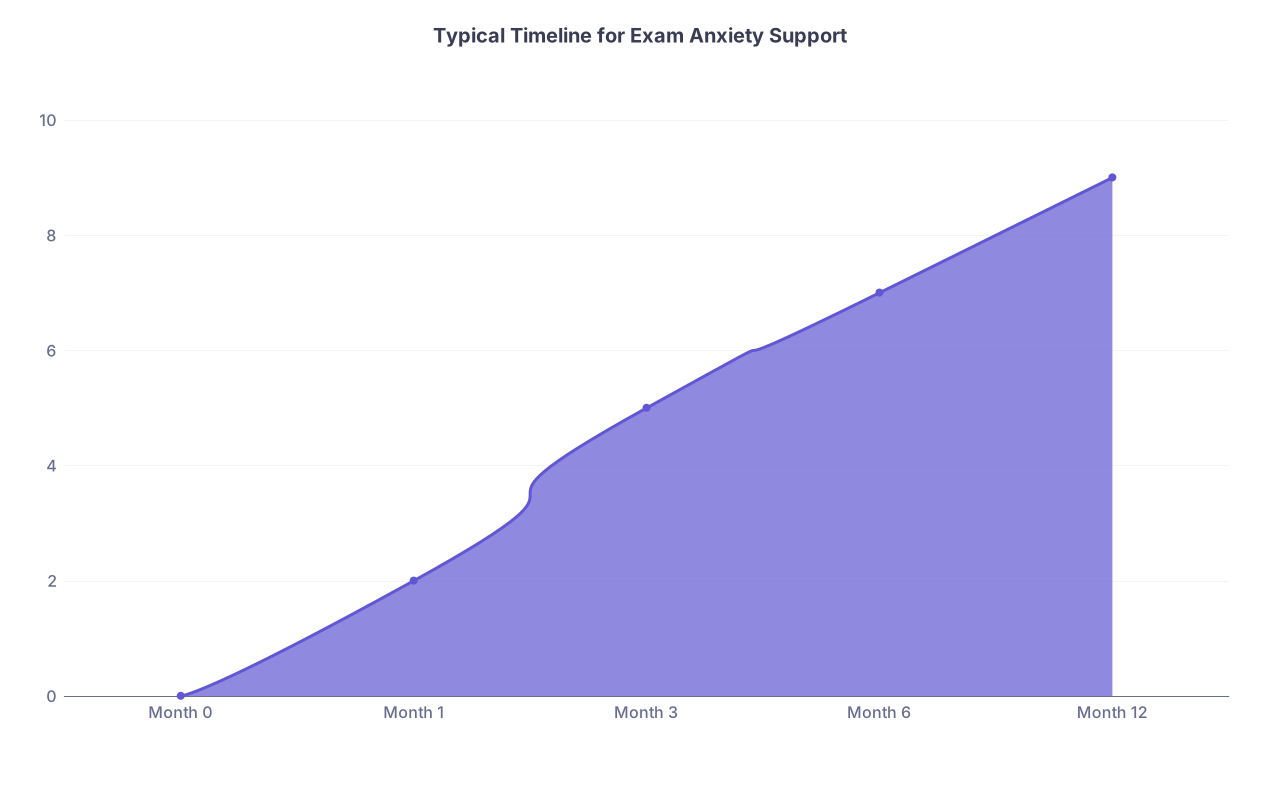
| Category | Value |
|---|---|
| Month 0 | 0 |
| Month 1 | 2 |
| Month 3 | 5 |
| Month 6 | 7 |
| Month 12 | 9 |
(Where the “value” here is just a rough index of how fully your support system is built: from 0 = no support to 9 = mature, tested plan with documented accommodations and effective personal strategies.)
Step 11: Use Faculty As Allies, Not Just Gatekeepers
The whole point of talking to faculty is not to confess your weakness. It is to recruit allies.
The better ones will:
- Normalize what you are experiencing.
- Share other students’ success stories (anonymized, obviously).
- Write supportive memos or notes in your file.
- Help structure remediation that is fair, not punitive.
- Advocate at promotion committees when your anxiety-exam mismatch comes up.
Your job:
- Communicate early rather than waiting until you fail.
- Bring data instead of drama.
- Demonstrate that you are actively doing the work (therapy, skills training, practice exams).
They are far more inclined to fight for a student who is clearly fighting for themselves.

| Step | Description |
|---|---|
| Step 1 | Clarify Problem & Gather Data |
| Step 2 | Get Clinical Evaluation & Documentation |
| Step 3 | Contact Disability Services |
| Step 4 | Plan Meeting Objectives & Script Story |
| Step 5 | Meet with Faculty / Dean |
| Step 6 | Email Follow-up & Document Plan |
| Step 7 | Implement Accommodations + Therapy Work |
| Step 8 | Reassess, Adjust, and Plan for Future Exams |
The Three Things To Remember
You need a plan, not a confession. Walk into faculty meetings with data, a clear story, and a specific ask. Do not just “share your feelings” and hope they guess what you need.
Documentation unlocks the system. A focused mental health evaluation and a clear letter about functional impairment and recommended accommodations are non-negotiable if your anxiety is truly disabling.
This is a long game. You are building a support and accommodation structure that should carry you through medical school, licensing exams, and beyond. Start early, be direct, and treat faculty as potential allies rather than obstacles.


