
You can destroy a good score with a bad 24 hours.
Not on test day. On practice test day.
What you do in the first 24 hours after a meltdown-inducing NBME, UWorld self-assessment, COMSAE, or shelf practice exam often matters more than the score itself. This is where people either spiral into months of test anxiety… or build the mental callus that lets them walk into the real thing sharp and steady.
Let me walk you through a concrete 24‑hour protocol. Step-by-step. No fluff. No “just relax” nonsense.
Step 0: What Just Happened? (0–15 Minutes)
You click “End Block” on a practice NBME. The score loads. It is lower than you expected. Much lower.
Here is the typical internal script I have heard from hundreds of med students:
- “I am not built for this.”
- “I am going to fail Step / COMLEX / this shelf.”
- “Everyone else is doing better than me.”
- “I have no business applying to [insert specialty].”
You are not unique. That is exactly the problem. You are running the standard-issue catastrophic med student program.
The fix starts immediately.
0–15 Minutes: The Do-Nothing Rule
For the first 10–15 minutes after seeing your score:
- Do not open the question review.
- Do not text five people your number.
- Do not decide your specialty, career, or self-worth.
- Do not change your exam date.
You are physiologically flooded. Cortisol, adrenaline, racing thoughts. Your brain is in “run from tiger” mode, and you are asking it to calmly evaluate your future.
It cannot.
Instead, do this:
- Stand up.
- Leave the room.
- Drink a full glass of water.
- Walk slowly for 5–10 minutes (inside, outside, hallway, staircase—does not matter).
- Hard rule: No phone, no email, no group chat “score reveals” yet.
You are not “wasting time.” You are preventing the worst decision-making window of your week.
Step 1: Physically Turn Off the Alarm System (First 1–2 Hours)
Panic is a body problem long before it is a “mindset problem.” If you try to “positive think” your way out while your heart rate is at 120, you will lose.
You must downshift your nervous system first.
A. Short Reset Protocol (15–30 Minutes)
Pick one of these and actually do it, not just skim it:
1. Physiological Sigh (5 Minutes)
This is not woo. This is Stanford-lab, measured-on-spirometers stuff.
- Inhale through your nose until your lungs are ~80% full.
- Without exhaling, take a second “top-up” sniff to fill to ~100%.
- Exhale slowly through your mouth until your lungs feel empty.
- Repeat 5–10 times.
You will feel your chest pressure ease a bit. That is the point.
2. 4-7-8 Breathing (5 Minutes)
- Inhale through nose for a count of 4.
- Hold for 7.
- Exhale through mouth for 8.
- Repeat 4–6 cycles.
If you get lightheaded, shorten the counts but keep exhale longer than inhale.
3. Cold Face / Hands (2–3 Minutes)
- Splash cold water on your face or hold an ice pack to your cheeks and forehead.
- Or run your wrists under cold water for 30–60 seconds.
This can trigger the dive reflex and nudge your heart rate down.
You are not trying to feel “great.” You are trying to move from full panic to “uncomfortable but functional.”
B. Move Your Body (15–20 Minutes)
Do something that raises your heart rate in a controlled way:
- Brisk 15‑minute walk outside.
- 10–15 minutes of light bodyweight exercise (air squats, wall pushups, planks).
- Short stationary bike or treadmill walk.
Why? You are converting anxious energy into physical work your body understands. Then you cool down. This backward-engineers the message: “The threat passed; we exerted; now we recover.”
Step 2: Put the Score in Context (Hour 2–4)
Once the acute panic is dialed down, you deal with the story in your head. Because “I bombed it” is almost always a half-truth at best.
A. The Brutal Reality Check: A Single Table
You need to know what this score actually means in your exam ecosystem. One quick reference:
| Exam Type | Strongly Concerning | Workable But Risky | On Track Range |
|---|---|---|---|
| Step 1 (Pass/Fail) | < 60% NBME avg | 60–65% NBME avg | > 65–70% NBME avg |
| Step 2 CK | < 215 predicted | 215–230 predicted | > 230–240+ predicted |
| COMLEX Level 1 | < 425 predicted | 425–470 | > 470–500+ |
These are ranges, not commandments. But they keep you from hallucinating that a 63% NBME is “failure” or that a 49% means “everything is fine.”
Your job today is not to fix your entire prep. It is to:
- Classify where you are.
- Decide if this is:
- A red flag (need major plan change), or
- A yellow flag (plan is okay but execution or test anxiety needs work).
B. Separate Score from Identity (10 Minutes)
You are going to write, by hand, three short lists. Not on your laptop. Pen and paper.
Cold Facts About This Test
- Date
- Which exam (NBME 28, UWSA1, COMSAE C, etc.)
- Raw / percent correct / predicted score
- How much sleep you had night before
- Any major disruptions (noise, hunger, headache, etc.)
What This Score Does Not Mean
- “It does not mean I will get the same score on test day.”
- “It does not mean my last 3 months of studying were wasted.”
- “It does not mean I am not smart enough for [specialty].”
What This Score Might Mean
- “My fundamentals in cardio physiology are weak.”
- “Under time pressure, I panic and change right answers.”
- “My sleep / schedule is sabotaging my performance.”
The “does not mean” list matters. It interrupts your brain’s lazy shortcut of making one data point equal your whole identity.
Step 3: The 3-Layer Debrief (Hour 3–8)
Most students commit the same two mistakes after a bad practice test:
- They avoid the review entirely (“too painful”), or
- They only read explanations and copy facts (“oh, so lupus nephritis is associated with…”).
Both are a waste.
You need to review at three levels:
- Behavior
- Process
- Content
Layer 1: Behavior Autopsy (15–20 Minutes)
You are answering: “How did I take this exam?” Not “what did I miss.”
Questions to ask yourself:
- Did I rush the first block? The last block?
- When did I first feel panicky? After how many questions?
- Did I reread questions multiple times? How often did I change answers?
- Did I run out of time on any blocks? How many questions guessed at the end?
- Did I eat / drink between blocks or just sit there doom scrolling?
Write bullet answers. You are looking for patterns like:
- “Started strong; melted down after seeing first drug mechanism I did not know.”
- “Time management collapsed; I spent 3–4 minutes on random zebras.”
Those are test-taking problems, not intelligence problems. Different treatment.
Layer 2: Process Autopsy (30–60 Minutes)
Process = how you think through questions.
Pick 15–20 missed questions spread across all blocks. Do not choose just the “I almost had it” ones. Include some train wrecks.
For each selected question:
- Cover the explanation.
- Re-read the stem and options.
- Ask:
- What was the actual question asking? (diagnosis? next step? mechanism?)
- Where in the stem was the key clue?
- What was my original thought process?
- Which step of my reasoning failed? (misread, knowledge gap, premature conclusion, etc.)
Then classify each miss into one of these buckets:
- Misread / Inattention – Skimmed, missed “except,” reversed electrolyte values, etc.
- Process / Strategy Error – Did not eliminate obviously wrong options, anchored on a detail, jumped to rare diagnosis.
- True Knowledge Gap – Had absolutely no idea about the topic or mechanism.
You are not trying to fix every question. You are mapping where your leaks are.
Layer 3: Content Autopsy (60–90 Minutes)
Now you deal with the actual medicine.
From the questions you reviewed above (and maybe 10–15 more), build a tight error log. Not a 50-page death document you never read.
Columns to include:
- Topic (e.g., “nephritic vs nephrotic,” “heart blocks,” “thyroid nodules workup”)
- Exam type/source (NBME 30 Q12)
- Error type (misread / process / knowledge)
- ONE key takeaway (one sentence or diagram)
- Follow-up resource (First Aid page, Anki tag, video timestamp)
You want something like:
- “Nephritic vs nephrotic – I missed that hematuria + RBC casts = nephritic even with some proteinuria; pay more attention to urinary sediment.”
Not:
- “Nephritic syndrome is characterized by … [entire paragraph copied from UWorld].”
Your brain does not encode full paragraphs under stress. It encodes:
- contrasts
- decisional rules
- visual anchors
So use those.
Step 4: Manage the Anxiety Spike, Not Erase It (Hours 4–12)
You will have intrusive thoughts the rest of the day:
- “What if this is how I actually perform under pressure?”
- “What if the exam is even harder?”
- “What if my last good practice test was a fluke?”
Trying to suppress these thoughts makes them louder. You need to trap them instead.
A. 10-Minute Thought Dump
Open a blank page (paper or digital). Set a timer for 10 minutes.
Write down every single anxious thought in bullet form. No censoring. No editing. Just list.
When timer ends, draw a line under the last one. That is your boundary.
Now, next to each thought, label:
- C – Controllable (I can directly act on this)
- I – Influencable (I can affect it indirectly)
- U – Uncontrollable (out of my hands)
Examples:
- “I am afraid my sleep schedule is wrecking my scores.” → C
- “What if my exam gets a brutal curve?” → U
- “What if my letter writers think I am not smart?” → I or U, depending on context.
You only get to spend mental energy on the C and maybe some I.
B. Convert 2–3 Thoughts Into Actions
Pick two C-labeled items and immediately build tiny actions:
- Sleep concern → Action: “Set hard screen-off time at 11 pm tonight, alarm for 7 am. No question blocks after 10 pm.”
- Timing issues → Action: “Tomorrow: 1 timed 40-question block with strict 1:15 per question; practice moving on instead of obsessing.”
Your brain calms down when it sees you are doing something about the threat.
Step 5: Rebuild Trust in Your Brain (Hour 8–18)
A panic-provoking test does more damage to your confidence than your content knowledge. If you do nothing, you start going into every block with the expectation of disaster. That expectation becomes a self-fulfilling prophecy.
You need quick “wins” in the 12–18 hours after the test.
A. The Confidence Block (Next Day Morning or Same Evening)
Do this no earlier than 4–6 hours after your debrief. Give your brain a break first.
Pick one of:
- 20–30 untimed questions in a topic you are decent at (not your best, not your worst).
- Or 10–15 questions in “Tutor” mode focusing on one system (e.g., cardiology).
Your goals:
- Use a clear, consistent question approach (e.g., read question stem, predict diagnosis, then look at options).
- Talk through your reasoning out loud or under your breath.
- Focus on process, not speed.
If you score reasonably (and you probably will), you have data that your whole brain did not collapse. You had a bad day. Not a bad brain.
B. Micro-Reps of Calm Under Pressure
You are training your nervous system to tolerate that “oh no” spike without flipping into chaos.
Try this:
- Set a timer for 5 minutes.
- Pull up a random, challenging UWorld question.
- Before you read it, do two physiological sighs.
- Then answer it under the mild pressure of the timer.
- Repeat for 3–5 questions.
You are pairing: “stressful stimulus + deliberate calming action + competent response.” That association is what makes you steadier on real test day.
Step 6: Decide If You Need a Plan Change (Hour 18–24)
By now you have:
- Cooled off physically.
- Mapped your behavioral and process issues.
- Identified real content gaps.
- Done at least one small confidence-boosting study block.
Now you decide: Is this score an outlier, a trend, or an emergency?
A. Look at the Trajectory, Not Just Today
Pull your last 3–5 practice assessments and put them in a simple chart.
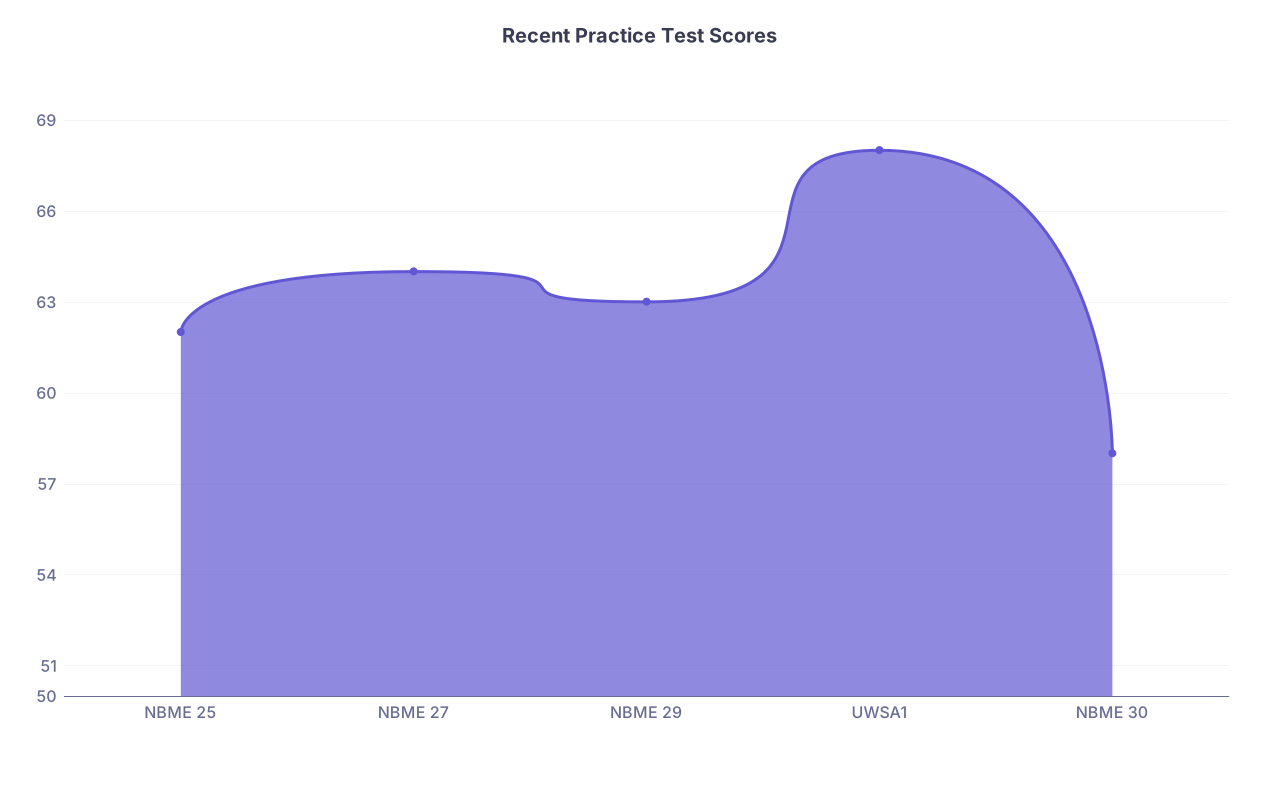
| Category | Value |
|---|---|
| NBME 25 | 62 |
| NBME 27 | 64 |
| NBME 29 | 63 |
| UWSA1 | 68 |
| NBME 30 | 58 |
This hypothetical graph shows a drop after some improvement. That is unnerving. But a downward blip is not the same as a downward trend.
Patterns:
- Generally rising but one bad exam → Execution / anxiety day. Adjust strategies, do not burn your whole study plan.
- Flat low scores (e.g., 55–60% repeatedly) → Content foundation problem + some strategy; might need 2–4 more weeks or a restructuring.
- Decreasing scores over multiple exams → Burnout, overtesting, or ineffective review. This is where you change something big.
B. Use a Quick Triage Grid
Ask yourself:
- Am I within ~5–7% of my target score range?
- Are my misses mostly knowledge gaps vs. sloppy / anxious errors?
- How far out is my real exam date?
Then slot yourself:
| Category | Description | Action in Next Week |
|---|---|---|
| Stable but Shaken | Within range, 1 bad test | Tweak anxiety + process, keep schedule |
| Borderline | Slightly below target, mixed errors | Add targeted content blocks, 1 extra NBME |
| High Risk | Far below target, repeated low scores | Consider exam delay, restructure study plan |
If you land in “High Risk,” the response is not more panic. It is:
- Honest conversation with an advisor, dean, or trusted upperclassman.
- Concrete questions: “What scores have you seen pass? How long did people need to move from X to Y?”
- Possible exam reschedule. Not as failure, but as strategy.
Step 7: Use the Rest of the 24 Hours Intentionally
Here is how I would script the rest of the first 24 hours after a meltdown practice test for a med student:
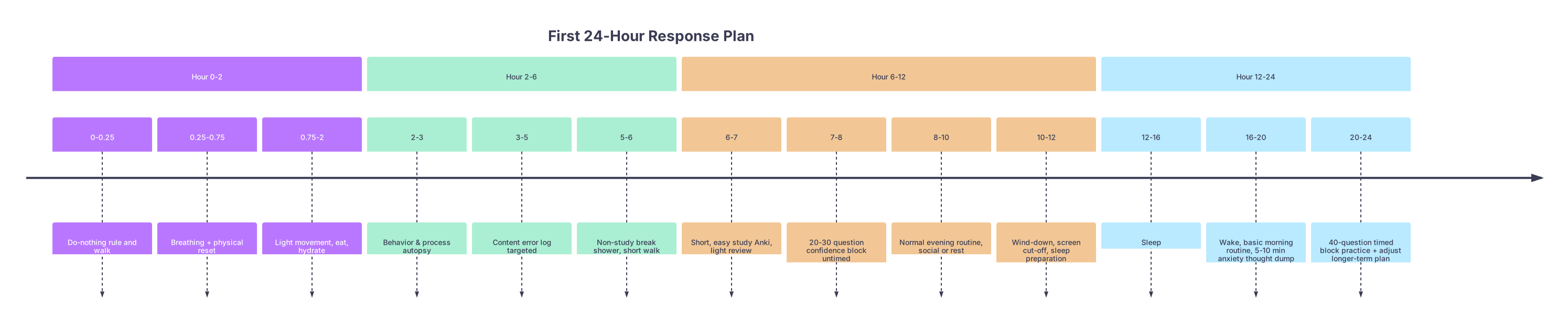
| Period | Event |
|---|---|
| Hour 0-2 - 0-0.25 | Do-nothing rule and walk |
| Hour 0-2 - 0.25-0.75 | Breathing + physical reset |
| Hour 0-2 - 0.75-2 | Light movement, eat, hydrate |
| Hour 2-6 - 2-3 | Behavior & process autopsy |
| Hour 2-6 - 3-5 | Content error log targeted |
| Hour 2-6 - 5-6 | Non-study break shower, short walk |
| Hour 6-12 - 6-7 | Short, easy study Anki, light review |
| Hour 6-12 - 7-8 | 20-30 question confidence block untimed |
| Hour 6-12 - 8-10 | Normal evening routine, social or rest |
| Hour 6-12 - 10-12 | Wind-down, screen cut-off, sleep preparation |
| Hour 12-24 - 12-16 | Sleep |
| Hour 12-24 - 16-20 | Wake, basic morning routine, 5-10 min anxiety thought dump |
| Hour 12-24 - 20-24 | 40-question timed block practice + adjust longer-term plan |
Adjust the specific times to your day, but keep the sequence:
- De-escalate physically.
- Understand what actually went wrong.
- Get one confidence win.
- Protect sleep.
- Make a small, rational adjustment to your study plan.
Two Silent Killers You Should Stop Feeding
Let me call out two things I have watched sabotage students repeatedly after a bad practice test.
1. Group Chat Score Olympics
You fire off: “Anyone else just get wrecked by NBME 29?”
Screenshots start rolling in. Someone posts a 78%. Another a 65%. One friend says, “Ugh I did so badly—only 72%.”
You got a 54%.
You silently decide you are broken.
Stop doing this.
- Sharing resources.
- Accountability (“I am doing 40 questions by 3 pm, text me if I do not update you.”).
- Emotional support without numbers (“Had a rough NBME, I am stepping away for a walk.”).
You do not owe your exact score to anyone within the first 24 hours. Or ever, frankly.
2. Last-Minute Radical Study Swaps
Bad score → Immediate reaction: “Clearly Boards & Beyond / Sketchy / Pathoma / [insert resource] is not working, I need to switch to [other resource] for everything.”
This is almost always wrong.
Resource-hopping destroys continuity. Often the issue is not what you are using, but how:
- Watching too fast without questions.
- Not revisiting concepts.
- Never doing mixed blocks.
Before you blow up your whole resource stack, fix your habits:
- 2/3 of study time on questions + review.
- 1/3 on targeted content review of actual weaknesses (from your error log).
Only if you have multiple weeks of flat scores and truly ineffective retention do you consider large resource changes.
A Word About “Test Anxiety” vs Being Underprepared
A bad practice test exposes real pain. Many students immediately label all of it “test anxiety.” That is convenient but incomplete.
Some of your distress is anxiety. Some is your brain correctly screaming that you are not ready.
Distinguish:
Likely Test Anxiety Dominant:
- You know content cold in untimed or low-pressure situations but collapse timed.
- Scores on school exams are solid, but standardized practice tests are erratic.
- On review, >30–40% of your misses are misreads / changed answers from right to wrong / silly mistakes.
Likely Underprepared Dominant:
- Even untimed or open-book you miss basic diagnosis or mechanism questions.
- Your error log is full of “I have never seen this before” on core topics.
- You cannot explain big-ticket concepts (shock types, murmurs, acid-base) without notes.
Often it is both. But the ratio matters. You treat them differently:
- Anxiety: breathing, exposure, process training, simulated conditions.
- Underprepared: more time, better spaced repetition, fewer resources, deeper passes.
Be honest. It is better to slightly delay your exam than to use “test anxiety” as a cover story for gaps that will hurt you clinically.
Protecting the One Thing That Actually Moves Scores: Long-Term Consistency
Panic after a single bad test tempts you into all-or-nothing thinking:
- “I will just grind 16 hours a day for the next two weeks.”
- “If I cannot get this right, why am I even in medicine?”
- “Maybe I should just wing it and hope for the best.”
You cannot cram your way out of chronic anxiety. You can train your way out.
One last visual to keep in mind:
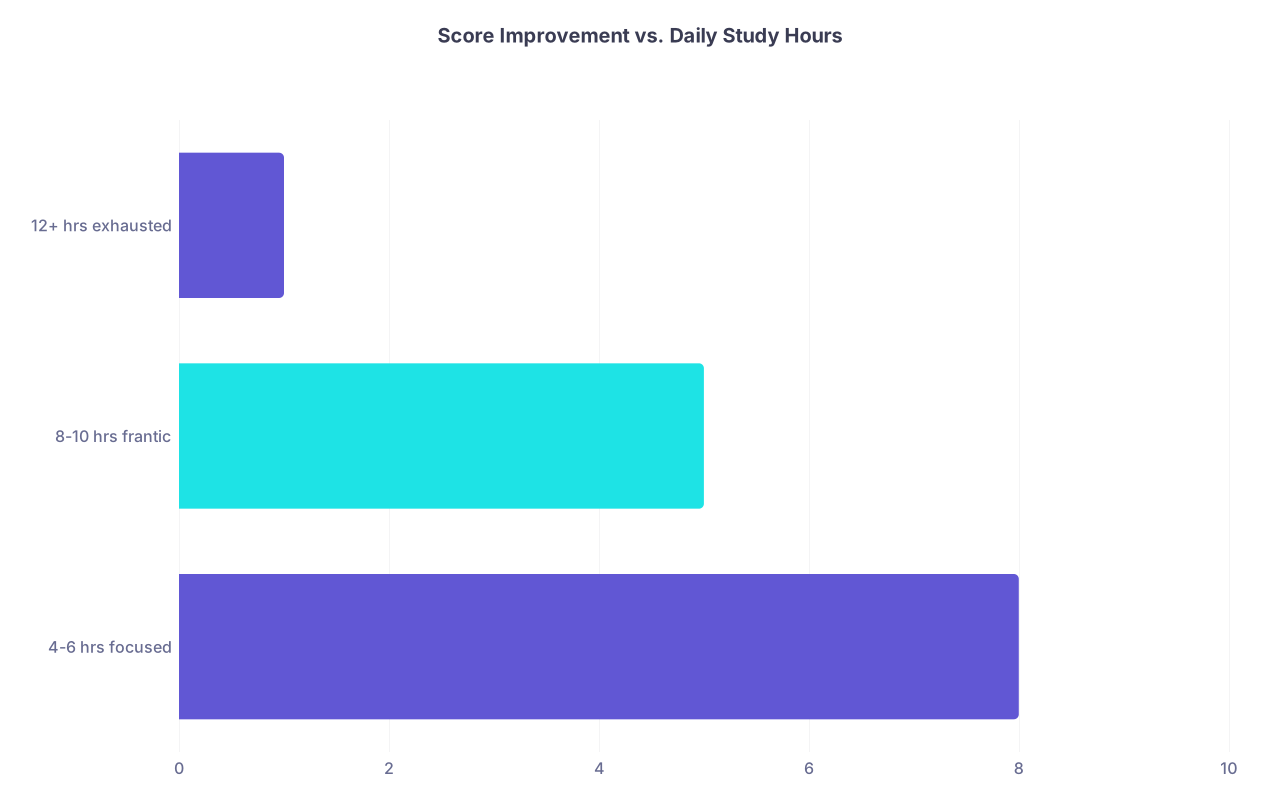
| Category | Value |
|---|---|
| 4-6 hrs focused | 8 |
| 8-10 hrs frantic | 5 |
| 12+ hrs exhausted | 1 |
Interpretation:
- Students who consistently put in 4–6 focused hours/day with solid review and breaks often gain ~8–10 points over a few weeks.
- Those doing 8–10 frantic hours/day, burned out, panicking, bouncing between resources, sometimes move a little. Sometimes not.
- Those trying 12+ hours exhausted, usually see almost no gains and start scoring worse.
The bad 24 hours after a rough practice test are where you decide which of these students you become.
Your Next Move: Do This in the Next 15 Minutes
If you just had (or recently had) a panic-provoking practice test, do not sit there ruminating.
Here is your concrete next step:
Take a blank sheet of paper and write three headings:
- “Facts from my last practice test”
- “What this score does NOT mean about me”
- “Top 5 specific things I missed (topics or habits)”
Fill it out. No more than one page.
Then, pick one of those five missed things and schedule a 30‑minute targeted session for tomorrow to work on just that.
Not your whole future. Not your entire test prep plan. Just one small, precise correction.
Open your calendar right now and block that 30‑minute slot. Give it a name: “Fix: [cardio phys timing / nephrotic vs nephritic / test-day breathing routine].”
That is how you turn a panic-provoking practice test from a trauma into training.