
You walk out of the testing center. Your stomach is tight. You replay missed questions in your head: the nephrotic vs nephritic mix-up, the cardiology murmur stem you rushed, that biostat question you flat-out guessed.
You check your phone. A class GroupMe message pops up: “That was actually not as bad as I expected lol.”
You feel worse.
By the time you get home, you are not just doubting the test. You are doubting yourself. Your abilities. Your future specialty. Whether you even belong in medicine.
This is the point where most students either spiral or numb out. Neither fixes the problem. You are not just dealing with a bad exam. You are dealing with a hit to your confidence system.
You need structure. Not vibes. Not “self-care” with Netflix and vague optimism. A structured two-phase protocol to:
- Stop the psychological free-fall, and
- Systematically rebuild real confidence based on evidence and skills.
That is what we are going to do.
The Two-Phase Framework (Stop the Bleeding, Then Rebuild)
This is the basic architecture:

| Step | Description |
|---|---|
| Step 1 | Bad Test Day |
| Step 2 | Phase 1: Acute 72-Hour Response |
| Step 3 | Emotion + Physiology Stabilization |
| Step 4 | Reality Check & Data Containment |
| Step 5 | Phase 2: 2-6 Week Rebuild Plan |
| Step 6 | Targeted Weakness Repair |
| Step 7 | Confidence Rebuilt on Evidence |
Phase 1:
- Time window: First 24–72 hours after the exam
- Goal: Contain damage, stop spiraling, protect your next exam or rotation
Phase 2:
- Time window: Next 2–6 weeks
- Goal: Convert this bad test from a vague “failure story” into a concrete performance problem you have solved
If you only do Phase 1, you feel “emotionally better,” but you repeat the same score.
If you only do Phase 2, you burn out because your nervous system is still fried.
You need both.
Phase 1: The 72-Hour Protocol After a Bad Test
Phase 1 is not about fixing your knowledge gaps. It is about stabilizing your brain enough that you can work on them later.
Step 1: Lock in a 24-Hour No-Score-No-GroupMe Rule
First move: stop feeding the anxiety machine.
Do not:
- Ask “What did you get for question X?”
- Re-open UWorld or Anki to “check” specific stems
- Read Reddit/Discord “exam experience threads”
- Obsessively calculate prediction ranges
Do:
- A single text to 1–2 trusted people: “Test felt rough, taking 24 hours off from talking about it. I’ll regroup tomorrow.”
- Mute GroupMe / WhatsApp study chats for a day
- Physically put your resources away (close UWorld, shut the Step book)
Why? Because every rehash of “I think I missed that” reinforces a memory trace that says: “I fail. I choke. I do not know enough.” That is how you hardwire test anxiety.
You are interrupting that loop.
Step 2: Run the Acute Decompression Checklist (Same Day)
You are not going to meditate your way out of cortisol. You have to treat your body like it just ran a trauma scenario. Because in a way, it did.
Within 6–8 hours of finishing the exam, do 3 types of reset:
Physiological reset (non-negotiable)
Pick at least 2:- Hard 20–30 minute walk outside, no music, no podcast
- Light to moderate workout (nothing PR-level, just move your body)
- Hot shower or bath + 10 minutes lying down, no phone
Sleep reset (same night)
- Commit to one full night of sleep. If you are tempted to start studying “to make up for it” that night, you are making a bad situation worse.
- Protect this: no caffeine after 3 pm, no doom-scrolling before bed.
Food + hydration reset
- Eat an actual meal with protein, carbs, and fat. Not just coffee and vending machine trash.
- Drink water deliberately. Your brain just did a 6–8 hour cognitive marathon.
This is not “self-care fluff.” It is basic nervous system triage.
Step 3: Write a 10-Minute “Containment Script”
Your brain is going to run wild with global, catastrophic thoughts:
- “I am not smart enough for this.”
- “Everyone else did fine.”
- “I will never match into [insert specialty].”
You are going to create a short written script that you will literally read back to yourself when your mind starts doing that.
Take 10 minutes and write 5–7 sentences that do three things:
Acknowledge the hit:
- “This exam felt bad. I am allowed to be upset about that.”
Put a boundary around the event:
- “This is one test on one day, not a verdict on my career or abilities.”
Set a future action focus:
- “In 48–72 hours, I will sit down, review what went wrong, and build a specific plan. Right now, my only job is to recover.”
Example script:
“Today’s test felt rough. I am disappointed and anxious about my score. That reaction is normal. This is one test, not a referendum on my ability to be a good physician. I have handled hard things before, and I can handle this. In two days, I will review what happened and build a detailed plan to fix the issues. For now, my job is to rest, reset my nervous system, and not make permanent conclusions based on one bad day.”
Whenever your brain starts spiraling → read this out loud or in your head. Every single time. You are training a counter-response.
Step 4: Schedule, Do Not Ruminate (The 48–72 Hour Rule)
You are not banned from thinking about the exam. You are going to schedule thinking about the exam.
- On your calendar:
- “Exam Post-Mortem: [Date], [Time], 60–90 minutes”
Until that appointment:
- If a thought pops up (“I think I failed”), respond with:
- “I will think about this at [time]. I have a slot for that.”
Sounds trivial. It is not. You are teaching your brain that not every anxious thought is an emergency.
Step 5: Protect the Next 3–5 Days of Performance
Most damage from a bad test does not come from the score. It comes from the chain reaction:
Bad test → panic → poor sleep + compulsive over-studying → worse performance on practice tests / quizzes → “See, I really am failing.”
Your job in Phase 1 is to break that.
For the next 3–5 days:
Keep your usual study schedule, but do not:
- Add extra hours at the expense of sleep
- Start new massive resources “to catch up”
- Punish yourself by cutting all breaks
Avoid “score-chasing” behavior:
- No new NBME or large practice exam in the first 3 days.
- Use short blocks: 10–20 questions, then review slowly and carefully.
If you are on rotations:
- Do not tell every attending you “bombed the exam.”
- Show up, be prepared, be present. Do not let one test ruin your clinical performance.
Phase 2: The 2–6 Week Confidence Rebuild Plan
Once you are out of the acute zone, you start the real work: rebuilding confidence based on evidence, not wishful thinking.
Phase 2 has four pillars:
- A structured post-mortem
- A targeted remediation plan
- A confidence scorecard
- Ongoing anxiety management behaviors
Pillar 1: Run a Ruthless, Structured Post-Mortem
You are not just going to say: “I suck at cardiology.” That is useless.
You need specifics. Ideally when you have score report data (NBME, shelf breakdowns, COMSAE, etc.). But even without official breakdowns you can do a lot.
A. Classify the Failure Mode
Most bad exam days are driven by one of these core problems:
- Knowledge gap – The content was unfamiliar or half-baked.
- Application gap – You “knew it” but could not pick the right answer in a long stem.
- Strategy / timing – You ran out of time, changed many right answers, or misread stems.
- Physiology / anxiety – Brain fog, panic, physical symptoms during the test.
Be honest: pick the top two that resonate. You are allowed to say “all four,” but there is usually a 60/40 split.
B. Use Any Available Data
If you have a breakdown (NBME, shelf report, school exam analytics), do this:
| Domain | Performance | Relative Rank | Priority |
|---|---|---|---|
| Cardiovascular | Low | Bottom 25% | High |
| Renal | Medium | 50–75% | Medium |
| Biostatistics | Low | Bottom 25% | High |
| Behavioral/Social | Medium | 50–75% | Medium |
| General Principles | High | Top 25% | Low |
Now you have targets. You are not fixing “everything.” You are fixing specific systems.
If you do not have an official breakdown:
- Pull your last 2–3 weeks of question bank history.
- Look at performance by system/topic. Identify the bottom 3.
C. Write a One-Page “Exam Autopsy”
Yes, literally one page. Not a novel. Force yourself to be specific.
Sections:
What actually went wrong?
- Example: “I lost ~10–12 questions from rushing in the last block and misreading stems. I also saw 6–8 cardiology physiology questions I was not prepared for.”
What was under my control?
- “I did not simulate full-length exams. My longest blocks were 40 questions.”
- “I avoided cardiology because it felt hard and spent more time re-doing topics I liked.”
What was not under my control?
- “The school’s question style was unusually wordy compared to our usual practice questions.”
- “The exact topics in the ethics questions were unpredictable.”
What will I do differently in the next 2–6 weeks?
- 3–5 bullet points, concrete behaviors.
This becomes your blueprint.
Pillar 2: Build a Targeted 2–6 Week Remediation Plan
Now you translate the autopsy into an actual schedule. Not a vague “I will work harder.”
You build a short, intense, focused rehab block using three levers: content, questions, and test-day simulation.
Step 1: Select 2–3 Priority Domains
From your breakdown, pick the worst offenders. Example:
- Cardiovascular physiology & pathology
- Biostatistics & epidemiology
- Time management / pacing
That is enough. If you try to fix 10 domains at once, you fix none.
Step 2: Allocate Weekly Time Intentionally
You are building a mini “rehab rotation” for your exam performance.
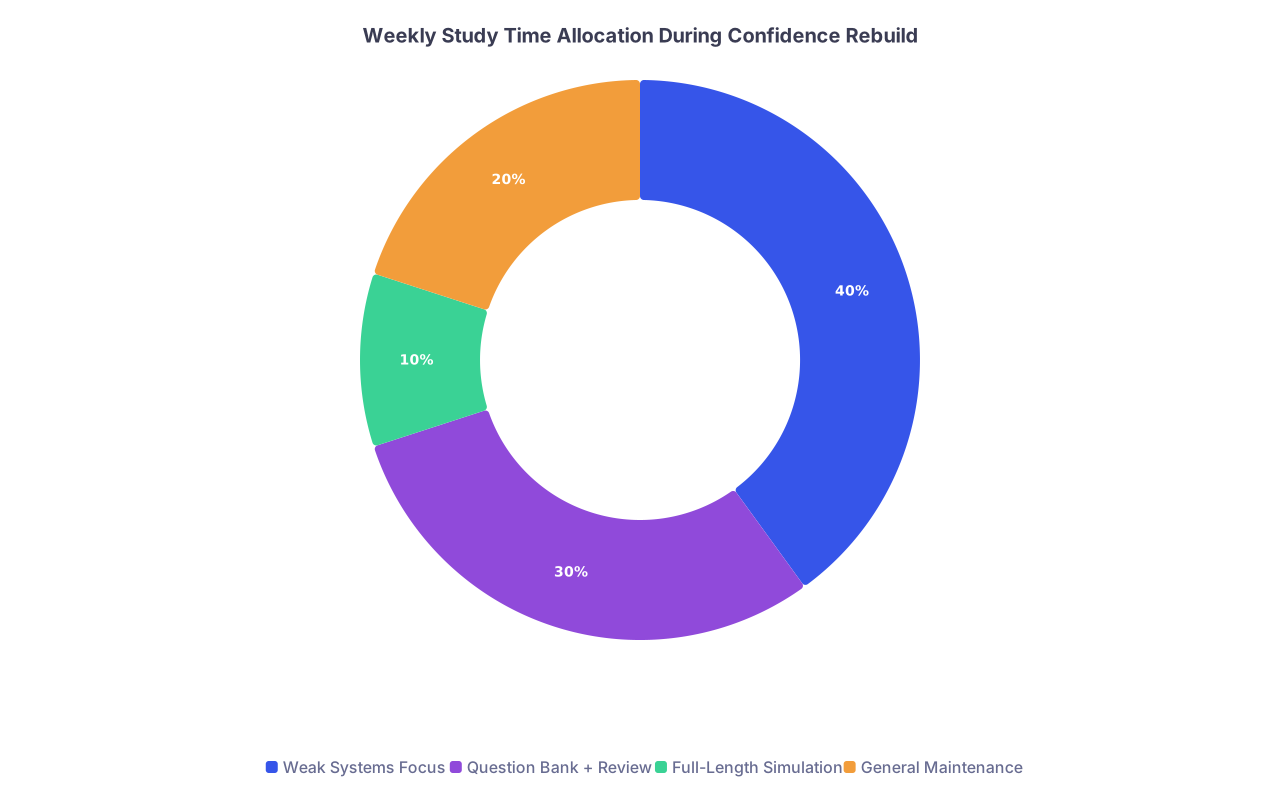
Sample 4-week structure (modify for your reality):
| Category | Value |
|---|---|
| Weak Systems Focus | 40 |
| Question Bank + Review | 30 |
| Full-Length Simulation | 10 |
| General Maintenance | 20 |
Interpretation for a 20-hour study week:
- 8 hours – Focused work on weak systems (cardio, biostats)
- 6 hours – Mixed question bank blocks + review
- 2 hours – Long-block / simulation work
- 4 hours – Maintenance of other content (Anki, light review)
If you are on a busy rotation, cut the total time, keep the same proportions.
Step 3: Use the Right Tools for Each Problem
You match tools to failure modes.
| Problem Type | Primary Tool |
|---|---|
| Knowledge gap | Targeted video / textbook + Anki |
| Application gap | System-tagged question blocks |
| Strategy / timing | Timed 40–80 question blocks |
| Anxiety / physiology | Repeated simulation + breathwork |
Examples:
Cardiovascular weak?
- Use Boards & Beyond / OnlineMedEd / Sketchy or your preferred resource.
- Then immediately do 20–40 cardio-only questions.
- Create or tag flashcards for every concept you missed.
Biostats weak?
- Do a single dedicated day (4–6 hours total) to relearn core formulas and concepts.
- Then 10–15 biostats questions daily for a week.
- Keep a 1-page formula and “pattern” sheet that you review every 2–3 days.
Timing / strategy weak?
- Once a week: one long block (60–80 questions) under exam conditions.
- After: review not just content, but timing data:
- Where did you slow down?
- Did you change right answers?
- Did you read the last 5 stems too fast?
You are treating this like PT after a knee injury. Specific exercises. Reps. Progression.
Pillar 3: Build a “Confidence Scorecard” Based on Evidence
Confidence is not a mood. It is your brain’s summary of the evidence it has about your competence.
Most students after a bad test only collect evidence of failure. You are going to start collecting evidence of competence.
Create a simple scorecard you update weekly. It should include:
Objective metrics:
- Question bank performance (overall + in weak systems)
- NBME/shelf practice scores
- Number of full-timed blocks completed
Process metrics:
- Did I stick to my study schedule this week? (Yes/No)
- Did I complete my planned review of missed questions?
- Sleep: average hours per night (rough estimate)
Subjective metrics (but concrete):
- Rate anxiety before practice exam (0–10)
- Rate anxiety after practice exam (0–10)
- Rate sense of control over mistakes (0–10)
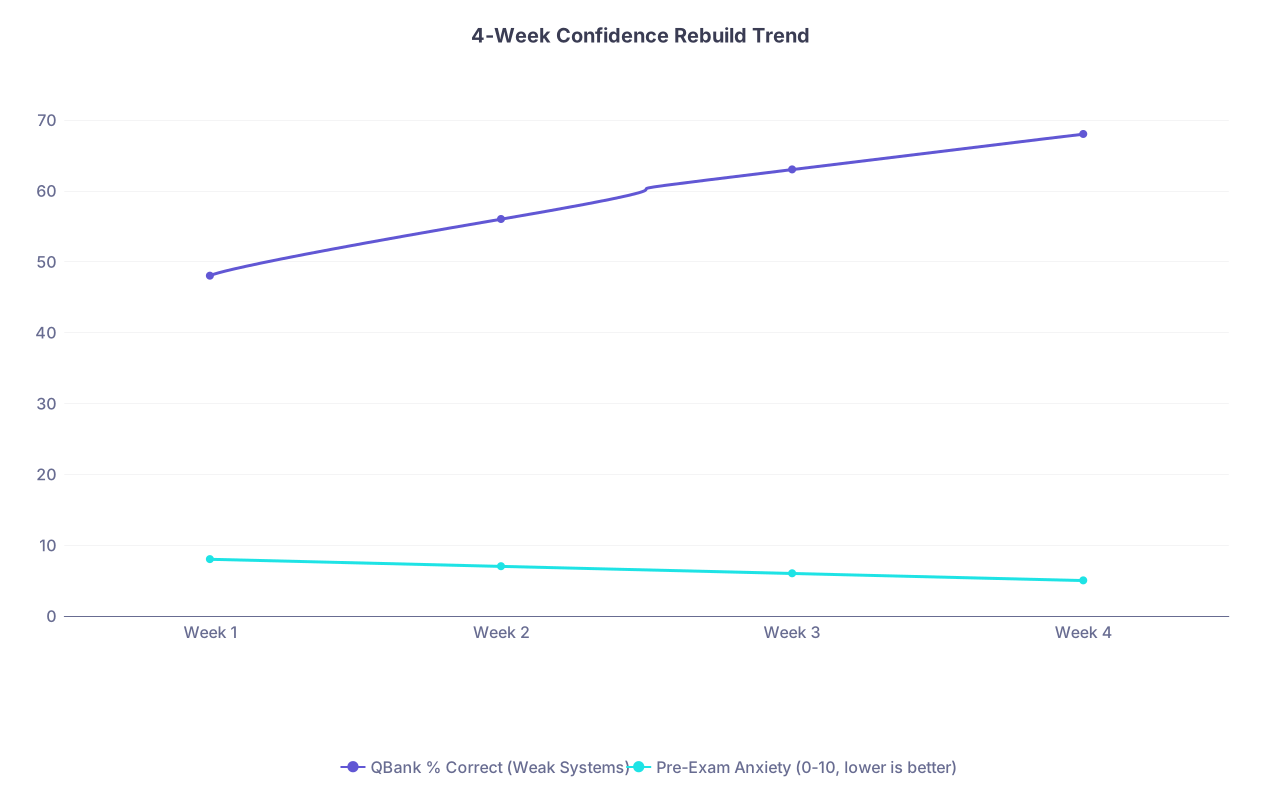
Sample weekly snapshot:
| Category | QBank % Correct (Weak Systems) | Pre-Exam Anxiety (0-10, lower is better) |
|---|---|---|
| Week 1 | 48 | 8 |
| Week 2 | 56 | 7 |
| Week 3 | 63 | 6 |
| Week 4 | 68 | 5 |
You update it once a week. Then you step back and ask:
- Am I moving in the right direction, even if slowly?
- Where did I actually improve?
- Where am I flat or worse, and why?
You want to see your comeback, not just hope for it.
Pillar 4: Ongoing Anxiety Management You Will Actually Do
You are in medical school. You are not going to meditate for 45 minutes a day and journal in a cabin in the woods.
Pick 2–3 anxiety tools that are:
- Short
- Repeatable
- Evidence-based
And actually use them.
1. A 60-Second Pre-Block Reset
Before every timed block (practice or real exam):
- Exhale fully through your mouth
- Inhale through your nose for ~4 seconds
- Hold for 2 seconds
- Exhale slowly for ~6 seconds
Do that 4–6 times. You are shifting your autonomic state, not doing a spiritual retreat.
Then tell yourself one sentence:
- “My job is to make the best decision I can on this question, not to be perfect.”
Repeat between blocks on big tests. Train it now so it is automatic on exam day.
2. A Simple Thought Reframe Template
When the “I am a failure” thought hits, do not argue with it for an hour. Use a template:
- Name the thought: “I am having the thought that I will never [pass / match / succeed].”
- Ground in present: “Right now I am [doing what? reviewing questions / on the wards].”
- Re-align with action: “Given my goals, the next best action I can take is [concrete action].”
Example:
“I am having the thought that I will never match into dermatology. Right now I am sitting at my desk, reviewing cardiology questions. Given my goals, the next best action I can take is to complete this 20-question block with full focus.”
Short. Not inspirational poster material. Functional.
3. A Hard Boundary Around Sleep Before High-Stakes Tests
The night before major exams (NBME, shelf, Step, COMLEX):
- Cut studying at a fixed time (e.g., 8–9 pm). No exceptions “because this test is important.”
- Do a 10–20 minute non-medical wind-down (light reading, shower, stretching).
- Put your phone on Do Not Disturb.
Confidence is impossible if you are chronically sleep-deprived and jittery.
Putting It All Together: A Concrete 3-Week Example
Let me show you what this looks like so it is not just theory.
Scenario:
- You took an internal medicine shelf.
- You feel you bombed it. Later, you get the score: 3rd percentile. It stings.
- You have another shelf (peds) in 4 weeks and Step 2 in 3 months.
How to apply the two-phase strategy:
Week 0 (Test Week): Phase 1 Only
Day 0 (exam day):
- No-Score-No-GroupMe for 24 hours
- 30-minute walk + decent meal + early sleep
Day 1:
- Write 10-minute containment script
- Schedule post-mortem for Day 3
- Light review only (1–2 hours max), no big decisions
Day 2:
- Normal clinical duties, light study
- No practice NBME or long blocks
Week 1: Post-Mortem + Plan
Day 3:
- 60–90 minute exam autopsy (using your score breakdown)
- Identify: weakest systems (e.g., cardio, renal, biostats), main failure mode (e.g., timing + cardio knowledge)
- Draft 3–4 specific changes for the next 3 weeks
Rest of Week 1:
- Allocate:
- 40% of your limited post-rotation study time to cardio + renal targeted learning
- 40% to mixed question blocks and review
- 20% to biostats (short, daily drill)
- Implement 1 long timed block (40–60 questions) near the end of the week
- Start weekly confidence scorecard
- Allocate:
Week 2: Execution and First Checkpoint
- Continue your targeted plan
- Add:
- One pediatrics-focused long block under timed conditions
- Daily 60-second pre-block reset
- End of week:
- Review your scorecard
- Adjust: if cardio is improving but biostats is still trash, shift an extra hour to biostats.
Week 3: Rehearsal for the Next Exam
- One full-length practice session (2–3 blocks back-to-back) to simulate test fatigue
- Still maintain focused remediation on worst topics
- Use all your anxiety tools (breathwork, thought reframe) in these practice runs so they are automatic on test day.
By the time you walk into the pediatrics shelf, your brain does not just have the memory: “I bombed the IM shelf.”
It has:
- 3 weeks of consistent, targeted work
- Clear evidence of improved performance in specific domains
- Several rehearsals of test-day conditions that did not end in disaster
That is how you rebuild real confidence.
Common Pitfalls That Will Keep You Stuck
You are going to be tempted by a few bad strategies. Skip them.
Over-correcting with volume, not precision
- “I will just do 200 questions a day.”
- Translation: “I will skim questions, rush reviews, and burn out.”
Avoiding your worst topics
- You “kind of” review them but live in the comfort zones.
- Then act surprised when the next exam punishes the same holes.
Constant comparison
- Stalking classmates’ scores, Reddit posts, anonymous stats.
- None of that raises your score by a single point.
Treating this as a moral failure
- “I am lazy.” “I am not cut out for this.”
- No. You have a performance problem that needs a performance plan.
You are in medical school. That alone is evidence that your baseline capacity is high. One bad test (or several) does not erase that.
But if you do not convert those tests into specific, addressed problems, they will absolutely keep repeating.
FAQs
1. What if my bad test was a major board exam like Step or COMLEX?
Same two-phase structure, but you extend Phase 2. When you get your score:
- Run the autopsy with official breakdowns
- Compare your problem domains with your target specialty’s expectations
- If you are far below your goals, build a 2–3 month remediation plan before the next major exam (e.g., Step 2). The process is the same; the timeline is longer.
2. How do I handle it if my friends all did well and I am embarrassed?
Set boundaries. You do not owe anyone your score. Script a stock response:
- “It was a tough exam for me. I am working on a plan to do better on the next one.”
Then change the topic. If certain people keep probing or flexing, mute them or see them less. Protecting your headspace is part of performance.
3. What if I truly do not know what went wrong because it just felt generically bad?
Then your first job is data collection. Before the next exam, take:
- 1–2 official practice tests (NBME, UWSA, COMSAE)
- Track: timing, fatigue, anxiety, and question-type trends
Use those to reconstruct your actual problem pattern. You do not guess; you test.
4. How do I know if this is normal stress or if I should get professional help?
Red flags that warrant talking to a counselor, school mental health, or a physician:
- Persistent insomnia or appetite changes for more than 2 weeks
- Panic attacks, severe dread before every study session
- Thoughts like “Everyone would be better off if I was not here” or any self-harm ideation
- You are starting to avoid school, clinics, or exams entirely
Getting help is not a sign that you are weak. It is a sign that you are treating your brain with the same seriousness you treat your patients’ bodies.
Key takeaways:
- Do not let a bad test become a character judgment. Contain the immediate damage in the first 72 hours.
- Turn vague “I did badly” into specific, fixable problems with a structured autopsy and targeted plan.
- Rebuild confidence using evidence: measurable improvement in weak areas, not just positive thinking.