
The way most students “push through” USMLE test anxiety is backwards. You do not beat anxiety by doing more questions in a panicked state. You beat it by running a controlled reset that stabilizes your brain first, then your study system.
You have seven days. Not a vacation. A reset. Structured, deliberate, and slightly uncomfortable.
This is that 7‑day reset plan.
What “Derailment” Actually Looks Like (And Why You Must Stop Lying To Yourself)
Let me call this out clearly: you are not “just stressed.”
You are derailed when at least one of these is true:
- You open UWorld and stare at the first question for 5 minutes doing nothing.
- Your NBME or UWSA scores dropped 10–20+ points in 2–3 weeks despite “studying more.”
- You reread the same First Aid page three times and retain nothing.
- Your heart rate spikes just from seeing the exam login screen.
- You start avoiding full-length blocks, telling yourself you’re “saving them for later.”
That is not a content problem. That is a nervous system problem.
If you keep forcing full-intensity prep on a dysregulated brain, your performance will keep sliding. So the next seven days are about three things:
- Regulate your body so your brain can actually learn.
- Rebuild your test-taking system so each block feels predictable, not chaotic.
- Re-anchor your confidence to process, not scores.
We are not stopping prep. We are running a controlled recalibration.
The 7‑Day Reset: Overview
Here is the skeleton of your week.
| Day | Primary Focus | Study Load |
|---|---|---|
| 1 | Stop the spiral, stabilize body | Light |
| 2 | Rebuild structure & boundaries | Light-Moderate |
| 3 | Controlled exposure to blocks | Moderate |
| 4 | Deep work on weak systems | Moderate |
| 5 | Full practice block with rituals | Moderate-High |
| 6 | Targeted refinement, not volume | Moderate |
| 7 | Dress rehearsal or consolidation | Moderate |
You will:
- Keep studying every day.
- Cut the right things (random doom-questioning) instead of blindly doing more.
- Practice anxiety management inside your study blocks, not as some abstract “mindfulness” side project.
Let’s go day by day.
Day 1 – Hit the Brakes and Stabilize
Day 1 is about one thing: stop the freefall. You are not solving all test anxiety today. You are creating a floor.
Step 1: Call the Situation What It Is
Write this down. Literally:
- “My last 3 blocks: ___, ___, ___ %.”
- “My last NBME/UWSA: ___.”
- “Symptoms I notice: racing heart / nausea / blanking out / avoiding blocks / crying / insomnia / irritability.”
Put it on paper. Not as punishment. As data. Vague dread loves ambiguity. Data gives it less room.
Step 2: Physiology First – Non-Negotiable Reset
For today only, you prioritize your body hard:
Sleep target: 7.5–8.5 hours tonight.
- No phone or Anki in bed.
- Cut caffeine after 2 PM. I have watched dozens of students gain 5–10 exam points just by sleeping like a semi-normal human the week before their exam.
Move your body for 30–45 minutes.
- Brisk walk, light jog, cycling, YouTube bodyweight workout.
- This is not “exercise for fitness.” This is forcing your sympathetic system to ramp up and down in a controlled way.
Eat like you have an exam tomorrow.
- Real meals. Protein, complex carbs, some fat.
- No “coffee + random granola bar” as your main fuel.
If you skip this and jump back into UWorld because you “don’t have time,” then you are choosing to keep your brain in fight‑or‑flight. That is a losing trade.
Step 3: Light, Structured Study Only
Maximum 3–4 hours total today. If you try to do 10 hours on Day 1, you will crash again.
Do:
- 1–2 short question sets:
- 10–15 questions, tutor mode, one system (e.g., Cardio).
- Focus on slow, deliberate reasoning and reading.
- 60–90 minutes of targeted content review on your top 1–2 weak areas from your last practice test.
- 30 minutes of low-stress Anki or light review (no timers, no rushing).
Do not:
- Do a full 40‑question timed block.
- Check old scores repeatedly.
- Cram an entire subject you “forgot.”
Step 4: Create a Quick “Calm Protocol” You Will Use All Week
You are going to use the same 60–90 second pattern every time anxiety spikes.
Here is one that works for most students:
-
- Inhale 4 seconds → Hold 4 → Exhale 4 → Hold 4.
- Repeat 4 cycles. That’s about 1 minute.
Name 5–4–3–2–1 (grounding technique)
- 5 things you can see.
- 4 things you can feel (chair, desk, clothes).
- 3 things you can hear.
- 2 things you can smell or remember smelling.
- 1 thing you can taste or remember tasting.
Micro-script to yourself
- “This is anxiety, not danger. I can think with this feeling here.”
You will practice this inside question blocks from Day 3 onward. Not just on your couch.
Day 2 – Rebuild Structure and Boundaries
Day 2 is where you stop “vibing” your prep and start running a system again.
Step 1: Diagnose Your Real Problem
Most anxious students tell me: “I just suck at X subject.” Usually wrong.
Common real problems I see when I sit next to people:
- Reading stems too fast, missing key qualifiers.
- Switching answers impulsively in the last 15 seconds.
- Losing track of time and panicking mid‑block.
- Second-guessing every answer, even obvious ones, because of a bad earlier block.
Today, pull your last 2–3 practice blocks or NBMEs and ask:
- Where did I lose points?
- Misreading?
- Rushing last 5–10 questions?
- Specific pattern (e.g., endocrine, pharm)?
Pick one cognitive error (e.g., “I misread key details”) and one content weakness (e.g., “renal phys”) to focus on this week.
Not ten. One of each.
Step 2: Build a 7‑Day Micro-Schedule
You are not designing the rest of your prep. Just the next 7 days.
| Time Block | Activity |
|---|---|
| 08:30–09:00 | Wake, light breakfast, no phone |
| 09:00–09:15 | Calm protocol, plan the day |
| 09:15–10:45 | Questions (block or mini-sets) |
| 10:45–11:15 | Review top misses |
| 11:15–12:00 | Targeted content (weak area) |
| 12:00–13:00 | Lunch + 15 min walk |
| 13:00–15:00 | Content + Anki |
| 15:00–15:30 | Short break, no screens |
| 15:30–17:00 | Light review / second Q set |
You can shift the time, but keep:
- A morning question block (even short).
- Built-in movement.
- Hard stop in the evening. You will not fix anxiety by studying until 2 AM.
Step 3: Strict Technology and Comparison Rules
Today you implement:
- Social media blackout for 7 days
- Delete the apps or log out. “I only check for 5 minutes” is almost always a lie.
- No score-check loops
- You are allowed to look at scores once after each block, then move on.
- Comparison ban
- Mute / hide group chats where everyone posts their UWSA 265 flex. You are not them. Their brain, schedule, baseline, and luck are different.
Study load today: 4–6 hours, mostly structured, not frantic.
Day 3 – Controlled Exposure to Question Blocks
Day 3 is where we cautiously reintroduce real test conditions. Not full throttle yet, but real enough to trigger mild anxiety so you can practice your system.
Step 1: One Timed Block Only (30 Questions)
Do:
- 30 questions, timed, random or by system depending on your exam timeline.
- Aim for ~60–75 seconds per question.
- Practice not looking at the clock every 15 seconds.
At question 10 and 20, pause for 20 seconds and run:
- 2 cycles of box breathing.
- Quick script: “Check posture, read the stem clearly, first pass answer.”
This teaches your brain that you can run a “calm protocol” inside time pressure.
Step 2: Ruthless Review – But Not Of Everything
You are not going to deep-dive all 30 questions.
Review in three passes:
Rapid scan
- Mark:
- A: Knew it cold
- B: Narrowed to 2, guessed
- C: Complete guess / had no idea
- Mark:
Deep review only B and high-yield C
- For each, write:
- “What was the exact thinking error?” (rushed reading, content gap, misapplied rule, panic-switch).
- “What would I do differently next time in this situation?”
- For each, write:
Build a tiny error log (no novels)
- Example entries:
- “Misread ‘decreased’ vs ‘increased’ in question 14 → new rule: underline trend words.”
- “Changed from A to C in last 5 sec → new rule: only change if I find an actual contradiction in the stem.”
- Example entries:
Your anxiety drops when your brain sees that each mistake has a specific fix, not a global “I am dumb” label.
Step 3: Keep Content Review Narrow
Study load today: 5–7 hours.
- Morning: 30-question timed block + review (~2–2.5 h).
- Midday: 60–90 minutes targeted review of the specific weaknesses from that block.
- Later: 20 un-timed questions in tutor mode on that same weak topic to consolidate.
You are still not allowed to do two big timed blocks in one day. Not during reset.
Day 4 – Attack the Systems That Are Failing You
By Day 4, you should have some pattern to your errors. Time to go after them directly.
Common broken systems:
- Timing – always rushing last 5–10 questions.
- Overthinking – burning 3 minutes on every question.
- Reading – missing key modifiers, not tracking the actual question.
- Content clusters – e.g., always missing endocrine, biostats, cardio pharm.
Step 1: Pick One System to Fix Today
One. If you chase everything, you fix nothing.
Example: Timing system
- Goal: Finish a 40‑question block with 5+ minutes to spare, without rushing.
- New rule set:
- 10‑question checkpoints: at Q10, you should be around minute 15; at Q20 around 30; at Q30 around 45.
- If you are >5 minutes behind at any checkpoint, you start doing the next 3 questions in 60 seconds each, forcing yourself to choose best answer and move on.
Example: Reading system
- Goal: Stop missing simple stem details.
- New rule set:
- Underline or mentally highlight: age, sex, key time words (acute, chronic, sudden), and the actual question (“next best step,” “most likely diagnosis”).
- Force yourself to summarize the stem in 1 sentence in your head before looking at options.
Step 2: Drill the System With Short Blocks
Today’s question work:
- 3 mini‑blocks of 10–12 questions timed, each with explicit focus on that system.
- Block 1: implement your rules.
- Block 2: same rules, but consciously faster reading.
- Block 3: same rules, but imagine you are slightly behind on time and practice staying calm.
You are training a motor pattern, not just “knowledge.” Think of it like practicing procedural steps.
Step 3: Midweek Reality Check
At the end of Day 4, write down:
- What has actually improved, even slightly?
- Less dread starting blocks?
- Fewer misreads?
- Less urge to change answers?
- What still feels out of control?
If nothing feels even 5–10% better, then something is off:
- You might still be skimping on sleep.
- You might be adding too much volume.
- Or you’re reviewing in a vague, passive way instead of naming specific errors.
Fix that tomorrow, not in two weeks.
Day 5 – Full Practice Block With Rituals
Day 5 is your first serious stress test under the new rules.
Step 1: Pre-Block Ritual (Same Every Time)
High performers are ritual-heavy. They remove micro-decisions.
Your pre-block ritual (10 minutes total):
- Bathroom, water, light snack if needed.
- 2 minutes of box breathing.
- Read your 3–5 “rules of engagement” out loud or in your head:
- “Read the question first line carefully.”
- “Underline age / key modifiers.”
- “Only change answers if I find new evidence in the stem.”
- “If I am stuck at 90 seconds, I pick the best and move on.”
Then you start. Immediately. No “let me just check my phone.”
Step 2: Run One Full 40‑Question Timed Block
Non-negotiable conditions:
- No pausing.
- No music (match exam conditions if you can).
- Same desk / chair setup as exam day whenever possible.
Inside the block:
- At question 10, 20, 30 → quick check:
- Time status (you want to be roughly 15, 30, 45 minutes in).
- Posture check (uncurl, feet grounded).
- 1 slow breath.
Your brain must learn: “I can feel anxious and still execute my rules.”
Step 3: Review Focused On Process, Not Just Content
Post-block review (this will take 2–3 hours, that is fine):
- Separate misses into:
- Process errors (timing, misread, second-guess).
- Content gaps (did not know the fact / concept).
- For each process error, write a micro-correction:
- “Missed ‘pregnant’ in stem → add ‘pregnancy status’ to my mental checklist before picking any medication.”
- “Panicked when I saw ECG → new habit: describe ECG in plain language before thinking of diagnosis.”
You want a running 1‑page “playbook of me” – your patterns and your fixes.
Content gaps get 10–15 minutes each of focused review, not an entire afternoon.
Study load Day 5: 6–8 hours, but front-loaded on block + review.
Day 6 – Targeted Refinement, Not Volume
By now, you will be tempted to “make up” for the earlier lighter days by doing three blocks. Do not do that. You are rebuilding, not punishing yourself.
Step 1: Analyze the Week’s Data
Look at:
- The Day 3 30‑question block.
- The Day 5 40‑question block.
- Mini-blocks from Day 4.
Check for these:
- Has your accuracy in your strongest system stayed stable or improved?
- Are you making fewer dumb process errors?
- Is your time per question closer to 75 seconds and more even?
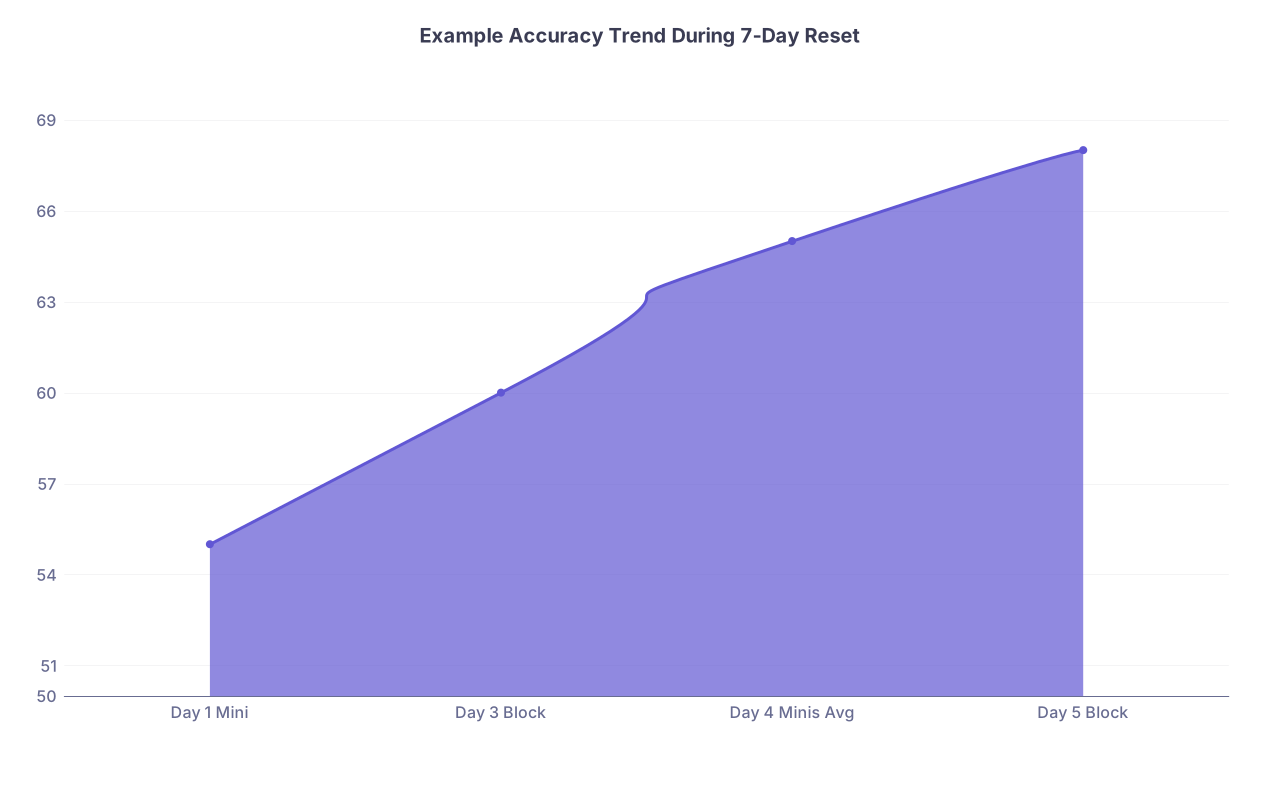
| Category | Value |
|---|---|
| Day 1 Mini | 55 |
| Day 3 Block | 60 |
| Day 4 Minis Avg | 65 |
| Day 5 Block | 68 |
Even a 5–10% bump in accuracy under similar or slightly stricter conditions is a real gain. Your emotions will not recognize it as progress. Your spreadsheet will.
Step 2: Two Micro-Goals Only for Today
Pick two targets, such as:
- “No more than 3 misreads in 40 questions.”
- “End with 3+ minutes left and no blind guesses at the end.”
- “No more than 2 answer changes, and only when I find new info.”
Design your day:
- 1 block of 20–25 questions timed, focusing on those goals.
- 1–2 sets of 10 questions tutor mode in your weakest topic from the week.
- 2–3 hours of content / Anki directed specifically by your error log.
Step 3: Work On Your Response To Bad Moments
Not every block today will feel good. That is the point.
When you have a rough patch (3 confusing questions in a row), your usual pattern might be:
- “I am failing. I am not cut out for this. It is over.”
Replace it with a rehearsed script:
- “Three hard questions in a row is normal. The test is supposed to have those. My job is to make my best guess and keep going.”
Yes, that sounds cheesy. But I have watched this exact reframe change behavior at question 38 when people normally melt down.
Day 7 – Dress Rehearsal or Consolidation
Day 7’s plan depends on where your exam date is and how fried you feel.
Option A: Dress Rehearsal (If Exam ≤ 3–4 Weeks Away)
You will simulate a partial exam:
- 2 back‑to‑back 40‑question blocks, timed, with a 10–15 minute break in between.
- Full pre-block ritual before Block 1.
- Mini pre-block reset before Block 2 (2 cycles of box breathing, rules review).
During both blocks:
- Use the same timing checkpoints.
- Run your calm protocol briefly at least once in each block when you feel your chest tighten or thoughts race.
Review:
- Not full line-by-line analysis today.
- Focus on process patterns, where fatigue changed your decision making from Block 1 to Block 2.
Option B: Consolidation (If Exam Is Further Out Or You Feel On The Edge)
If you are still emotionally wrung out, you consolidate instead of pushing:
- 20–30 questions, mixed, tutor mode, lower stress.
- 2–3 hours of tight, focused review of your personal error log.
- Build a one-page exam-day playbook that you will use when real test day comes.
Your playbook includes:
- Pre-exam morning plan
- Wake time, breakfast, commute time, what you are not allowed to do (e.g., no new content).
- Block ritual
- Breathing, rules, micro-checkpoints.
- If-then plans for common disasters
- “If I completely blank on a question, then I will: read stem twice, eliminate obvious wrongs, pick best, move on.”
- “If I feel a panic wave, then I will: drop shoulders, exhale slowly, and remind myself this is anxiety, not a stroke.”
Write it. Print it or save it offline. Read it before every major practice test.
What Happens After The 7 Days
This reset is not a magic cure. It is a pattern interrupt plus a new operating system.
After this week:
Keep 1–2 rituals permanently.
- Pre-block routine.
- Box breathing once per block.
- Strict rules on answer changes.
Run a mini-reset every 2–3 weeks.
- One lighter day with more movement and less volume to prevent another crash.
- Quick check of your error log and rules.
If your anxiety is still crippling despite this:
- You are blanking on every block.
- You cannot sleep more than 3–4 hours.
- You have panic attacks thinking about the exam.
Then you are no longer dealing with just “USMLE stress.” You need professional help – a physician, psychiatrist, or therapist who deals with performance anxiety. Medication or brief therapy is not a moral failure. It is smart resource use.
A Quick Visual: Your Reset Week As A Process

| Step | Description |
|---|---|
| Step 1 | Anxiety derails prep |
| Step 2 | Day 1 Stabilize body |
| Step 3 | Day 2 Rebuild schedule |
| Step 4 | Day 3 Controlled exposure |
| Step 5 | Day 4 Fix broken systems |
| Step 6 | Day 5 Full timed block |
| Step 7 | Day 6 Targeted refinement |
| Step 8 | Day 7 Dress rehearsal or consolidate |
| Step 9 | Return to regular prep with new rituals |
How This Actually Feels In Real Life
Here is the pattern I have seen in real students:
- Day 1–2: Guilt. “I am not doing enough, everyone else is cranking out 120 questions a day.”
- Day 3–4: Slight relief. “Okay, I can survive a timed block without totally imploding.”
- Day 5: Mixed. One decent block, one painful review. But the errors look more fixable.
- Day 6–7: Confidence not in scores, but in having a way to study and test, even when scared.
Then, two weeks later, you pull a new NBME and your score is up 10–20 points. Not because you suddenly became brilliant. Because your brain was finally not sprinting in circles while you took the test.
Final Takeaways
- You do not grind your way out of test anxiety; you systematize your way out. Sleep, movement, rituals, and defined rules beat “just try harder.”
- Process errors – misreads, timing, second-guessing – are usually more fixable than content gaps and give faster score gains.
- A 7‑day reset is not lost time. It is the foundation that makes every remaining hour of USMLE prep actually count.