The way you spend the last 3 hours of your day will make or break your shelf exam performance. Not your IQ. Not the perfect Anki deck. Your evening routine.
Most medical students handle this wrong. They grind questions until midnight, doom-scroll, then wonder why their heart is pounding on exam morning and their brain feels like it is running through molasses. That is not anxiety. That is poor systems design.
Let me show you a structured evening routine that actually lowers test anxiety before shelf exams. Step-by-step. Time-stamped. No fluff.
The Core Problem: Your Brain Does Not Have an “Off” Switch
Test anxiety before shelf exams is not mysterious. It is predictable.
Here is what I see over and over:
- Students doing random tasks each night: sometimes notes, sometimes questions, sometimes panic.
- Studying until exhaustion, then “collapsing” into bed.
- Checking scores (NBME, UWorld, AMBOSS) at night and spiraling.
- Eating junk, drinking caffeine late, and calling it “hustle”.
- Going to bed with 15 open loops in their head: “What if they ask…?” “What if I fail?” “What if I have to repeat the rotation?”
That combination guarantees:
- Racing thoughts at night
- Fragmented sleep
- Higher resting heart rate
- Worse recall on test day
The fix is not “relax more” or “think positive.” The fix is a structured, repeatable evening routine that:
- Tells your brain: “Workday is done.”
- Gives you controlled, bounded exposure to exam content.
- Closes mental loops so your brain does not chew on them at 2 a.m.
- Winds your nervous system down on purpose.
You need a protocol. Not vibes.
The 3-Hour Evening Routine Framework
You will customize details, but the overall frame is:
- T‑3:00 to T‑2:00 — Focused, time-limited review
- T‑2:00 to T‑1:00 — Planning, closure, and deactivation
- T‑1:00 to sleep — Wind-down and nervous system reset
Where “T” is your target bedtime. I am going to assume 11 p.m. bedtime for concreteness. Adjust forward or backward, but keep the relative structure.
So:
- 8:00–9:00 pm → Focused review
- 9:00–10:00 pm → Plan and close
- 10:00–11:00 pm → Wind down and sleep prep
Let’s break each block down.
Block 1 (T‑3:00 to T‑2:00): Focused, Contained Review
This is the only serious “studying” part of your evening. The goal is confidence, not coverage. You are reinforcing what you already mostly know, not cramming new weird zebras.
Step 1: Pre-Block Reset (5 minutes)
Before you touch a single question:
Change locations if possible
- Leave the bed. Go to a desk or table.
- If you study in the hospital call room, move from the bed to the chair.
Quick physical reset
- 10 slow air squats or wall pushups
- 5 deep diaphragmatic breaths: in for 4, hold 2, out for 6.
You are telling your body: “New mode now.”
Step 2: Choose ONE Structured Task Type
Do not mix. Do not bounce. Pick one for the evening:
Option A: Light Qbank review
- 10–20 questions in tutor mode
- Focus on high-yield, frequently tested topics (e.g., hemodynamics in IM, stages of labor in OB, developmental milestones in Peds).
Option B: High-yield summary pass
- 2–3 chapters or sections from:
- Emma Holliday slides
- OnlineMedEd notes
- Divine Intervention outlines
- Your personal “red notebook” summary
- 2–3 chapters or sections from:
Option C: Exam-mode simulation (only 1–2 nights/week)
- 1 short timed block of 10–15 questions to practice staying calm under a clock.
- Do not do a 40-question block at 9 p.m. You are trying to sleep tonight, not run an NBME.
Pick whichever best fits where you are:
| Situation | Best Choice |
|---|---|
| 1–2 weeks before shelf, content gaps | Summary pass |
| 3–7 days before shelf, refining | Qbank tutor |
| Confidence good, anxiety about timing | Short timed |
Step 3: Hard Time Box (no more than 45–50 minutes)
Set a timer for 45–50 minutes. When it rings, you stop. Period.
During that block:
- Phone on Do Not Disturb, face down, in a drawer if possible.
- Browser: one tab only (Qbank or notes).
- No switching resources every 5 minutes because you feel behind. That feeling is anxiety lying to you.
For Qbank:
- Use tutor mode most nights. Read the stem calmly.
- After each question:
- If wrong, write one one-line correction in a notebook:
- “SIADH → low serum osm, high urine osm, treat with fluid restriction +/- demeclocycline.”
- If right but uncertain, still write a brief anchor sentence.
- If wrong, write one one-line correction in a notebook:
Aim for 10–20 solid questions, not 40 rushed ones.
For summary pass:
- Quickly highlight or underline:
- “I know this cold.”
- “I kind of know this.”
- “I have no idea what this is.”
You will target the “kind of know” and “no idea” items later, not tonight.
Step 4: 5-Minute Extract and Close
At the end of the study block, before you get up:
- Open a physical notebook or a simple document.
- Write down 3–5 bullet points only:
- 2–3 facts you want to remember.
- 1–2 patterns you saw in questions (e.g., “All the septic shock questions hinged on recognizing warm vs cold shock.”)
That is it. You are not making a beautiful new resource. You are distilling.
Then say out loud (sounds silly, works):
“Study block done for tonight.”
That verbal closure matters. Your brain listens.
Block 2 (T‑2:00 to T‑1:00): Planning, Closure, and Mental Offloading
This is where most students accidentally spike their anxiety: they look at their entire study schedule at 10 p.m., decide they are “behind,” and start mentally writing their own failure narrative in bed.
We are going to do the opposite. We close loops before they chase you into sleep.
Step 1: Micro-Debrief (5–10 minutes)
Ask yourself three simple questions and write answers:
- What went well in my studying today?
- What is still shaky?
- What is tomorrow’s #1 priority topic/task?
Keep it brief. 3–5 sentences total. This is training your brain to see progress instead of chaos.
Step 2: Build a Tiny Plan for Tomorrow (10–15 minutes)
Not a perfectionist masterpiece. A 3-task plan.
Write out tomorrow’s:
- One content block (e.g., “GI path from OME + 30 Anki cards”)
- One question block (e.g., “20 UWorld questions in tutor mode, GI-focused”)
- One logistics/life task (e.g., “Email attending about days off before exam”)
Nothing more than 3 “must-do’s”. Everything else is a bonus.
Now put these in time slots you can actually hit, given your rotation:
- “Lunch break: Anki 20 cards”
- “After work 6–7 pm: 20 UWorld questions”
- “8:30–9 pm: Review wrongs from today”
This short plan is your answer to the 2 a.m. voice that says “You are not doing enough.” You can point to a concrete plan.
Step 3: Externalize All Remaining Worries (10 minutes)
You know the thoughts:
- “What if they ask a weird rheum case?”
- “What if my NBME score did not reflect my true level?”
- “I still do not get acid-base with compensation.”
You cannot think your way out of this at night. You will just loop.
Instead, do a brain dump:
- Set a 5-minute timer.
- Write every worry related to the shelf, rotation, or schedule. Messy is fine.
- When timer ends, draw a line.
Then next to each worry, mark:
- A — Actionable (I can do something)
- N — Not actionable (out of my control)
For “A” items, add them to a future day’s plan. For “N” items, write a brief reality check:
- “I cannot control the exact test questions; I can control that I review high-yield topics and sleep.”
- “I cannot change my past NBME; I can use it to target weak areas.”
This sounds soft. It is not. It is targeted cognitive offloading. You are telling your prefrontal cortex, “I captured this. You can rest.”
Step 4: Cut Off Content After This Point
Hard rule: No more new medical content after this block.
No “just one more video.”
No scrolling Reddit r/Step2 for “high-yield last-minute tips.”
No checking MedTwitter for what people did on their shelf.
You are turning off the tap that keeps refilling your anxiety bucket.
Block 3 (T‑1:00 to Sleep): Nervous System Downshift
You cannot think your way into less anxiety if your physiology is jacked up. You need to turn the volume down in your body.
This last block is about two things:
- Making sleep easier to start.
- Teaching your brain that “bedtime” ≠ “panic review session.”
Step 1: Tech Boundary (first 10 minutes)
You already cut off medical content. Now:
- Put your phone on Do Not Disturb.
- Move it across the room (or outside the bedroom) if you can.
- Turn screen brightness down on any remaining screens.
- No social media feeds. No score checking. No email.
If you must use your phone (I know, some of you use it for guided breathing):
- Use only pre-downloaded apps (meditation, breathing, white noise).
- Do not open messages or apps with infinite scroll.
Step 2: Simple Physical Ritual (10–15 minutes)
Your body learns routines. Make a fixed physical sequence you repeat every night before shelf exams. For example:
- Quick tidy of your desk (2–3 minutes).
- Lay out clothes for tomorrow (or exam day).
- Brush teeth, wash face, change clothes.
- Fill water bottle for morning.
The key: same order, every night. You are building a “bedtime script” that cues your brain: “We are shutting down.”
Step 3: 10–15 Minutes of Non-Medical, Low-Stimulation Activity
Pick one:
- Light fiction reading (paper or basic e-reader, not phone).
- Gentle stretching or basic yoga sequence.
- Coloring book, simple drawing, or journaling.
- A short, calming podcast that is not about medicine or productivity.
Nothing work-related. Nothing competitive. Nothing intense.
Your barometer: if it raises your heart rate, do not do it.
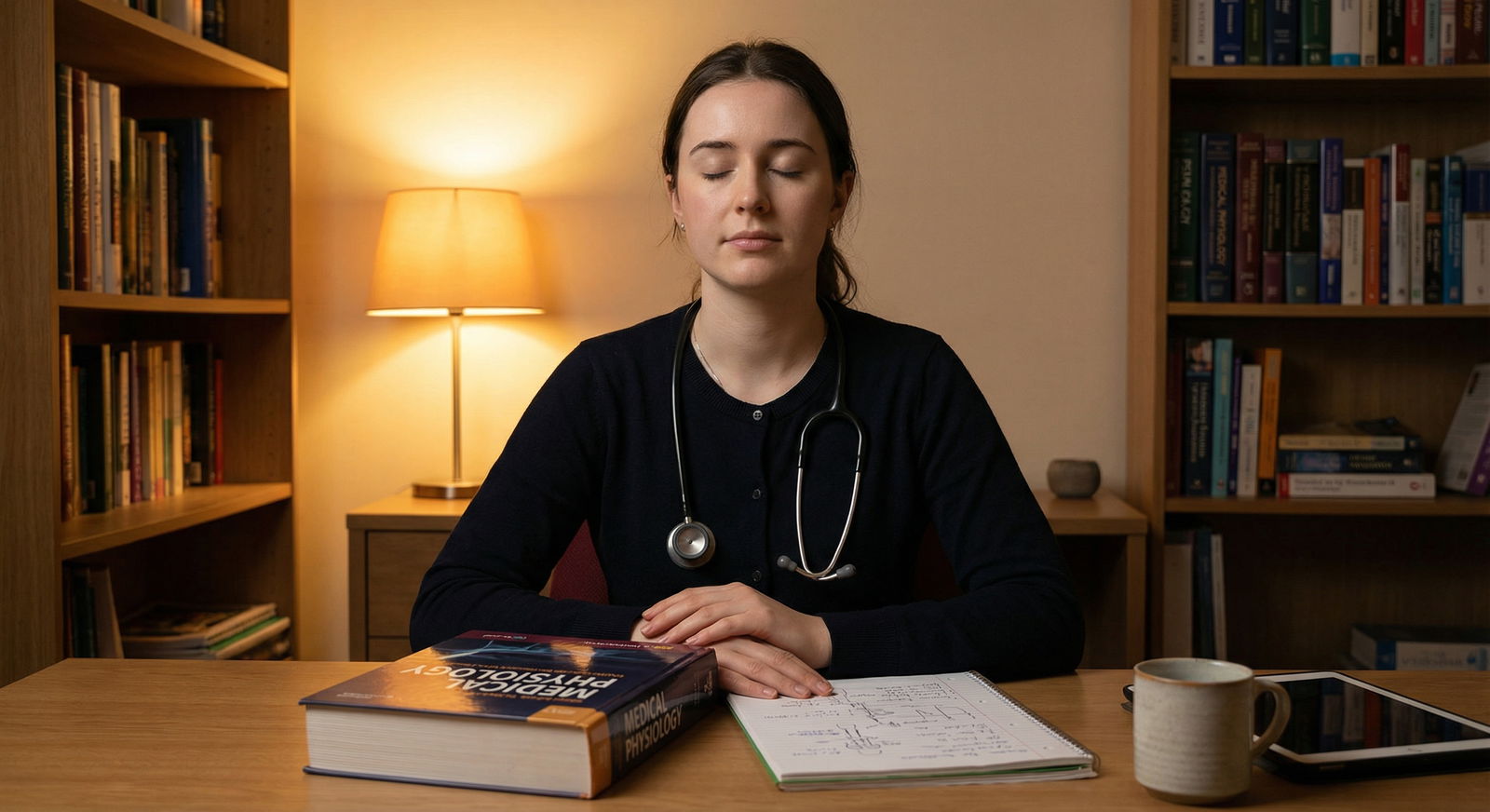
Step 4: 5–10 Minutes of Structured Relaxation
Here is where we hit anxiety directly.
You can pick any of these. Rotate if you like, but do one every night.
Option A: 4-7-8 breathing
- Inhale through nose for 4 seconds.
- Hold for 7 seconds.
- Exhale slowly through mouth for 8 seconds.
- Do 4 cycles.
Option B: Box breathing (great pre-exam too)
- Inhale 4 seconds.
- Hold 4 seconds.
- Exhale 4 seconds.
- Hold 4 seconds.
- Repeat for 10–15 rounds.
Option C: Progressive muscle relaxation (PMR)
Brief version, lying in bed:
- Tense feet for 5 seconds, release.
- Tense calves, release.
- Thighs, release.
- Abdomen, release.
- Hands/forearms, release.
- Shoulders/neck, release.
- Face muscles, release.
You are teaching your nervous system an alternative to “panic before sleep.”
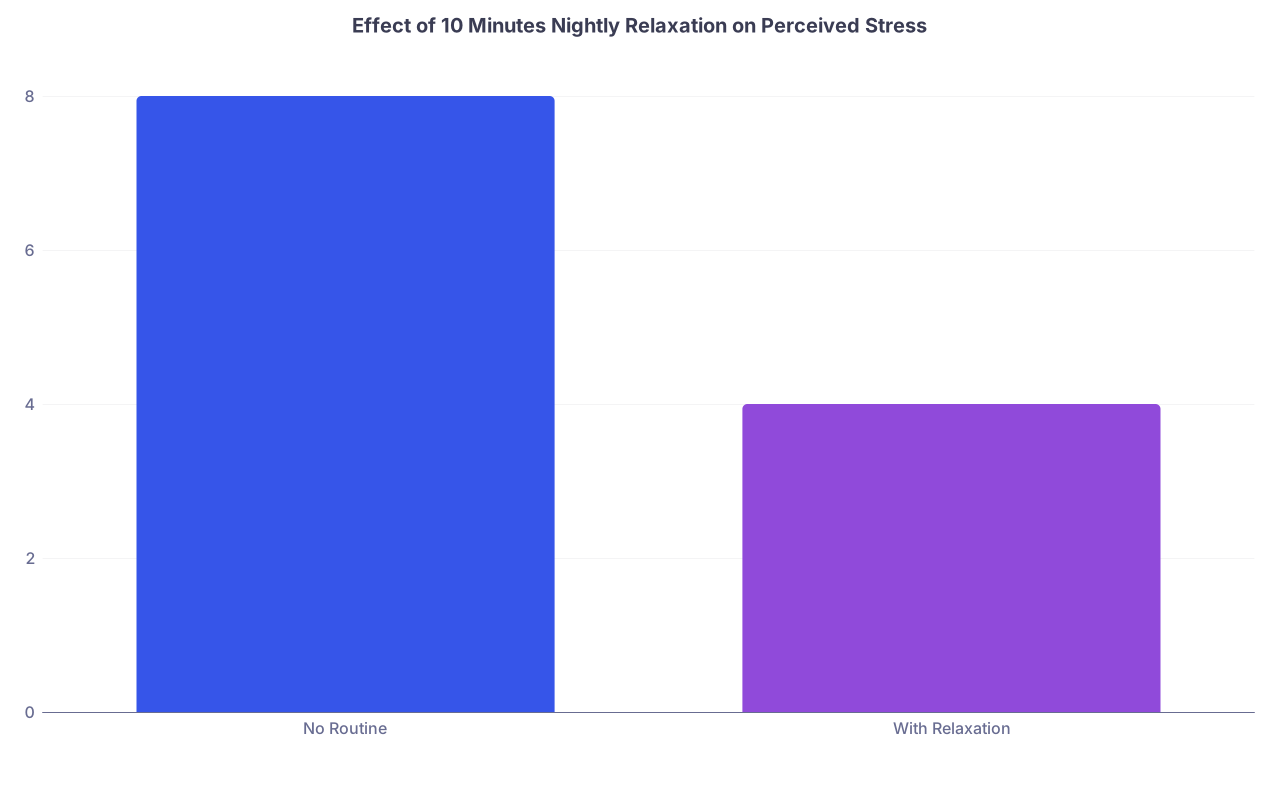
| Category | Value |
|---|---|
| No Routine | 8 |
| With Relaxation | 4 |
(Scale: 0–10 self-rated pre-exam stress; example numbers from typical student reports I have seen.)
Step 5: A Script for Nighttime Anxiety Surges
You will still have nights where you lie down and your brain starts yelling:
- “You forgot cardiomyopathies.”
- “You did not finish UWorld.”
- “If you fail this, your career is over.”
Do not respond with more studying. That is anxiety’s favorite trick.
Use this two-step script:
Name it:
- “This is my anxious brain trying to protect me.”
- “These are anxiety thoughts, not prophecies.”
Redirect with a cue phrase:
- “I have a plan for tomorrow. Now my job is to sleep.”
- “More studying right now will hurt me tomorrow. Sleep is study.”
Then bring your attention back to your breathing or your body (PMR). Every time your brain wanders to exam catastrophes, gently drag it back.
This is not about never worrying. It is about refusing to reward worry with action at midnight.
Special Case: The Night Before the Shelf
The routine stays mostly the same, but we tighten it even further. No surprises. No heroic study.
1. Stop All Intense Study by T‑4:00
If bedtime is 11 p.m., your last real question block or heavy review should end by 7 p.m.
Between 7–8 p.m.:
- Only light pass through your personal high-yield sheet:
- List of must-know equations
- “Buzzwords” for common conditions
- Algorithms (e.g., neonatal resuscitation, hypertension management)
No new notes, no new topics.
2. Use Block 2 to Lock in Logistics
During your 9–10 p.m. block, focus on reducing uncertainty:
- Print or save exam permit.
- Put ID, keys, and any allowed snacks or water near the door or in your bag.
- Set two alarms (phone + physical alarm if possible).
- Check exam location and transport time (Uber, bus, parking plan).
Then write out a mini timeline:
- Wake-up time
- Breakfast time / what you will eat
- Leave-home time
You are stripping away decisions from exam morning. Fewer choices → less anxiety.

| Step | Description |
|---|---|
| Step 1 | Stop intense study by 7 pm |
| Step 2 | Light high-yield review |
| Step 3 | Prepare exam logistics |
| Step 4 | Set alarms and pack bag |
| Step 5 | Wind-down routine |
| Step 6 | Sleep |
3. Shorten Wind-Down, Lengthen Sleep
Your target the night before: 7–9 hours of sleep. Not 4 hours “because I needed to review.”
If your normal bedtime is chaotic, this is not the night to reinvent everything. Use the same routine, just start 30–60 minutes earlier so you are not pushing sleep later.
And the non-negotiable:
- No NBME score-checking.
- No group chat comparing how much people studied.
- No “one last” random YouTube crash course.
What To Avoid in the Evenings (If You Actually Want Less Anxiety)
You can have the perfect routine on paper and still wreck it with a few bad habits. I have watched this happen in real time with students who “tried everything” but refused to change these.
Here is the hit list.
1. Late Caffeine
You are on rotations. Coffee is survival. Understood.
But if you are still taking:
- Coffee after 3–4 p.m.
- Energy drinks “to study after call”
- Pre-workout in the evening
You are volunteering for:
- Longer sleep latency (takes longer to fall asleep)
- More nighttime awakenings
- Higher physical anxiety baseline
Simple rule: Caffeine cutoff by 3 p.m. on any day that matters to you.
2. Checking Scores or Evaluations at Night
Looking at:
- Old NBME or COMSAE scores
- UWorld percent correct by subject
- Rotation evaluations / feedback emails
…after 8 p.m. is a direct shot of adrenaline.
If feedback is good, you will get wired. If it is bad, you will panic. Either way, sleep loses.
Set a “no scores after 7 p.m.” policy. That includes re-reading your last NBME and trying to re-curve it in your head.
3. High-Intensity Exercise Right Before Bed
Working out helps anxiety. But timing matters.
- Heavy lifting or intense cardio in the 1–2 hours before bedtime will keep your nervous system revved. Heart rate, body temperature, and cortisol all jump.
If the only time you can work out is late, keep it:
- Light (walking, easy cycling, stretching)
- Short (20–30 minutes)
Save the hard sessions for earlier in the day on non-call days.
4. Late, Heavy Meals
You are post-call and starving at 9:30 p.m. I get it.
But stacking:
- Huge meal
- Then lying flat
- Then trying to fall asleep in 20 minutes
…will give you reflux, poor sleep quality, and more night awakenings.
Try:
- Main meal earlier (whenever you get off).
- Light snack (yogurt, banana, small bowl of cereal, nuts) if you are hungry closer to bed.
How This Routine Lowers Test Anxiety Mechanically
This is not magic. It is physiology and cognitive science.
- Time-boxed study prevents endless rumination and the feeling you should always be doing “one more thing.”
- Micro-planning tells your brain “a competent adult is in charge,” which drops perceived threat.
- Brain dumping externalizes worries so they stop looping as much.
- Physical rituals give your nervous system predictability, and humans relax when patterns are stable.
- Breathing and PMR directly modulate your autonomic nervous system (vagus nerve, heart rate variability), which lowers somatic anxiety.
- Cutting stimulation (caffeine, screens, intense content) improves sleep onset and depth, and sleep is your best memory consolidator and emotional regulator.
Over about 7–10 days of doing this, most students report:
- Fewer late-night freakouts
- Less “impending doom” feeling on waking
- More stable performance on timed question blocks
- A quieter mind during the actual shelf exam
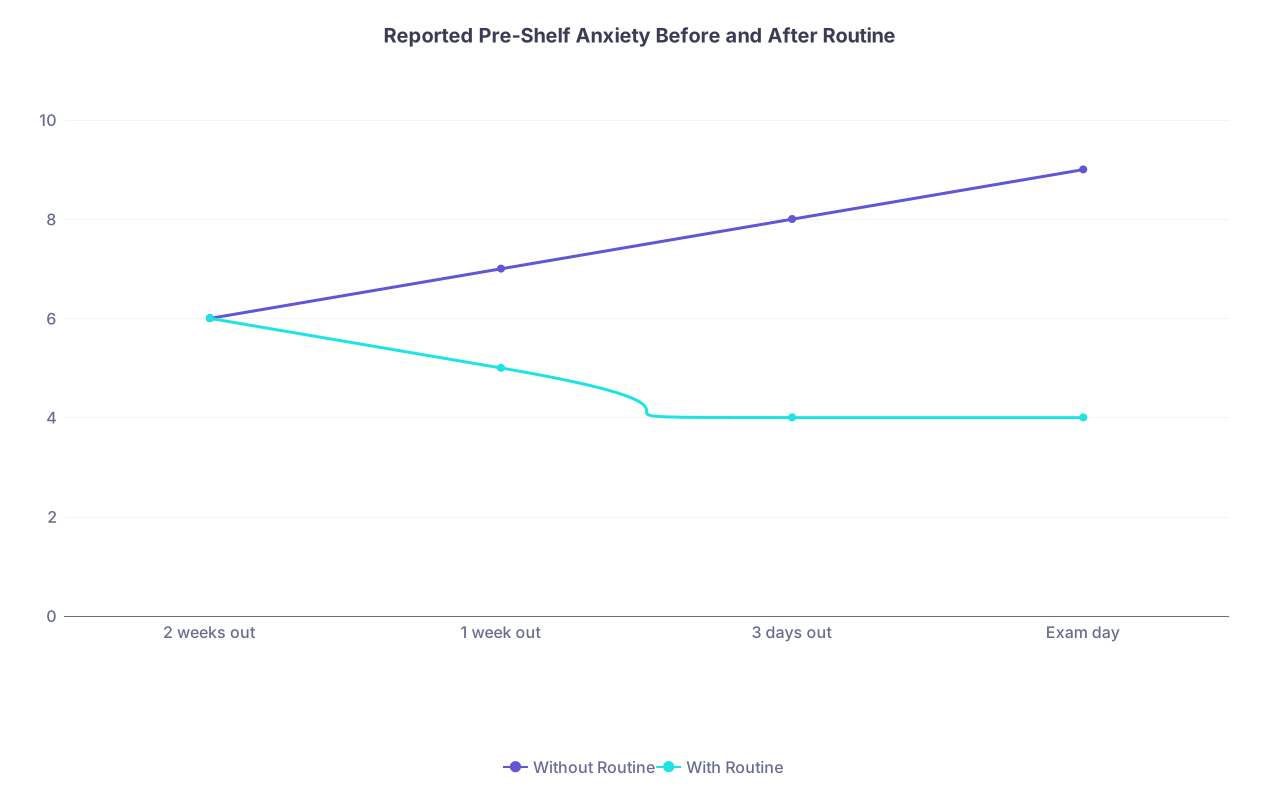
| Category | Without Routine | With Routine |
|---|---|---|
| 2 weeks out | 6 | 6 |
| 1 week out | 7 | 5 |
| 3 days out | 8 | 4 |
| Exam day | 9 | 4 |
(Again, example pattern based on what I consistently see with students who implement this fully.)
How to Implement This Without Overhauling Your Life Overnight
You do not need perfection. You need consistency.
Here is a simple 7-day ramp-up:
Days 1–2:
- Pick a fixed bedtime window (e.g., 10:45–11:15).
- Add one thing:
- Time-boxed 45-minute study block, then stop.
Days 3–4:
- Keep the study time-box.
- Add:
- 10-minute tomorrow plan (max 3 tasks).
- No new med content after that.
Days 5–6:
- Add:
- 10-minute brain dump and A/N labeling.
- One relaxation practice (e.g., 4-7-8 breathing).
Day 7 and onward:
- Tidy up:
- Remove scores after 7 p.m.
- Cut caffeine after 3 p.m.
- Install the predictable physical pre-bed ritual.
Do not try to build the perfect routine in one night. Build a good enough routine you actually stick to.
Your Next Step: Design Tonight’s 3-Hour Window
Do this now. Not tomorrow. Right now:
Decide your target bedtime for tonight.
Count back 3 hours. That is the start of your structured evening.
On a scrap of paper (or notes app), write:
T‑3:00 to T‑2:00 – Study:
- Task type (Qbank tutor / summary pass / short timed)
- Max minutes (no more than 50)
T‑2:00 to T‑1:00 – Plan & offload:
- 3-sentence debrief
- 3 tasks for tomorrow
- 5-minute brain dump
T‑1:00 to T – Wind down:
- Physical ritual steps (list them)
- One non-med activity
- One relaxation method
Later tonight, follow that script exactly once. See how you feel getting into bed compared with your usual chaos.
Then repeat tomorrow. And the next day. That is how you lower test anxiety before shelf exams—not by hoping to be less anxious, but by building an evening system that makes anxiety run out of fuel.