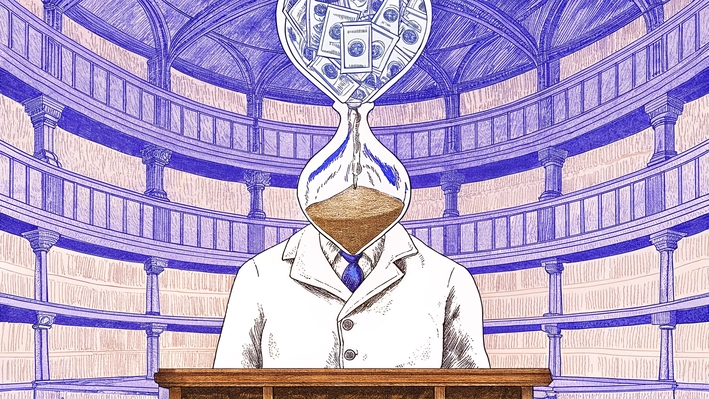
It’s 10:30 p.m. You’ve read the same paragraph on beta-blockers five times. None of it is landing. Your NBME is in three days, or your next block exam, or Step-style school test. And under everything is this one loud thought:
“I failed last time. What if it happens again?”
Your heart speeds up just thinking about walking into the exam hall. You remember the feeling of opening that score report. The “We regret to inform you…” email. The remediation meeting. Maybe the look on your dean’s face. Maybe how small you felt when your classmates asked how it went and you dodged the question.
Now anything that even smells like a big exam sends your nervous system into full alarm mode.
If that’s where you are, this is for you. Not generic “take deep breaths” nonsense. You already tried that. This is: you failed once (or more), your test anxiety is now supercharged, and you still have more exams you absolutely have to pass.
Here’s how to handle it.
1. Understand Why Your Anxiety Got So Much Worse (You’re Not Broken)
You did not become “bad at tests” overnight. Your brain is doing something very predictable: it’s linking “big exam” with “that horrible memory of failing.”
That’s classic conditioning.
Last time:
- You were stressed → you took a high‑stakes exam → outcome was failure → emotional pain, shame, fear, maybe academic consequences.
Your brain is not subtle. It goes: “High‑stakes exam = danger. Must panic earlier and harder next time so you don’t get hurt again.”
So before you beat yourself up for being anxious, understand what’s actually happening:
- Your anxiety isn’t random.
- It’s your brain trying (clumsily) to protect you.
- The issue is how it’s trying to protect you: by flooding you with fear that actually wrecks your performance.
The goal is not “no anxiety.” For med students, zero test stress is fantasy. The goal is: anxiety that’s proportionate and doesn’t hijack you.
And because the spike happened after a clear trauma point (the failed exam), this is more like a specific phobia or trauma response than just “I’m nervous.” Which means:
- You have to address the event and the story you told yourself afterward, not only your study schedule.
Let’s dig into the real problem: the story.
2. Rewrite the Story of That Failure (Bluntly, Not Softly)
Right now, your brain probably runs a script like:
“I failed because I’m not smart enough / I’m not cut out for medicine / I always choke on big tests / Everyone else gets it except me / If I fail again my career is over.”
That script is gasoline on your test anxiety.
You do not fix this by chanting affirmations in the mirror. You fix it by doing a cold, almost clinical, post‑mortem on that failure. Like you’re M&M‑ing your own exam.
Do this on paper, not in your head. That matters.
Step 1: Deconstruct the Actual Failure
Take one sheet of paper. Make three columns:
- Column 1: “What definitely contributed”
- Column 2: “What maybe contributed”
- Column 3: “What I just feel ashamed about, even if it wasn’t causal”
Then list specifics. Not vibes. Not “I suck.”
Real examples I’ve seen from students:
- Started serious prep too late (2–3 weeks before a major exam).
- Did way more passive review than questions (watched 100 hrs of videos, did 300 questions total).
- Didn’t review missed questions systematically, just glanced at the explanations.
- Let one bad NBME freak them out, then studied frantically without a plan.
- Sleep averaged 4–5 hours for the week before the test.
- Took exam while sick / going through a major life event.
- Scored consistently at or below the pass line on practice tests but took the real thing anyway.
You’re looking for fixable processes, not character flaws.
Step 2: Strip Out the Garbage Beliefs
Now, on a second sheet, write:
“That failure meant…” and fill in the first 10 things your brain tells you.
You’ll see junk like:
- “I’m imposter.”
- “Real doctors don’t fail these.”
- “My classmates will always be ahead of me.”
- “I’ll never catch up.”
Now ask two questions for each:
- Is this literally, objectively true? Or just a feeling?
- Can I name at least one physician or upperclassman who had a failure/setback and is now doing fine?
If you’ve been in med long enough, you know people who:
- Failed Step 1, repeated, matched into solid residencies.
- Repeated a year and are now chiefs.
- Bombed early block exams and then stabilized once they learned how to study.
Your brain will resist this exercise because shame likes to stay vague. Don’t let it. Drag it into daylight. Once you see “this equals career over” written on paper, it looks as ridiculous as it actually is.
The point isn’t to sugarcoat. It’s to be accurate. You failed one (or a few) exams. That’s a problem. It’s also solvable.
3. Separate Two Problems: Knowledge Gap vs. Anxiety Spiral
If you had a prior failure, your current performance risk comes from two directions:
- You may still have a content or strategy gap.
- You now also have a panic / over‑activation problem near exams.
You have to treat both. Students screw this up all the time by focusing only on one.
- If you only “work on anxiety” but still don’t know renal phys, you’ll stay in trouble.
- If you only “study harder” but keep melting down 48 hours before test day, you’ll underperform what you actually know.
So let’s split them cleanly.
4. Fix the Academic Side Ruthlessly (So Anxiety Loses Ammunition)
Your anxiety loves ambiguity. “I don’t really know how prepared I am” is anxiety catnip.
Your job is to make your academic situation so concrete that anxiety has less room to invent catastrophe.
Step 1: Get Objective Data
You need numbers, not vibes.
For a course exam:
- Use prior exams, question banks (UWorld, AMBOSS, etc.), and any self-assessment tools your school gives.
- Track performance by topic: not just “65% overall,” but “Cardio 80%, Pulm 55%, Renal 50%.”
For Step-style exams:
- NBME practice tests or UWorld self-assessments.
- Again, don’t just look at the three‑digit. Look at category performance.
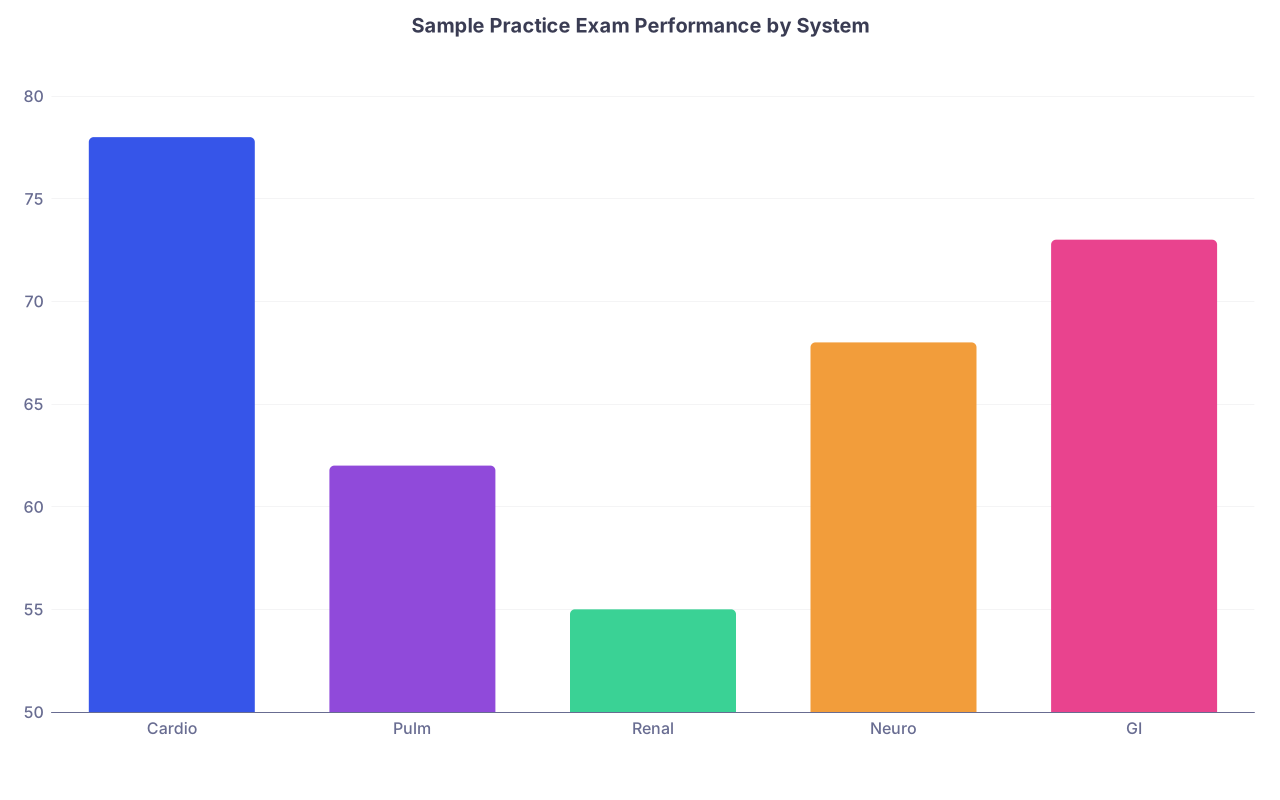
| Category | Value |
|---|---|
| Cardio | 78 |
| Pulm | 62 |
| Renal | 55 |
| Neuro | 68 |
| GI | 73 |
This does two things:
- It tells you if you are actually near the pass line or not.
- It gives you a focused target, instead of “I need to know everything better.”
If your practice numbers are comfortably above the pass threshold repeatedly (not just once), some of your anxiety is pure trauma from the past. Good. That’s treatable.
If your numbers are borderline or low, then you have honest work to do on content and approach. Also treatable.
Step 2: Build a Short, Brutally Clear Plan
Not a fantasy plan where you’ll magically study 12 hours a day and suddenly become Anki royalty.
A practical 2–4 week game plan that answers:
- What questions will you do daily (type and number)?
- When and how will you review missed questions?
- Which weak topics get dedicated repair time?
Example for a med school systems exam, 3 weeks out:
- 40–60 mixed questions daily related to current/previous systems.
- Every missed question: tag the topic, write a 1–2 line “why I missed it” and a mini‑takeaway.
- Each evening: 60–90 minutes targeted review on the 1–2 weakest tagged topics, not random notes.
The specific numbers will vary, but you get the point: simple, measurable, boringly consistent.
If you don’t trust yourself to design this, talk to:
- A learning specialist at your school.
- A trusted upperclassman who improved over time (not the genius who got a 270 without trying).
- A tutor who has actually helped students with failures, not just “high scorers.”
Step 3: Protect Sleep and Timing Like They’re Exam Content
If your last failure happened after:
- All‑nighters,
- Caffeine overload,
- Or weird schedule (staying up till 3 a.m. then a 7 a.m. exam),
you need to treat sleep and circadian rhythm as non‑negotiable “study items.”
For at least 7–10 days before the exam:
- Go to bed and wake up on the same schedule you’ll use on test day.
- No new resources. No last‑minute “maybe Sketchy for everything tonight!” panic.
- Use late evenings for light active recall, flashcards, and winding down, not full-sprint question blocks.
When students fix just those two things—structured questions + sane sleep—I see anxiety drop by half, simply because their body feels less wrecked.
5. Attack the Anxiety Problem Like It’s a Skill, Not a Personality Trait
Now the second front: your nervous system.
You cannot “think” your way out of a panic response 2 days before an exam. You have to train it ahead of time, in low‑stakes settings, the way you train any other reflex.
Think of it like this: your prior failure turned “exam environment” into a trigger. So you systematically:
- Rehearse exam‑like conditions,
- Pair them with physical calming tools,
- And unhook the automatic “test = danger” association.
Step 1: Build a 10-Minute Daily Nervous System Drill
Daily. Not “when I’m freaking out.” That’s like trying to learn CPR during a code.
Here’s a simple template (10 minutes total):
2 minutes: Slow breathing with a timer
- Inhale 4 seconds, exhale 6 seconds (or 4 in / 4 hold / 6 out if you like box-ish patterns).
- Sit up straight, feet on floor.
- Notice shoulders and jaw. Drop them.
5 minutes: “Micro-exposure” to exam thoughts
- Close your eyes. Visualize walking into the exact testing room (or a generic one if it’s unknown).
- Picture: logging in, seeing the first question, hearing typing, the clock in the corner.
- Let the anxiety rise a bit. Then keep breathing slowly through it.
- Repeat short phrases you actually believe, like:
“I’ve failed before and I’m still here.”
“I know how to answer one question at a time.”
“Panic is a feeling, not a prophecy.”
3 minutes: Short grounding routine
- Open your eyes and name: 5 things you see, 4 you can touch, 3 you can hear, 2 you can smell, 1 you can taste.
- Stand up, stretch your neck, roll shoulders, shake out your hands.
You’re training your body: “We can think about exams and not die.”
If you skip this because it feels silly or you’re “too busy,” expect your body to keep doing the same thing it did last time: red alert at the worst possible moment.
Step 2: Simulated Exams Under Controlled Stress
You need at least 2–3 realistic practice runs where you:
- Sit for a full block or two (60–80 questions),
- Use the exact breaks you’ll have on test day,
- Use only what you’ll have in the exam (no notes, no phone).

| Step | Description |
|---|---|
| Step 1 | Schedule Mock Exam |
| Step 2 | Set up exam-like environment |
| Step 3 | Timed question block |
| Step 4 | Short break with breathing |
| Step 5 | Second timed block |
| Step 6 | Post-exam anxiety rating + notes |
- Do your 10-minute nervous system drill. During:
- Watch for your first anxiety spike. Maybe question 5, maybe question 30.
- As soon as you notice it, implement a mini‑protocol: one slow breath, physically drop your shoulders, silently say, “Next question.”
After each mock:
- Rate 0–10: “How hijacked did I feel?”
- Write 2–3 lines: “What set me off? What helped even a little?”
You’re building proof: “I can get anxious and still function.” That’s the key. Not “I must never get anxious.”
6. Decide What to Do About Meds or Therapy (Not Last‑Minute)
Here’s where I’ll be direct: some of you need more than breathing and schedules.
If:
- You have full‑blown panic attacks (chest pain, derealization, can’t read the question),
- Your anxiety starts weeks out and wrecks sleep and appetite,
- You’ve failed multiple times despite strong prep,
then talk to someone clinical. Not just a friend. Not Reddit.
You have three main options, and they’re not mutually exclusive.
| Option | When It Helps Most |
|---|---|
| Short-term therapy | Breaking trauma link to past exam failure |
| Performance coaching | Strategy + structured study + accountability |
| Medication trial | Severe, disabling anxiety or panic symptoms |
Therapy
Ideally someone who knows CBT (cognitive behavioral therapy) or ACT (acceptance and commitment therapy) and has actually worked with medical / graduate students.
What they can help with:
- Identifying the exact catastrophic thoughts that blow up before tests.
- Designing exposure exercises beyond what you’ll do alone.
- Dealing with shame from prior failure so it doesn’t bleed into everything.
If your school offers free counseling and you’ve been avoiding it out of pride, stop. You’re past the “I’ll just grind harder” phase. You need another layer of support.
Medication
I’m not your prescriber, so I’m not going to tell you what to take. But I will say this:
Last‑minute, first‑ever benzo on exam day is a terrible idea. I’ve watched that movie. It doesn’t end well.
If you and a clinician are considering:
- A daily SSRI/SNRI for generalized anxiety.
- A beta‑blocker for physical symptoms (tremor, heart racing) during exams.
- Short‑acting anxiolytics.
Then:
- Start that conversation at least 4–6 weeks before a high‑stakes test, not 3 days before.
- Trial any “performance day” meds on a mock exam day. See how your body and brain respond.
There’s no virtue in white‑knuckling if you’re legitimately in panic territory. But meds are a tool, not a magic fix. They work best layered on top of everything we’ve already talked about.
7. Handle the Social and Administrative Fallout Like an Adult
Part of what spikes anxiety after a failure is the social and institutional debris:
The remediation plan. The email. The “So…how’d it go?” from classmates.
Avoidance keeps all of that radioactive.
With Your School
If you’ve failed a major exam, you probably had:
- A meeting with student affairs,
- Maybe a formal remediation plan,
- Or at least a “we’re concerned” conversation.
Here’s what you do now:
- Email or schedule a follow‑up: “I’ve been working on test anxiety since the last exam; here’s what I’ve changed, and here’s what still worries me. Is there any additional support available?”
- Be specific about what you want: maybe a learning specialist, extra time if you qualify and have documentation, quiet testing environment, or structured check‑ins.
This is not special treatment. This is using the system the way it’s intended to be used.
With Classmates
You don’t owe a full confession to anyone. But secrecy feeds shame, which feeds anxiety.
Pick 1–2 people you trust and say something like: “I bombed that last exam and it messed with my head more than I expected. I’m working on it. If I seem weird leading up to this test, that’s why.”
That’s it. You don’t need to turn it into a therapy session. But having even one person who “knows” reduces the pressure of pretending everything’s fine.
8. Build a Short “Day Before / Day Of” Battle Plan
The day before and the morning of your next major exam are danger zones for people who’ve failed before. That’s when all the old images come back. You need a script.
Day Before
Do:
- 1–2 light blocks of questions (or review of previous errors) max, focusing on process, not score.
- A full walk‑through of your exam routine: what you’ll eat, when you’ll wake, what you’ll pack.
- Your 10‑minute nervous system drill, plus maybe a bit longer breathing practice at night.
Don’t:
- Start a new resource.
- Pull an all‑nighter “just this once.”
- Obsessively re‑calculate your chances based on every prior NBME.
Put a hard cutoff time: “After 7 p.m., no new content. Only light review or relaxation.”
Exam Morning
You need 3 things:
- A predictable pre‑exam routine you’ve rehearsed on mock days.
- A micro‑script for when anxiety spikes.
- A rule for what to do if a block goes badly.
Example micro‑script:
- Before starting: 3 slow breaths, say in your head, “I answer one question at a time.”
- Mid‑block, if panic spikes: close your eyes for one full breath, then physically relax your hands and jaw. Whisper internally, “Next best guess, move on.”
- Between blocks: bathroom, water, light snack, and no post‑mortem of previous questions.
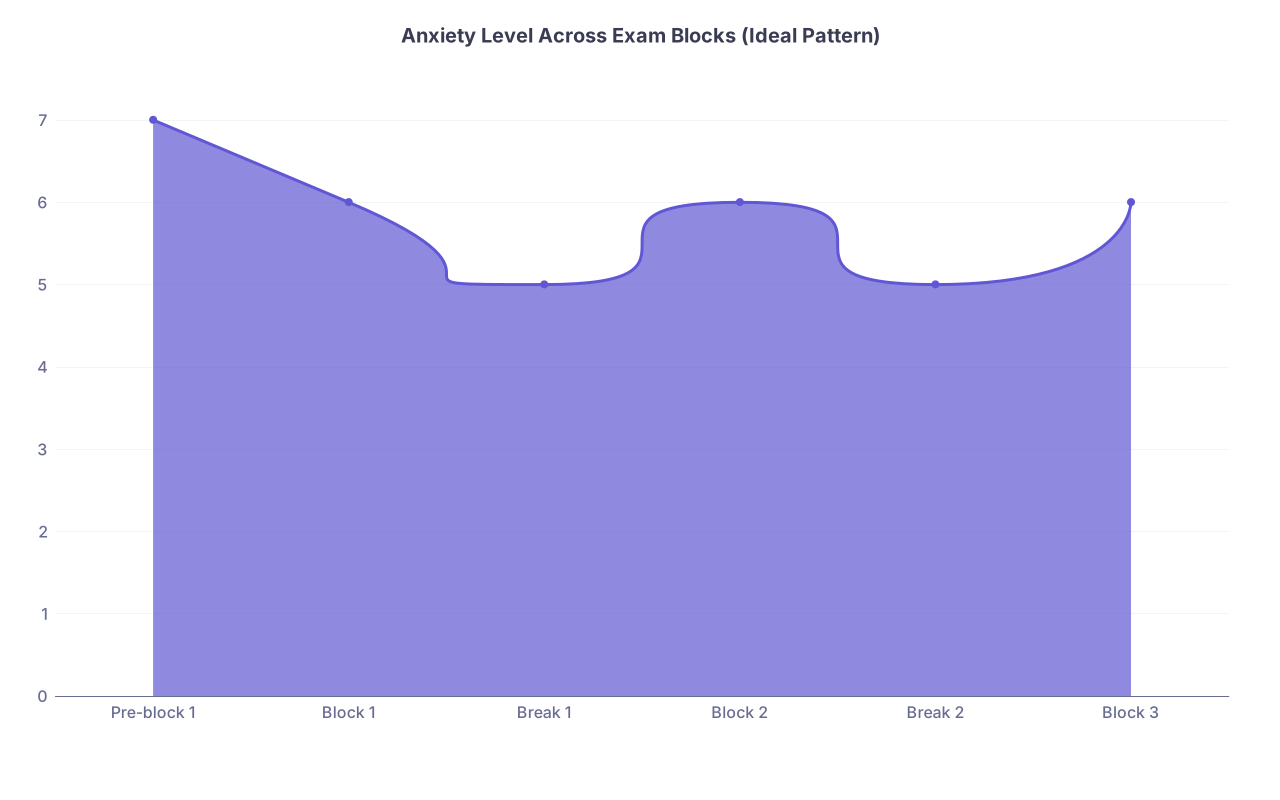
| Category | Value |
|---|---|
| Pre-block 1 | 7 |
| Block 1 | 6 |
| Break 1 | 5 |
| Block 2 | 6 |
| Break 2 | 5 |
| Block 3 | 6 |
You’re aiming for that pattern: high-ish but stable anxiety that does not escalate to 9–10 and shut you down.
9. If You Fail Again (Or Think You Did): Emergency Protocol
You may walk out of this next exam feeling like you failed again. Sometimes you’ll be wrong. Sometimes you won’t.
Either way, you need a rule.
Immediately after:
- No score‑stalking or compulsive question‑checking with friends.
- 24‑hour “no life decisions” window: you do not quit medicine, rewrite your entire future, or decide you’re a failure.
If the actual result is a fail:
- Re‑run the same three‑column post‑mortem, but this time add one more section: “What actually did go better than last time?” Maybe your sleep was better. Maybe your panic didn’t fully spike until later. That’s still progress.
- Book your support meetings immediately (advisor, learning specialist, therapist). Don’t ghost the system out of shame. That’s how single failures become multi‑year derailments.
I’ve seen students fail Step 1, barely pass the retake, then go on to crush Step 2 because they finally took their anxiety and their learning style seriously. They’re residents now. Nobody cares about that early failure except them.
10. Looking Ahead: Turning This Into a Strength, Not a Scar
Once you get through a big exam after a failure, with this kind of deliberate plan, something shifts.
You’ll have a new data point:
- Not “I failed once, so I’m doomed.”
- But “I failed, rebuilt, and then held it together under pressure.”
That changes how you’ll feel about in‑training exams, boards, even real clinical pressure later. You learn that:
- Your self‑worth is not stapled to one score report.
- Your nervous system is trainable, not fixed.
- Setbacks don’t mean “game over”; they mean “new rules.”
You’re still in the trenches right now. You probably don’t care about long‑term growth arcs; you just want to not implode on the next test. Fair.
So start there:
- One honest post‑mortem of the last failure.
- One clear, boring study plan for this exam.
- One daily 10‑minute anxiety training routine.
- One or two people in your corner, plus professional help if your symptoms are severe.
You stack those days and get through this next exam. Then the one after that. At some point you’ll look up and realize: the failure that used to own you is now just a chapter you reference when a junior student whispers, “I bombed my test—what do I do?”
With these next steps in place, you’re not “fixing” yourself. You’re leveling up your ability to function under pressure—the same thing residency will demand of you again and again. But that’s the next phase. For now: one exam, one plan, one day at a time.