The students you think are “naturally calm” before exams are not calm. They’re running a playbook you were never taught.
I’m going to walk you through that playbook.
I’ve watched the full spectrum: the gunner who looks ice-cold before Step 1 but is dry-heaving in the bathroom 30 minutes before the exam, the quiet mid-class student who somehow crushes NBME after NBME, the resident who can nap in the call room 15 minutes before an in-training exam and then score in the 90th percentile.
None of them are anxiety-free. They just manage it like professionals. And most of what actually works never makes it into wellness handouts or mindfulness workshops.
This is the insider version. The stuff that gets said behind closed doors.
The First Secret: Top Test-Takers Don’t Aim for “No Anxiety”
Let’s get rid of the biggest myth first: the goal is not zero anxiety. That’s fantasy.
Behind the scenes, program directors talk about this all the time. The residents who perform the best on exams and in the hospital? They usually report some anxiety. Not crippling. Not paralyzing. But a sharp, focused hum in the background.
What the strong performers learn early—often by crashing and burning once—is this:
They don’t fight anxiety. They shape it.
Students who struggle keep trying to “calm down,” “relax,” or “make the anxiety go away.” So when their heart rate jumps on exam day, they interpret it as failure. “I’m freaking out again. I’m not ready. This is going to go badly.”
The good test-takers have a different internal script. When their heart rate rises, they think, “Good. System’s online. Let’s use it.”
I’ve seen this play out during dedicated. Two students with the same knowledge base:
- Student A: feels anxious before a UWorld block → spirals, stalls, doom-scrolls Discord.
- Student B: feels anxious before a UWorld block → automatically labels it as “normal activation,” does the block anyway, reviews mistakes methodically.
Six weeks later, Student B has done 2–3x the practice, not because they “felt better,” but because their anxiety wasn’t something they negotiated with every morning.
They’ve turned anxiety from an obstacle into background noise.
The Real Backstory: What Faculty Actually Notice
Let me tell you what attendings and program directors actually talk about when they’re off mic.
No one says, “Wow, she never seems anxious.” They say things like:
- “He gets rattled but recovers fast.”
- “She’s clearly stressed but still thinks clearly when it matters.”
- “He looks nervous as hell but he does not fall apart in high-stakes moments.”
That’s what translates to test performance too. Not some zen master stillness. Just functional under pressure.
The students who quietly score 250+ on Step 2 or honors all their shelf exams usually share a few traits that are never advertised:
- They treat anxiety like a predictable, scheduled visitor, not a surprise intruder.
- They have rituals that start the anxiety earlier, not hide from it until exam morning.
- They rehearse the worst-case scenario so deeply that, when things go sideways, it feels familiar rather than catastrophic.
You’re going to recognize yourself in some of this. And you’ll recognize the people you’ve envied, too.
The Hidden Daily Playbook: How They Manage Anxiety Long Before Exam Day
Let’s zoom into ordinary days in medical school. Not test day. Not dedicated. The boring Wednesday in the middle of a clerkship.
The anxious student’s day usually looks like this:
Wake up → feel behind → scroll → procrastinate → cram randomly → feel guilty → tell themselves they’ll “really start tomorrow.”
The high-performing, high-anxiety student’s day is not magically peaceful. But they’ve built scaffolding around their anxiety.
Here’s what I keep seeing, semester after semester:
1. They Make Anxiety Smaller by Making the Day Smaller
They don’t wake up thinking, “I have to master all of cardiology” or “I need to be ready for Step 2.” That’s how you induce panic before breakfast.
They think in tightly defined, uncontestable chunks:
- “Two UWorld blocks. Fully reviewed.”
- “30 AnKing cards x 3 sets.”
- “One hour of reading on CHF + 10 questions on it.”
That’s it. Small enough that arguing with it is harder than doing it.
The trick? Each of those chunks is non-negotiable. The rest of the to-do list is optional. Those core anchors are not. So even on a disaster day, they still put points on the board.
If your anxiety spikes because every day feels like you’re supposed to conquer an infinite mountain, this is the first lever to pull.
2. They Use Time Boxing, Not “I’ll Just Study All Day”
The most anxious students love vague plans. “Today is for studying.” That’s a trap.
The people who quietly dominate exams do something different: they time-box everything. Not because of “productivity hacks”—because it reduces anxiety through clear boundaries.
“I’m anxious about this UWorld block” feels different when the brain hears:
“We’re doing 40 questions from 9:00–10:30. At 10:30, this ends.”
Finite suffering is less scary than endless, formless effort.
I’ve watched students move from, “I cannot even open UWorld right now” to, “Fine, I’ll suffer for this one 90-minute block and then I can reassess.” That shift alone breaks a lot of paralysis.
3. They Have Set Rules for Bad Days
This is a huge one. Top test-takers don’t reinvent their life every time anxiety spikes. They have pre-written rules for “off” days.
I’ve seen versions like:
- “On any bad day, I still:
– complete at least 1 block
– review every wrong answer
– do bare-minimum Anki for retention”
That’s it. Not heroic. Just non-zero.
Why it works behind the scenes: faculty and residents know progress across months matters more than a couple of “perfect grind” days. The people who succeed avoid the all-or-nothing oscillation: 12-hour binge days followed by three days of hiding in bed.
You do not need high motivation. You need rules that survive low motivation.
The Pre-Exam Rituals You Never Hear About
The night before a major exam is where you see the clearest difference between people who sink and people who stay functional.
Here’s what you don’t see on social media: most top performers feel awful the day before a big test. The difference is they expect to feel awful and have a plan that doesn’t depend on feeling confident.
Let me walk you through what a real playbook looks like.
The Day Before: Controlled Exposure, Not Avoidance
Anxious students often oscillate between two extremes:
- Cram mindlessly until 2 a.m.
- Or refuse to look at anything exam-related because “it makes me panic.”
The high-scorers usually do a shorter, deliberately structured day:
- A half-day of light to moderate review (maybe 2–3 hours focusing only on weak topics or key formulas/lists).
- One clearly defined cutoff time (e.g., 5 or 6 p.m.—hard stop).
- After that: only low-arousal tasks. Food, shower, light walk, maybe a familiar TV episode. Nothing that ramps up adrenaline.
Why? They’re not trying to learn more; they’re trying to signal to their nervous system: “The heavy lift is done. We’re in landing mode.”
The Night Before: Pre-Deciding Failure Conditions
Here’s a move most anxious people never use, but top test-takers do:
They pre-decide how they’ll handle partial failure.
Things like:
- “If the first block goes terribly, I will not void. I will finish the exam, then process it later.”
- “If I see a question I have no idea on, I’ll:
– take one slow breath
– eliminate obviously wrong choices
– make my best guess
– fully let it go before the next question”
They run these scripts like an athlete visualizing a race. So when the disaster thought comes—“I have no idea what this question is asking”—their brain has a rehearsed response instead of raw panic.
I’ve asked high-scorers about their worst moment on exam day. The answer is almost always something like: “I had a block where I felt like I was guessing on everything. But I had promised myself I’d keep going, so I stuck to my routine and compartmentalized until the break.”
That “promise to self” wasn’t spontaneous bravery. It was planned.
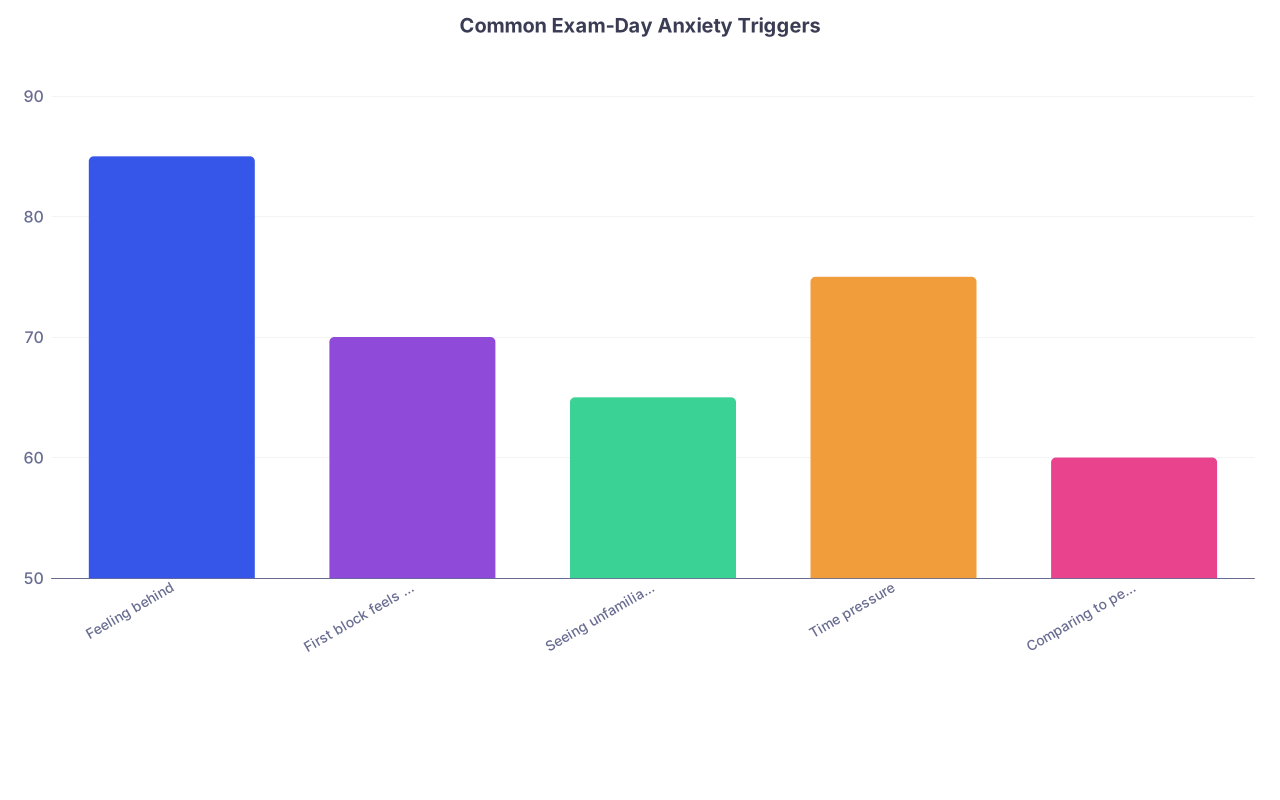
| Category | Value |
|---|---|
| Feeling behind | 85 |
| First block feels hard | 70 |
| Seeing unfamiliar topics | 65 |
| Time pressure | 75 |
| Comparing to peers | 60 |
The 10–15 Minutes Before the Exam: What High-Scorers Actually Do
Most students are a mess in that pre-exam holding area. I’ve watched it in COMLEX, Step, shelf exams, in-house finals. The room is an anxiety amplifier.
The strongest test-takers have very specific, selfish rituals. Let me be blunt: they’re not there to comfort you. They’re there to protect their own mental bandwidth.
Patterns I keep seeing:
- They avoid last-minute question drills. No Anki, no random UWorld screenshot, no “just one more fact.” That spikes uncertainty and rarely helps.
- They usually avoid anxious peers. If a friend starts spiraling, they’ll politely step away, go to the bathroom, or put in headphones.
- They run a short, rehearsed routine—often the same every exam:
- 5–6 slow, controlled breaths (4-second inhale, 6–8-second exhale).
- Mentally rehearsing the first 5 minutes of the exam step by step: adjust chair → confirm name → scan first 3 questions → do not panic if they look rough.
- One core reminder phrase, something like: “You’ve done the work. One question at a time.” or “Your job is not to feel ready; your job is to execute.”
The key is consistency. Same breaths. Same phrase. Same micro-routine. Your brain stops re-evaluating whether you’re ready and just runs the script.
During the Exam: How Top Performers Talk to Themselves
Here’s what faculty never teach and wellness lectures never touch: the inner monologue is everything.
The average anxious student’s inner dialogue:
- “I should know this.”
- “I’m blowing it.”
- “That last question was definitely wrong.”
- “Everyone else probably finds this easy.”
The quieter high-scorer’s inner dialogue is different. Not positive fluff. Just ruthless practicality:
- “No idea? Fine. What can I eliminate?”
- “That last block felt bad. Doesn’t matter. New block, same plan.”
- “You don’t have to feel confident. You just have to keep answering.”
They keep the conversation focused on behaviors they can control: read carefully, eliminate, decide, move on.
The other big thing: they’re not aiming to feel smart during the test. I’ve heard this exact sentence from multiple 250+ scorers:
“I felt like I was guessing on half the test. That’s just how these exams feel.”
They go in expecting that emotional landscape. So when anxiety pops up—“I’m guessing too much”—their reaction is, “Yep, this is what we signed up for,” not, “Something’s gone horribly wrong.”
What They Do Outside Studying That Actually Matters
This is where a lot of generic advice gets thrown at you: sleep more, exercise, meditate. Yes, yes, yes. You already know.
Let me tell you which pieces actually move the needle specifically for high-anxiety med students, based on the people who dramatically changed their scores over a dedicated period.
Sleep: They Treat Pre-Exam Sleep Like Procedure Prep
The students who rebound from poor practice scores and crush the real thing get one harsh reality early: sleep before an exam is non-negotiable performance infrastructure.
They don’t pull true all-nighters in the last 48–72 hours. Ever. They may go shorter on sleep 1–2 weeks out. But the last 2–3 nights? Guarded.
I’ve literally seen an attending tell a student: “If I find out you stayed up until 3 a.m. before Step 1, I’ll be more worried about your judgment than your score.” That wasn’t a joke.
High-anxiety students who keep tanking usually bargain: “I know I should sleep, but I’ll feel better if I review just a bit more.” That is how you sacrifice 10–20 points for a marginal illusion of preparedness.
Movement: They Use Exercise as a Reset Switch, Not Self-Improvement
Most high scorers during dedicated are not chasing PBs in the gym. They use movement in one of two ways:
- Short, intense sprints or quick circuits to burn off the adrenaline spike.
- Or slow, steady walks to bring the system down after long question blocks.
The pattern that works: scheduled movement, not “if I have time.” For example:
- “Every day at 2 p.m., I walk for 20 minutes. No phone. No questions. Just walking.”
- “After every two blocks, I do 5–10 minutes of light bodyweight exercise or stretching.”
They’re not trying to be athletes. They’re managing their baseline arousal level so the anxiety doesn’t accumulate unchecked.
Information Diet: They Cut the Toxic Channels
Let me say this bluntly. Your group chats, Discord, Reddit, and certain “supportive” classmates are making your anxiety worse. A lot worse.
Top performers during exam periods do quiet, ruthless pruning:
- Muting group chats that constantly share scores, panic, or new resources.
- Limiting Reddit/Discord to very specific, short windows, or cutting it entirely 2–3 weeks before the exam.
- Avoiding hallway conversations that start with, “How many blocks have you done?” or “I heard the new exam has way more XYZ.”
They’re not stronger than you. They’re just less exposed to constant triggers.

The Dark Side: When Anxiety Management Becomes Performance Itself
I’m not going to pretend there’s a clean boundary between “normal” and “too much.” But I’ve sat in enough closed-door meetings to know when faculty start getting worried.
Here’s what crosses the line from “high but managed anxiety” to “this is actively undermining your future”:
- You’re routinely voiding exams, cancelling last minute, or rescheduling repeatedly.
- You’re skipping clinical duties or important exams because of physical symptoms (vomiting, near-syncope) clearly tied to anxiety.
- You’ve built an entire avoidance infrastructure: expanding dedicated indefinitely, refusing to do practice questions, only reviewing “safe” content.
I’ve seen students hide this for months. The story they tell externally: “I just need a bit more time to feel ready.” The reality: fear has become the central organizing force of their life.
Here’s the part most people do not realize: programs are not impressed by suffering. They’re impressed by adaptation.
If you’re at the point where anxiety is driving significant avoidance, the strongest move is not to “try harder.” It’s to medicalize the problem: talk to student health, get evaluated for performance anxiety, OCD traits, ADHD, depression—whatever’s in the mix.
The students who turn it around didn’t white-knuckle their way out. They got treatment. Therapy. Sometimes medication. Sometimes official accommodations. And then they layered the playbook on top.
No one on the residency selection side punishes you for getting help. They do punish consequences: repeated failures, withdrawals, professionalism issues. Address the cause early, before it leaves a paper trail.
A Concrete Micro-Plan You Can Steal
Let me crystallize this into something you can actually run this month.
| Day | Core Focus | Non-Negotiable Action |
|---|---|---|
| 1 | Baseline | 1 UWorld block + review; 10-min walk |
| 2 | Structure | Time-box 2 study blocks; set daily cutoff |
| 3 | Rituals | Create pre-exam script + breathing routine |
| 4 | Triggers | Mute 1–2 toxic group chats/feeds |
| 5 | Bad Days | Write your “bad day rules” (min work) |
| 6 | Simulation | Full timed block using exam-day ritual |
| 7 | Reflection | 15-min review: what reduced anxiety most |
Repeat that cycle with slightly increased volume. Keep the structure, adjust the content.
This isn’t about feeling fearless. It’s about proving to yourself, over and over: “I can be anxious and still execute.”

| Step | Description |
|---|---|
| Step 1 | Anxiety Spike |
| Step 2 | Run Pre-Exam Ritual |
| Step 3 | Follow Daily Study Plan |
| Step 4 | Breathing + Script |
| Step 5 | Begin Questions |
| Step 6 | Time-Boxed Study Block |
| Step 7 | Short Walk Reset |
| Step 8 | Post-Block Review |
| Step 9 | Exam Soon? |
What Comes Next
You’re not going to flip a switch and become the calmest person in your class. That’s not the goal.
The goal is to become the person who can say, honestly: “Yeah, I was anxious. And I did it anyway. Because I know my system works.”
Start small. One UWorld block done while anxious is more valuable than three done on a hypothetical perfect day you keep postponing. One exam where you feel shaky but stick to your script is more transformative than a hundred wellness tips you never implement.
Once this foundation is in place—once your anxiety is something you work with instead of fight—then we can talk about optimization: score maximization, strategic scheduling, how to perform under the eyes of attendings who terrify half your class.
But that’s a story for another day.