
It’s 3:45 p.m. on a Thursday. You’re on surgery, post-call, brain fried. The resident just reminded you the “little shelf quiz” is tomorrow. Your stomach drops.
You nod like it’s no big deal, but you already feel your pulse climbing. You know you know this stuff… until there’s a timer. Then your mind blanks, your hands sweat, and every question stem looks like static.
And you’re wondering: Do they think I’m dumb? Weak? Not cut out for this? Do attendings actually care that I have test anxiety—or do they just think it’s an excuse?
You will not get the real answer to that from wellness handouts or school-wide emails. You get it from what people say after you walk out of the workroom. I’ve been in that room. I’ve heard what’s said.
Let’s walk through what faculty actually think.
The Quiet Truth: Faculty Don’t All See This the Same Way
Here’s the first thing you need to understand: “Faculty” is not one unified, enlightened organism. It’s a messy mix of:
- Old-school “I took exams on stone tablets and survived” people
- Quietly-compassionate, burned-out but trying people
- Younger faculty who took Step 1 pass/fail and actually remember what panic felt like
- Program directors who pretend to be neutral but are staring at your numbers on a spreadsheet
Different groups, different reactions.
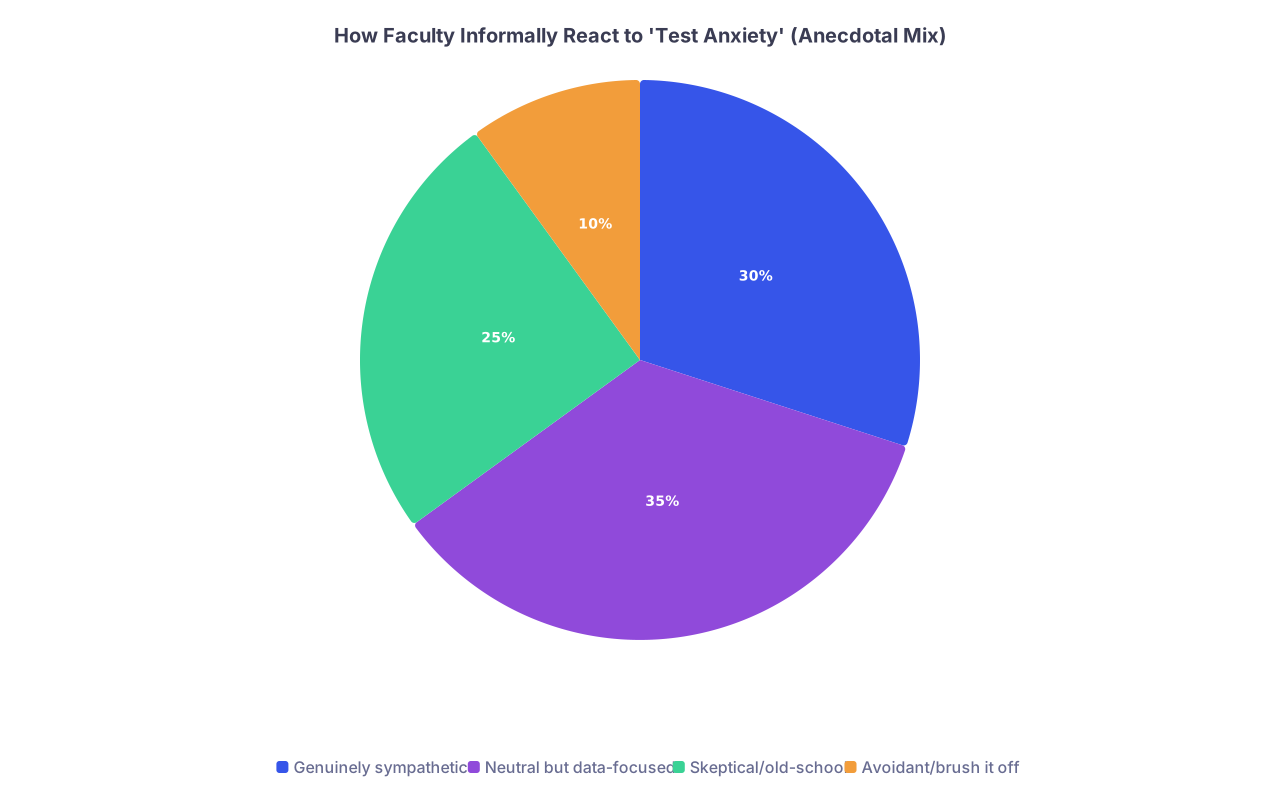
| Category | Value |
|---|---|
| Genuinely sympathetic | 30 |
| Neutral but data-focused | 35 |
| Skeptical/old-school | 25 |
| Avoidant/brush it off | 10 |
Those aren’t formal statistics. That’s the distribution you feel when you sit in on evaluation meetings. Let me decode how each group thinks when they hear “test anxiety” on clerkships.
The Old-School Skeptics
These are the ones who say things like:
- “In my day we just studied harder.”
- “Everyone is anxious. That’s medicine.”
- “If you can’t handle a shelf, what happens in a code?”
Behind closed doors, when a student bombs a shelf and mentions anxiety, this group often translates that as:
- Poor preparation
- Low resilience
- Not someone they want in a high-acuity, high-pressure specialty
Is that fair? No. Is it real? Yes.
You’ll recognize them because they roll their eyes (literally or internally) when wellness resources are mentioned. You’re not going to convert them. But you can work around them.
The Quiet Realists
This is the largest group. They may not say much when you mention anxiety. They don’t immediately hand you tissues or an inspirational quote.
They’re thinking something like:
- “Okay, but can this student safely learn and function?”
- “Is this affecting patient care or just scores?”
- “Do I have any actual data? Or is this just how they feel?”
They’re not hostile. They’re metrics-driven. If your evals say “works hard, connects well with patients, shows initiative” and your only weak point is “shelf a little low,” this group often shrugs and says, “Fine. Solid student. Move on.”
If your clinical performance is also shaky—late, disengaged, disorganized—then when you bring up anxiety, they quietly file it under “global functioning problem,” not just an exam issue.
The Actually-Get-It Crowd
Usually younger faculty, sometimes those who barely got through Step 1 alive, sometimes people who’ve had panic attacks themselves. You can hear it in how they talk:
- “Test-taking is a separate skill from clinical reasoning.”
- “This student knows the material but melts under the timer.”
- “Let’s see how they do with oral questions versus MCQs.”
These people will defend you in evaluation meetings. I’ve watched an attending say, “Their shelf was weak but I would trust them with my family as a doctor,” and that changed the room.
You want these people to know your story—in a contained, professional way.
What They Actually Notice About Your Anxiety
Here’s the harsh part: faculty are usually not diagnosing your internal state. They’re inferring it from your behavior, and they’re often wrong.
You might think, “I’m clearly anxious, how can they not see it?”
What they see is:
- You freeze on rounds when asked “What’s your differential?”
- You stammer but then give the right answer 20 seconds later.
- Your exam score is lower than your apparent knowledge.
- You make basic errors on written tests you would never make out loud.

From their side of the table in an eval meeting, this is how the conversation goes:
“She’s really anxious on rounds but she reads a lot. Shelf was borderline.”
“Yeah, she knows the answers but freezes up. I don’t think it’s knowledge.”
“She’s not dangerous, just nervous. I’d mark her as ‘meets expectations’ overall.”
Or the opposite:
“He says he has test anxiety but he’s not prepared on the floor or on the exam.”
“Yeah, I didn’t feel like he had ownership of patients. The anxiety might be real, but so is the lack of work.”
“Let’s mark him lower. This isn’t just an exam thing.”
Your anxiety by itself isn’t what gets judged. The pattern around it is.
What Helps You Versus Hurts You
Helps you in faculty eyes:
- Strong clinical performance + weaker exam + clear insight: “I struggle under timed tests; here’s what I’m doing about it.”
- Owning mistakes and showing a plan: “I reviewed my wrong questions and realized I rush stems when I’m stressed.”
- Taking feedback without getting defensive or crumbling.
Hurts you:
- Saying you have test anxiety but never seeking accommodations, help, or coaching.
- Using “anxiety” as the explanation for every shortcoming.
- Breaking down visibly in a way that disrupts patient care or team function, repeatedly, without a plan.
That last one matters. Faculty are much more tolerant of quiet internal suffering than public collapse that affects workflow. Not fair. But very real.
The Accommodations Question: What They Will Not Say Out Loud
Let’s talk about extended time and other accommodations, because there’s a lot of nonsense floating around.
Here’s the private faculty truth:
- Most attendings don’t know the details of your official accommodations. They just see your shelf score at the end.
- Some quietly resent the system; they think “the job doesn’t slow down for anxiety.”
- The better ones understand that accommodations level the field, they don’t tilt it.
What they really think boils down to this:
“If you still have issues with test performance even with appropriate accommodations, is this a fixable skill gap or a long-term mismatch with very test-heavy specialties?”
They don’t usually say that to your face. But I’ve heard it in promotions, remediation, and residency letter meetings.
| Faculty Type | What They Say Politely | What They Think Privately |
|---|---|---|
| Old-school surgeon | "Just keep working hard." | "If they can’t handle this, not for surgery." |
| Young hospitalist | "Let’s strategize for the next exam." | "They’re smart; this is a performance issue." |
| Clerkship director | "Have you talked to Student Affairs?" | "Can I justify this grade on paper later?" |
| Psych faculty | "This is common and treatable." | "Are they engaging in treatment or stuck?" |
You need to understand you’re being evaluated on two planes:
- The clinical plane: can you think, communicate, function on the team?
- The testing plane: can you clear the numerical hurdles the system demands?
Faculty worry most when both planes are shaky.
When (and How) To Tell Faculty About Your Test Anxiety
This is where students screw it up all the time. Either they overshare in the worst moment, or they hide it entirely until they’re in academic trouble.
The unfiltered reality:
Most faculty do not want your full psychiatric history. They want to know:
- Does this affect your performance here?
- Is there anything reasonable they can do to help?
- Are you being proactive, or do they need to worry about you imploding?
When disclosure helps you
- You already have documented test anxiety or panic disorder and use accommodations.
- You’ve had a prior bad exam outcome and are trying to prevent a repeat.
- You can speak about it calmly, like a clinical problem with a management plan, not like you’re falling apart in front of them.
How this actually sounds when done well:
“Dr. Lee, I wanted to share something briefly so you have context. I’ve historically struggled with significant test anxiety. I’ve worked with Student Affairs, I have accommodations through the school, and I’m doing targeted practice with a tutor. On the floor, I’m fine, but under a timer I can underperform what I know. I’m not asking for any special changes here, I just wanted you to know this is an area I’m actively working on.”
Faculty response in their head:
“Okay, they’re self-aware, they have a plan, I don’t need to fix this for them. And if their shelf isn’t stellar, maybe I won’t write them off as lazy.”
When disclosure backfires
- You use “test anxiety” as the first line of defense when you underperform.
- You get emotional in a way that makes the attending feel trapped or manipulated.
- You imply they need to change grading policies or expectations just for you.
Just so you hear the internal monologue on the other side when it goes badly:
“She had a bad quiz and immediately launched into ‘I have test anxiety.’ We all have stress. This feels like an excuse.”
Or:
“I feel bad for him, but he cried twice on rounds in front of the team. I can’t trust him with overnight cross-cover.”
You’re allowed to have emotions. But work on channeling them to safer places and times—mentor meetings, mental health visits, not mid-code or mid-oral-exam.
How Faculty Quietly Distinguish “Anxious but Capable” from “Concerning”
Here’s what people actually say in end-of-rotation evaluation huddles. Pay attention to the difference.
Anxious but capable:
“Yeah, she was nervous with pimp questions. But by week three, she was giving solid plans. Patients loved her. Shelf was average but I’m fine with a high pass.”
“He overthinks and second-guesses himself, but if you let him talk it out, his reasoning is sound. I’d take him on my team again.”
Concerning:
“She was so anxious she avoided patient contact. Always in the workroom. That’s not just tests.”
“He froze when we needed a simple order placed. Everyone gets nervous, but that crossed into unsafe.”
Notice the pattern:
Faculty forgive a lot of internal chaos if the output is safe, prepared, and gradually improving. If your anxiety starts to visibly compromise patient care, communication, or reliability, the tone shifts.
What Actually Improves How Faculty See You (Even If Anxiety Never Fully Goes Away)
You’re not going to cure a lifetime of test anxiety in a 4-week clerkship. But you can absolutely shape the narrative faculty build about you.
Think narrative, not perfection.
Show prep in ways they can see.
Quote guidelines, reference articles you read last night, pre-chart intelligently. Faculty interpret that as “this student works hard,” even if you’re trembling inside.Recover visibly from small stumbles.
If you freeze in a question, circle back later:
“Dr. Patel, about that question on SIADH earlier—I looked it up, and the key difference with CSW is…”
That one move tells them your anxiety doesn’t paralyze your growth.Make them trust you with follow-through.
If they say, “Follow this patient’s sodium trend and let me know if it hits X,” you do it. On time. Every time. Anxious but reliable is acceptable. Unanxious but flaky is not.Own the test weakness clinically.
After the shelf, if it went poorly and they ask, you do not hide in vague language. You say:
“I think the test went below where I wanted. I’ve struggled with timed exams before. I’m already in touch with Student Affairs and planning dedicated time with question banks to target the weaker areas.”
That sounds like a resident.
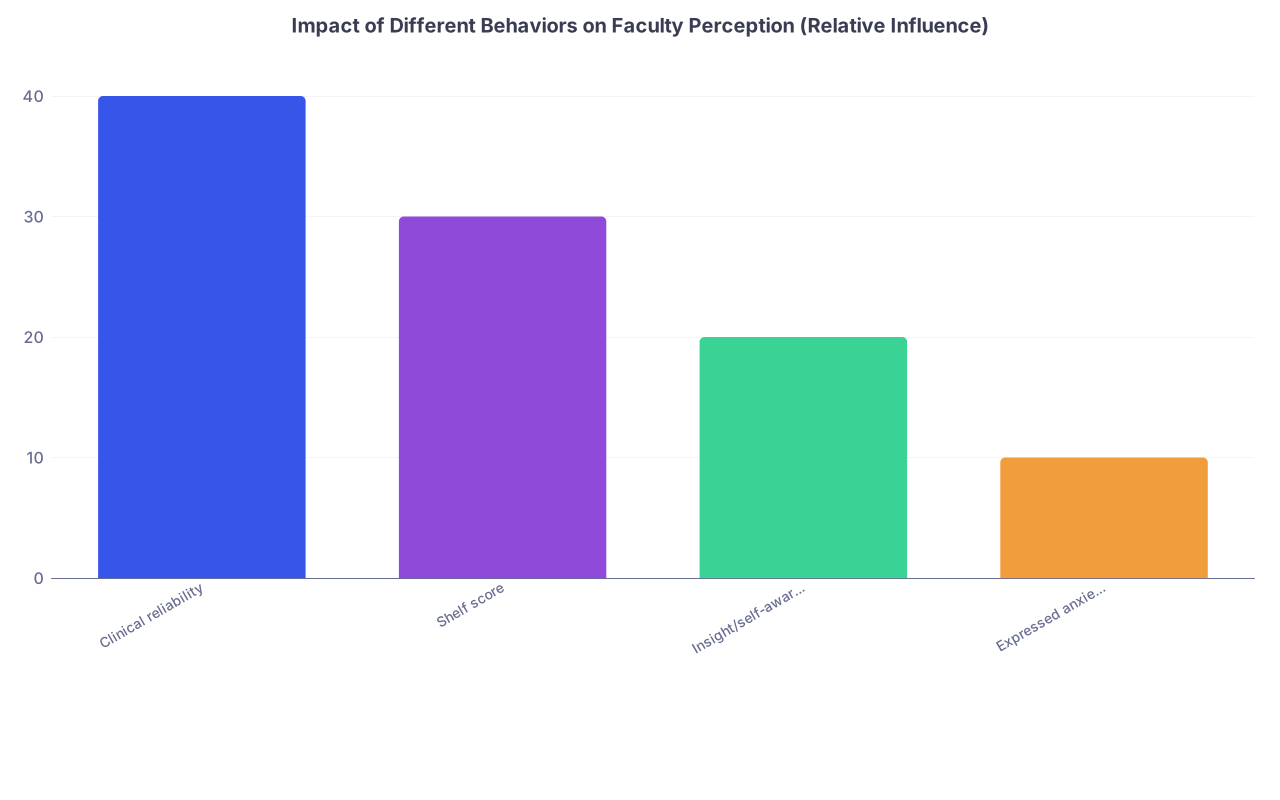
| Category | Value |
|---|---|
| Clinical reliability | 40 |
| Shelf score | 30 |
| Insight/self-awareness | 20 |
| Expressed anxiety alone | 10 |
That’s how the weighting feels in real life, not what schools officially publish. Reliability and day-to-day clinical behavior outweigh your spoken anxiety by a lot.
The Unsaid Reality About Specialty Choice
You’re probably wondering: Does test anxiety quietly close doors for me?
Sometimes, yes. Not always for the reasons you think.
Certain specialties have residency directors who are test-score absolutists. Surgery, derm, ortho, some EM programs. They see anything less than strong standardized performance as risk. When your clerkship faculty sit down to write letters, they do think about: “Can this person survive that environment without getting destroyed?”
Others—family med, psych, peds, hospitalist tracks—care more about your actual functioning with patients and your long-term stability.
Faculty will rarely say to you:
“You might want to avoid X because your anxiety will be shredded there.”
But I’ve heard them say it about students when advising each other.
Here’s the thought process:
- “She’s brilliant but melts under pressure. I’m not sure trauma surgery is the healthiest place for her.”
- “He struggles with every high-stakes test but is fantastic with kids and families. Peds or FM would love him.”
That’s not them limiting you. That’s them quietly drift-guiding you toward places where you’re more likely to thrive.
You can absolutely still choose a competitive specialty with test anxiety. People do. But you do it with:
- Serious treatment or coaching
- A ruthless approach to exam skills
- Faculty advocates who can say, “Yes, the scores are X, but this person is gold clinically.”
What You Should Actually Do Next Rotation
Let me strip this down into something you can act on in the real, messy world you’re in.
Decide who gets your story.
One person per clerkship. A clerkship director, a trusted attending, or chief resident who seems psychologically safe. Not every random fellow you meet once.Script your 60-second explanation.
Keep it clinical, not confessional: history, impact, and management plan. Practice it until you don’t shake saying it.Document your effort somewhere.
Email to Student Affairs, meeting with learning specialist, mock exams. Faculty are more generous when they hear, “They’ve been working with X and Y on this.”Handle your first bad test like a professional, not a catastrophe.
Reflection, plan, follow-up. Not silence, avoidance, and vague “I’ll try harder.”Protect your bandwidth.
Sleep is not optional for anxious brains. You can’t brute-force your way through chronic panic with more Anki cards and less REM.

| Step | Description |
|---|---|
| Step 1 | Recognize test anxiety pattern |
| Step 2 | Identify 1 faculty to inform |
| Step 3 | Contact Student Affairs/Mental Health |
| Step 4 | Start treatment/coaching |
| Step 5 | Use scripted 60-sec disclosure |
| Step 6 | Demonstrate strong clinical reliability |
| Step 7 | After exam: honest debrief + plan |
| Step 8 | Refine strategy for next clerkship |
| Step 9 | Already documented/treated? |
You’re not trying to become a non-anxious robot. You’re trying to become the anxious-but-effective student faculty recognize as safe, self-aware, and improving.
FAQ: What Faculty Really Think About Test Anxiety
1. If I tell an attending I have test anxiety, will they secretly lower my evaluation?
Some will be neutral, a few will silently judge, and some will actually be more understanding. What matters is how you tell them. If you present it with insight and a concrete management plan, most reasonable faculty do not punish you for it. They may even defend you when your shelf score doesn’t fully match your clinical performance.
2. Do faculty think accommodations like extra time are “cheating”?
A minority do, usually the old-school crowd who never engaged with disability frameworks. The majority barely think about it beyond: “Does this student meet competency and behave safely?” They see your final grade, not your testing conditions. It becomes a red flag only if, even with accommodations, you still chronically underperform without any visible effort to improve.
3. Can test anxiety alone make a program director avoid ranking me?
On its own, no, because it’s rarely visible to them as “test anxiety.” What they actually see are your scores, your clerkship comments, and your letters. If those say “nervous but excellent with patients and reliable,” it’s fine. If they say “disorganized, struggles under pressure, weak exams,” anxiety is just part of a bigger concern.
4. Should I mention test anxiety in my Dean’s letter or personal statement?
Usually not as a central theme. You don’t want your application framed around “I am the anxious one.” If you discuss it, it should be in the context of: challenge → insight → concrete adaptation → evidence of success. One short, controlled paragraph at most, and only if you’ve clearly turned it into a strength in how you function now.
5. What makes faculty genuinely worried versus just mildly concerned?
They get genuinely worried when your anxiety interferes with patient care, reliability, or team functioning—missed pages, freezing in emergencies, avoiding patient interactions. They’re mildly concerned but generally accepting when you’re clearly anxious yet still: show up prepared, improve over time, communicate, and follow through. They don’t need you to be calm. They need you to be safe and growing.
Years from now, you won’t remember the exact scaled score on that awful shelf you took post-call. You will remember the story you built about yourself: fragile and defeated, or anxious but still showing up, learning to manage your mind in the same way you manage a crashing patient—systematically, calmly, one step at a time.