
It’s 6:45 a.m. on the morning of your in-training exam. You’re in the call room, still in fleece pants, scrolling through UWorld explanations you’ve already memorized. Your senior walks in, grabs her coffee, and watches you flip between panic-texts and Anki. She doesn’t comment. But she notices.
Fast forward to noon sign-out. Someone mentions your name and the exam. A couple of attendings chuckle about “the resident who was pacing in circles and asking if anyone knows if NBME ever mis-scores tests.” Faculty remember that. Program leadership remembers that. More than you think.
Let me be blunt: your test day behavior is shaping how faculty see you as a future attending. Not your score report. Your behavior.
Everyone in academia says they care about “lifelong learning,” “resilience,” “wellness.” What they’re really watching—quietly, systematically—is how you act under controlled, predictable stress like exams. Because that’s their proxy for how you’ll behave under uncontrolled, clinical stress.
I’ll walk you through how this actually plays out behind closed doors, how attendings read your exam day behavior, and what you can do to manage anxiety without branding yourself as “that resident.”
What Faculty Actually Watch Around Exam Time
Here’s what you probably think: “They only care if I pass. Everything else is noise.”
That’s not how it works.
Faculty form impressions through a series of small data points. Exams are one of the few standardized stressors everyone in the program goes through at the same time. It’s a natural lab for faculty to observe who unravels, who overcompensates, and who quietly handles business.
There are four windows they watch, even if they never say it:
- The week before the exam
- The day of the exam
- The 24–48 hours after scores drop
- The pattern over multiple exam cycles
Let’s pull back the curtain on each.
The Week Before: Subtle Red Flags vs. Quiet Pros
The week leading up to an in‑training exam or Step is where patterns show up. Residents think they’re “hiding” their stress. They’re not.
Attendings and chiefs notice things like:
- How you cover your clinical duties
- How much you talk about the exam
- Whether your anxiety spills onto patients or teammates
I’ve sat in faculty rooms where someone says, “He’s strong clinically, but every time there’s an exam he becomes unusable for three days.” That becomes part of your reputation. It shows up on rank meetings. On fellowships. On job calls.
You don’t need to be zen and unbothered. That’s fake and nobody buys it. What faculty are evaluating is control vs. contagion.
They ask themselves, often unconsciously:
- Does this resident’s anxiety stay with them, or does it spread to everyone around them?
- Do they own their schedule, or do they catastrophize and expect others to clean up?
- Are they transparent and professional, or passive-aggressive and flaky?
The “High Maintenance” Resident
Typical behavior pattern I’ve seen plenty of times:
- Starts requesting last-minute schedule changes
- Makes snide comments about “this program not caring about boards”
- Leaves work marginally incomplete because “I just really need to study”
- Constantly polls co-residents about how much they are studying, fishing for reassurance
From the outside, what attends see is: this person is fragile around stress and externalizes it onto the system.
Nobody writes that exact sentence in an evaluation. But it colors words like “reliable,” “professional,” “team player.” And those are the words that actually matter.
The “Quiet Competent” Resident
By contrast, here’s what puts attendings at ease:
- Clear communication early: “I have my ITE next Thursday; can I pre-round on X patients the night before so morning is smoother?”
- Stable mood: a little stressed is fine; snappish and brittle is not
- No performative suffering: not announcing “I’m so behind in studying” every third sentence
When faculty see you anticipate and manage stress without drama, you move in their mental file from “good resident” to “this is someone I’d trust as a junior attending.”
Exam Morning: Your Micro‑Behaviors Are Loud
Let’s go to the main event: test day.
No one cares if you bring highlighters or three pens. They care about the signals around your behavior.
What Faculty Infer From Your Pre‑Test Behavior
Picture two residents on the morning of the in‑training exam.
Resident A:
- Shows up on time, coffee in hand
- Chats lightly with co-residents, not obsessing over content
- Not scrolling through last-second notes in a frantic way
- When asked how they feel, says something like “Nervous but ready enough—let’s get it done”
Resident B:
- Shows up late and flustered, blames traffic or sign-out
- Has First Aid open, furiously scanning paragraphs
- Keeps saying “I’m going to fail, I’m going to fail”
- Asks people “What’s the normal range for X again?” or “Do you remember that weird vasculitis?” five minutes before the test
Both might end up with similar scores.
But faculty read Resident B’s behavior as: under pressure, they dysregulate and demand emotional labor from everyone around them. That’s the exact opposite of what you want associated with your name.
I’ve literally sat in a program leadership meeting where the PD said, “Scores were fine, but his exam-day panic was something else—I don’t want to be on call with him in a real emergency.”
That’s the translation in their heads: If this is how you behave for a predictable, scheduled exam, how will you behave for an unexpected code at 3 a.m.?

During the Exam: Stories Spread, Fair or Not
You think what you do inside the exam room is private. Technically it is. Practically, not really.
Testing center staff talk. Co-residents talk. Chiefs talk. And some of it reaches faculty, especially in smaller programs.
Behaviors that get noticed (and not in a good way):
- Repeatedly getting up, pacing, or sighing loudly
- Complaining aggressively to proctors about rules that everyone else accepted
- Making melodramatic comments walking out of each block (“That was sadistic,” “They’re trying to fail us”)
- Talking loudly about item content right outside the room
None of this makes you a bad person. It just makes you high maintenance in a system that prizes low‑maintenance reliability.
How Leadership Reconstructs Your Behavior
You’ll never hear the full chain, but it often goes like this:
- Co-resident: “Yeah, he was freaking out during the exam, kept saying he was failing.”
- Chief, in a private leadership huddle: “He really fell apart on test day. We need to watch how he handles pressure.”
- PD: “This fits with some of the comments from ICU about needing a lot of reassurance.”
Now your exam-day behavior has been anchored to your clinical persona. That’s where the damage happens.
If you already have a strong, calm reputation? People shrug it off as “bad day.” If you’re borderline? It reinforces doubts.
After the Exam: The 24–48 Hour Window That Exposes You
There’s a cruel little truth here: many attendings care less about the exact score and more about your reaction to the score.
This is especially true now that Step 1 is pass/fail. People scrutinize your behavior more, your score less.
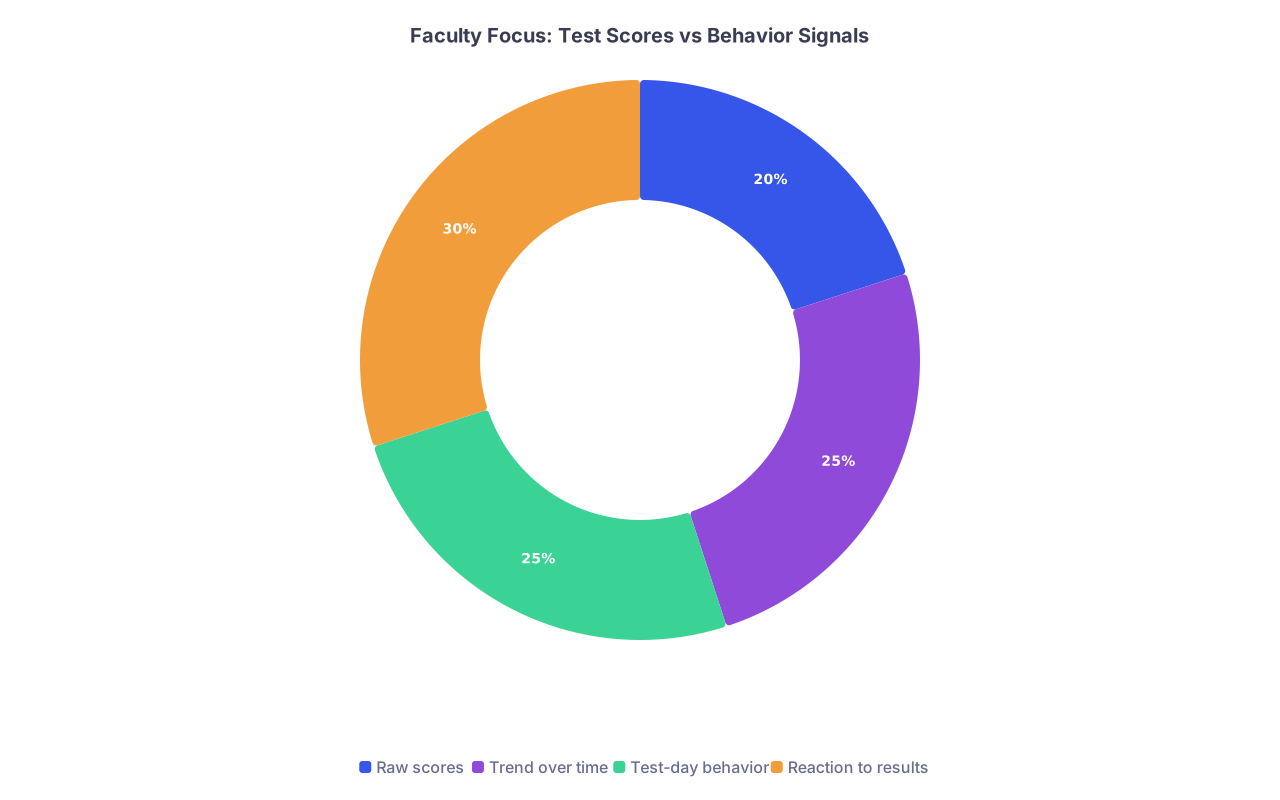
| Category | Value |
|---|---|
| Raw scores | 20 |
| Trend over time | 25 |
| Test-day behavior | 25 |
| Reaction to results | 30 |
The informal breakdown I’ve seen: the score is maybe 20–25% of the story. Your pattern and professionalism around it is the rest.
How You Talk About the Exam Matters
Immediately post-exam, faculty notice:
- Do you constantly corner attendings with, “That exam was garbage, right?”
- Do you loudly dissect items and accuse the test of being “unfair”?
- Do you humblebrag, “Honestly, it felt easy, I finished early”?
The subtext they hear:
- Chronic victimhood (“The system is out to get me”)
- Fragile ego (“If I don’t crush it, I blame the exam”)
- Poor self-awareness (“Not reading the room with classmates who struggled”)
The residents who quietly say, “Glad it’s done, I’ll see how it shakes out and adjust my studying if needed” come across as… grown-ups. The bar is not high.
When Scores Come Back
This is where people really show their hand.
Residents who worry faculty:
- Public meltdown over a borderline but passing score
- Blaming everyone and everything: the program, the schedule, the call burden
- Rewriting history: “I didn’t even study” when everyone knows you took days off
Residents who impress leadership, even with a less-than-stellar number:
- Schedule a brief, focused meeting: “Here’s my score trend, here’s what I think it means, here’s what I plan to change. I’d like your input.”
- Express appropriate disappointment without collapse: “I was aiming higher, but I’m going to use this to tighten up X and Y areas.”
- Take feedback without defensiveness
I’ve watched a PD advocate hard for a resident with mediocre test scores because, in her words, “He handles every setback like a professional adult. I trust him.”
You will never be punished for a calm, solution-focused response to a bad score. You will absolutely get quietly dinged for dramatics around a decent score.
Why Test Day Behavior Matters So Much to Faculty
Let me spell out the subtext that’s never written on an eval: test behavior is seen as a proxy.
Faculty use exams to infer:
- Your stress calibration – Do you react proportionately or catastrophically?
- Your emotional containment – Can you be anxious without leaking all over the team?
- Your reliability under pressure – Do you stay functional or require rescue?
- Your trajectory – Are you improving, plateauing, or decompensating over time?
| Observable Behavior | Faculty Interpretation |
|---|---|
| Calm, on-time, modest pre-test rituals | Likely to stay steady in codes/emergencies |
| Pacing, catastrophizing, last-minute chaos | Tends to dysregulate under predictable stress |
| Blaming exam/others for result | Externalizes responsibility, fragile accountability |
| Plans constructive changes after score | Growth mindset, good candidate for fellowship |
| Public meltdowns over minor setbacks | Emotional liability, concerning for leadership roles |
Nobody will tell you this openly because it sounds judgmental. But I’ve heard these discussions in program evaluation meetings for years. This is how people think.
And attitudes about your exam behavior absolutely bleed into:
- Chief resident selection
- LOR tone and strength
- Fellowship advocacy calls
- Who gets invited into early attending/academic tracks
You can have a rocky test history and still be highly supported—if your behavior around it signals maturity.
Managing Anxiety Without Broadcasting It
You’re not a robot. You’re allowed to be anxious. The goal isn’t to feel nothing. The goal is to contain what you feel and choose what you show.
Let’s talk practical.
Before the Exam: Set a Public vs Private Strategy
You need two lanes:
- Private coping – where you let yourself be as anxious as you actually are
- Public behavior – the curated version that your program sees
High-functioning residents understand this. They make time for their real panic with safe people, in safe places, and keep their professional face on at work.
That might mean:
- Scheduling a 20–30 minute call the night before with a trusted friend outside your program where you can say, “I’m freaking out” uncensored
- Journal dumping the “I’m going to fail” spiral before bed instead of doing it at sign-out
- Blocking a study-free dinner the night before, even if your brain is screaming to cram, because you know it keeps you more stable
If your only coping is public venting, that’s what faculty will see and remember.
On Test Day: Predictability Beats Drama
Build a morning routine you can execute half-asleep:
- Wake at a consistent time
- Light breakfast you already know sits well
- One realistic “anchor” phrase you repeat: “I won’t know everything, I’ll do my best with what’s in front of me”
- A hard cutoff: no new content 30–60 minutes before the exam
Inside the hospital, keep your chatter short and neutral. Comments like:
- “I’m nervous but ready enough.”
- “Just want to get through it and then coffee.”
If you feel yourself escalating, do not grab the nearest attending and unload. Find a bathroom. Two minutes of breathing. Text a non-hospital friend.
Remember: people are not judging you for being human. They’re reacting to whether they suddenly have to manage your emotions.
How Your Test Behavior Affects Peer and Faculty Trust
You’re not just shaping what attendings think of you. You’re shaping whether your peers trust you at 3 a.m.
Medicine runs on quiet trust: who you want by your side, who you avoid assigning to the sickest patient. Test behavior leaks into that.
The “Crisis Magnet” Resident
Every program has one. Solid test scores. Good on paper. But when anything high-stakes hits—exams, RRTs, boards—they become a chaos engine.
Over years, they accumulate reputations like:
- “He’s fine until something actually matters.”
- “She’ll freak out before you do.”
- “Great with routine, shaky with stress.”
Those lines get said in closed rooms. They affect who gets protected spots. Who gets recommended to high-power fellowships.
The Resident Everyone Wants on Service
You know who gets pulled into more opportunities?
The person who:
- Has normal, verbalized anxiety, but doesn’t implode
- Cracks a small joke walking into an exam room, not a catastrophe narrative
- Comes out of a bad exam, shrugs, says, “Alright, I’ll fix the gaps next time,” and gets back to work
That person reads as “safe” to trust with sicker patients, more responsibility, more leadership.
It’s not because they’re better people. It’s because their stress isn’t contagious.

| Step | Description |
|---|---|
| Step 1 | Exam or High-Stakes Event |
| Step 2 | Calm, Contained |
| Step 3 | Anxious but Professional |
| Step 4 | Visible Dysregulation |
| Step 5 | High Trust, Leadership Potential |
| Step 6 | Solid Trust, Support for Growth |
| Step 7 | Concerns About Reliability |
| Step 8 | Resident Response |
Fixing a Bad Reputation: It’s Possible
If you’re reading this thinking, “That’s me, I’ve already been the meltdown person,” there’s good news: faculty notice patterns more than single events. You can rehab this.
What works:
- Own it once, calmly. Example: “I realized I didn’t handle the last exam gracefully. I’m working on better strategies this year.” Then stop apologizing and prove it with behavior.
- Show the pattern shift. Two exam cycles in a row where you’re calmer, less dramatic, more measured—that gets noticed.
- Align your story. If you’ve been overreacting to minor score changes, shift your language: “This isn’t where I want to be yet, but I’m improving X and Y.”
What doesn’t:
- Long monologues about how the exam doesn’t reflect your intelligence
- Blaming the program’s call schedule for every score that’s less than perfect
- Over-correcting into fake overconfidence and arrogance
Faculty are surprisingly forgiving when they see genuine maturation. They’re much less forgiving of residents who never change their pattern.
A Quick Reality Check on Test Anxiety
One thing attendings quietly respect: residents who seek help early instead of imploding every cycle.
If your test anxiety is severe—full panic attacks, insomnia for days, physical symptoms—handle it like a medical problem, not a personal failure.
- Quietly ask your PCP for an eval for anxiety.
- Talk to your program proactively: “Exams have been a specific trigger for intense anxiety for me. I’m working with a therapist/doctor. I want to ensure I can still perform clinically at my best.”
- Consider simple accommodations if needed: scheduled day off post-exam, adjusting call around Step dates. Approached reasonably, this reads as maturity, not fragility.
The difference between “resident with an anxiety disorder managing it like a professional” and “resident who uses anxiety as an excuse for chaos” is night and day in faculty eyes.
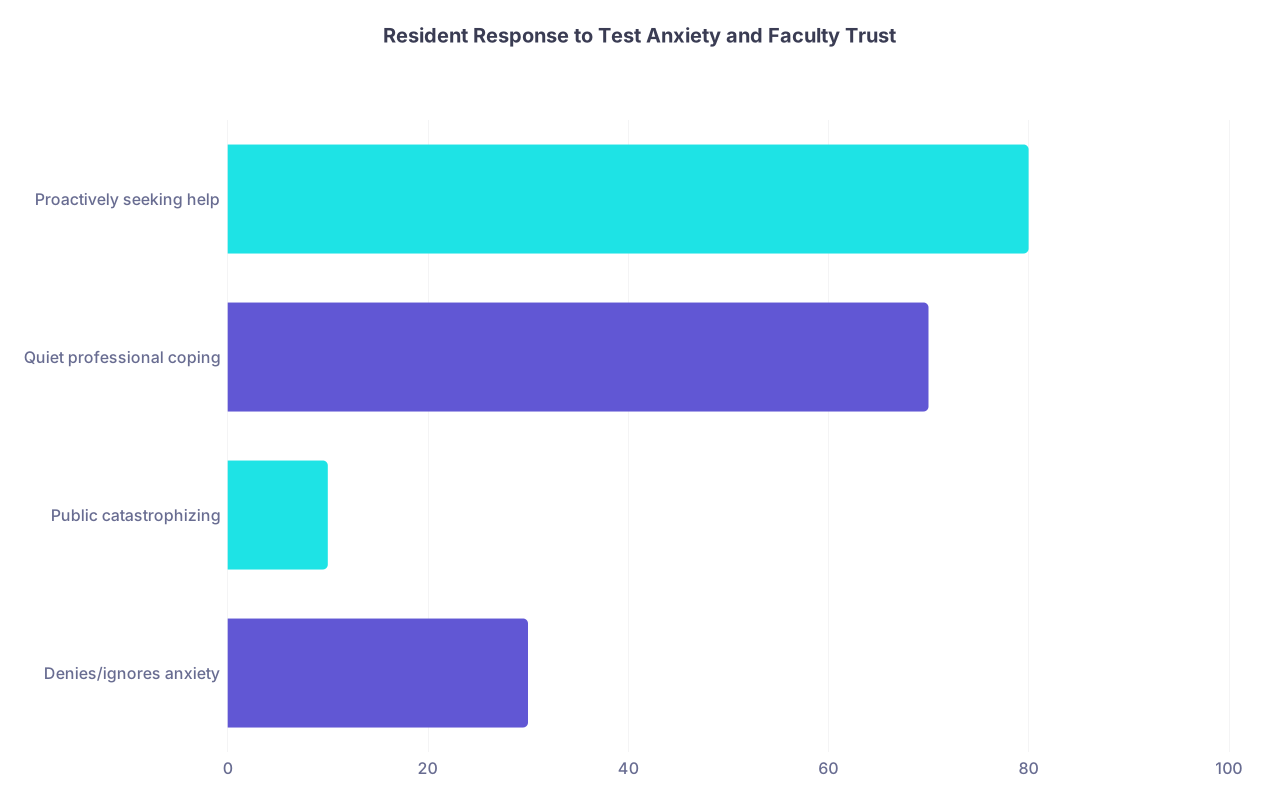
| Category | Value |
|---|---|
| Denies/ignores anxiety | 30 |
| Public catastrophizing | 10 |
| Quiet professional coping | 70 |
| Proactively seeking help | 80 |
The Bottom Line: What Actually Sticks in Faculty Minds
You will take a frightening number of high-stakes exams in training. Most faculty can’t remember your exact scores. But they do remember your patterns.
They remember:
- Whether your anxiety was contained or contagious
- Whether setbacks triggered melodrama or problem-solving
- Whether you felt like someone they’d trust with a crashing patient or someone they’d have to babysit
If you remember nothing else:
- Exams are not just academic events; they’re live-fire simulations of how you handle controlled stress. Faculty are watching that far more than they admit.
- You don’t need to be fearless. You need to be containable. Let yourself be fully anxious in private, show the steadier version in public.
- Over time, your test-day behavior will do as much to shape your reputation—and your opportunities—as the three-digit numbers ever will.
You can’t control the exact questions on the exam. But you have a lot more control over what people remember about the way you walked into that room and how you walked out.
Behave like the attending you plan to be. Long before you are one.