The last 48 hours before your USMLE can either steady you or quietly wreck you. Most students let those two days turn into a panic marathon. That is a mistake.
You cannot meaningfully raise your score in the final 48 hours. You can absolutely sabotage it. At this point, your only real job is simple: protect your brain, protect your body, and avoid doing anything stupid.
Here is exactly how to structure those final 2 days and the final 24 hours so you stay calm and walk in clear-headed.
Big Picture: What the Final 48 Hours Actually Are
Think of the last 48 hours as three distinct phases:
- T‑48 to T‑24 hours – Controlled review and logistics
- T‑24 to bedtime – Wind-down and sleep protection
- Exam morning – Execution mode
You are not “still studying.” You are managing your own physiology and emotions.
To make this concrete, here is a high-level structure:
| Window | Primary Goal | Main Activities |
|---|---|---|
| T‑48 to T‑36 hours | Light recall | Targeted review, logistics check |
| T‑36 to T‑24 hours | Confidence & routine | Light questions, relaxation, prep |
| T‑24 to bedtime | Wind-down | No new info, movement, sleep setup |
| Exam morning | Activation | Breakfast, brief review, commute |
We will walk through this chronologically. At each point: what you should do, what you should avoid, and how to keep anxiety from running your day.
T‑48 to T‑36 Hours: Control the Day, Do Not Chase Points
This is roughly two days before your exam, morning to evening.
Morning (T‑48 to T‑42): Set the Tone and the Boundaries
At this point you should:
- Decide your “no more questions” cut-off time for the day (e.g., 5 p.m.).
- Decide your “books closed” time for the night (e.g., 8–9 p.m.).
- Confirm transportation and logistics:
- Exact address of the Prometric/test center
- Travel time at your exam time (check for rush hour)
- Backup route / Uber or Lyft app ready
- Parking situation, cost if relevant
- What you will bring (ID, snack list, layers)
You are locking down the variables that create last-minute panic. I have watched students burn an entire day’s focus because they realized at 9 p.m. their driver’s license was expired. Do not be that person.
Content for this window:
- 2–3 hours max of light active recall, not learning:
- Skim your personal anki deck / core facts you know are high-yield
- Quick pass through one-liners from wrong question notes
- Short review of images/diagrams that always trip you up (heart murmurs, rashes, glomerulonephritis slides)
No full-length blocks. No new resources. No NBME. That ship has sailed.
You want content that reminds you, “I know a lot,” not content that proves you do not know everything.
Midday (T‑42 to T‑38): One Controlled Question Block (Optional)
If you are going to touch questions, this is the last full block.
At this point you should:
- Do one timed block of 20–40 questions max (UWorld or similar):
- Simulate normal timing but do not obsess over the score.
- Focus on process: reading speed, flagging, moving on from stuck questions.
- Spend as long or longer on review as on the block:
- Skim the explanations.
- Mark only the “I would miss this again tomorrow” facts to a small note sheet.
If your anxiety spikes with questions, skip the block entirely. It is optional. Not a requirement for everyone.
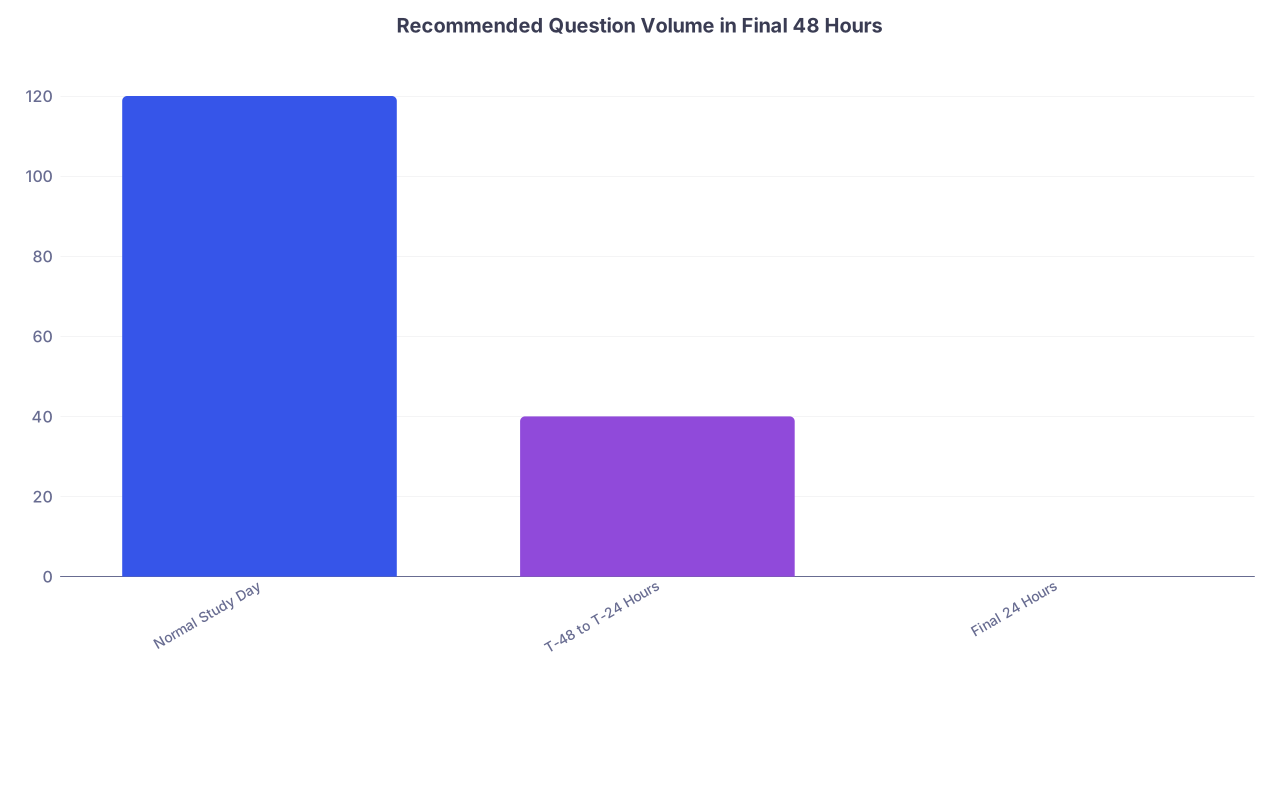
| Category | Value |
|---|---|
| Normal Study Day | 120 |
| T-48 to T-24 Hours | 40 |
| Final 24 Hours | 0 |
What to avoid here:
- Multiple blocks “because the first went badly.” That is a spiral.
- Reviewing huge system PDFs. You will not consolidate anything meaningful.
- Talking to classmates about their scores, their NBMEs, or their test dates. That never calms anyone.
Late Afternoon to Early Evening (T‑38 to T‑36): Transition Out of Study Mode
By this point:
- Questions are done.
- No new topics. You are shifting to maintenance and body care.
At this point you should:
- Do a 15–20 minute walk outside. No lectures in your ears. Just walk.
- Tidy your study space. Stack books. Clear the desk. This reduces mental clutter.
- Eat a real meal with protein + complex carbs (e.g., chicken + rice, lentil soup + bread). Heavy junk food now will echo into your sleep.
Content allowed:
- 10–20 minutes of skimming your personal “must know” sheet or high-yield diagrams.
- Then stop.
Your job now is to make the evening peaceful, not productive.
T‑36 to T‑24 Hours: Build Calm Confidence, Not New Knowledge
This is roughly the full day before your exam. The most dangerous day, psychologically.
Morning (T‑36 to T‑32): Controlled, Short Review Only
You wake up and your first thought might be: “I forgot everything.” That is normal. Do not react to that thought by opening six resources.
At this point you should:
- Wake at your planned exam-day wake time (or earlier).
- Do your exam-day breakfast rehearsal:
- Same amount and type of food you will eat tomorrow.
- Avoid “experiment foods” you never eat (no new energy drinks, weird bars).
Study plan for these hours:
- 60–90 minutes of:
- Quick pass through 1–2 high-yield areas (e.g., biostats formulas, equations, pharm mechanisms).
- Re-do 5–10 previously missed questions just for confidence (things you now understand).
Then stop. Take a 15–20 minute break away from screens.
Late Morning to Early Afternoon (T‑32 to T‑28): Logistics and Environment
This is where you remove all logistical doubt from your brain.
At this point you should:
- Pack your exam bag:
- Valid ID (check expiration date)
- Prometric confirmation / scheduling permit (printed or accessible)
- Simple snacks (nuts, banana, protein bar; not messy, not noisy)
- Water bottle (check local rules)
- Earplugs (if allowed), glasses/contacts supplies
- Light sweater / zip-up layer
- Lay out exam clothes:
- Comfortable, layered, nothing scratchy or tight.
- Confirm alarm strategy:
- Main alarm + backup alarms (phone + separate device).
- Plug in devices away from bed to avoid scrolling trap.
Mental strategies here:
- Set a “no discussion” boundary:
- Tell friends/partners: “I am off exam talk today. I will message you after the test.”
- Turn off or limit social media. The fastest path to anxiety is seeing someone brag or meltdown the day before their exam.
Study content for this window:
- Max 60–90 minutes of passive + light active review:
- Path images, EKGs, murmurs, rashes.
- A few last formula rehearsals (sensitivity/specificity, RR, OR, NNT).
You are rehearsing what is already there. Not installing new software.
Mid to Late Afternoon (T‑28 to T‑24): Start the Descent
By now, your formal “study” is effectively done. Mentally you are stepping away from the exam.
At this point you should:
- Do some form of movement:
- 20–30 minute walk, easy jog, stretching, yoga.
- Not a brutal workout. You do not want DOMS on exam day.
- Plan and eat an early, familiar dinner:
- 5–7 p.m. local time.
- Again, simple, low-grease, nothing that usually upsets your stomach.
Study / exam-related activity:
- Optional: 30–45 minutes with one thin stack of your own flashcards or “golden sheet”.
- Hard stop at your chosen no-study time (usually 6–7 p.m.).
- Physically put books and laptop away. Out of view.
The goal here is to let your brain understand: the heavy lifting is over.
Final 24 Hours: From T‑24 to Bedtime – Wind Down Intentionally
This is the phase almost everyone mismanages. They panic, push late, then try to “force” sleep. That backfires.
Evening (T‑24 to T‑14): Protect Your Sleep Before You Sleep
Sleep anxiety will hit here. You cannot fix that by reading more.
At this point you should:
- Keep light exposure predictable:
- Dim screens after 8 p.m.
- Avoid blasting blue light in your face in bed.
- Choose one calming, non-medical activity for 60–90 minutes:
- A familiar show, light reading (non-medical), talking with a non-anxious friend.
- No medical dramas, no Reddit “Step score” threads.
Wind-down checklist:
- Prepare breakfast items so morning is frictionless.
- Put your exam outfit, keys, wallet, bag by the door.
- Set multiple alarms (e.g., 2 on phone, 1 separate device).
- If you are driving: gas tank full, navigation saved.
What not to do:
- Do not start “just one more” UWorld block. That is how you end up up past midnight.
- Do not google “last minute USMLE tips.” You already know the fundamentals.
- Do not start negotiating with yourself: “If I do not sleep, I am doomed.” Many people do fine on suboptimal sleep. The stress about sleep is worse than the sleep itself.
Pre-Bed (T‑14 to T‑8): The Last Hour Before Lights Out
You are not going to suddenly feel peaceful. Aim for “less activated,” not “zen monk.”
At this point you should:
- Choose a bedtime aligned with your exam:
- Aim for 7–8 hours before wake time, but accept if you get less.
- Use a brief relaxation routine (10–15 minutes):
- Simple breathing: 4 seconds in, 4 hold, 6 out, repeat.
- Or a body scan: notice each muscle group, tense, release.
- If your brain is racing with “what if” scenarios:
- Open a paper notebook.
- Write down the worries as bullet points.
- Next to each, one simple statement: “Future me will handle this at the test center.”
- Close the notebook. This helps “park” thoughts temporarily.
Medications and sleep aids:
- Do not experiment for the first time tonight.
- If a physician has already prescribed you something (like a low-dose beta-blocker or sleep aid) and you have tested it on previous nights, follow their advice.
- If not, skip the Benadryl / random OTC cocktail. Groggy and dehydrated on exam morning is worse than mildly short on sleep.
If you cannot sleep:
- After ~30 minutes, get out of bed.
- Sit somewhere dim, read something non-medical.
- Return to bed when you feel drowsier.
- You are still resting, even if not deeply asleep.
Exam Morning: T‑8 to T‑0 – Execute the Plan, Not Your Fears
This is where many students undo two calm days by improvising. Do not improvise.
Wake-Up (T‑8 to T‑6): Start on Autopilot
At this point you should:
- Get up at your planned time. Do not hit snooze repeatedly.
- Light stretching, wash face, shower if you normally do.
- Eat your rehearsed breakfast, nothing new:
- Examples: oatmeal + peanut butter, toast + eggs, yogurt + granola.
You may feel nauseated. Eat something anyway. Half of your usual amount is better than nothing.
Mental framing:
- One short, concrete self-instruction repeated a few times:
- “I will focus on one question at a time.”
- “Perfect is not required. Steady is enough.”
- Avoid elaborate affirmations you do not believe. Keep it simple.
Last Mini-Review (T‑6 to T‑4): Strategic, Not Desperate
You can glance at material, but it must be narrow.
At this point you should:
- Spend 20–30 minutes max with:
- A tiny formula sheet.
- 1–2 pages of your personal “must not miss” items.
- Stop. Put it away and do not bring dense books to the test center.
If you commute via public transport and feel calmer reviewing, you can bring a single folded page of notes. That is it.

| Step | Description |
|---|---|
| Step 1 | T-48 hrs: Light review & logistics |
| Step 2 | T-36 hrs: One small block & movement |
| Step 3 | T-24 hrs: No new content, pack & prepare |
| Step 4 | Evening: Wind-down routine |
| Step 5 | Exam Morning: Breakfast & brief review |
| Step 6 | Arrival: Focused & calm |
Commute and Arrival (T‑4 to T‑0): Contain the Noise
This phase is about not getting rattled by the environment.
At this point you should:
- Leave with enough buffer:
- Aim to arrive 30–45 minutes before check-in.
- On the way:
- Use music or a podcast that calms you. Not medical content.
- If intrusive thoughts come (“I am not ready”), label them: “Exam brain noise,” and return to the present (breath, road, steps).
At the test center:
- Expect:
- Other anxious people.
- Someone bragging about NBMEs.
- Overly intense conversations about question styles.
You do not need any of that.
At this point you should:
- Check in calmly. Present ID, follow instructions.
- Sit away from others if possible.
- Do not open new content. At most, glance at your tiny fact sheet if you genuinely find it calming, then put it away.
Your internal script now:
- “I know enough to pass this test.”
- “I will not know everything. Nobody does.”
- “One screen at a time.”
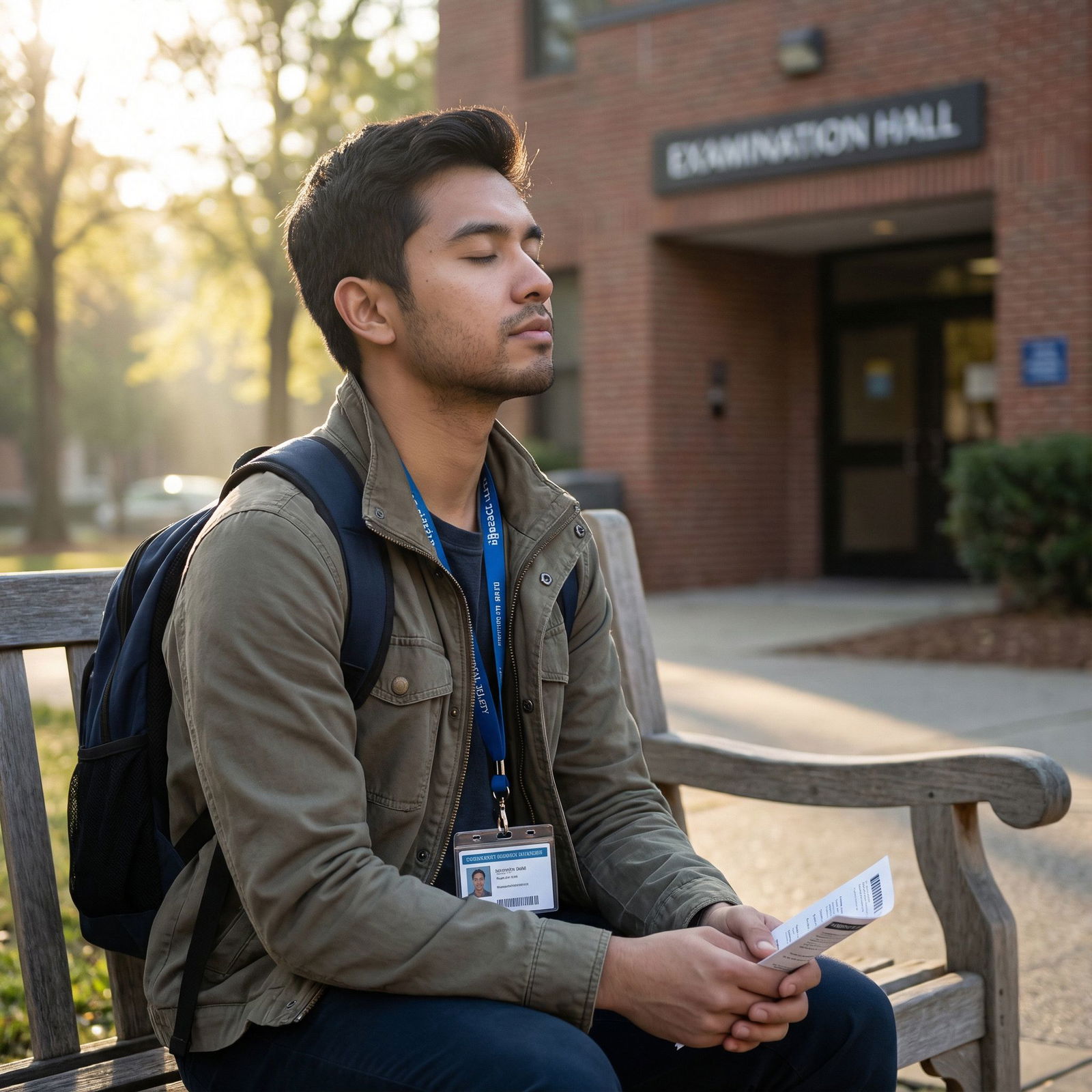
During the Exam: On-the-Spot Anxiety Control
This is technically beyond the 48 hours, but your calm prep feeds into what you do in the moment.
Use a simple in-exam protocol:
At this point you should:
- For each block:
- Take 3–5 slow breaths before starting.
- Scan first question, commit to an answer in under 90 seconds when possible.
- When you hit a wall:
- Give it your best shot, choose a reasonable answer, flag it, move on.
- Do not spend 4 minutes to gain 0.5% more certainty.
- On breaks:
- Leave the room, restroom if needed.
- Eat a small snack, sip water.
- Do a brief physical reset: shoulder rolls, stretch, 3 deep breaths.
- Avoid talking about specific questions with anyone.
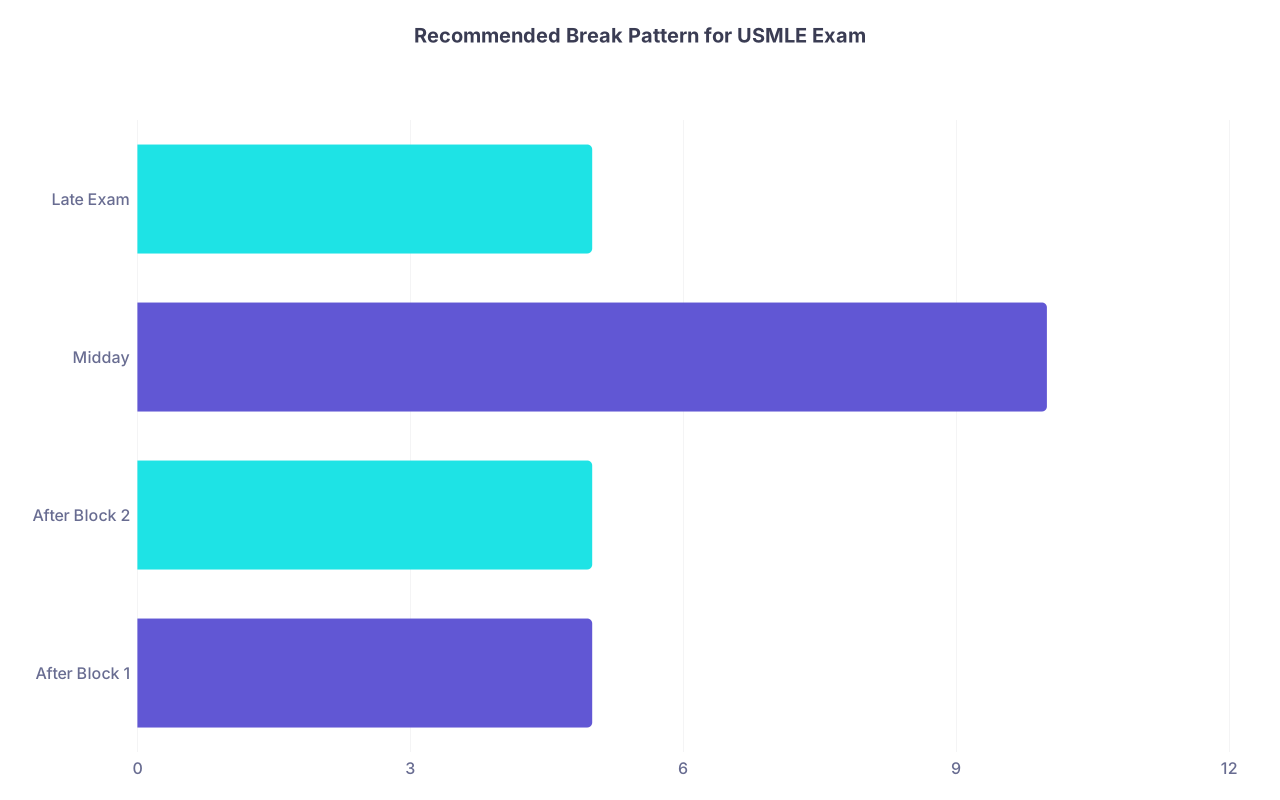
| Category | Value |
|---|---|
| After Block 1 | 5 |
| After Block 2 | 5 |
| Midday | 10 |
| Late Exam | 5 |
You prepared your brain for this. Let it work. Over-control in the middle of the test is how people panic.
What to Do If You Feel Yourself Spiraling at Any Point
Spiral signs:
- Compulsively opening more resources.
- Re-doing NBMEs at midnight.
- Googling “failed Step, still matched??” stories.
If you catch this:
- Physically change location – step outside, walk to a different room.
- Do one grounding exercise:
- 5 things you see, 4 you can touch, 3 you can hear, 2 you can smell, 1 you can taste.
- Call or text one trusted person with a predefined script:
- “I am taking my exam tomorrow. I do not need advice, just distraction / normal talk.”
Then return to the schedule. You do not let the spiral define the next 6 hours.
Final 3 Key Points
- The last 48 hours are about protecting function, not gaining knowledge: light review, no new resources, and ruthless limits on question volume.
- Calm comes from logistics and routine: know exactly how you will eat, sleep, pack, and get to the test center; remove every avoidable variable.
- You do not need to feel confident. You just need to follow the plan: one hour at a time, one block at a time, one question at a time.