
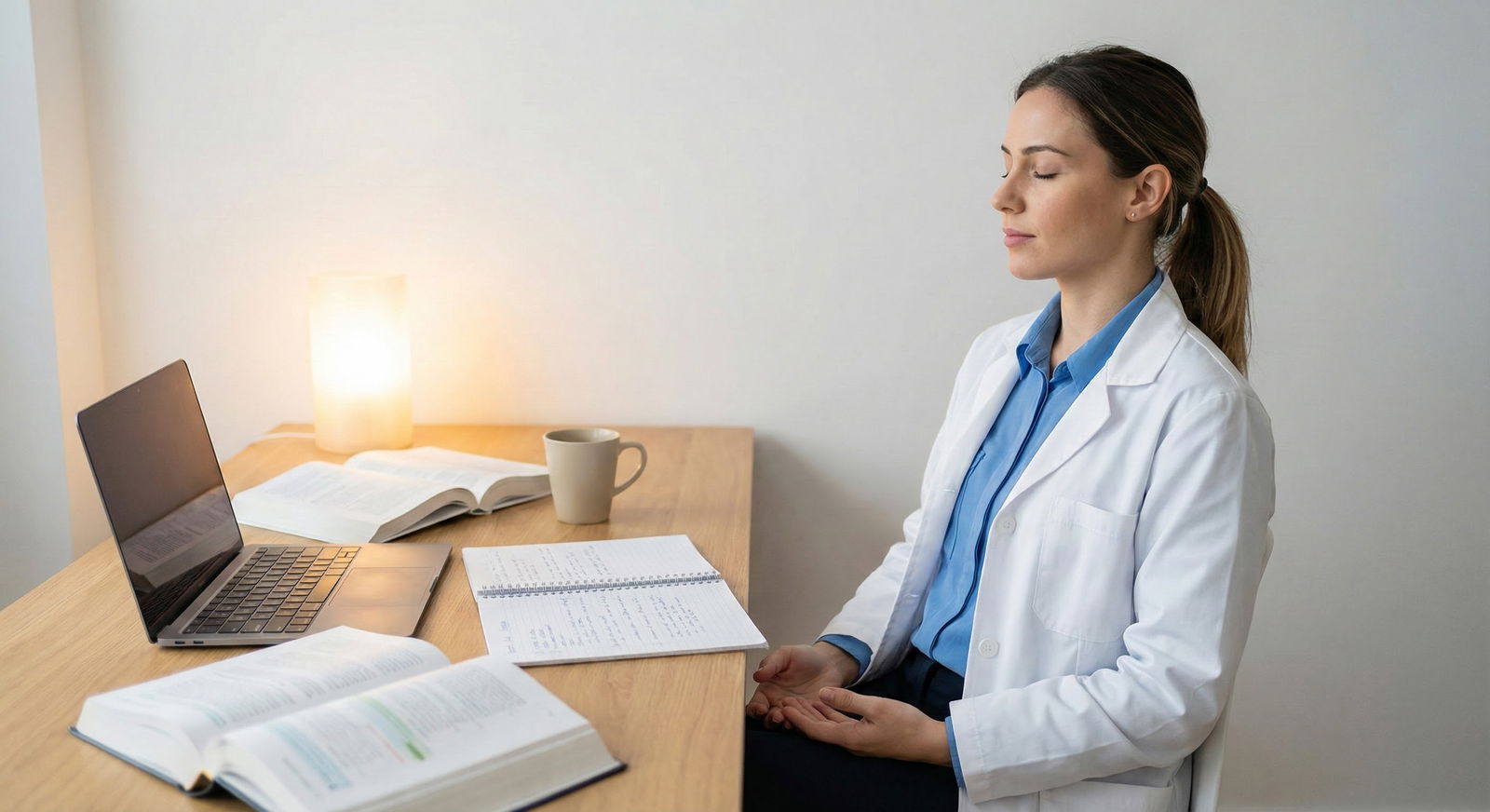
The last 10 minutes before an exam can ruin weeks of studying if you use them badly.
Most students do. They cram, panic, ask their friends last‑second questions, and walk into the room with their nervous system on fire. You are not doing that.
You are going to follow a strict, minute‑by‑minute plan.
Overview: Your 10‑Minute Exam Start Timeline
At this point, your content studying is done. The only job now is to get your brain into “steady operator” mode, not “freaked‑out intern on first night float” mode.
Here is the skeleton timeline. Then we will go through it in detail.
| Time Mark | Primary Goal |
|---|---|
| -10:00 | Physical reset, claim space |
| -9:00 | Grounding + posture |
| -7:00 | Controlled breathing cycle |
| -5:00 | Mental script + exam strategy |
| -3:00 | Micro visualization |
| -2:00 | Practical checks (ID, login) |
| -1:00 | Final reset and “stop” line |
Minute −10 to −9: Step Away from the Chaos
At T‑10 minutes, your priority is environmental control, not information intake.
At this point you should:
Physically separate from the crowd (1–2 minutes)
Get at least a few meters away from the cluster of students arguing about the Krebs cycle regulation or the exact mechanism of some obscure monoclonal antibody.If you stay in that conversation, two things always happen:
- Someone mentions a topic you barely reviewed.
- Your brain decides that topic will be 100% of the exam.
Go:
- Down the hallway.
- To a quiet corner.
- Against a wall where you can lean and not be bumped.
If a classmate approaches with, “Hey, what did you get for—”, you say:
“I’m in my quiet zone right now. I’ll talk after.”
Short. Polite. Firm.Stop all active studying now
No more:- Flashcards
- Lecture slides
- Sketchy videos
- Group explanations
Doing this in the last 10 minutes:
- Increases cognitive load.
- Makes your working memory noisy.
- Tricks you into overestimating how much you have forgotten.
The knowledge you will use on this exam is already encoded. Last‑second facts almost never stick; they just stir up anxiety.
Secure your physical setup
Use this minute to make the logistics automatic:- Put your phone on silent and out of sight.
- Place pens/pencils where you can reach them easily.
- Have your ID and any required documents in a specific pocket or hand.
- If allowed, have water close but not on the edge where it can spill.
You are building a small, controlled bubble. You need that bubble to manage test anxiety.
Minute −9 to −7: Ground Your Body Before Your Mind
At this point you should bring your nervous system down one notch.
1. Posture reset (30–45 seconds)
Anxious posture looks like:
- Shoulders elevated
- Chin forward
- Chest compressed
- Hands fidgeting
You want the opposite:
- Feet flat on the floor, hip‑width apart (or seated with both feet grounded).
- Shoulders rolled up, back, and down once or twice.
- Chin slightly tucked, neck long.
- Hands resting loosely in your lap or on your thighs.
Why this matters:
Your brain reads your body. A collapsed, jittery posture tells it you are under threat. A stable, open posture tells it you are ready to work.
Stand or sit like you are about to scrub in. Calm, competent, not slouched in the resident lounge.
2. Quick grounding: 5–4–3–2–1 (about 1 minute)
You are going to anchor your attention back into your senses.
Silently run through:
- 5 things you can see
(The exam room door. The pattern on the floor. The clock. Someone’s backpack. The light switch.) - 4 things you can feel
(Your feet in your shoes. Clothing on your skin. The chair/wall against your back. Air on your face.) - 3 things you can hear
(Murmur of voices. AC hum. Footsteps.) - 2 things you can smell
(Coffee. Hand sanitizer. Even “nothing” is fine—just notice it.) - 1 thing you can taste
(Leftover mint, coffee, or just your tongue.)
This is not mindfulness theatre. It yanks your attention out of catastrophic future scenarios and back into the present, where the exam actually happens.
Minute −7 to −5: Breathing Like a Professional, Not a Panicked Student
At this point you should actively lower physiological arousal. Not to zero. Just from “alarm” to “alert.”
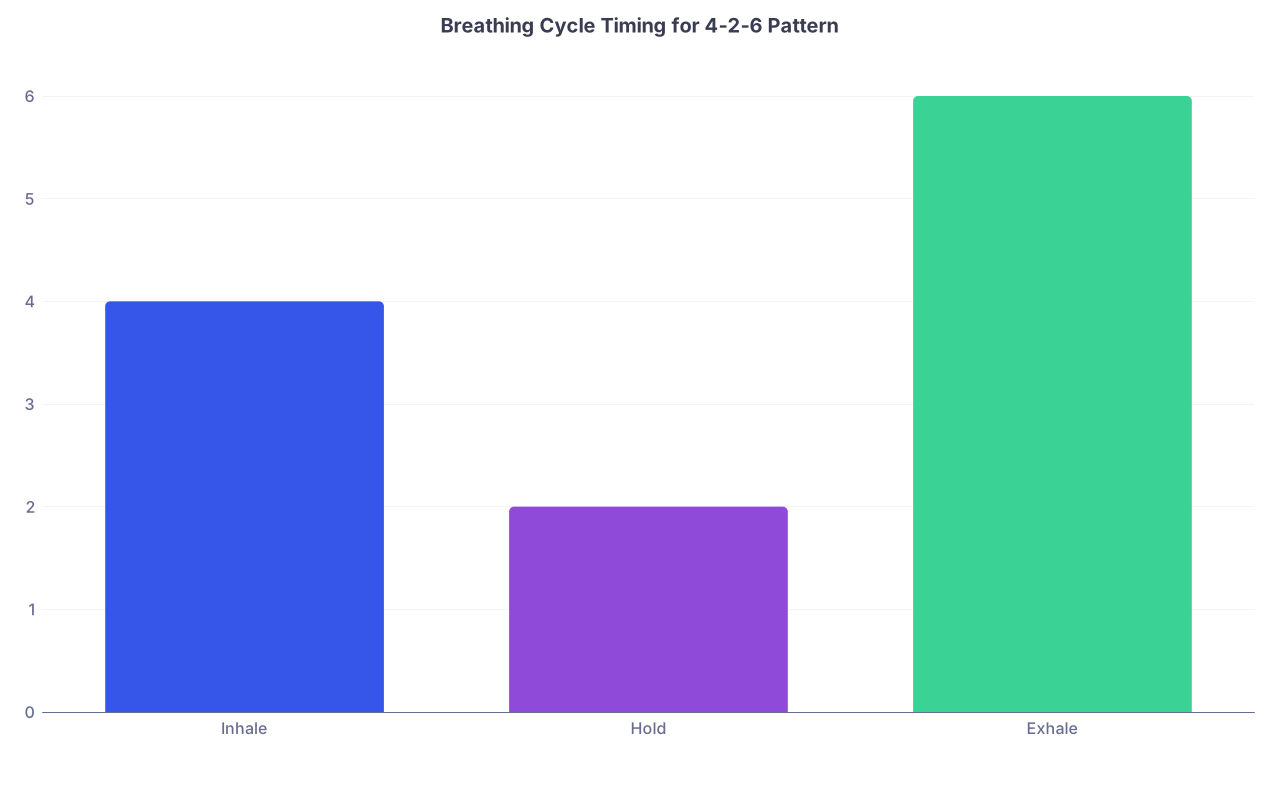
Use a structured pattern. My go‑to for medical students is 4–2–6 breathing.
4–2–6 breathing (about 2 minutes)
- Inhale through your nose for 4 seconds.
Slow, steady. Let your belly expand slightly; do not lift your shoulders. - Hold for 2 seconds.
No straining. Just a brief pause. - Exhale through pursed lips for 6 seconds.
Like slowly blowing out through a straw.
Do this 8 cycles. It will take about 2 minutes.
Key details:
- Count in your head: “In 1‑2‑3‑4, hold 1‑2, out 1‑2‑3‑4‑5‑6.”
- If you start to feel light‑headed, shorten the counts but keep the exhale longer than the inhale (e.g., 3‑1‑4).
- If you are near others, do it quietly. No dramatic sighing.
| Category | Value |
|---|---|
| Inhale | 4 |
| Hold | 2 |
| Exhale | 6 |
What this does:
It extends your exhalation, which signals your parasympathetic system to step in. Heart rate edges down. Muscles release a bit. Thoughts slow just enough.
You are not trying to feel “Zen”. You are trying to feel like you are about to start a surgical time‑out: focused and serious, but not panicked.
Minute −5 to −3: Install the Mental Operating System
Now your body is a bit calmer. Time to set the “software” you will run during the exam.
At this point you should repeat, not invent. You are loading pre‑decided rules, not improvising.
1. Say your exam script (30–45 seconds)
Have a fixed, short phrase you always use pre‑exam. For anxiety, repetition is power.
Examples:
- “I will miss questions. I do not chase them. I move on.”
- “My job is not to be perfect. My job is to earn points.”
- “Read the question stem. Find the task. Answer once.”
Pick one that is:
- Short (one breath)
- Concrete (not vague affirmations)
- Familiar (you have said it before practice tests)
Say it silently 3–5 times while breathing normally.
2. Rehearse your first 5 minutes inside the exam (1 minute)
You are going to walk through your exact behavior after sitting down.
Silently, in sequence:
- “I will sit, place my ID, and adjust my chair once.”
- “I will read the instructions slowly and not click through mindlessly.”
- “For Question 1–10, I will go slightly slower than usual to settle in.”
- “If I hit a hard early question, I flag it and move on within 30 seconds.”
- “I will not change answers unless I see clear evidence.”
You are writing code for your brain. When stress hits, it will run whatever code is installed. If you do not install anything, it runs panic.
3. Anchor to your proven data (45–60 seconds)
Recall specific, objective proof that you can handle this.
Not “I studied a lot.” That is vague. Use hard facts:
- “I scored 78% on the last two UWorld blocks in this subject.”
- “I completed 1,000+ practice questions for this exam.”
- “I improved from 55% to 70% on NBME practice over 4 weeks.”
Silently list 2–3 of these. You are reminding your brain that fear is not data.
Minute −3 to −2: Micro Visualization, Not Fantasy
At this point you should show your brain the immediate future in detail.
You are not visualizing walking out with honors, hugging friends, or seeing a 270 score pop up. That is fantasy. It spikes anxiety.
You are visualizing the process, not the outcome.
60–90‑second visualization
Eyes open or closed, your call. Run through:
Walking into the room
- You feel the door handle.
- You hear chairs moving.
- You see monitors, proctor, exam booklets.
Sitting and starting
- You adjust the chair once.
- You log in or fill out your ID fields.
- You take one slower breath before Question 1.
Encountering difficulty
- First confusing stem. Your chest tightens slightly.
- You notice it, label it “anxiety,” and keep reading.
- You decide: “I will pick the best answer, flag, and move on.”
Recovering mid‑exam
- You imagine reaching a small “flow” patch.
- Questions feel familiar.
- You notice time, confirm you are on pace, and keep going.
You are pre‑training your stress response. When the real thing happens, it feels like a replay, not an ambush.
Minute −2 to −1: Final Practical Checks, No Drama
Now we shift to pure logistics. This is where students make dumb, preventable mistakes because they are too anxious to think clearly.
At this point you should make sure nothing stupid will derail you.
1. Identity and access (30 seconds)
Quick, silent touch‑check:
- ID where it needs to be?
- Admission ticket or required paperwork?
- Login info ready in your brain: username and password (mentally rehearse typing them once).
If it is a computer exam:
- Mentally walk through:
“Type username → Tab → Type password → Enter.”
If it is a paper exam:
- Mentally walk through:
“Write name → Fill bubbles completely → Check test form code.”
2. Time anchor (20–30 seconds)
Look at:
- The wall clock, or
- Your allowed timepiece, or
- The computer clock on the login screen (if visible).
Fix the start time in your mind:
“Start: 9:00. Midpoint check: 9:45. 10‑minute warning: 10:35.”
No complicated math. Just two reference points: midpoint and 10‑minute warning.
3. Last physical reset (20–30 seconds)
- Relax your jaw: let your teeth separate slightly.
- Unclench your hands: gently shake them once at your sides.
- Roll your shoulders once more.
This is the last chance to downshift tension out of your muscles before you freeze into “exam posture” for an hour or three.
Final Minute: Draw the Line and Step Over It
This is where most people sabotage themselves. They keep mentally rehearsing content, catastrophizing outcomes, or checking their notes “just once more.”
You are going to do the opposite.
At this point you should explicitly stop preparing and start executing.
1. Set a mental “no more prep” boundary (10–15 seconds)
Pick a very clear line in your head:
“When I hear them say ‘You may begin,’ preparation ends. From that second on, I am only taking the exam.”
Say it once internally. That line protects you from last‑second frantic thinking.
2. One‑sentence commitment (10 seconds)
Choose a single, simple commitment:
Examples:
- “For the next [X] minutes, I am just solving one question at a time.”
- “My job now is to be systematic, not perfect.”
- “I will finish this exam doing the best I can with the brain I have right now.”
You are switching from evaluation mode (“Am I ready?”) to execution mode (“Do the task.”).
3. Micro‑breath at the doorway or login (15–20 seconds)
When you are about to:
- Walk through the door, or
- Click “Begin exam”
Pause for exactly one breath:
- Inhale normally
- Exhale slightly longer
No dramatic ritual. Just a quiet internal signal: Now we start.
4. Eyes forward, not sideways (remaining seconds)
Do not:
- Scan your classmates’ faces to see who looks confident.
- Count how many notes people are still frantically reading.
- Look for reassurance from friends.
All of that just feeds your anxiety monster.
Instead:
- Keep your eyes on the exam screen or booklet.
- Touch your pen/keyboard.
- Wait for the start signal like a runner in the blocks.
The last thing your brain sees before starting should be the test interface, not someone else’s panic.
What You Absolutely Should Not Do in These 10 Minutes
Let me be blunt. These are the behaviors that reliably spike test anxiety right before the exam. If you catch yourself doing them, stop immediately.
Arguing about content with classmates
“Wait, is it an upper motor neuron lesion that gives hyperreflexia or—”
Useless. You will not rewire your neuro exam knowledge in 6 minutes.Checking group chats or social media
The “good luck” messages are fine, but they drag your attention away from the scene in front of you. You are not in their exams. You are in yours.Trying to memorize lists
Last‑minute lists (drug side effects, enzyme deficiencies, cranial nerve lesions) make you feel like you never knew anything, because you are viewing them with a critical, fearful brain.Catastrophic mental math
“If I fail this, my entire career is over, my rank list is ruined, I’ll never match…”
None of that is remotely solvable in 10 minutes. It is emotional self‑harm dressed as planning.Fighting anxiety directly
Telling yourself, “Do not be anxious, calm down, stop it,” just adds a second layer of frustration. The goal is not zero anxiety. The goal is functional anxiety—enough to care, not so much that you freeze.
Better mindset: “I am allowed to feel anxious and still perform well.”
Build This Routine Before Game Day
One more hard truth: If the first time you try this 10‑minute routine is on exam day, it will feel fake.
You need to rehearse it during practice tests.
How to integrate this during medical school exams
Two weeks before the exam:
Start using a simplified version before each long question block (NBME, UWorld, AMBOSS). Even 3–4 minutes of:- Step away from others
- 3 cycles of 4–2–6 breathing
- One exam script sentence
One week before the exam:
Run the full 10‑minute sequence before at least one timed practice block. Same seat, same headphones, same water bottle if possible. Train your body to associate the routine with performance.Day before the exam:
Walk through the timeline once in your head. Not to obsess. Just to refresh the steps so they feel automatic.
The routine becomes your “mental scrub.” You would not walk into the OR without a scrub sequence. Stop walking into exams without one.
Your Action Step Today
Do this right now, before your next exam is even scheduled:
Take 5 minutes and write out your personal 10‑minute script on a small index card:
- Minute −10 to −9: where you will stand/sit and what you will stop doing
- Your exact breathing pattern
- Your exam script sentence
- Your first‑5‑minutes‑inside checklist
Then put that card where you keep your ID or exam supplies.
Next practice block you do, follow that card for 10 minutes before you start. Train the routine before you need it.


