

Beta‑blockers do not “fix” test anxiety. They hide part of it.
Let me be blunt: the med student culture around propranolol before OSCEs, shelf exams, and Step is getting reckless. I’ve watched students treat beta‑blockers like magical courage pills. Then they’re stunned when the same anxiety wrecks them on a day they forgot the pill—or when the dose backfires and they feel weak, foggy, or hypotensive halfway through a 7‑hour exam.
You want the real answer: beta‑blockers are a narrow‑use tool for a specific slice of performance anxiety. Used right, they can help. Used as a crutch, they will stall your long‑term progress and sometimes put you at medical risk.
Let’s dismantle the myths with what the data actually shows—and what I’ve seen play out in real students.
What Beta-Blockers Actually Do (And Don’t)
Start with physiology, not vibes.
Beta‑blockers (like propranolol, atenolol, metoprolol):
- Block β‑adrenergic receptors
- Blunt sympathetic output: heart rate, tremor, palpitations, sweating to some extent
- Do not directly fix thoughts like “I’m going to fail” or “I don’t belong here”
They target the body’s response, not the mind’s narrative.
That distinction matters. Because most students are mixing these up. They feel calmer on a beta‑blocker and assume their anxiety is gone. It isn’t. It’s restrained. For now.
There are two key buckets of performance anxiety:
- Somatic anxiety – heart racing, shaking hands, sweating, feeling like you can’t breathe
- Cognitive anxiety – self‑criticism, catastrophizing, impostor thoughts, fear of failure
Beta‑blockers are mostly for bucket #1. The research on stage fright, musical performance, and some test settings is fairly consistent: when physical symptoms are the main problem, low‑dose beta‑blockers help performance and perceived control.
When your real issue is intrusive thoughts, perfectionism, or chronic avoidance, beta‑blockers are a band‑aid slapped over a structural crack.
What The Evidence Actually Says About Beta-Blockers And Test Performance
Let’s get out of anecdote land.
The data on beta‑blockers for test anxiety is surprisingly limited compared to how casually they’re used in med school. Most research lives in performance anxiety:
- Public speaking
- Musicians and stage performance
- Some small trials in high‑stakes academic testing
Patterns:
Low‑dose propranolol (often 10–40 mg) taken 1–2 hours before performance tends to:
- Decrease self‑reported physical anxiety
- Improve subjective confidence
- Sometimes improve objective performance when physical symptoms were disruptive
Effects are modest, not miraculous. We’re talking calmer delivery, fewer visible tremors, steadier hands—not turning a 205 Step taker into a 260 monster.
A few key points from this kind of research:
- People who mainly experience body‑driven anxiety (shaking, pounding heart) benefit more than those whose anxiety is mostly mental.
- There’s a ceiling: once you suppress somatic symptoms enough, extra beta‑blocker doesn’t keep increasing performance. It just adds side effects.
- Most studies are short‑term, single‑event. That’s your OSCE, your presentation, maybe a single high‑stakes clinical exam—not an entire exam year.
Now the part nobody mentions:
There’s almost no high‑quality evidence that chronic pre‑test beta‑blocker use for every exam leads to better long‑term academic outcomes. GPA, board performance, clerkship evaluations—this stuff does not have a clean “beta‑blocker = better” line.
At best, they’re useful in specific, targeted windows. At worst, they become a psychological dependency with physiological downsides.
The Myth of the “Magic Pill”: Why Med Students Overvalue Beta-Blockers
Let me walk you through the pattern I’ve seen a dozen times.
A student bombs their first OSCE because they’re shaking, voice quivering, heart pounding. Faculty writes “appeared anxious, disorganized”. They knew the material, but their delivery tanked.
Someone in their class Telegram channel says, “Dude, just take 20 of propranolol before your next one, it fixes it. Everyone does it.”
So they:
- Get a script from a well‑meaning PCP or campus clinician
- Take propranolol before their next OSCE
- Feel much less shaky, more composed
- Do better
- Conclude: the drug fixed my test anxiety
No. The drug interrupted the adrenergic response. That’s it.
What actually changed performance?
- They had already experienced an OSCE once, so less novelty
- They likely prepared more to avoid a repeat disaster
- Their expectation—“this will keep me calm”—reduced anticipatory panic
- Yes, the blocked tachycardia and tremor helped with visible poise
The problem is the narrative they form afterward:
“I can’t perform without this pill.”
That’s how a tool becomes a crutch. Their self‑efficacy gets outsourced to a tablet.
Tool vs Crutch: The Real Risk Isn’t Just Side Effects
Everyone asks, “Is propranolol safe?” Wrong first question. Safety matters, but the deeper question is: What does repeated pre‑test use do to your relationship with anxiety and performance?
When It’s a Tool
You’re using beta‑blockers as a tool when:
- You’ve already worked on core anxiety skills (breathing, exposure, cognitive restructuring)
- You understand your anxiety is episodic and mostly somatic
- You use it selectively:
- A major OSCE where your hands tremor while suturing
- A big oral exam where your voice shakes
- A high‑stakes presentation to attendings where you otherwise know your content
- You’ve done at least one test run with the same dose in a similar context (mock exam, practice talk)
- You can imagine—and have proof—you can perform without it
When It’s a Crutch
It’s a crutch when:
- You take it before every quiz, shelf, simulation, and case presentation
- You panic if your prescription runs out or you forget the pill
- You’ve never tested your actual baseline anxiety skills without it
- You use it instead of:
- Sleep
- Adequate prep
- Therapy/skills training
- You’re increasing doses because “it didn’t feel like it worked last time”
That second pattern is what I see more and more on med campus. And it’s how high‑functioning students slowly build a dependency story in their heads: “Without this medication, I fall apart.”
You’re in training for a career where you need to function under acute stress without always having time for a pill to kick in.
Side Effects: The Part Future Doctors Weirdly Ignore
Med students, of all people, should not be surprised that messing with your cardiovascular system has consequences.
Common beta‑blocker issues:
- Bradycardia
- Hypotension (or at least lower baseline BP)
- Fatigue, low energy, exercise intolerance
- Cold extremities
- Lightheadedness, near‑syncope in some
Now add normal exam conditions:
- Fasting or semi‑fasting (coffee instead of food)
- Dehydration
- Long sedentary periods
- High cognitive load
You’re designing the perfect setup for “I stood up for a break at Step, felt woozy, and had to sit back down.” I’ve heard that story more than once.
There’s another subtle risk: mental sharpness.
Most people tolerate low‑dose propranolol fine, especially the young and healthy. But in some, that slight drop in cardiac output plus a blunting of physiologic arousal correlates with:
- Feeling “slowed” mentally
- Less motivated
- Mild cognitive dulling
You want optimal arousal for performance, not zero. Rosenhan/Yerkes–Dodson still applies: some stress improves focus. Flatlining your sympathetic system too hard can push you into under‑arousal, where you’re weirdly sleepy or disconnected in the testing chair.
Also: if you have asthma, conduction abnormalities, diabetes with hypoglycemia unawareness, or already‑low blood pressure, you’re playing with a different level of risk. This should not be a casual, group‑chat‑recommended decision.
Here’s a quick reality check:
| Scenario | Beta-Blocker Role |
|---|---|
| Severe hand tremor in OSCE suturing despite knowing skills | Reasonable tool |
| Mild nervousness before written shelf exam | Usually unnecessary |
| Panic-level tachycardia before every low-stakes quiz | Crutch pattern |
| Single high-stakes oral exam with strong prep and rehearsal | Possible tool |
| Chronic avoidance of therapy and coping skills | Crutch, not treatment |
The Bigger Problem: You’re Not Treating Test Anxiety, You’re Muting It
Test anxiety is not a random curse. It’s feedback.
Students with intense test anxiety almost always have one or more of these underneath:
- Unrealistic standards (“Anything below honors = failure”)
- Catastrophic thinking (“If I fail this exam, my career is over”)
- Lack of process skills (poor question review, no spaced repetition, all cramming)
- Past failures or trauma around performance
- Perfectionism and chronic self‑criticism
- Identity fusion with scores (“I am my Step score”)
Beta‑blockers do nothing for any of those.
And that matters, because those same drivers:
- Hit you again with oral pimping on rounds
- Show up in residency when a consultant grills you
- Hit even harder when you’re managing a crashing patient with five people watching
You will not be popping propranolol before every key moment of your career. Nor should you.
What actually works on test anxiety at its root?
There’s strong evidence for:
- CBT for test anxiety – challenging cognitive distortions, structured exposure to testing conditions, behavioral experiments
- Skills training – practice exams under realistic conditions, structured review, error analysis
- Physiologic regulation – paced breathing, HRV biofeedback, progressive muscle relaxation
- Identity work – separating self‑worth from performance outcomes
This is slower, yes. Less sexy than a pill, yes. But it’s durable.
Here’s how the contrast really looks over time:
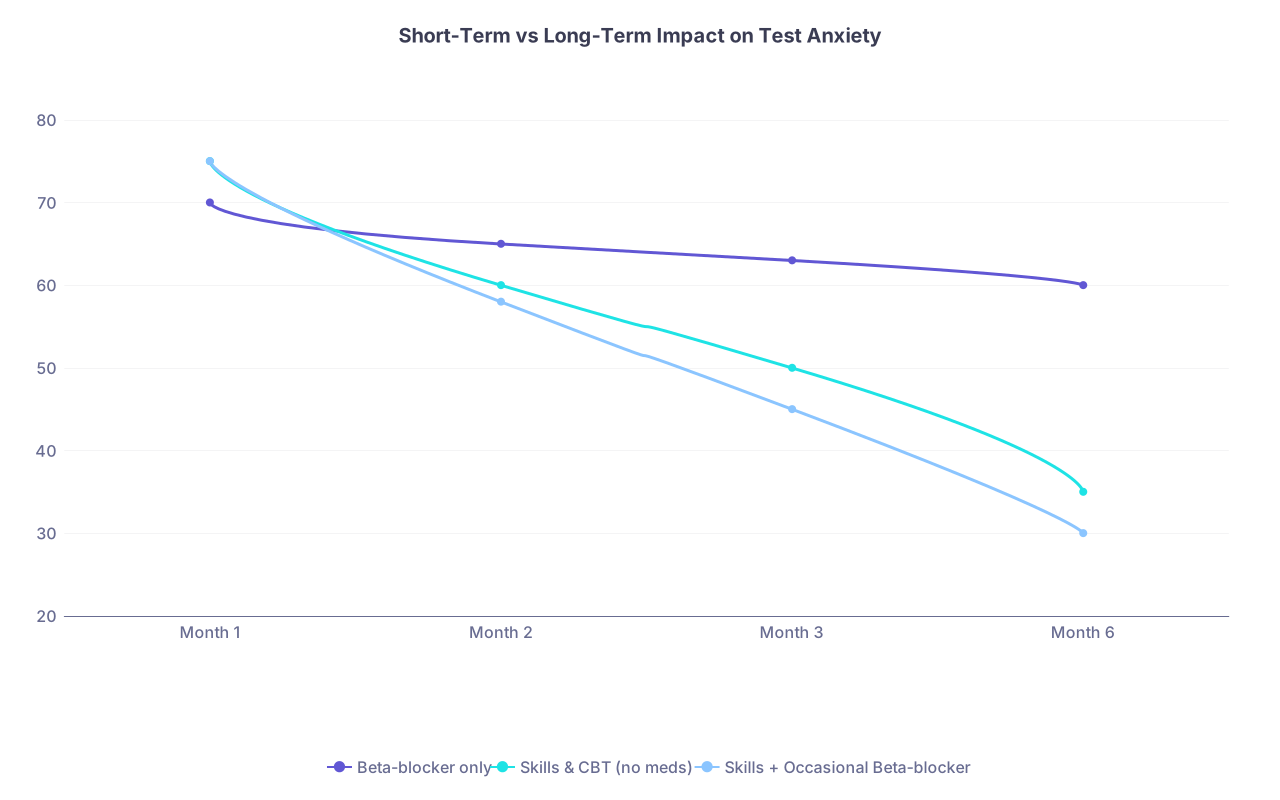
| Category | Beta-blocker only | Skills & CBT (no meds) | Skills + Occasional Beta-blocker |
|---|---|---|---|
| Month 1 | 70 | 75 | 75 |
| Month 2 | 65 | 60 | 58 |
| Month 3 | 63 | 50 | 45 |
| Month 6 | 60 | 35 | 30 |
(Values here are hypothetical “anxiety severity” scores—but the pattern matches what I’ve seen: meds alone flatten, skills change the slope.)
A Sane, Evidence-Aligned Way to Use Beta-Blockers (If You’re Going To)
I’m not anti‑beta‑blocker. I’m anti‑lazy thinking.
If you’re considering using them for exams, here’s a medically and psychologically sane way to approach it.
1. Get a Real Evaluation, Not a Hallway Script
Talk to someone who actually:
- Knows your medical history
- Knows test anxiety and performance issues (campus mental health, psych, or a savvy PCP)
Tell them:
- What symptoms you get (body vs mind)
- How often
- What you’ve already tried without meds
- Your other diagnoses and meds
If the conversation is 90 seconds and ends with “Here’s 60 tablets, take 20 mg whenever,” that’s lazy medicine.
2. Test the Dose Before a High-Stakes Exam
Take the exact dose you’re prescribed:
- On a normal day
- When you’re doing a realistic practice exam or simulated OSCE
- Under similar conditions (caffeine intake, sleep, food)
Watch for:
- Lightheadedness
- Fatigue
- Mental fogginess
- Over‑blunting (feeling too flat to care)
If your practice performance is worse, that’s data. Believe it.

| Step | Description |
|---|---|
| Step 1 | Consider beta-blocker |
| Step 2 | Consult clinician |
| Step 3 | Use non-med approaches |
| Step 4 | Test dose on practice day |
| Step 5 | Adjust/stop with clinician |
| Step 6 | Optionally use on select high-stakes exams |
| Step 7 | Medically appropriate? |
| Step 8 | Side effects? |
3. Keep Them for Narrow Use Cases
You don’t need them for every block exam.
Reasonable targets:
- OSCEs where tremor and voice quiver wreck your performance
- Major oral defenses/presentations
- Very few, very high‑stakes written exams where your somatic anxiety has historically been extreme
And even then, use them alongside:
- Proper preparation
- At least some structured anxiety skills (breathing, cognitive work, realistic self‑talk)
- A plan for eventually tapering reliance
The Hard Truth: You Still Have To Learn To Be Anxious And Functional
Here’s the uncomfortable reality med culture avoids: you are not supposed to be calm all the time.
Surgeons are anxious before first solo cases. Residents feel their heart rate spike when a patient decompensates. Interns get an adrenaline surge when the pager goes off at 3 a.m. and the message says “BP 60/40”.
The goal is not “no anxiety.” The goal is “I can feel my heart racing and still think clearly.”
Beta‑blockers can help you get through some early hurdles where physical symptoms get unmanageably loud. But if you let them become the only reason you believe you can perform, you’re quietly training the belief that you are not capable—only the medicated version of you is.
That belief is more dangerous than a little tachycardia.
Bottom Line: Tool, Not Savior
Keep it simple:
- Beta‑blockers mute the body, not the brain. They help when physical symptoms are the main barrier. They do not fix perfectionism, catastrophizing, or bad study habits.
- Chronic pre‑test use is a psychological crutch. You’ll feel dependent, and you’ll dodge the real work of building durable anxiety skills. That will bite you later in training.
- Use them surgically, not casually. Proper consult, test dose, narrow indications. And always paired with actual anxiety management skills—not instead of them.
You’re in medicine. Act like you believe in more than just quick pharmacologic patches.


