

You Don’t Need to Be ‘Naturally Calm’: Myths About Test Anxiety
Why can two med students with the same knowledge walk into the same exam, but only one walks out shattered—and everyone assumes the shattered one just “wasn’t calm enough”?
Let me ruin that story upfront: the idea that good test-takers are “naturally calm” and bad ones are “just anxious” is lazy, wrong, and not what the data shows.
Test anxiety is not some personality flaw or permanent label. It’s a predictable interaction between pressure, preparation style, and how your brain handles threat. And in medical school, that interaction gets stress-tested harder than almost anywhere else.
Let’s dismantle the biggest myths that keep students stuck.
Myth #1: “Real high-performers are naturally calm under pressure”
This is the favorite myth of attendings who brag about “never being stressed for exams” and classmates who rewrite history after getting their Step score back.
Here’s what the data and reality actually show:
High achievers are more likely to have anxiety, not less.
Studies on test anxiety repeatedly find that students with high academic goals, perfectionistic standards, and competitive environments report higher rates of test anxiety, not magically serene ones.Calm is not a trait. It’s a state.
Anxiety is your body’s threat system. Heart rate up, cortisol up, attention scanning for danger. That system is modulated by:- Sleep
- Caffeine
- Perceived consequences (Step, NBME, OSCE, shelf)
- Past bad experiences (failed exam, pimping humiliation, Step score scare) Someone can look “naturally calm” because their environment and habits reduce threat signals, not because of some mystical personality trait.
People misjudge their own anxiety all the time.
I’ve watched students say “I’m not that anxious, I just blank out on exams.” That’s literally test anxiety. Somatic symptoms? Racing heart, sweating, tunnel vision. Cognitive symptoms? Blank mind, stuck on one question, catastrophizing. You do not need to feel like you’re “having a panic attack” to be experiencing performance-impairing anxiety.
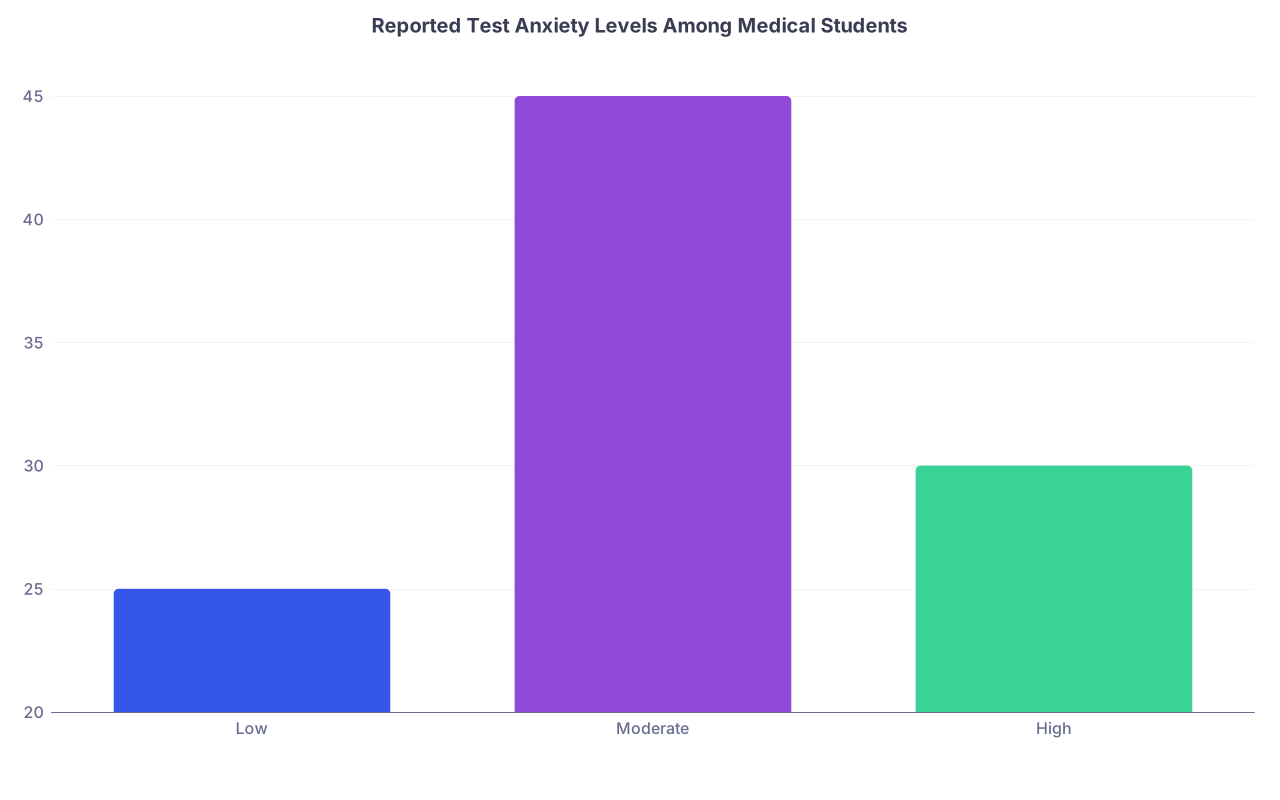
| Category | Value |
|---|---|
| Low | 25 |
| Moderate | 45 |
| High | 30 |
The research is boringly consistent: a large chunk of med students are in the moderate-to-high anxiety categories. The difference between those who perform well and those who underperform isn't who “feels calm.” It’s who has systems that prevent anxiety from hijacking working memory during the exam.
If you’re anxious but functioning, you’re not broken. You’re just running modern medical training on 200,000-year-old threat hardware.
Myth #2: “If I’m anxious, I must not be prepared enough”
This one is seductive because it sounds rational. “If I truly knew the material, I wouldn’t be anxious.” I hear that a lot. It sounds logical. It’s also false.
There are four different issues that get mashed together here: knowledge, preparation quality, self-efficacy, and test anxiety.
| Knowledge Level | Anxiety Level | Typical Outcome |
|---|---|---|
| Strong | Low | Performs as expected |
| Strong | High | Underperforms vs prep |
| Weak | Low | Predictably poor score |
| Weak | High | Catastrophic performance |
I’ve seen plenty of students in this category: Strong knowledge + High anxiety + Underperformance.
The classic pattern:
- UWorld QBank percentages: solid.
- NBME practice: within target range.
- Real exam: 10–20 points below their practice.
- Subjective experience: “I panicked early, got stuck, kept thinking about time, kept re-reading questions.”
That’s not a knowledge deficit. That’s a performance deficit driven by anxiety.
The research backs this:
- High test anxiety is linked with reduced working memory capacity during exams, not lower baseline intelligence or knowledge.
- When anxiety-reduction and test-taking strategies are taught, performance improves even when content knowledge doesn’t change.
So no, anxiety does not automatically mean you’re underprepared. It might mean:
- You’ve tied your self-worth to the score.
- You’ve had a previous bad outcome that your brain keeps replaying.
- You’ve never been taught how to recognize and interrupt an anxiety spiral in real time.
The real danger of this myth? Students respond to anxiety by only “studying more” instead of:
- Fixing sleep.
- Practicing under test-like conditions.
- Learning basic cognitive restructuring.
- Training attention control (yes, that’s a skill).
You can’t out-anki your threat system.
Myth #3: “The goal is to eliminate anxiety completely”
No. The goal is not to feel nothing.
The Yerkes–Dodson law (actual data, not Instagram wisdom) shows a curve: zero arousal = low performance, moderate arousal = peak performance, excessive arousal = impaired performance.
You actually need some activation. If you felt nothing, you’d read questions lazily, miss nuances, not care about time. That’s not who scores 260+.
The goal is:
- Enough arousal to be alert and focused.
- Not so much that your working memory collapses under threat.
When students try to “get rid of anxiety,” they usually do it in ways that backfire:
- Over-avoidance: “I’ll look at less practice because it freaks me out.”
- Emotional suppression: “I shouldn’t feel this way; real doctors handle it.”
- Magical rituals: lucky pen, lucky socks, special chair, special drink.
Those rituals “work” until they don’t. Then the floor falls out.
Instead, the data-backed approach:
- Label anxiety accurately (“This is my body’s alarm system, not proof of failure.”)
- Expect some anxiety and plan for it.
- Use simple in-the-moment tools that reduce physiological activation enough to keep cognition online.
Is that sexy? No. Is it what actually works? Yes.
Myth #4: “Test anxiety is a fixed part of who I am”
The personality myth. “I’ve always been bad at tests.” “I’m just an anxious person.” “I don’t do well under pressure.”
Let me be blunt: those are stories, not traits.
What the research on cognitive-behavioral therapy (CBT) for test anxiety shows is:
- Test anxiety responds to intervention.
- Both cognitive (thought-based) and behavioral (exposure/practice) approaches work.
- Skills generalize to later high-stakes exams.
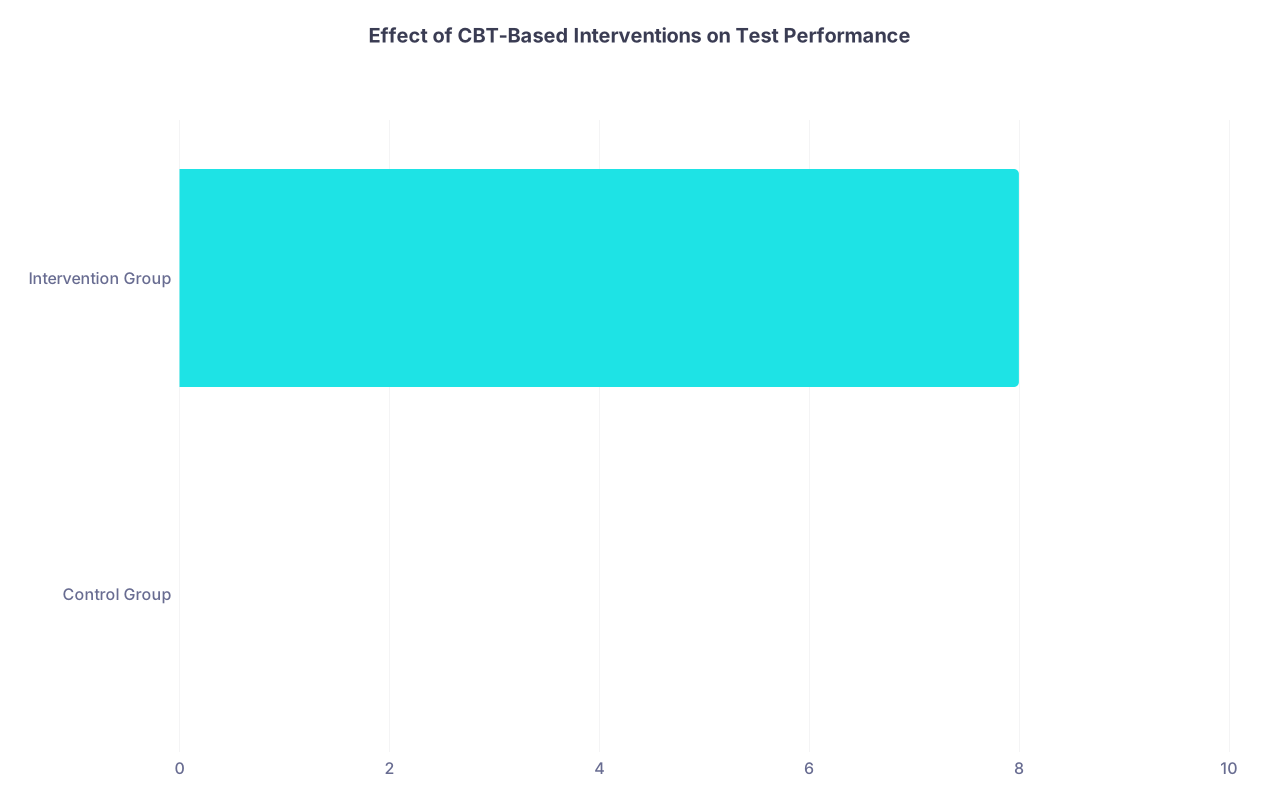
| Category | Value |
|---|---|
| Control Group | 0 |
| Intervention Group | 8 |
(Values: average performance improvement in percentage points; this is the kind of margin that separates “borderline pass” from “solid pass” on many exams.)
What actually changes when people work on test anxiety?
- Their interpretation of physical symptoms: “My heart is racing; I’m failing” → “My body is gearing up; I can still think.”
- Their self-talk before and during the exam.
- Their habits leading up to tests (sleep, last 48 hours, warm-up, cool-down).
- Their behavior in the first 10–15 minutes of an exam (where many anxiety spirals start).
Personality is real. Some people are more neurotic, more threat-sensitive, more self-critical. But even then, we’re talking about a starting point, not a prison.
You are probably not “an anxious test-taker.” You’re a person using a set of untrained or maladaptive responses in a high-pressure context.
That’s modifiable.
Myth #5: “Breathing exercises and ‘just relax’ is all there is”
If one more person tells an anxious med student to “just take deep breaths,” I might start handing out PubMed printouts.
Let’s be precise:
- Breathing techniques can absolutely reduce physiological arousal.
- They’re not a cure. They are a tool. And a narrow one.
You want a stack, not a single hack. The evidence-based stack looks more like this:
Physiological tools (baseline + in-exam)
- Controlled breathing (e.g., 4-6 breaths per minute, longer exhale than inhale).
- Brief muscle tension-release cycles before or during the exam.
- Caffeine control (yes, this matters; some of you are basically inducing tachycardia and then calling it “anxiety”).
Cognitive tools
- Catching catastrophic thoughts:
- “If I fail this shelf, my career is over.”
- “Everyone else is more prepared.”
- Replacing them with accurate but not fluffy alternatives:
- “This exam matters. It is not the only data point in my entire life.”
- “I have passed every exam that felt like this so far.” This isn’t toxic positivity. It’s getting out of your own way.
- Catching catastrophic thoughts:
Behavioral tools
These are where a lot of med students quietly sabotage themselves.- Studying in exam-like conditions: timed, mixed topics, no phone, same time of day.
- Pre-exam warm-up: 5–10 questions before walking in, to switch from “reading mode” to “question mode.”
- A simple first-pass strategy: e.g., 60–90 seconds max before mark-and-move, no camping out on hard stems early.
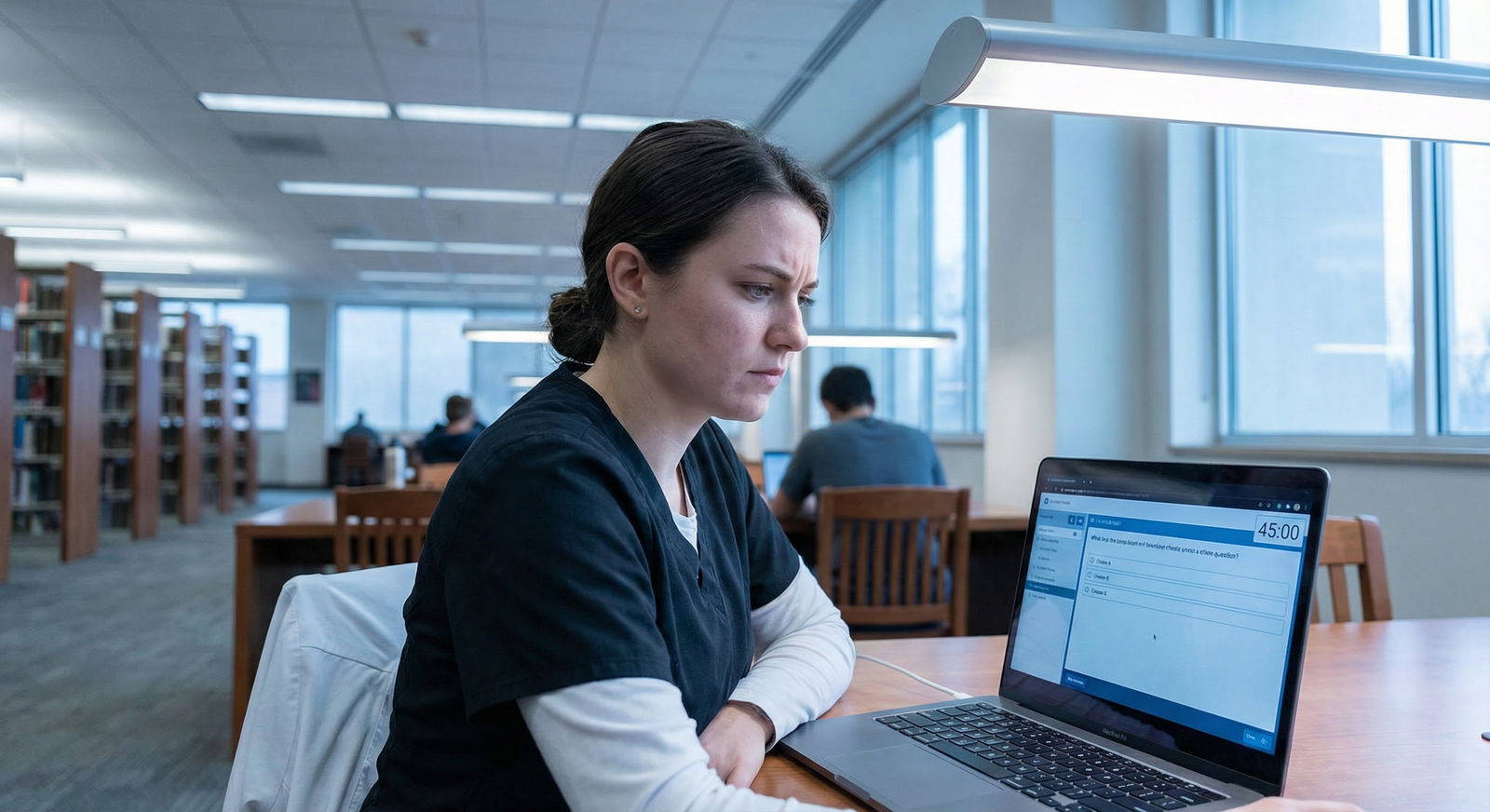
Most people overfocus on study volume and almost completely ignore test-taking behavior. Then they’re “shocked” when anxiety plus poor strategy tanks their performance.
So no, you do not fix test anxiety with vibes and breathing alone. You treat it like what it is: a performance problem with physiological, cognitive, and behavioral angles.
Myth #6: “I just need to push harder right before the exam”
If you want to crank your test anxiety to maximum, this is the way:
- Cut sleep in the final week.
- Double your question volume.
- Change your routine at the last minute.
- Cram until 2 a.m. and call it “dedication.”
Medical culture almost worships this. “I barely slept before Step and still crushed it.” Good for them. Also irrelevant.
Here’s what performance science and memory research actually show:
- Sleep in the last 48 hours is critical for recall and executive function.
- Massive deviations from your routine increase physiological stress.
- High-pressure “last stand” cramming confirms your brain’s story: “We are in danger. This is life-or-death.”
I’ve seen students with consistent 230–240 NBMEs walk into Step after three nights of 4–5 hours of sleep, insane caffeine, and panic-studying micro details. They walk out feeling wrecked. Their score comes back 10–15 points lower than their practice range.
Not because they were underprepared. Because they treated the last week like a crisis rather than a taper.

| Step | Description |
|---|---|
| Step 1 | 7 Days Before Exam |
| Step 2 | Increase hours, cut sleep |
| Step 3 | Maintain hours, protect sleep |
| Step 4 | Higher arousal, impaired recall |
| Step 5 | Stable arousal, preserved cognition |
| Step 6 | Approach |
You shouldn’t be “coasting” the week before a big exam. But you absolutely shouldn’t be detonating your nervous system either.
A better rule:
- Keep daily study at 70–80% of your peak.
- Keep bedtime and wake time constant.
- Focus on mixed blocks and weak areas, not new obscure content.
- Practice your exam-day routine exactly (wake, breakfast, commute pattern, warm-up questions).
That’s how athletes taper before competition. We pretend med exams are “like marathons,” then ignore how actual marathoners prep.
Myth #7: “If I don’t feel confident, I’ll definitely do badly”
Confidence is wildly overrated as a predictor of performance. What you feel is a noisy signal.
I’ve watched students walk out of Step, shelf exams, and OSCEs saying “I definitely failed,” then match into competitive specialties with absolutely fine scores. Others walk out saying “That wasn’t so bad” and get hit with a below-expected result.
What the literature shows:
- High test anxiety -> lower self-estimated performance, even when actual performance is fine.
- Students with anxiety discount correct answers they gave and amplify the memory of questions they struggled with.
Your post-exam gut feeling is basically a bias factory:
- You remember the painful questions.
- You forget the straightforward ones.
- You assume everyone else “knew that weird one” you missed.
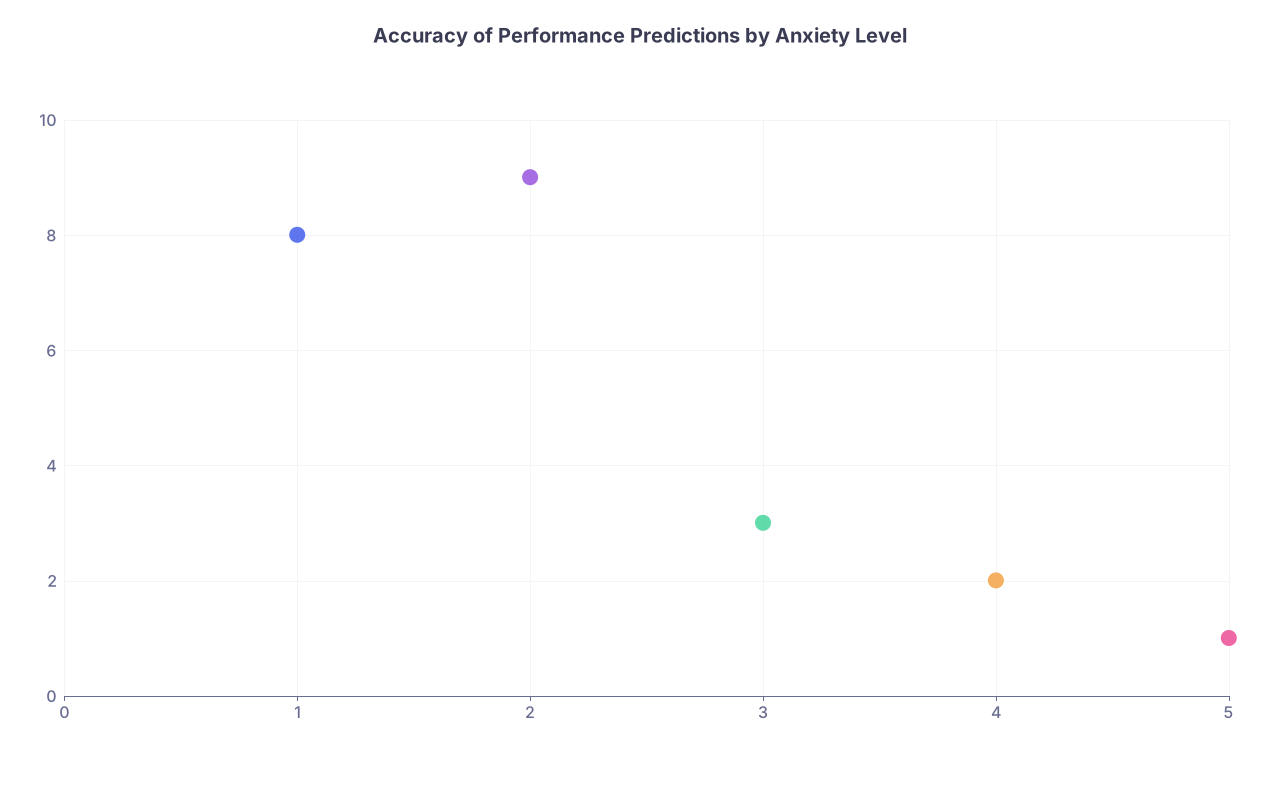
| Category | Value |
|---|---|
| Low A1 | 1,8 |
| Low A2 | 2,9 |
| High A1 | 3,3 |
| High A2 | 4,2 |
| High A3 | 5,1 |
(Interpretation: low-anxiety students predict their score more accurately; high-anxiety students’ confidence is poorly correlated with actual performance.)
So yes, you may feel like you bombed. That doesn’t tell you much. What tells you something is:
- Your practice scores.
- The realism of your prep.
- Whether your exam-day behavior matched your plan.
Confidence is pleasant. Evidence is what matters.
How to Actually Work With Test Anxiety (Without Needing to Be “Naturally Calm”)
Let me pull this together into something practical, because otherwise this is just theory.
If you recognize yourself in any of this, start with three concrete moves:
Stop turning anxiety into identity
Replace:- “I’m terrible at tests” → “My anxiety spikes on tests and I haven’t trained for that yet.”
- “I just can’t think clearly under pressure” → “Right now, my strategies don’t protect my thinking under pressure.”
Subtle difference. Huge impact.
Train like it’s a skill, not a curse
Pick one exam in the next 1–2 months and treat it as a test-anxiety lab:- Do at least 3–5 fully timed practice blocks in real conditions.
- Before each block: 2 minutes of slow breathing + clear first-pass strategy.
- After each block: jot down when anxiety spiked and what you did in the next 5 questions. That’s the data you work with.
Control what’s controllable the last week
Non-negotiables:- Minimum 7 hours of sleep nightly the last 5 nights.
- Fixed wake/bed schedule.
- No major new resources or strategies.
- Practice your exact exam-day morning at least twice.

If your anxiety is severe—full-blown panic, repeated failures despite preparation, or you’re avoiding even scheduling exams—then it’s not a DIY project. You talk to someone: campus counseling, a psychologist who actually gets performance anxiety, or a physician comfortable with this territory. That’s not weakness; that’s using the tools available.
Quick Reality Check: What Actually Matters
Strip away the myths and you’re left with three facts:
- You do not need to be “naturally calm” to perform at a high level on exams. You need trained responses, not a different personality.
- Test anxiety is a performance issue with physiological, cognitive, and behavioral components—all of which are modifiable, especially in the context of medical school exams.
- More content is not the universal solution. Matching your test-taking behavior and exam-week routine to what the data supports will often give you more gain than another 500 flashcards.
You’re not broken because you’re anxious. You’re just trying to run a high-stakes, high-demand exam on default settings.
Change the settings. The rest follows.


