Is Test Anxiety Just Poor Preparation? What the Data Actually Shows
Why do you walk into some exams knowing you’re prepared—and still feel your heart racing, hands sweating, thoughts blanking—while the person next to you did half your prep and is calm enough to color‑code their name on the answer sheet?
Let me be blunt: “Test anxiety is just poor preparation” is lazy, wrong, and actively harmful. Especially in medical school.
That line usually comes from one of three people:
- Someone who’s never had real test anxiety.
- Someone who crammed, got burned, and now thinks their story is universal.
- A faculty member who hasn’t read a single modern paper on performance anxiety since before USMLE Step 1 went pass/fail.
Let’s tear this apart properly.
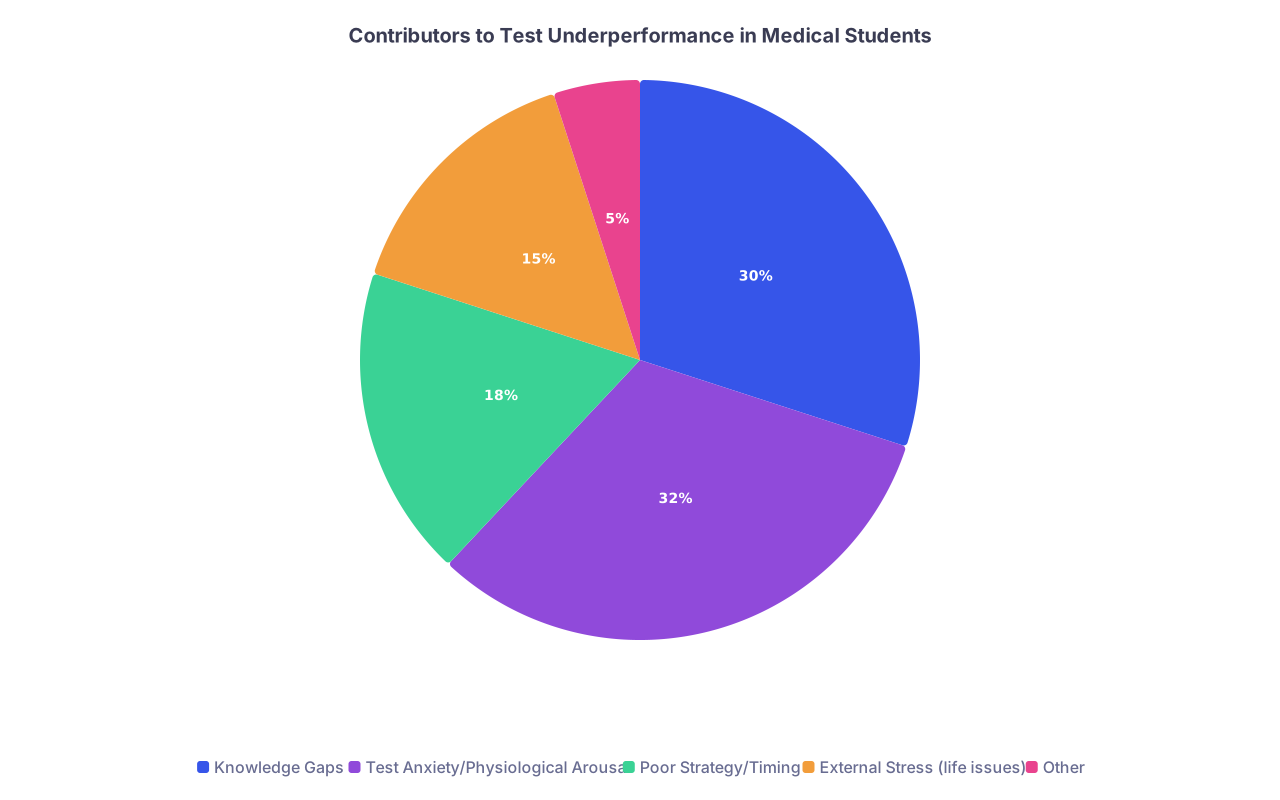
| Category | Value |
|---|---|
| Knowledge Gaps | 30 |
| Test Anxiety/Physiological Arousal | 32 |
| Poor Strategy/Timing | 18 |
| External Stress (life issues) | 15 |
| Other | 5 |
Myth vs Reality: What Test Anxiety Actually Is
Test anxiety isn’t the same thing as being underprepared. They can overlap, sure. But they’re distinct problems with distinct signatures.
The research definition (not the social media version) usually breaks test anxiety into two main components:
- Worry – racing thoughts, catastrophic predictions, “I’m going to fail, I’ll never match derm, my life is over.”
- Emotionality / physiological arousal – heart pounding, sweating, shaky hands, GI upset, shortness of breath.
Both can exist even when content knowledge is solid.
There are dozens of studies on this, but here’s the big pattern that keeps repeating:
- Two students with equivalent practice test scores and similar prep hours sit for a high‑stakes exam.
- The one with higher pre‑test anxiety underperforms compared to their practice baseline.
- The one with moderate anxiety (yes, a bit is normal) tends to perform closer to or at their practice level.
This isn’t a vibe; it’s a documented effect. Meta-analyses of test anxiety show moderate negative correlations with performance even after controlling for ability and prior achievement.
So no, it’s not just “you didn’t study enough.”
It’s more accurate to say:
- Under-preparation → lower ceiling of possible performance.
- Test anxiety → pulls you down from whatever ceiling you actually earned with your studying.
Different mechanisms. Different interventions.
How Test Anxiety Shows Up in Med School (That’s Not Just “I Didn’t Study”)
If you’re in med school, you’ve probably seen at least one of these:
- The classmate who scores 70–75% consistently on UWorld or AMBOSS blocks… then gets a Step/NBME score that corresponds to about 58–60% performance.
- The student who knows the material cold during group review but goes blank on basic questions during the real exam.
- The person who can’t sleep the night before big exams no matter how early they start winding down.
Those aren’t just “I didn’t prepare” problems. Those are state‑dependent performance problems.
Here’s what the cognitive science actually says about why anxiety tanks your score:
Working memory hijack
Anxiety eats working memory. You only have so many “slots” for holding and manipulating information at once. If half of those slots are taken by “What if I fail? What will my family think?” you’re solving pathophys questions with half a brain.Shift from deep processing to threat monitoring
High anxiety pushes your brain into “scan for danger” mode. On a test, that looks like:- rereading stems without actually processing them
- constantly checking the clock
- second‑guessing obvious answers
That’s not a content problem. That’s a state problem.
Catastrophic thinking narrowing your options
Under stress, thinking becomes more rigid and black‑and‑white. In medicine exams, where nuance matters, that rigidity leads you away from probabilistic reasoning and toward dumb mistakes.Physiological overload
When your heart rate is 130 bpm before question 1, your brain labels the situation as “threat,” not “challenge.” Functional MRI studies on anxiety and cognition are clear: that shift changes which circuits dominate. Not in your favor.
None of this gets fixed by just “study harder.” If anything, a lot of anxious students are already compensating by over‑studying—and still underperforming compared to their true knowledge.

What the Data Actually Shows: Preparation vs Anxiety
To separate myth from reality, you have to look at studies that control for prior achievement or practice scores.
Across those, a few patterns keep coming up:
Anxiety predicts performance even after controlling for ability
In multiple meta-analyses of test anxiety research, the correlation between test anxiety and performance remains significantly negative even when you control for:
- prior GPA
- standardized scores
- objective measures of preparation
Translation: even at the same ability/prep level, the more anxious student usually scores lower.
There’s a sweet spot of arousal
The classic Yerkes–Dodson curve actually holds up decently well:
- Low arousal → under-energized, careless errors.
- Moderate arousal → best performance.
- High arousal → performance drops off a cliff.
High test anxiety lives in that far-right drop-off zone.
Prediction error is bigger in anxious students
When you compare:
- average practice performance (NBME, UWorld % correct, school-written practice exams)
- vs actual high-stakes exam scores
Students with higher anxiety tend to have a larger negative gap. Their knowledge didn’t suddenly vanish; their access to it did.
Interventions that don’t change content knowledge still improve scores
This is the nail in the coffin for the “it’s just poor prep” crowd.
When students receive:
- brief cognitive-behavioral training
- expressive writing about their exam fears
- targeted breathing/regulation practice before tests
- basic cognitive restructuring about catastrophic beliefs
…their scores improve without any change in how much content they studied. That should tell you exactly how real anxiety’s impact is.
| Factor | Under-Preparation | Test Anxiety Impact |
|---|---|---|
| Practice Question % | Consistently low | Often adequate to strong |
| Content Recall in Calm Setting | Poor | Good to excellent |
| Exam Day Symptoms | Mild nerves, no major physical symptoms | Palpitations, racing thoughts, GI upset |
| Typical Intervention | Better schedule, more reps, spaced review | CBT skills, exposure, regulation, reframing |
| Score vs Practice | Matches low practice level | Often significantly below practice level |
Why “Just Study More” Advice Backfires
Here’s what actually happens when you tell an anxious med student, “You’re just not prepared enough”:
They double down on what they’re already doing: more hours, more questions, more Anki. No change in physiology, no change in thought patterns, just more grind.
Short-term, sometimes that muscle brute force works. Usually at a cost:
- sleep debt
- mood problems
- worsening somatic symptoms
- resentment and burnout
Long-term, this backfires because:
- They start equating any anxiety with “I must not be ready.”
- They never build exam‑day regulation skills.
- They become dependent on over-prep as a crutch. When time is constrained (clinicals, residency, boards plus 80-hour weeks), that strategy breaks.
And when they still underperform relative to their prep? They assume it’s a character flaw. “I’m just not cut out for this.” When in reality, nobody showed them how to manage the state they’re testing in.
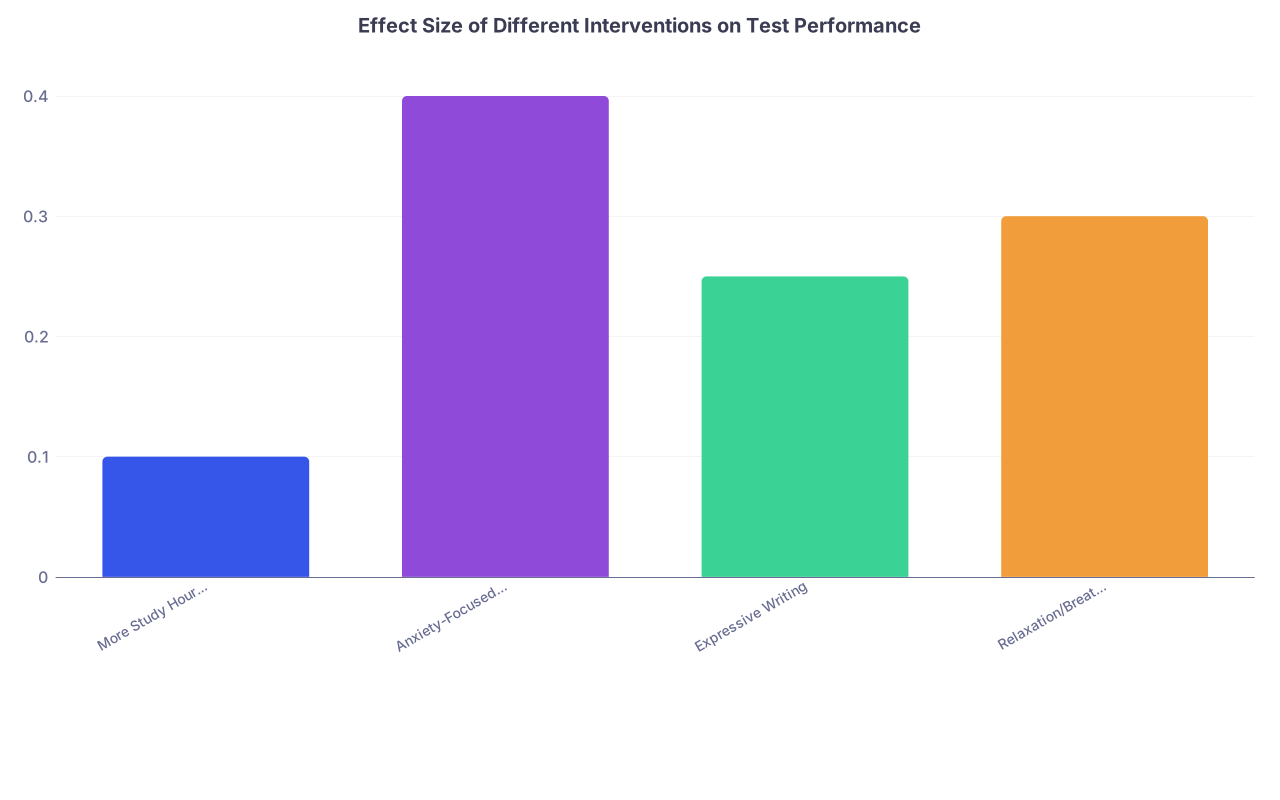
| Category | Value |
|---|---|
| More Study Hours Only | 0.1 |
| Anxiety-Focused CBT | 0.4 |
| Expressive Writing | 0.25 |
| Relaxation/Breathing Training | 0.3 |
What Actually Works: Evidence-Based Anxiety Management for Exams
If test anxiety were just about laziness or poor prep, then interventions that ignore content wouldn’t move the needle. But they do.
I’m not going to give you feel-good platitudes. Here’s what has data behind it, specifically for academic/test performance.
1. Short, targeted CBT-style work
Not year-long therapy (though that can help too). I’m talking brief, structured interventions:
- Identify catastrophic thoughts:
“If I fail this shelf, I’ll never get into a good residency, my career is over.” - Challenge and reframe them:
“One shelf score is one data point. Programs look at trends, narrative, letters, Step scores, performance on rotations. A single dip is recoverable.”
Studies show that when students learn to catch and reframe these thoughts, test performance improves independent of content knowledge.
2. Expressive writing before the exam
Sounds fluffy. It’s not.
Protocols look like:
- 10 minutes, pen and paper, right before an exam
- Write freely about your fears, worries, “worst case scenarios”
- No structure needed; just dump the mental load
Multiple randomized trials show:
- Lower test anxiety
- Higher scores
- Biggest benefits in highly anxious students
Mechanism? You offload worry from working memory before you need it for questions.
3. Physiological regulation training
Not just “take a deep breath.” That’s Instagram-tier advice.
The more effective version usually includes:
- Practicing slow, paced breathing (e.g., 4–6 breaths per minute) daily, not just on test day
- Pairing that with a visual cue (watch, ring, specific gesture) so you can trigger it during exams
- Learning to identify early body signs of anxiety (tight chest, clenched jaw) and intervene at 30% intensity instead of waiting until 90%
Studies in performance settings (sports, music, testing) show that regulating arousal this way prevents that far-right crash on the Yerkes–Dodson curve.
4. Voluntary, graduated exposure to exam conditions
If you only ever take questions:
- late at night
- in your bed
- with your phone next to you
- pausing whenever you feel like it
…then of course your brain freaks out when you’re suddenly in a silent room, time-pressured, with no escape.
Better approach:
- Simulate full-length blocks at the same time of day as your exam
- Use the same timing rules
- Minimal breaks
- Same physical position (desk, chair, etc.)
This is basically exposure therapy for test conditions. The “novelty” and “threat” signals drop over time, which drops anxiety.

| Step | Description |
|---|---|
| Step 1 | Recognize Performance Gap |
| Step 2 | Screen for Anxiety Symptoms |
| Step 3 | Focus on Content Prep |
| Step 4 | Brief CBT / Reframing |
| Step 5 | Physiological Regulation Training |
| Step 6 | Expressive Writing Pre-Exam |
| Step 7 | Simulated Exam Exposure |
| Step 8 | Reassess on Next Exam |
| Step 9 | Maintain Skills |
| Step 10 | Consider Formal Therapy or Disability Support |
| Step 11 | Practice vs Real Exam Mismatch? |
| Step 12 | Improved Match with Practice? |
When It Is Poor Preparation (And Not Anxiety)
Now, contrarian doesn’t mean delusional. Sometimes the brutal truth is: you’re anxious because, deep down, you know you didn’t do the work.
That has a completely different profile:
- Practice questions consistently low and not improving
- Lots of “I’ll start tomorrow” cycles
- Procrastination driven less by fear of the exam and more by general avoidance/planning issues
- On the exam, you’re more confused than blank: you genuinely don’t know the material
In that situation, no amount of breathing exercises will save a 40%-correct knowledge base. You need:
- structured study blocks
- accountability
- realistic scheduling
- and yes, more question reps
The problem is people keep conflating these scenarios.
Many med students with chronic test anxiety are actually some of the most prepared people in the room. They’re just running their exam on hardware that’s overheated and throttling.
A Quick Self-Check: What’s Really Going On With You?
Ask yourself a few blunt questions:
- Do my practice scores (under realistic conditions) predict a higher score than I actually get on high-stakes exams?
- Do I experience strong physical symptoms before or during tests that are out of proportion to other stressful situations in my life?
- Do I have frequent catastrophic thoughts specifically about exams and their consequences?
- Do people who quiz me informally say, “You know this stuff,” yet I underperform on formal assessments?
If you’re nodding yes to most of those, you’re not just underprepared. You’re dealing with real test anxiety that is separate from your knowledge.
If, instead, your practice scores are poor, your content recall is weak even when calm, and you’re not especially more anxious for tests than other stressors? Then the problem is mostly preparation. Different battle.
The Bottom Line: Stop Blaming the Wrong Thing
Let me cut through the noise.
No, test anxiety is not just poor preparation. Data from multiple fields—education, psychology, performance science—shows anxiety independently drags down scores even when knowledge is held constant.
Yes, you can be both underprepared and anxious. They stack. But treating one while ignoring the other is why so many smart med students keep underperforming.
Interventions that don’t touch content still improve scores. CBT-style skills, expressive writing, physiological regulation, and exposure to test conditions all move performance. That alone proves the myth wrong.
If your lived experience is, “I work my ass off and my exam scores still don’t reflect what I know,” you’re not crazy, lazy, or doomed. You’re just fighting a second, invisible exam on test day—your own physiology and thoughts.
Stop pretending that’s the same as “you should’ve done more UWorld.” It’s not. And the data backs you up.